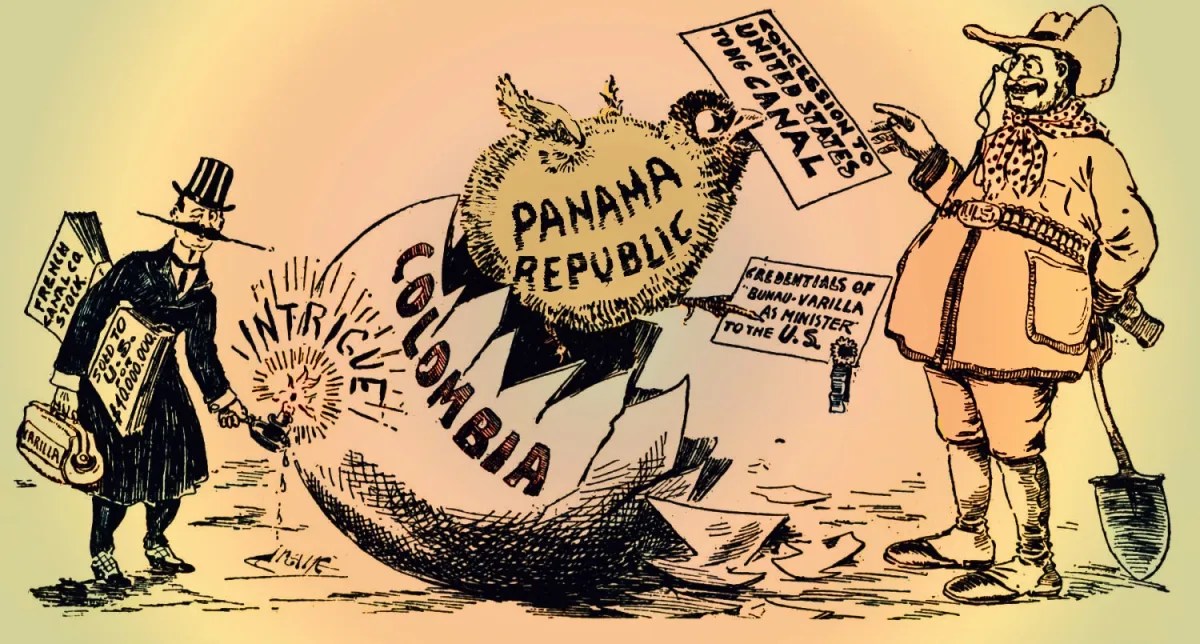
There is no better case and point that empires are criminal enterprises than the United States creation and ‘acquisition’ of the country of Panama.
‘Panama: U.S. Imperialism at Work’ by R.F. Pettigrew from Truth (Duluth). Vol. 7 No. 10. March 9, 1923.
The story of our criminal aggression in the Philippines is not the only shameful page in American imperial history–far from it. The United States has been following the course of empire for many a year. Since the days when the white man first came into contact with the American Indians, the English-speaking people of North America, after the example of their cousins across the water, have been robbing weaker nations of their property and calling it civilization.
Our first aggressive war after the Revolution, which made us a nation, was the war in 1846 with Mexico. We invaded Mexico without any provocation and stole from Mexico half her territory and annexed it to the United States. General Grant, in his Memoirs, writes:
“The occupation and annexation of Texas was, from the inception of the movement to its final culmination to acquire territory out of which slave states might be formed for the American slave-holders. Even if the annexation of Texas could be justified, the manner in which the subsequent war was forced upon Mexico could not.” (Vol. 1, p. 33.)
At another point Grant holds that “the war was one of conquest in the interest of an institution.” (Vol. 1, p. 115.) Again he states: “It was an instance of a republic following the bad example of European monarchies in not considering justice in their desire to acquire additional territory.” (Vol. 1, p. 32.) These are the sentiments of a man who was an officer in the American army that conquered Mexico and who later distinguished himself in the Civil War.
LINCOLN DENOUNCED MEXICAN WAR.
Abraham Lincoln, in the House of Representatives, voted against and denounced the war with Mexico as a great wrong. (See his speech in the House of Representatives January 12, 1848. Later in the same year, in a letter to J.M. Peck Washington, May 21, 1848 (Complete Works, N.Y. Century Company, 1894, Vol. 1, pp. 120-122), he writes:
“It is a fact that the United States army, in marching to the Rio Grande, marched into a peaceful Mexican settlement, and frightened the inhabitants away from their homes and their growing crops. It is a fact that Fort Brown, opposite Matamoras, was built by that army within a Mexican cotton field…It is a fact that when the Mexicans captured Captain Thornton and his command they captured them within another Mexican cotton field.”
We went into Mexico because we had taken a fancy to some of Mexico’s territory. After a war that lasted two years we helped ourselves to nearly nine hundred thousand square miles of land. That was the first great military triumph of the American imperialists.”
Our next performance was the annexation of the Hawaiian Islands, and this was closely followed by the conquest of the Philippines. This robbery did not inure to the benefit of the laboring people of the United States, but exclusively to the advantage of the exploiting speculators and plunderers.
MEXICAN WAR FOR CONQUEST.
The Mexican War occurred more than seventy years ago. Between that) time and the Spanish War exactly fifty years elapsed without a single act of aggression or a single war of conquest waged by the United States. Those were the years during which the slave oligarchy of the South was replaced by the power of an exploiting plutocracy of the North–the years that saw the rise to power of a new ruling class in the United States. The new rulers were busy with their internal affairs at first. By the time of the Spanish-American War, however, they had found their Btride and they have been lengthening it ever since.
TAKING PANAMA A DISGRACE.
We had scarcely reduced the Philippines to subjection when the Roosevelt administration became involved in the taking of Panama one of the most infamous episodes that ever disgraced American history.
The Republic of Colombia is situated on the north coast of South America and embraced the whole of the Isthmus of Panama. It has a government modeled after that of the United States, and is composed of several independent states having governors and legislative bodies of their own. The Isthmus of Panama was the State of Panama, one of the states composing this Republic of Colombia.
In 1903, while Roosevelt was President, he negotiated with the French company that held the franchise for the purchase of the then uncompleted canal across the Isthmus and approached the Republic of Colombia with an offer of ten million dollars if they would cede to the United States a strip ten miles wide across the Isthmus. The cession was to grant sovereign rights and thus give the United States exclusive control over the Canal. At the same time this cession would cut the State of Panama in two. Colombia was afraid to deal with us for fear that we, having obtained a foothold at Panama, might take the whole country. She therefore declined to sell the Canal Zone.
ORDERED A REVOLT.
Roosevelt thereupon sent our navy and our marines to Colon, which is the port on the Gulf side of the Isthmus of Panama, and secretly notified the government of the State of Panama that, if they would set up a republic and revolt against the Republic of Colombia, he would give them the ten millions of dollars for the canal strip, and would also see that Colombia did not send any troops to suppress their rebellion. The Governor of Panama agreed to this arrangement, and, at the proper time, started a rebellion to set up an independent government.
ROOSEVELT THE FIXER.
The Republic of Colombia sent sufficient troops to overthrow and suppress the rebellion, but Roosevelt had instructed the officers in control of the American marines not to allow Colombia to land any troops in Panama or to interfere with what went on there. Pursuant to their instructions, our officers refused to allow the Colombian troops to proceed to the scene of rebellion, but, instead, turned them back and compelled them to return to Colombia.
On November 2. 1903 the Department of State at Washington telegraphed the naval authorities at the Isthmus as follows:
“(a) Keep the transit free and interrupted. Should there be a threat. of interruption by armed force, occupy the railroad line; prevent the landing of any armed force having hostile intentions, whether the government or insurgent, at Colon, Portobelo, or any other point. Prevent landing if in your judgment it might precipitate a conflict.
“(b) In case of doubt regarding the intentions of any armed forces, occupy Ancon Hill and fortify it with artillery.”
About 3:40 P.M. on November 3, 1903, Loomis, Acting Secretary of State, sent the following telegram to the person in charge of the United States consulate at Panama:
“We are informed that there has been an uprising on the Isthmus; keep this department informed of everything without delay.” The Consul of the United States answered on the same day: “The uprising has not occurred yet; it is announced that it will take place this evening. The situation is critical.”*
Later on the same day (November 3) at about nine o’clock, Loomis sent the following telegram to the United States consulate at Panama: “Troops which landed from Cartagena must not continue to Panama.”
At 10:30 the same day, another telegram was sent to the same official: “If the cablegram to the Nashville (one of the war vessels then at Panama) has not been delivered inform her captain immediately that he must prevent the government troops from continuing on to Panama or from assuming an attitude which might result in bloodshed.”
On the same day, November 3, the following telegram was sent to the Secretary of the Navy by the commander of one of the war vessels stationed at Colon:
“I acknowledge receipt of your telegram of November 2 (above referred to). Before receiving it, there were landed here this morning by the Colombian government about four hundred from Cartagena. There is no revolution on the Isthmus, nor any disturbance. It is possible that the movement to proclaim independence may take place in Panama this evening.”
At about 10 o’clock P.M. of the same day, the Department of State at Washington received from the Vice-Consul of the United States in Panama the following telegram: “The revolt took place this evening at six; there has been no bloodshed. The government will be organized this evening end will be composed of three consuls and a cabinet. It is believed that a similar movement will take place in Colon.”
U.S. TROOPS ON JOB.
On the same day General Tovar arrived at Colon with a battalion of sharpshooters from the Colombian army, a force more than adequate to handle the uprising on the Isthmus.
On the following day, November 4, Hubbard, commander of one of our war vessels at Colon, sent the Secretary of the Navy the following dispatch: “Government troops (Colombian) now at Colon. I have prohibited the movement of troops in either direction. There has been no interruption of transit yet. I shall make every effort to preserve peace and order.”
On November 6, the Secretary of State at Washington, telegraphed to the Vice-Consul in Panama in the following terms: “The people of Panama by an apparently unanimous movement have severed their political bonds with the Republic of Colombia and have assumed their independence. As soon as you are convinced that a de facto government, republican in form and without substantial opposition on the part of its own people, has been established on the Isthmus of Panama, you will enter into relations with it as the responsible government of the territory.” Here, then, was a rebellion by one state against a sister republic–a rebellion which we helped to organize, a rebellion which was assisted by our troops and navy, which were sent in advance to help make the rebellion a success. Is there any more glaring chapter of infamous conduct in the treatment of one nation by another than this proceeding on the part of the United States? I know of nothing that parallels it in its Infamy except the annexation of Texas, the acquisition of Hawaii and of the Philippines.
(EDITOR’S NOTE: This is the eighteenth article in a series by R.F. Pettigrew who was a senator at Washington for twelve years. His exposure of the activities of those at Washington shows that government is the instrument used by the owning class to further their own economic interests at the expense of the working class. Space prevents using the complete chapter about the Philippines.)
(Copyright 1922 by R. F. Pettigrew. Reprinted by permission of The Federated Press from IMPERIAL WASHINGTON, published by Charles H. Kerr & Co., Chicago.)
Truth emerged from the The Duluth Labor Leader, a weekly English language publication of the Scandinavian local of the Socialist Party in Duluth, Minnesota and began on May Day, 1917 as a Left Wing alternative to the Duluth Labor World. The paper was aligned to both the SP and the IWW leading to the paper being closed down in the first big anti-IWW raids in September, 1917. The paper was reborn as Truth, with the Duluth Scandinavian Socialists joining the Communist Labor Party of America in 1919. Shortly after the editor, Jack Carney, was arrested and convicted of espionage in 1920. Truth continued to publish with a new editor JO Bentall until 1923 as an unofficial paper of the CP.
PDF of full issue: https://www.mnhs.org/newspapers/lccn/sn89081142/1923-03-09/ed-1/seq-1
 Revolution's Newsstand