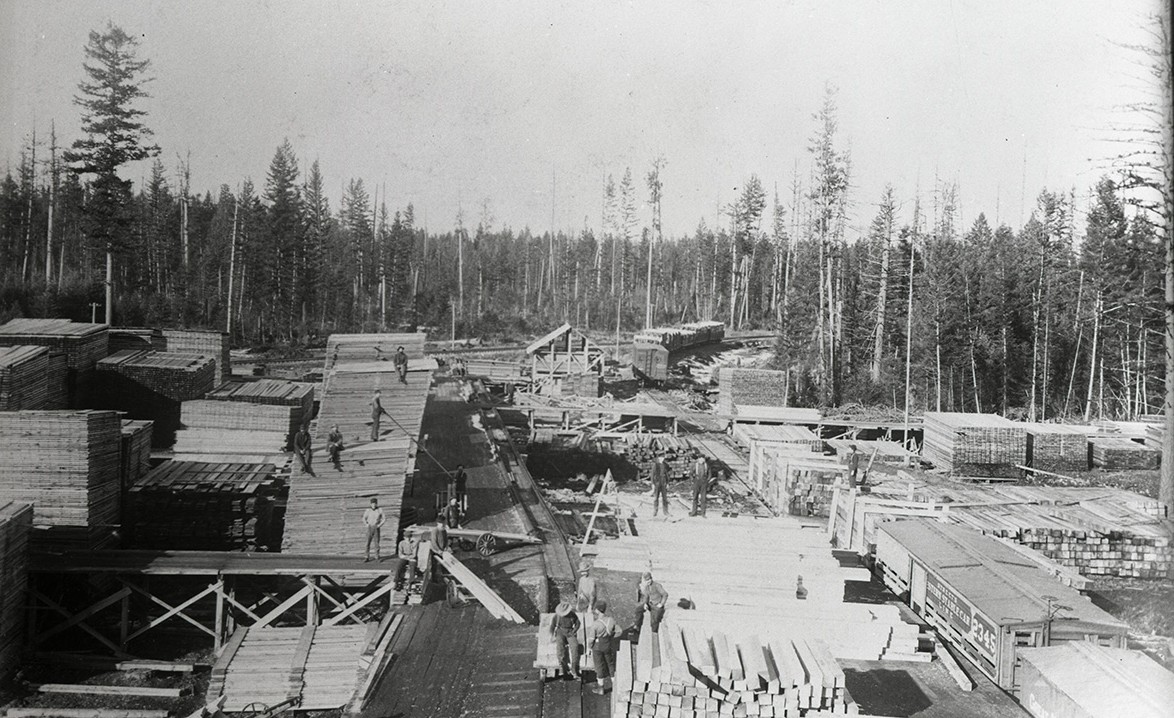
A fascinating look at the organization of workers in the camps and towns of Montana’s Flathead County.
‘Industrial Unionism in Flathead County, Montana’ by Fred W. Heslewood from Industrial Union Bulletin. Vol. 2 No. 16. June 13, 1908.
What had dwindled down to a few paid up members in Sherman locals in the towns of Kalispell and Somers in November, 1907 are at the present time large healthy organizations, numbering many hundreds of members, and are beginning to make themselves felt in the way of getting some demands for the workers in the towns and in the lumbering industry, even in the face of the hard times, when thousands of workers are tramping the ties looking for a master to buy their labor at almost any price.
Torn asunder by the falsehoods and deceptions of labor fakirs and other criminals in the labor movement who love dollars better than a principle, jumping hither and thither from Shermanism to State Unionism, with the hope that they would get on to the true course, it was not to be wondered at that several meetings had to be held at Somers before sufficient enthusiasm could be aroused in the workers to get them out to hear of how they had been deceived by schemers and traitors; and even after the work was accomplished of swinging the few men who were left in good standing into their proper course, it then became necessary to oust another bunch of fakers from office, this time in the local union. By this action it is needless to say that two factions were created and at the present time one faction numbers over 300 and the other side has just four members that is the “Sherman faction.” One of them is under bonds in the sum of $1,500 to appear before the district court on a charge of helping himself to $632.00 of the Union’s money, and another has lately been fined $50.00 for trying to take the independence out of the oldest man in the Union, by attempting to rake the man’s brains out with a hoe on the public highway. Nothing better can be expected from a pig but a grunt. To the ardent lovers of graft and fakerism, the Somers Union is a very bad thing, but 300 true men are not to be swayed from their course by a small nest of fakers who love graft and dishonesty more than they do a clear cut Union.
Somers is a typical lumber town. There is only one house in the place and several hundred shacks. The house sits on a hill overlooking the shacks, and the building would be a credit to some capitalist row in New York. It is owned by the company and occupied by some officer of the company. The shacks were owned to a great extent by the workers, until a slippery document was handed around for signatures lately which means that when this lovely corporation don’t want a person to stick around very long that he will have to get out on five day’s notice, as the company owns the land where these beautiful residences are located.
Summing up the house proposition. I might state that the one house on the hill is worth more than all the rest of the houses or shacks combined, and then some. It is the class struggle thoroughly exemplified by paper covered shacks for the workers, and a beautiful home for the master who lives in luxury off the product of the toil of the workers. Of course Somers has the Company store; it could not be a Company town without the store to get back practically all the worker receives in wages. There are laws in Montana against Company Stores, but laws are not for to be used against Companies, laws are only for the workers to obey. Nothing ever comes down in the Company store, unless it is first run up a notch; wages are the only things that come down in Somers, and there has been several cut prices in them.
There are other laws in this State in the interest of labor. One of them is that it is unlawful for a man to pack his blankets on his back. This was supposed to assist the workers by making the Company furnish a bed to a man when he was employed, but it would be impossible to find a Company blanket large enough to cover a bed bug in any of the camps that I have visited, but hundreds of men can be seen carrying their blankets and breaking the law by so doing.
Another law that the people of the Commonwealth of Montana points to with pride is the 8-hour law for all public work, but in the face of this law even the officers of the law (road commissioners) are going to work men 10 hours a day on the county roads for $2.00 while last year the workmen received $2.50 for the lawful hours. So we see that even a part of the government will take advantage of the unemployed to exact a greater day’s toil for a less wage, even though it be in violation of the sacred laws. To see that these laws will be enforced is work that the locals of the valley will take up immediately.
Last year a workingman was fined $25.00 for catching one small fish about 5 inches long out of season. There was so many bones in the fish that a cat could not eat it, but then he should not have broken the law. Great is the law.
Somers can be classed with one of the places that is thoroughly organized and lately some concessions have been gained from the Company, but not by any means what the men demand. Every branch of the industry is organized from the sawyer, who receives in the neighborhood of $7.00 per day to the lowest paid and unskilled worker, which is $2.00 per day.
Until the Union recently took up the matter of wages with the Company officials, common labor was being paid as low as $1.80 per day. A common characteristic found among all employers in the lumber industry is that the highly skilled workman (for instance, the sawyer), never gets his wages cut; he is always expected by the Company in case of trouble to be “Johnny on the spot” and stick like a leech to the Company and thus help defeat the other workers, who are just as necessary in the work of producing lumber, as the sawyer. All the workers in Somers including the engineers and captains of the boats, which tow in the logs are members of the I.W.W. and take an active interest in the work of the organization.
Organizing the workers where once a fair start is had, with a few progressive men to push the work in a camp where the men are practically in a compact mass, is not such a hard job as getting among the men known as lumber jacks and river drivers. These men are scattered out in all directions, and in different camps situated on different rivers, that empty into the Flathead lake where Somers is situated. Some camps have as low as 10 men in them while others have as high as 40, this being about the maximum number in Flathead valley camps. Here is where the real work has to be done, and the organizer in the city who can pick up a soap box and get a crowd on the first corner, or the Marxian student who has the exasperating job of trying to pound his reflex ideas into the minds of half a dozen others in some dingy back room, called headquarters in a big city, would find himself in a somewhat different position, if he took a rig out at a cost of $5.00 to the local for the purpose of getting to some camp 20 miles off or more, organizing the camp and getting back the same night. On arriving at the camp the foreman has to be seen for the purpose of getting stable room and provisions for man and beast; at some places the foreman is one of the boys, is in favor of the Union, and cannot do too much to assist the organizer, at other places a slave driver proper is met who thinks that he is made out of some superior kind of clay to the ordinary lumber man, and for the privilege of sneaking a foot or two closer to the loving embrace of his master orders the organizer away from the camp, but that does not mean that you would necessarily have to go, as a company tool never runs anything but a bluff.
Immediately after supper is over the men congregate in the bunk house, where all sleep in one room, and where one large stove serves to keep the place warm, and at the same time dry out all the wet socks (never mind about the healthy part of it) as that is one thing that the ordinary lumber jack possesses is health. Leaflets are now distributed and the men are always anxious to read; after the leaflet has soaked in a little attention is asked for and for an hour or more the aims and objects of the industrial workers are explained, and here I might say that the great majority of the woodsmen are eager to know of the conditions in the country and of the class struggle that is being waged so fiercely. After the speaking is over the applications for membership are handed around and a cordial invitation extended to all the men to join their nearest local. Where the foreman will assist the men to get the initiation fee, and the first month’s dues it is possible to get all the men to join, and in places where this cannot be done the men assist each other by lending money to each other. It is not uncommon to get 95 per cent of the workers in one camp into the Union in one night. A more independent class of workers cannot be found than the men who work in the woods, and if the Unions are carried on in a systematic manner together with honesty, it is a matter of just a short while when these men will comprise an intelligent fighting force that the lumber association will yet have to reckon with.
The defaulting of the Secretary of the local at Kalispell has done great injury to the locals, as many of the men who are scattered through the country do not know that every cent was returned, and the defaulter immediately expelled from the organization. Some of the men maintained that had there been a system in the union that it would have been impossible for the Secretary to have had the sole handling of the money, and in this they are quite correct, but it must also be remembered that Kalispell local built up from about 30 members to over 300 in the course of one month, and it was while the local was trying to establish a thorough system by electing a Treasurer, and bonding the officers who had the handling of the funds that the crooked work was discovered, and while it is to be regretted that the enemies of the I.W.W. were given a chance to spew their venom on the organization, yet it can also be said that among those who hate the Industrial Workers of the World, many of their tribe can be found in the penitentiary for embezzleing the funds even where a thorough system of bonding is carried on. Experience is a good teacher, and the I.W.W. locals in Flathead County will profit by the past experience and such arrangements are now made that a reoccurrence of the past mishaps cannot again occur.
Kalispell is the headquarters of the woodsmen and river drivers of this end of the county where they are out of work, and as there is no place for them to frequent when in town except the booze mills, dance halls and cheap show halls, the local at Kalispell is now busily engaged in finding a suitable place for a reading room and office where the men can read and write their letters without any restrictions as to smoking, chewing, or anything else as long as it does not conflict with the rights of the other fellow. In connection with the reading room an office will be established where the local organizer and Financial · Secretary of the local can hold fort in the evenings and when such arrangements are made there will then be no excuse for the woodsman who wishes to pay his dues, because he could not find the Secretary or anyone to pay to.
The Eureka local has had an uphill fight from its inception, as the manager of the raw mill company at that place started in to show the workers as soon as they joined the Union who was boss, and whether there was any slavery in America or not, by discharging them. However, the one master at that point, who is a stickler for fair play, and a great admirer of the star spangled banner of liberty, has not up to the present time succeeded in destroying the local. The work of organization has really just begun in the valley, as, the seed that has been sown is just beginning to sprout, and now that the locals of Kalispell and Somers have set aside 20 per cent of their gross receipts each month for the purpose of maintaining an organizer in the valley, with an ever increasing Bulletin circulation, the establishing of a reading room and a central office, no doubt something will be heard to drop in this neck of the woods before the summer is over.
The Industrial Union Bulletin, and the Industrial Worker were newspapers published by the Industrial Workers of the World (IWW) from 1907 until 1913. First printed in Joliet, Illinois, IUB incorporated The Voice of Labor, the newspaper of the American Labor Union which had joined the IWW, and another IWW affiliate, International Metal Worker.The Trautmann-DeLeon faction issued its weekly from March 1907. Soon after, De Leon would be expelled and Trautmann would continue IUB until March 1909. It was edited by A. S. Edwards. 1909, production moved to Spokane, Washington and became The Industrial Worker, “the voice of revolutionary industrial unionism.”
PDF of full issue: https://www.marxists.org/history/usa/pubs/industrialworker/iub/v2n16-jun-13-1908-iub.pdf
 Revolution's Newsstand