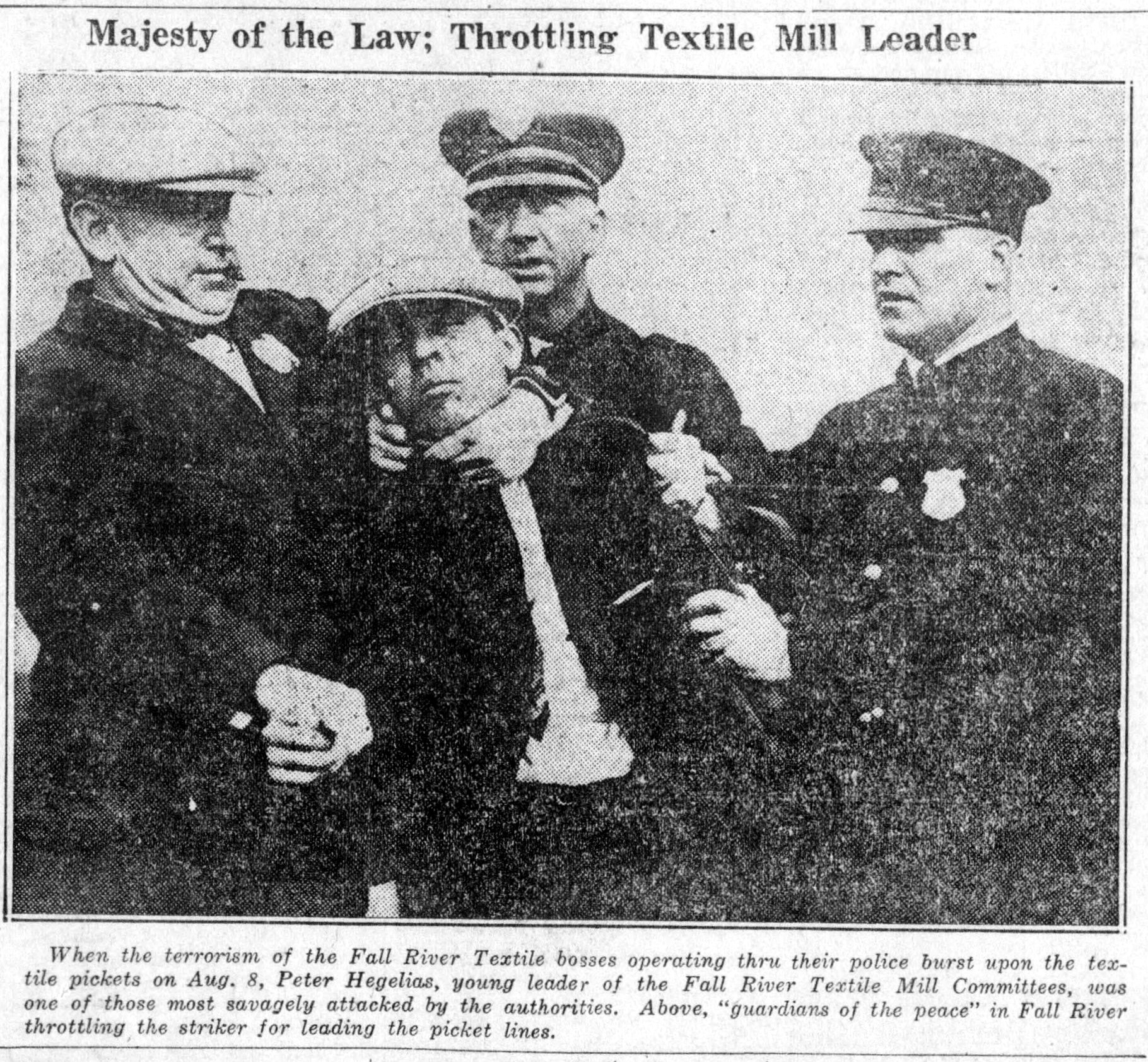
T.U.E.L. organizer Amy Schechter on the high drama that began the militant 1928 Fall River, Massachusetts mill strike, often overlooked by the larger and longer struggle in nearby New Bedford, both led by C.P. affiliates.
‘Ten Days of Struggle’ by Amy Schechter from The Daily Worker. Vol. 5 No. 203. August 27, 1928.
Police Murder Pregnant Woman; Clubbing Fails to Break Picket Lines
At the first signs of revolt among their slaves in the grey stone mill prisons of Fall River, the millowners stripped the millworkers of all the defences won by labor in generations of struggle, and systematically set about throttling them into submission.
Police, press, courts, reactionary craft union bureaucracy were immediately mobilized against the strikers. Police violence was used to smash picket lines, the courts to outlaw the strike and forge legal shackle to the activities of the strike leaders; the press to pour slime over the Textile Mill Committees and discourage the strikers by fake back-to-work stories; the labor bureaucrats to order the men under their control to scab in the strike.

The Fall River cotton manufacturers learned to fear the strength and staying power of militantly led millworkers in the course of the New Bedford textile strike still going strong in New Bedford after four months under T.M.C. leadership. Long before the Fall River strike vote was taken all their forces were lined up in readiness to block the first strike move.
Monday, August the sixth, at dawn, when the Fall River strike opened with the walkout of 3,000 workers from the American Printing Company, the city was practically declared under martial law for textile workers. No breathing space. No quarter. Police swarming over the streets “below the hill” where the millworkers of the American Printing Company live. Solid police cordons thrown across the viaducts leading to great fortress of the American Printing Company. Patrol wagons and vans drawn up at the curb ready for mass arrests or use as barricades.
Men and women clubbed and strangled as line after line, five times shattered and five times reforming tried to break through the police wall to picket their mill. The wave of terror, rising higher every day. A pregnant woman striker crushed against the iron railing of the viaduct by the police, beaten and thrown aside for the strikers to take to the hospital after the police had gone. Johnny Medeiros, six year old striker’s child, ridden down by a trooper herding strikers into their houses after the daily break up of the picket line, running for refuge through a gap in the fence near the river, found soon after drowned–“while swimming”–the police say.
A hundred and fifty police massed on the church steps and the streets outside barricaded to hold back the mill workers attempting to march after the coffin of the boy.
From the break-up of the first T.M.C. mass meeting in Fall River weeks before the strike, the Fall River police have carried out the role of company gangsters as openly as the Coal and Iron in any Rockefeller coal town. Police Chief Feeney, boasting of his personal supervision of police operations in the strike area, openly stated in the press the third day of the strike that he believed he was having success in “breaking the back of the strike.” Over a hundred arrests were made during the first days.
The organizers, Jim Reid, Sam Weisman, Peter Hagelias and young Bill Sroka were arrested and rearrested, sometimes three times in a day. A week after the strike began the first case came up for trial. Picketing, singing strike songs, addressing mass meetings, or attending them were all branded as criminal activities. Not content with imposing vicious prison sentences on organizers and the leading rank and file strikers, and demanding heavy bail to keep them jailed, the mill owners’ Judge Hannity, created a new legal strikebreaking precedent by placing these men under forfeitable $1000 bonds to “keep the peace” interpreted as refraining from all strike activities.
Of course the strike is meat for the American Legion, which has passed a resolution pledging its members to back Chief Feeney to the limit in his operations to put down “the labor agitation.” The last few days a number of prosperous-looking men with the solemnly stupid look of the true legionnaire have been seen sleuthing around “Liberty Lot” during the T.M.C. mass meetings.
Strike Spreads.
And still the strike and preparations for spreading the strike to all the mills of Fall River go on. Thursday the leaders got out on bail. Friday they addressed mass meetings and resumed their other strike activities.
The heavy police barrage may force new tactics on the part of the leaders, but no retreat. The workers, previously unorganized and striking for the first time in their lives, in ten days have learned more about) the nature of the capitalist state and its role in bludgeoning the workers back into slavery, at the employers command than in all the previous years of their life. They have had their baptism of fire in the class war, and come out of it not intimidated but hardened to the struggle. Committees are stiffened up. Organizational work is carried on with new understanding.
Conditions in Fall River were known as the worst in northern mill towns before the 10 per cent cut last January. $15 was given as the official average wage for Fall River mills at the State Arbitration Board hearing in New Bedford last week. Pay envelopes for July taken at random from a collection of those handed to men working in the Print Works of the American Printing Company show $10.89, $13.41, $12.11, $15.85, $8.18, $12.86, $13.16, $12.05. Most of them married men. In this division men work 11, 12, 13, sometimes up to 16 hours, at the heaviest jobs in the mills, in steaming, fume-laden rooms at high temperatures.
Speed-Up.
Steadily increasing speed-up in mill after mill is paring down the little left to the mill workers after the 10 per cent slash, and driving them beyond endurance. If their stand fails, the workers know that another cut will come in the early Fall.
The fight will be increasingly bitter, but it must go on. Abandonment of the fight for the right to organize, the right to hold meetings, the right to strike, the right to picket, means condemning the mill workers to blacker slavery.
Challenge to Labor.
The denial of these rights by the mill owners and their courts, their violent suppression of every attempt of the mill workers to reach out and take these rights is a challenge to labor and all who believe in guarding the elementary rights.
Outside aid is urgently needed for the Fall River strikers, relief, defense, help in establishing the few legal rights that capitalist legality allows, in order to break through the wall of violence, the cotton manufacturers have built around the mill workers, and give them a fighting chance for their lives.
The Daily Worker began in 1924 and was published in New York City by the Communist Party US and its predecessor organizations. Among the most long-lasting and important left publications in US history, it had a circulation of 35,000 at its peak. The Daily Worker came from The Ohio Socialist, published by the Left Wing-dominated Socialist Party of Ohio in Cleveland from 1917 to November 1919, when it became became The Toiler, paper of the Communist Labor Party. In December 1921 the above-ground Workers Party of America merged the Toiler with the paper Workers Council to found The Worker, which became The Daily Worker beginning January 13, 1924. National and City (New York and environs) editions exist.
PDF of full issue: https://www.marxists.org/history/usa/pubs/dailyworker/1928/1928-ny/v05-n203-NY-aug-27-1928-DW-LOC.pdf
 Revolution's Newsstand