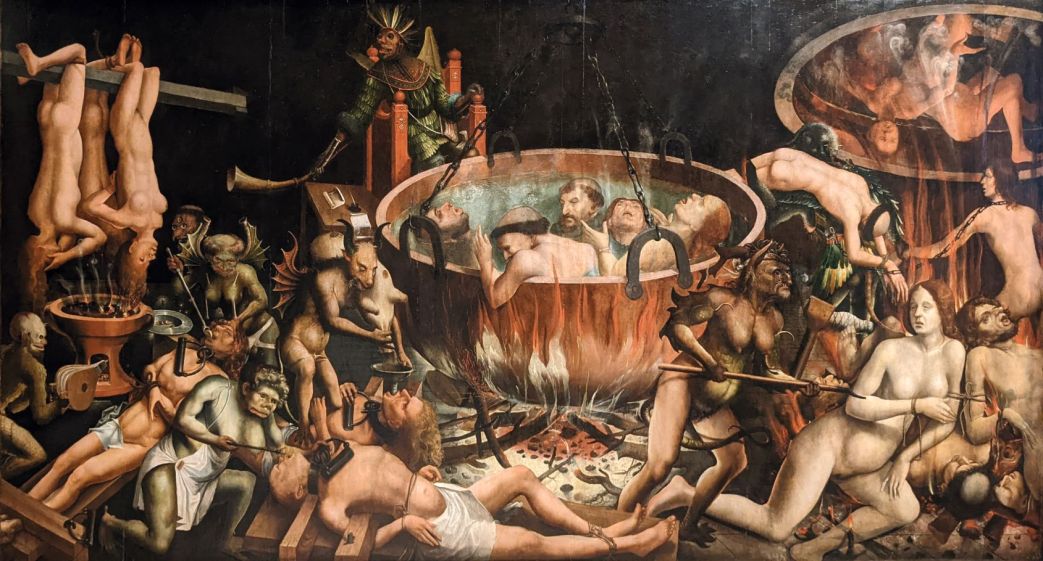
Lafargue on the origins of Western notions of the Hot Place.
‘The Invention of Hell’ (1909) by Paul Lafargue from The Origin and Evolution of the Idea of the Soul. Charles H. Kerr Publishers, Chicago. 1922.
The bourgeois democracy born in the industrial and commercial cities was not content with taking the animistic ideology of the savages, it completed it by the invention of Hell, of which no trace is found in savage and barbarous nations that have not come in contact with civilized peoples.
We do not see outlined the idea of a place of tortures, where the dead will be punished for faults committed during life, until a few centuries before the Christian era. The Tartarus of Greek mythology, situated below Hades, with doors and threshold of brass and where the light of the sun never comes, which might have been utilized for the manufacture of the hell of the Platonic philosophy and the Christian religion, is a subterranean cell, such as must have been found in the patriarchal dwellings, to imprison those who rebelled against the authority of the pater-familias; it is, in fact, in such a cell that Zeus imprisons Kronos and the Titans, who refused to submit to his rule. The chastisements inflicted on Sisiphus and Tantalus in Hades and Prometheus on Caucasus are in the nature of personal vengeance: Zeus tortures them because they offended him.
The vengeance which gave birth to the law of retaliation is a safe-guard for the savage. He cultivates the sentiment of vengeance, and gives it a vitality and a ferocity which it could not have with the modern civilized man, for whom individual vengeance has lost its importance as a means of conservation. The death of the offender does not suffice, it must be his death exasperated by torture, as was the phrase of the Christians of the Middle Ages, who revived the terrible vengeance of the savages and barbarians. The men of the first period of the patriarchate, tormented by the passion of vengeance, could only conceive of horribly vindictive gods. Zeus chastises his enemies, living and dead, and Jehovah exercises his vengeance up to the seventh generation. They inflict chastisements, not because the culprits have disobeyed the injunctions of “Impersonal justice”, but because they have infringed the orders of their sovereign will; they do not exercise public prosecution, but their personal vengeance; they are the representatives of the earthly patriarchs, who, centralizing in their own person the interests of the family collectivity, resented as a personal insult every offense to any of its members; for an analogous reason, under the old regime, justice was rendered in the name of the King, the sovereign master of the nation as the patriarch was of the family.
But the idea of punishment after death was inevitably to vanish at the same time with the suppression of the soul, not to revive until bourgeois democracy should introduce it: in fact Greek mythology mentions no more tortures in Hades, after the Ixion and Tantalus of the first period of the patriarchate. But in reappearing, the punishments of the dead lose their character of personal vengeance to take on that of collective vengeance, of class vengeance, called public prosecution: it is no longer an individual that takes vengeance, but a collectivity of individuals, having common interests. This transformation of personal vengeance into collective prosecution realizes itself at the very moment when individualism is asserting itself in social relations, because the class struggles let loose in the ancient cities welded the individuals into two hostile camps. The artisans, the shopkeepers and the poor citizens, struggling against the aristocratic class to dispossess it of its goods and its political power, put in common their desires, their hates and their angers; when victorious, they did not distinguish between their enemies, but avenged themselves collectively on all they could seize, in their wealth and their persons. This class struggle had necessarily to show itself in the conception of the future life reintroduced by the Mysteries: all promised happiness to their initiates, while the non-initiates, who were their adversaries, because attached to the official cults, were plunged into swamps of mire or into pools of burning sulphur. The Mysteries, because they entered into antagonism with the official religions, and honored divinities and hopes which they had suppressed, were obliged, at the very beginning of their revival, to recruit their initiates only among the persons who, suffering from the social order, desired its overthrow, while their adversaries, the non-initiates, were precisely the individuals who, profiting from the social order, wished to maintain it. The history of Christianity justifies this view; it recruited its first converts among the artisans, the common people, the poor, the women, in revolt against the conditions of their social environment.
The idea that, to be assured of eternal happiness, it sufficed to be initiated into a Mystery, while it might take root and perpetuate itself in limited congregations, who through solidarity closed their eyes to the faults and vices of their members, could not become general among the masses of the people. Now the idea of the soul was not the monopoly of the Mysteries; it is because. this idea, imposed by the new economic conditions of the growing bourgeois society, took possession of the spirit of the democratic crowds, that the Mysteries could revive and multiply to the point where each city had its own mystic cult, and that they could stand up in opposition to the official religions, and discredit them in public opinion. So while the Mysteries, to recruit initiates, continued to promise them future happiness, as primitive Christianity was to do later, there formed within the democratic multitude another idea of the future life; they busied themselves in utilizing it to the profit of the rising bourgeois society, as savage nations had used it to develop courage. A doctrine of remuneration was elaborated, which proportioned the delights and the punishments beyond the grave to the merits and demerits of the deceased, who passed through a tribunal. The Essenes of Judea, Josephus records, not accepting metempsychosis, thought that the souls of the just, delivered from the bonds of the body, in which they had been imprisoned, departed into places of refreshment and peace, while those of the wicked suffered eternal tortures. (Antiq. Jud., XII.) The punishment of the unjust as well as the reward of the just was the general assumption. Plato, one of the principal sophists who contributed to the elaboration of bourgeois and Christian ethics, ventures to describe the chastisements of the guilty; he relates in the tenth book of the Republic the story of Er, son of Armenius, who, left for dead on the battlefield, rose again like Jesus, to relate the penalties of the other life. “For all the unjust deeds that each man had ever done, he suffered retribution in due course, ten times for each…in order that he might pay ten- fold the penalty for injustice…Fierce men of fiery aspect carried the criminals away, bound them hand and foot, threw them down and flayed them and dragged them along the road over thorns and plunged them into Tartarus.” The Fathers of the Church had only to vary and improve the tortures of the pagan sophist to create the Christian hell. The idea of the penalties and rewards of the future life acquired such popularity that poets and charlatans took possession of it: Pindar warned men that “every crime that defiles the domain of Zeus was subject, in the dark regions and by order of destiny to the irrevocable decree pronounced by an inflexible judge.” (Olymp., II.) Virgil, having shown Aeneas the happiness of the blest, makes him view the tortures of those who have detested their brothers, struck their fathers, betrayed their clients, kept their wealth without giving from it to their near relatives, violated their sworn faith, followed enemy flags, etc.
The priests of Orpheus, according to Plato and Theophrastus, centuries before the priests of Christ, besieged the doors of the rich, persuading them that they had obtained from the gods, through prayers and through certain rites and enchantments, the power to atone for the sins of the living and the dead, and to guarantee happiness in the future life.
The bourgeois democracy of the ancient world had not awaited Christianity to establish solidly the idea of penalties and rewards in the future life; so the pagans reproached the Christians that they brought nothing new. Tertullian can not refrain from recognizing that they are right: “If we preach the future judgment of God”, he says, “they mock us, because the poets and philosophers also put a tribunal in hell. If we threaten subterranean flames for the punishment of the guilty, they laugh the louder, because fable makes a river of fire flow in the kingdom of Pluto. If we speak of Paradise, that place of delights prepared by God for the souls of the saints, and separated from this habitable world by a zone of fire, we find the Elysian Fields in possession of the general belief.” (Apoleg., XLVII.) The pagans had in fact unearthed all the pieces necessary for the manufacture of a new religion. It was a great deal to have revived the soul and the paradise of the savage ideology, to have invented hell and the doctrine of rewards and punishments after death, and to have elaborated the spiritualism and the ethics of bourgeois democracy; but it was insufficient, it remained to assemble and combine these religious elements and these philosophical principles into a democratic and cosmopolitan religion; this was the work of the Christians.
The Mysteries, although several of them had an idea of the cosmopolitan divinity demanded by bourgeois democracy1, could not accomplish this task; they were prevented from it by the sex and the nature of their divine personages, and by the impossibility of transforming themselves into a religion universal and open to all. The Mysteries of Samothrace might suit the Mediterranean coasting traders, shop-keepers and artisans, but their subaltern gods, the Cabiri, were not sufficiently exalted for the bourgeois democracy, which, aspiring to social domination, desired for the Gods of its religion the supremacy of heaven; at best the Cabiri might become the patrons of craft unions, as the saints of Christianity were to do later. The Mysteries of Demeter, of Cybele, of the Syrian goddess, of Aphrodite, of Isis and of the other goddesses responded no better to these needs, because of the sex of their divinities and the subordinate role enjoyed by the male gods. Commodity production, which was demolishing the patriarchal family and shaking the social and political order of the ancient cities, and which was organizing the producers and the traders into a revolutionary class and preparing for its triumph, did not aim at emancipating woman from the marital yoke, and still less at giving her again the management of the family; now these Mysteries recalled that she had possessed it. Commodity production desires the subjection of woman; consequently it needs masculine Gods. Mithraism, so widely diffused in military circles, and from which the Christians have made numerous borrowings, which they have tried to conceal by religiously destroying the books and the documents which mention it, was equally incapable of serving the purpose, although its God was a made, by reason of its masculine exclusiveness, since the new religion had to make a place for woman, who in the bourgeois family occupies a place less subordinate than in the patriarchal family.
These difficulties might have been surmounted by initiating women into the cult of Mithra, as men had been admitted into the Eleusinian Mysteries, by ennobling the gods of the Cabiric Mysteries and the other cults of artisans and small traders and by masculinizing the goddesses of the feminine Mysteries; this would not have been impossible, since in the Egyptian Pantheon we find goddesses provided with the sexual organs of man, and Aphrodite herself had in certain localities a beard on her chin. But other insurmountable obstacles existed.
The Mysteries were local cults, and one could be initiated into them only at the places of their origin; it was thus difficult if not impossible to give them a cosmopolitan diffusion, and the new religion had to be cosmopolitan, like commerce. The Mysteries of Demeter, the most celebrated and the most popular in the Greco-Latin world, initiated at first only the residents of Eleusis and Athens, and anciently were not known outside Attica; Herodotus records that Demaratus, king of Sparta, who captured Eleusis in the fourth century B.C., was ignorant of the existence of the divine personage Iolchos, who figured by the side of the goddess. But after the Persian wars Athens, which had not succeeded in anticipating Carthage as the greatest maritime power of the Mediterranean, was nevertheless an important commercial center, to which foreigners flocked; it finally had to grant them political and religious rights, and permit them to be initiated into the Eleusinian Mysteries, on condition that they must reside in Attica and speak the Greek language, that they might be understood by the goddess, who was not acquainted with barbarous tongues, and that they might understand her teachings; subsequently residence in Attica was no longer required, but it was necessary to go to Eleusis to be admitted into the congregation. The State, which had made of the Mysteries of Demeter an official cult, had a commercial interest in prolonging the initiation through several years, in order to order to draw a crowd of visitors to Athens, where the minor Mysteries were celebrated. The foreign initiates were obliged to return there every year, in order to conserve by a new intercession the sacred privileges they had obtained: these conditions necessarily limited their number and encouraged the creation of Mysteries in other cities. These different mystic cults, while all taught the doctrine of the immortality of the soul and the future life, remained isolated, not being bound together by any theocratic organization. The Egyptian priests tried to delocalize the cult of Isis. They traversed the ancient world to recruit converts, but, as we learn from Apuleius, there were three quite onerous degrees of initiation; each time it was necessary to make gifts in kind and in money, which reduced the number of initiates and forbade admittance to the poor and unfortunate; the new religion had to be democratic and fully open to the popular masses.
Bourgeois democracy, in manufacturing its religion, could utilize the primitive traditions revived by the Mysteries, but it could not accept their localism, their sorting out of neophytes and their other limiting peculiarities; it was moreover forced to reject a part of their teachings, to satisfy the exigencies of commodity production. Several attempts were made to organize this new religion; Orphism is one of the first and most celebrated. Its unknown founders, who must have belonged to the intellectual strata, utilized traditions and legends of barbaric Thrace, setting aside the feminine divinities, as the Christians were to do later. Their God, Dionysus Zagreus, son of Zeus, as Jesus is son of Jehovah, is like him an expiatory victim, killed and eaten by the Titans and revived by his father; their prophet, Orpheus, descends into hell to save the soul of his wife. The Jesus of the Christians, whom the faithful eat daily, combines the adventures of the two personages. Orphism, without a local cult, was a wanderer from city to city; no Mystery forbade entrance to the profane; instead of concealing its doctrine, its initiates propagated it openly in their speeches and writings. But instead of promising happiness immediately after death, it made the soul undergo six and even nine transmigrations on earth and under the earth, to assure it a future life of the most problematic kind. This tormented and uncertain life beyond the grave was not what the democratic masses desired. Orphism remained confined in a narrow circle of literary men and philosophers, who refined it into a quintessential idealism, despising the body, “that prison of the soul”, and into. a rigid and meticulous asceticism; while impudent and coarse charlatans dishonored it in the opinion of the public. Christianity was to take up its work and profit by its doctrines and its teachings.
1. Hecate, “polymorhphous and with multiple names”, whose worship was disseminated by the Orphics in Greece, was like Isis, adored pretty much everywhere.
The Charles H Kerr publishing house was responsible for some of the earliest translations and editions of Marx, Engels, and other leaders of the socialist movement in the United States. Publisher of the Socialist Party aligned International Socialist Review, the Charles H Kerr Co. was an exponent of the Party’s left wing and the most important left publisher of the pre-Communist US workers movement.
Access to full book: https://hdl.handle.net/2027/pst.000009944572
 Revolution's Newsstand