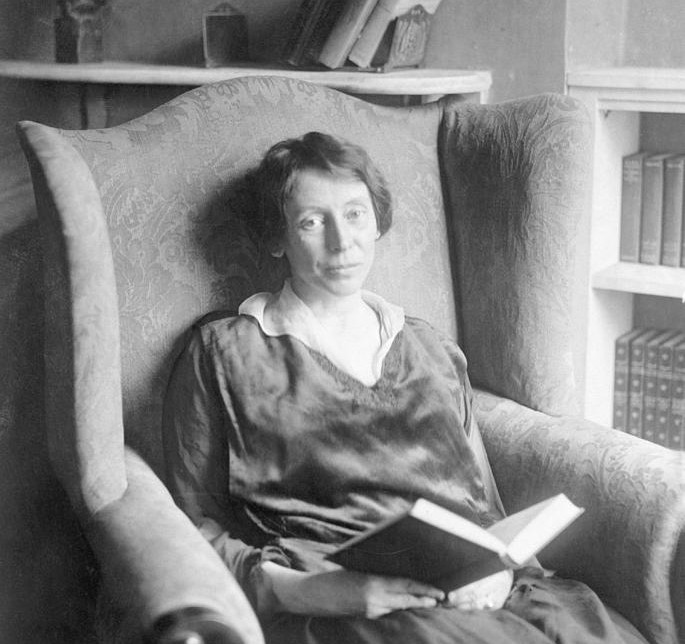
Some of labor journalist Mary Heaton Vorse’s finest work was around the era-defining 1919 Steel Strike. In the article below she dramatically encapsulates what the giant struggle was about.
‘In the Kingdom of Gary’ by Mary Heaton Vorse from Justice (I.L.G.W.U.). Vol. 1 No. 41. October 25, 1919.
The other day a man came into Foster’s office. He had been on strike three weeks, and now he had about 9 cents left. He had some chickens, he had good neighbors, who had given him vegetables and things from their gardens. The man was a foreigner, young married man, and what he had come for was not to ask strike benefits. He wanted advice and the moral support of encouragement.
He wanted to know how he was going to get along. He came rather deprecatingly, smiling in an embarrassed sort of fashion over his difficulties. Then he went away, still his smile, his only assets his friends, his 9 cents and his indomitable will to stick it out.
The strike is based on people like this; people full of faith; people full of endurance; people full of sacrifice–thousands and thousands of them. Thousands of them looking upward and forward to a better life for themselves and their children–for these people are striking for a right to be considered as men. They are striking for the right of a little leisure. They want an end put to this dehumanizing double shift.
The other day in Braddock a mill superintendent stopped an old timer on the street. “Aren’t you working?” he asked.
“No, I am not working. I’m taking a holiday. I am paying myself back those twenty Christmases I worked for the company,” said the man.
That has been the situation with the mill workers. No Sundays, no Christmas. Work that took it out of a man so that he was old at forty. Work that left him so tired at the end of the day that he wasn’t a human being anymore. And now these people are willing to sacrifice to change this sort of thing, for themselves, for their children, and for the workers of all time.
So when the history of this strike is written it is going to be history of the faith and courage and endurance of men and women living in wretched slums, their windows looking on filthy court yards–living in desolate mill towns in sheds around the great mills; living in bleak houses on steep hillsides where the roads turn to roaring torrents during each rain.
Allegheny County is a fair, sweet place. There are large, fat farms; oil bubbles underneath the earth, and all around are beautiful towns full of comfortable American homes. At each turn of the road the ravines and burnt hills make a new picture. Smoke shuts out all of this when you get to the towns where the mill workers live. Their landscape is the rows and rows of great chimneys and the smoke pouring out of them. Their music is the din of the shop and the roar of the whistle.
They have no life and now because they have asked for a few hours in which to live, every form of suppression and terror is being used against them. Why has the strike not already been smothered out of existence. Only because of the dogged endurance and the dogged faith of the men. The strike is not kept together by the ordinary strike discipline. It goes on by its own momentum through the faith and courage of the rank and file.
There is no one who reads this who does not know how the morals of a strike is kept up There is no one who has seen strikes where there were not meetings, entertainments, processions, the coming together of men working for a common purpose—there is nothing like this in the steel towns. It isn’t allowed. If more than half a dozen strikers stop on the street to talk over their affairs, they are arrested for “blocking traffic,” “inciting to riot,” etc.
No strike poster can be stuck up in a steel town–no leaflet passed on the street to tell the news. No meeting can be held without a permit of police. Many towns do not allow any meetings at all. In other towns where meetings are grudgingly allowed, the halls are so little that they can hold only a very small fraction of the men on strike.
So a smothering silence shuts down over the men. Every day they get up to read lying reports in the papers. Every day they meet on the street, mill employees who try to bribe them to go back. I know a young fellow who was discharged because he was getting men to join the union, and he was one of many in his town. I have a list of their names, though Mr. Gary states that men are never discharged for union activities. This man recently met the foreman of his shop who offered him back his old job at an increased wage. He didn’t go, for they are not going back because they have settled down to a long grim fight in spite of every force of the community against them, including uncertainty and suspense; in spite of all the rumors of strike breakers and that their jobs are gone forever, in spite of the terror of the “Cossacks,” the beatings, and the continual menace of arrest.
We must remember that in the steel towns people have been arrested wholesale because they have committed the crime of striking. There are charges such as obstructing traffic, unlawful assembly, etc., which make it possible to run a striker in without his having committed any real offense.
Suppression and oppression have been the Father and Mother of this strike and terror its godfather. But, when the company used terror. They forgot the old saying that the blood of the martyrs is the seed of the church. There hasn’t been a home searched or an illegal arrest made that hasn’t helped the strike. There hasn’t been a club that has come down on a defenseless mill-worker that hasn’t sent men hurrying to get out their union cards.
Take the case of Clairton for instance. This was the town where the Union had got no foot-hold–the watchful authorities had kept the “agitators” out. (“Agitator” is the company’s name for all members of the A.F. of L. who try to get their fellow workers to join a union.)
There were no halls in Clairton that could be rented. All permits were denied and street meetings were broken up. That is to say, the fundamental rights of Americans were sweepingly denied. There is no right of free speech and free assembly in the steel towns. When the people in Farrell want to go to a meeting they have to go over the Ohio state line into America–and the other evening four thousand of them walked over to hear Foster speak.
There are plenty of steel towns not in America and Clairton is one of them.
After a time the organizer hired a vacant lot from one of the mill-workers. But a man in Clairton can’t ask a few friends to a lawn party on his own property–the Cossacks rode down the strikers and broke up the meeting. The mill-workers didn’t know it was un-American to strike and they had put up an American flag–this the Cossacks tore down and the flag was trampled under the horses hoofs. This started trouble for there were some ex-service men there as there are in all workingmen’s crowds. The affidavits sent to the Senate abound in statements like:
“The state troopers rushed on the lot and the people started to run away but when said state troopers rushed to the platform and tore down our flag, the men became incensed and some ex-soldiers, seeing of flag being insulted and defiled, rushed at said troopers in defense of our flag and started the excitement and almost caused a riot, and loyal citizens were greatly incensed. There was no provocation for said interference and riding over women and children.” (Signed) Milton Terzich.
Before this happened the organization made no headway in Clairton but the Constabulary had made an irresistible argument men rushed away from the riot to get their union cards.
The State Constabulary had a splendid looking body of men in their smart dark grey uniforms and helmets but with their riot clubs three feet long they are terror incarnate to the workers–they are in the steel towns in many cases not because the town authorities asked them but at the request of the company. So brutal have they been that one can explain their acts only on the theory that they were acting under orders “to throw a scare into the workers” from the first, or else that they were openly trying to incite riot. How else can one account for the tearing down of the flag or the incident at Braddock? There was a mission in Braddock in the Slovak Church and the men were coming out from instruction at about nine–the Cosacks rode them down–not only that but they rode their horses up the narrow church steps. The men controlled themselves–they didn’t attack the Cossacks, and they did nothing in anger or reprisal when the Cossacks rode down a crowd of babies of the first grade who were going home from church. No assembling in crowds is allowed in Braddock.
There is a narrow street in Braddock along which runs the Baltimore and Ohio Railway. A tall fence separates the street from the tracks and children play here, for nothing on wheels is allowed here by city ordinance. Since the strike one of the mill owners drove his car down this street, scattering the children in front of him. Behind him for his protection rode two of the steel gray troopers, but they weren’t needed any more than they have been any time. The men are out to win the strike by peaceable means in spite of thugs, gunmen and State Constabulary.
The weekly newspaper of the International Ladies Garment Workers Union, Justice began in 1909 would sometimes be published in Yiddish, Spanish, Italian, and English, ran until 1995. As one of the most important unions in U.S. labor history, the paper is important. But as the I.L.G.W.U. also had a large left wing membership, and sometimes leadership, with nearly all the Socialist and Communist formations represented, the newspaper, especially in its earlier years, is also an important left paper with editors often coming straight from the ranks radical organizations. Given that the union had a large female membership, and was multi-lingual and multi-racial, the paper also addressed concerns not often raised in other parts of the labor movement, particularly in the American Federation of Labor.
PDF of full issue: https://www.marxists.org/history/usa/pubs/justice/1919/v01n41-oct-25-1919-justice.pdf
 Revolution's Newsstand