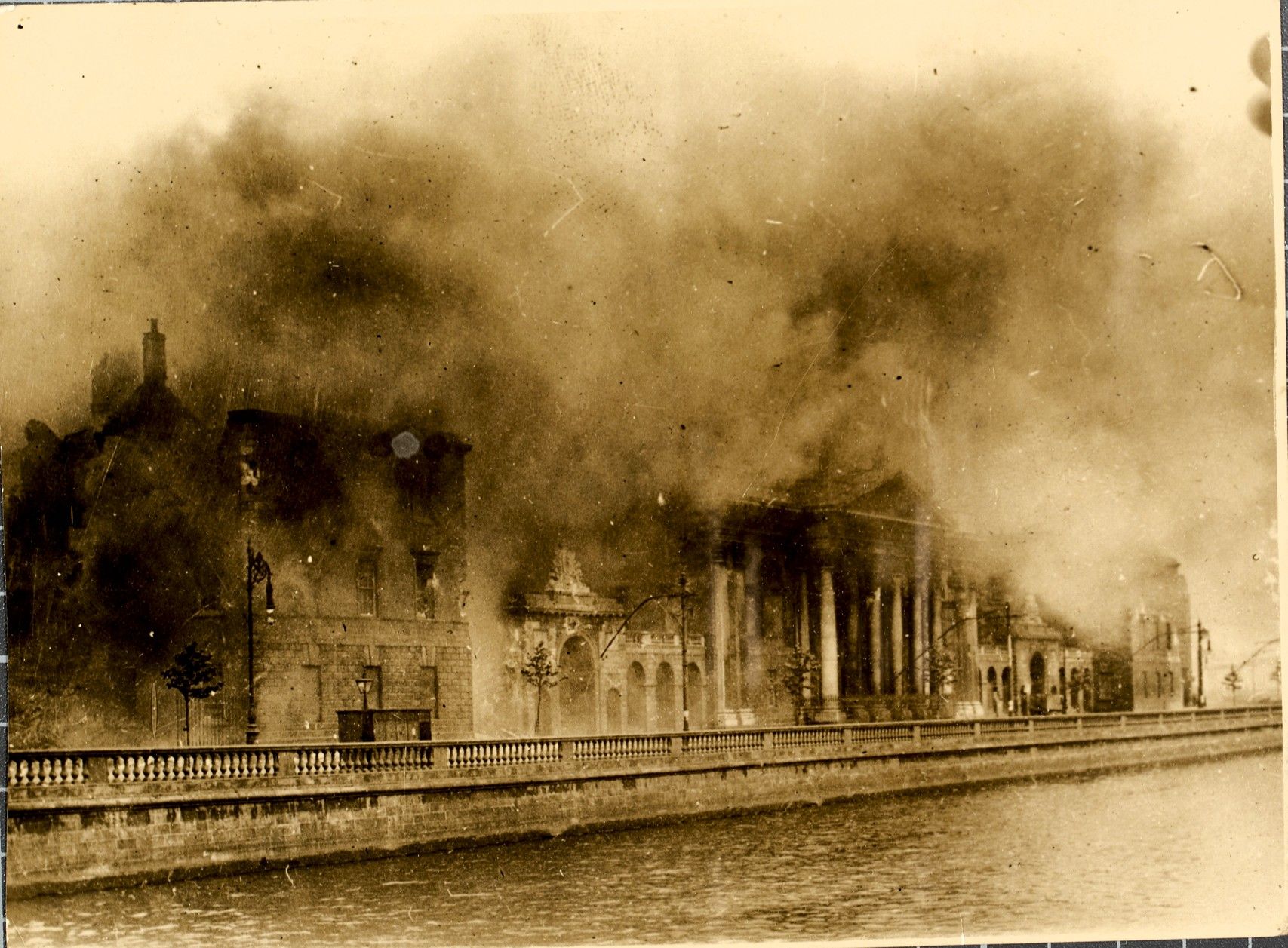
Murphy reflects on the defeat of the Republican Army and the Left in the Civil War and the end of Ireland’s ‘revolutionary period’ with the establishment of the reactionary Irish Free State.
‘Ireland’s Liberation a World Task’ by J.T. Murphy from Truth (Duluth). Vol. 7 No. 12. March 23, 1923.
Excerpts from “Ireland and the International Working Class”, British Labor Monthly.
The central problem of the working-class movement of the world is the defeat of imperialism; and upon this victory depends the liberation of the subject peoples of the earth. These national problems find no solution through a nationalistic approach to the problem. Ireland’s problem is not simply an Irish problem or an English problem. It is more. It is a problem of the international working-class movement, and until the working class of this country and Ireland face it as such, we shall wallow in a mass of confusion, be the victims of the clap-trap of the capitalist press, and be held up to derision throughout the world.
No phase of British history is so appalling to contemplate on the basis of the considerations we have put forward as the later period of the struggle for Irish independence. The long years of struggle against English domination found no echoing thrill in the hearts of the British workers and their leaders. They saw it only as a nuisance when it broke forth into open struggle, and either ignored it entirely at other times, or viewed it at the best through the spectacles of British Liberalism. British Labor protested against “atrocities,” but never against the domination of British imperialism in Ireland, even at the worst moments of intervention. Nor did their protests amount to anything more than paper protests and resolutions. Munitions, troops, equipment went as usual. Not once did British Labor hold up a single wagon of munitions or prevent the transport of a single soldier, whilst the common imperialist enemy delivered blow on blow. When Mr. Lloyd George held the weapon of greater war at the heads of the Irish leaders, Labor made a united front with the imperialist Government against the revolting Irish nationalists. It only required the hypocritical benediction on the resulting Free State Government and the moral castigation of the Irish republicans to complete the ignominy of it all. It is time indeed for a transvaluation of our values and a fresh acquaintance with the fundamental issues that are at stake.
Workers Used by Capitalist to Rid Themselves of External Domination.
Throughout the seven hundred years of Britain’s political domination over Ireland not a century has passed without an uprising and a forcible effort to throw off the invader. Time and again the Irish have been crushed, only to see succeeding generations renew the efforts of their fathers. With the period of struggle the elements which waged the fight have undergone a transformation true to the capitalist era they were entering. From a fight to revert back to a
social system of preceding generations, back to the clan and the commune, it became a fight in which the forces were divided into the social classes of capitalism. The capitalist class of Ireland proved no different to the capitalist of any other country, and used the sufferings of the workers and peasants as the means to liberate themselves from the inconvenience of external domination. Always they drew from the poorer strata of the population to fight their battles, but there were few who were themselves prepared to bear the brunt of these fights for freedom. The masses went into revolt. The exploiters reaped the goods.
British Ruling Class Divide Irish to Conquer Them.
Throughout the whole period of their rule the British Government has never been uncertain as to what it wanted or as to with path to pursue. The policy of divide and conquer has never been more efficiently applied. From the days when it brought thousands of Protestant workers into Northern Ireland, fanned the flames of religious hatred and created an Ulster problem, to the days of recent history when it left a hole in the boundary clauses of the recent treaty and prepared the way for re-invasion through Ulster, its policy has been a masterly application of the principle of division and a guarantee against a united Ireland.
Workers Get Worst of Struggle.
When the British ruling classes fettered Irish industry for generations, prevented the growth of an Irish merchant fleet, and placed Irish commerce at a disadvantage, they created situations which rallied the industrial workers to their employers. But in settlement they always settled with the employers and left the workers to make the best of it. When they created a land hunger, and compelled the transformation of rich cultivatable soil to pasture land for cattle rearing, and depopulated the country, they passed their Land Acts to ease the problems of the large farmers, and left the poor agrarian population in starvation. A short-sighted policy for an industrialized country to pursue with an agrarian neighbor, but never an uncertain one.
The ground for revolt has thus been fertile, whilst the means of division rooted in the class divisions of the Irish nation were ever open to pave the way to Irish defeat…
Ireland Will Never Be Free While British Empire Endures.
To take its proper role in Ireland as the leader in social progress it must perforce face the issue of the struggle against imperialism. In doing so Irish Labor will be placing itself in direct line with the interests of the working class of the world, and will have a basis for appeals for aid that is sounder and stronger than the political abstraction called self-determination.
The failure of Irish Labor to play its historic role during these years has driven it into the hands of its enemies. Objectively the interests of the workers are against the Free State Government. Every effort they make to improve the lot of the worker brings them up against the forces of the State. Nevertheless the policy of submergence is continued to the extent of denouncing the forces which have taken up the fight that they themselves have failed to prosecute, until it would seem that there is neither an appreciation of the role they ought to play or of the forces operating in their favor. First they appeared neutral in the struggle between the republicans and the Free State, and then allied themselves to the Free State. Right thoroughly we understand what would have happened had there come into being a republican bourgeois Government. The workers would still have been silent, but only because of the policy that has been pursued by Labor. That is why the hour of negotiation proved to be the hour of the great betrayal of the working class. Not because it was wrong to arrive at a compromise with British imperialism. Had the workers of Ireland been at the helm in the then existing international circumstances they also would have had to compromise. It is as true today as in the days of Mitchell that Ireland will never be free whilst the British Empire endures. But the failure of the working class of Ireland to take the lead left the capitalist class of Ireland free to make the compromise which left the workers where they were before—slaves still to be liberated. The new triple alliance on the pages of history looks well thus: Irish Labor, Irish Free State, British imperialism–versus the interests of the workers and the republican army…
Fate of British and Irish Workers Together.
Thus Ireland’s tragic hours reveal again and again how deeply its liberation tasks are entwined with the fundamental task of the international working class. Upon the men and women without property in Ireland devolves the task: to create a workers’ party out of her rich supplies of revolutionary workers and fighters, a party that will lead the workers and peasants of Ireland towards the workers’ republic through revolutionary struggle. This does not mean that it is the task of the Irish workers to rise arms in hand and seize power to-day or to-morrow. But it means that the whole character and direction of their activities must be towards that end…
The fate of Ireland and the fate of the British working class are tied together with the bonds of life and death. Neither can emerge from slavery whilst imperialism endures.
Truth emerged from the The Duluth Labor Leader, a weekly English language publication of the Scandinavian local of the Socialist Party in Duluth, Minnesota and began on May Day, 1917 as a Left Wing alternative to the Duluth Labor World. The paper was aligned to both the SP and the IWW leading to the paper being closed down in the first big anti-IWW raids in September, 1917. The paper was reborn as Truth, with the Duluth Scandinavian Socialists joining the Communist Labor Party of America in 1919. Shortly after the editor, Jack Carney, was arrested and convicted of espionage in 1920. Truth continued to publish with a new editor JO Bentall until 1923 as an unofficial paper of the CP.
PDF of full issue: https://www.mnhs.org/newspapers/lccn/sn89081142/1923-03-23/ed-1/seq-5
 Revolution's Newsstand