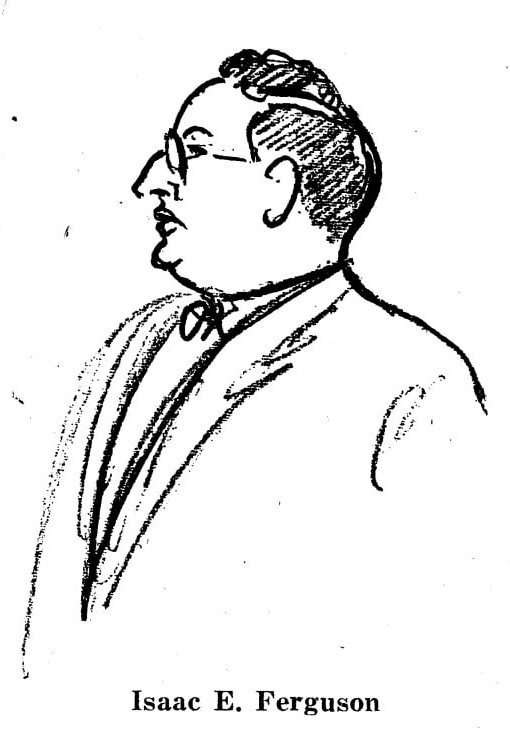
There is not a more damning report of the Socialist Party Right Wing’s rejection of the will of the members and democratic norms in its fight with the Left Wing than this. Ferguson’s brutal, day-by-day, account of the S.P. leadership plenum of May, 1919 which expelled tens of thousands of members and fixed the coming Emergency Conference is a must-read for all students of the U.S. left. With only Alfred Wagenknecht and L.E. Katterfeld representing the Left, the Right Wing walked away with the Party. Issac Ferguson was a major figure in the early Communist movement, serving as Secretary of the National Left Wing Council. He would become a leader of the (old) Communist Party. With Jay Lovestone, Ferguson was Charles E. Ruthenberg’s most important supporter, serving on the leadership of the United Communist Party. Arrested for ‘criminal anarchism’ in late 1919, he was sent to Sing Sing and ended his involvement in the movement on his release.
‘The Counterrevolution in the Party’ by I.E. Ferguson from The Revolutionary Age. Vol. 1 No. 34. June 7, 1919.
Report of the NEC Sessions in Chicago.
The counterrevolution within the American Socialist Party has begun. It is coming in its explosiveness and impotence. It makes piercingly clear the tragedies averted by the quick success of the Left Wing movement within the party…
The National Executive Committee came together May 24th, at Chicago, and before two hours had gone by, without charges, hearings, or intelligent statement of any kind, seven men “expelled” five thousand Socialists from the state of Michigan from the American Socialist Party. And that was only the beginning. When the true logic of this action reveals itself, as the business advances, the expulsion—slaughter will quickly jump from the 5,000 to 6,000 of Michigan to the more than 60,000 already clearly within the Left Wing—within the “insurgency” which “must be put down.”
***
Hillquit is not here. He is sick. His intellectual presence is evidenced by a communication outlining the stand of the NEC on the issues before us, national and international. The proposed statement is of a sick mind. It faces no issue squarely; it is sheer nothingness; it is not even clever in its equivocations.
One example will suffice. On the issue of the two Internationals, Hillquit is critical of the Berne Conference and opposed to the Communist International. He wants a “reunion”—with Luxemburg and Liebknecht dead, murdered under the auspices of opportunistic Socialism! Hillquit joins all Internationals—and none.
Otherwise, aside from unprincipled statement of principles which can be considered after revision by the Committee, Hillquit is advertises as being in favor of a party split.
Berger, too, is absent. But he has several mouth-pieces here.
The “expulsion” of Michigan was voted by Shiplacoff, Oneal, Goebel, Krafft, Stedman, Work, Hogan, and Holt. The contrary votes were two, Wagenknecht and Katterfeld. The other absentees were Clark and Herman, in jail, and Niells of California.
The motion was made by Stedman, after recommendation of action by the Executive Secretary, Adolph Germer. Stedman moves to destroy the votes which will put him off the NEC and which will help defeat him for International Delegate. Work and Berger likewise need to escape the Michigan votes. Also Oneal, Shiplacoff, and Hillquit, in relation to international representatives.
Only John Work squirmed a bit under Wagenknecht’s descriptives of this method of winning an election. Work would have given Michigan a “hearing,” but the amendment failing, he accepted Stedman’s motion.
Holt of Oklahoma thought the Committee might with a few days. The action of the Committee as “explained” by Stedman, was based on the adoption by the Michigan State Convention of an amendment to the State Constitution prohibiting advocacy of reforms in the propaganda of Socialism. This resolution of the Michigan Convention, everything else aside, had not yet been finally acted upon by the Michigan membership. It appeared that the result of the Michigan referendum would be available within three or four days. Holt was willing to wait until the membership of Michigan had gone “contrary” to the national platform, but Stedman had “a hunch” that the vote would be overwhelmingly in favor of the Convention resolution, and this settled the matter.
Katterfeld and Wagenknecht defended the Michigan stand against the advocacy of reforms. Wagenknecht pointed out that other states, notably Wisconsin, had seen fit to omit our “ultimate demands” from their platforms. He might have added that it is only by casuistical argument from a chance phrase or two that one can discover any “ultimate demands” in the National platform of 1918. Wagenknecht impressed the vote-stealing aspect of Stedman’s motion, and added good-naturedly that it would only be a short time until we changed the national platform to conform to that of Michigan.
To which Hogan retorted that it would be “just as well to disband the party”—and this was the sum total of his pudgy wisdom in relation to this question. And Goebel played the clown to perfection. Once before the writer saw the excitable, peevish Goebel in action, and that was at the meeting of the NEC in Chicago when Goebel went into wild raving against the party’s anti-war stand. Now he is the most vociferous exponent of “real Socialism!”
Shiplacoff and Oneal indulged in evasive refinements and sophistries which simply revealed that they were acting somewhat under the whip—and there was a fellow present by name of Gerber, from New York, a sort of Mephisto of small politics, presumably one of the coterie who planned the performance. Not that Shiplacoff and Oneal were not against the Michigan position; only they are the kind of men who must be driven into action with a whip.
Another tangent of the Michigan discussion was the stand of the Michigan Convention on the subject of religion. The Michigan position is that the subject of religion should not be under party taboo, but should be frankly presented according to the materialistic interpretation of history. Committeeman Krafft of New Jersey was especially sarcastic on this point as a deviation from party regularity, arguing that it was members of the Knights of Columbus who secured his release from Atlanta, where he was serving a term under the Espionage Act. The first time the word “revolution” happened to be mentioned in the discussion, this elderly gentleman from New Jersey raised both hands in derision. Perhaps he missed the whole record of world events during the past two years. Krafft is unquestionably a fine, worthy, idealistic gentleman. His presence on this Committee, and its accord with his political outlook, tells in a word the present status of the official control of the American Socialist Party. The clown-like Goebel hailed in this religious clause “the cloven hoof”—the basis of “organizing to fight the Socialist Party.” The weightiness of Goebel’s learning about Socialism does not keep him anchored very long at a time. He is constantly jumping up, walking around, pounding the table; and his talk is a squeakish whine about one triviality after another.
***
It is a curious spectacle, this group of half dozen old men taking upon themselves the stemming of the oncoming waves of a revitalized American Socialism. It answers itself without a word from the outside.
So much for the first session. There will be several days of lifeless life to this conference, though the first act leaves no question of what is to follow.
***
A week ago a history-making convention closed in Chicago with such a singing of “The Internationale” as was never heard in that city before. The words of a dozen languages merged in robust melody.
At this NEC meeting one could not escape cociousness of the unsung dirgeful accompaniment: “The old-time religion, the good old-time religion, the old-time religion is good enough for us.”
***
Session of May 26th.
All on a Monday morning the half dozen elder statesmen of the Socialist Party are going to dispose of the Left Wing movement. That is the special order of business. It is like the Senate Judiciary Committee getting rid of Bolshevism by orders of excommunication via imprisonment. It was lucky for many of us that the Socialist Party National Executive Committee has no prison at its disposal and no power of deportation…
The boast of these elder statesmen is the ancient vintage of their statesmanship. Constantly they repeat the number of years which separates the present from the time they acquired the Socialist consciousness. They do not seem remotely to suspect that there might be need for a new kind of Socialist consciousness in a new epoch of history.
***
The Committee proceeds with its task.
“The method,” “the method,” “the method”—that is the constant complaint, supported by sweeping generalities and accusations based on most petty items of detail, uncorroborated and not open to answer. One would never suspect that there is anything involved in this flood of righteous indignation other than the accumulation of details of “unconstitutionality.”
Out with the elections—that was the wholesale order for this morning. The Federations will be on the carpet tonight. Elections aside—pending investigation for “irregularities”—the mathematical problem is how to regulate the further expulsion so as to insure a “safe” Convention.
Because of this cancellation of elections until the Convention meets, the Committee itself calls a Special Convention. Goebel, Work, Hogan, go on record that the election issue is the only emergency. Shiplacoff realizes that there is an “emergency” aside from the elections. Wagenknecht and Katterfeld agree to the Special Convention except as to the election matter.
The discussion opened with a statement by Goebel that the initiation of the referendums now before the party were “deliberately fraudulent;” because they came from delegate bodies, instead of from membership bodies. He said that the method of carrying on the elections was the “open, shameless method of slates accompanied with misleading comment.” He complained that the official side was without papers, (though the Milwaukee Leader, so far as this district is concerned, pleaded for the reelection of Berger, Stedman, and Work). He indignantly charged that the Foreign Federations have banded together to capture the party. He failed to add for what purpose.
Julius Gerber was given the floor to report for the New York State Executive Committee as to the New York situation. The “report” was a speech, made up of accusations against the Left Wing, with several specifications of “unconstitutionality,” and a general justification of everything done by the New York Executive Committee. Gerber answered a joint Federation protest against expulsions in New York of certain foreign branches. This protest came before the Committee directly after Gerber was on the ground.
Gerber’s contention was that Local New York insists upon its right to compel all branches to adhere to the regular party platforms, and that the Left Wing platform was adopted by the rebel branches “willfully” in violation of the party law. The petty sarcasms of Gerber, and the whistling astonishment of the venerable delegate from New Jersey, and the equally profound comments of the other elder statesmen, are not worth dwelling upon, though it is of this stuff that party history is being made. Gerber’s sarcasm about Left Wing work within the party councils as showing no interest in “work against the capitalist system” is indicative of the grasp of issues here paraded as the acme of Socialist wisdom.
Referring to an application of a Russian branch for a charter in New York, which was refused, Gerber “explained” that 2 Russian branches were enough for New York. The writer is informed that there are 60,000 Russians in New York. Even Chicago has 7 Russian branches, of which some are already unwieldy.
Without an item outside of Gerber’s speech to the NEC, it was made evident that the Executive Committee of Local New York and of New York State had substituted their control for that of the party membership. This seems to be the precedent upon which the NEC is proceeding.
One gem of the discussion was that the New York Local does not “expel” anybody. It simply “reorganizes”—according to Shiplacoff—“a mere formality.”
Germer added the item of the mysterious disappearance of 15,000 ballots. It was all very, very mysterious, until Wagenknecht did a little questioning and developed the facts that this was a computation based on weighing ballots, making no allowance for differences in weight of different kinds of print paper.
Krafft challenged the opposition to make answer, to which Katterfeld responded. If there was any ballot-box stuffing, it ought to be investigated. But the voting of slates, which was so much protested, has been usual within the party. That was precisely the way Germer became National Secretary, by organized Federation slating. After reviewing the details of the discussion, Katterfeld went on to say that he took all the actions of the majority of the Committee serenely and expressed his assurance that they could not do enough to prevent victory within the party for revolutionary Socialism. He concluded that it was up to the majority of the Committee to prove their loyalty to the Socialist movement by handing over the power to the majority of the membership, if they want it, instead of wrecking the party to save their power.
With the elections and referendums temporarily invalidated, the Special Convention was moved by Work and unanimously carried, though Goebel protested the expense.
Then came the question of investigating the elections and the motion prevailed that the committee shall be appointed outside the NEC. Wagenknecht amended: “from both sides.” Oneal, in high dignity: “The party does not recognize the Left Wing!” Goebel, aside to Wagenknecht: “Both sides will be represented.” Amendment defeated, 2 to 8.
Next: Constitution “interpreted” to invalidate some Left Wing candidacies for International Delegates (Reed and Ferguson). It must have meant to exclude those not members three years. The logic for the 3-year rule is excellent. The fact is that the members have already acted under a Constitution which does not prohibit these candidacies. Goebel already has insisted that there is no personal element in these elections; that this is, for once, a vote on issues. This belated “interpretation” helps to register the vote on issues.
Wagenknecht amended that this ruling be not applied to an election already completed, when it was apparent that there was knowledge or fear of Left Wing success. Amendment defeated.
Shiplacoff made the complacent assumption that those not in the party three years could not know anything about Socialism. He was just as charitable to the membership which supported these candidates. He is a personal gainer by this elimination of contestants.
Monday Evening Session, May 26th.
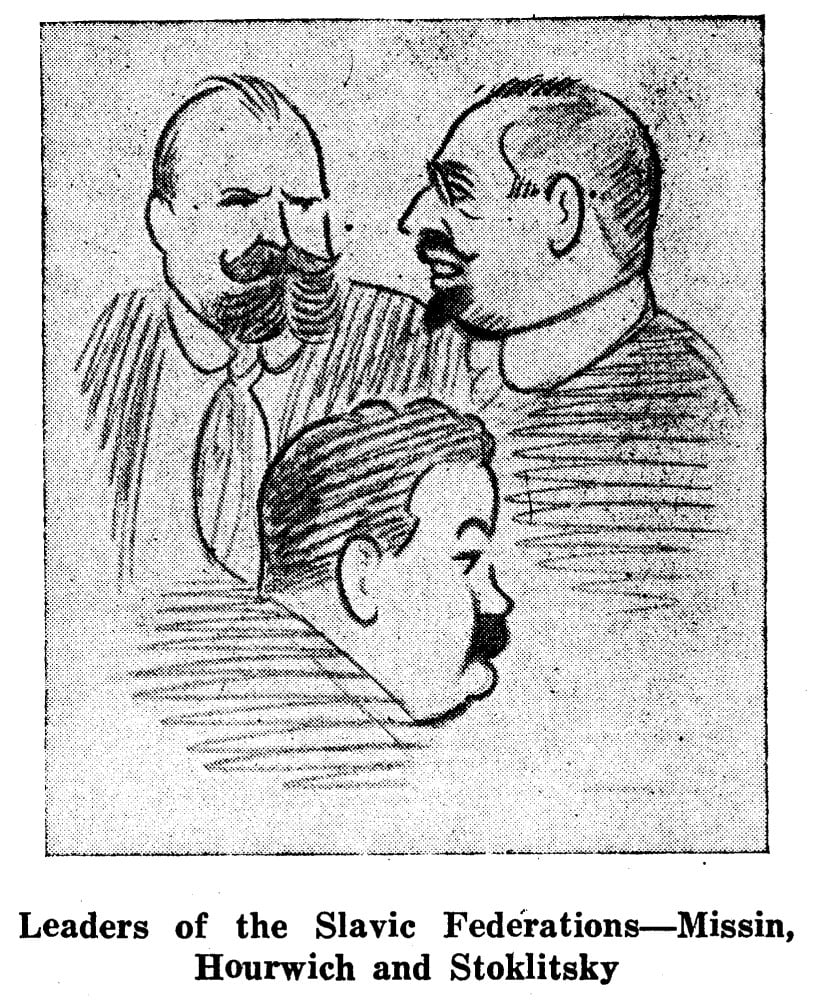
Motion by Krafft: whereas, and whereas, and whereas—let 30,000 members of the Socialist Party stand suspended! All the “whereases” of the Krafft motion were based on the language of a protest against the expulsion of foreign branches in New York, the protest being signed by the Translator-Secretaries of the Russian, Lettish, Lithuanian, Ukrainian, Hungarian, South Slavic, and Polish Federations. The history of this transaction shows its purely arbitrary and vindictive nature; it shows on its face how every subterfuge is used to disfranchise the opposition in order to win control of the coming Emergency Convention for the present officialdom.
Gerber of New York had volunteered to the NEC certain allegations of fact and sweeping charges as to illegal voting by Federation branches on the party referendums. The meager showing of facts was never scrutinized by the Committee; no explicit charges were made against any particular ones of the Federations; nobody was asked or given the chance to answer Gerber’s assertions. It became evident as the discussion proceeded that the Federations had been hampered in the elections by holding back of ballots; that Left Wing votes had been freely kept out, or even destroyed after receipt in the New York office. In Milwaukee, for instance, the Federations were refused ballots from the County office, and those finally obtained were imported from Minnesota. In Chicago, a Ukrainian branch of 300 members was given 35 ballots. At this time no more need be said about the elections, which are to be “investigated,” than that there was nothing definite enough before the NEC with respect to the elections upon which to base any action against the Federations. This the Committee itself recognized.
The insistence of the Translator-Secretaries on tolerance for the adherents of the Left Wing was condemned as “disloyalty” to the party platform and a breach of the party constitution. Judgment being duly entered, the “trial” began.
The document of protest stated that the Executive Committees of Local New York and of New York State had arbitrarily expelled three Federation branches; that the National Executive Secretary had reported these expulsions as arising from the affiliation of these branches with the Left Wing Section; and that this action was not only a disgrace to the Socialist movement, but that “the Russian Lithuanian, Lettish, Ukrainian, Hungarian, and South Slavic Federations have endorsed the Left Wing program, recognizing in it the most advanced expression of revolutionary Socialist principles, and we declare that these Federations will brook no opposition to the stand they have taken and will not consider as valid any proposal from any Executive Committee, either county, state, or national, to recede from that position. We do not consider that any Executive Committee has any right to pass on the legality of the Left Wing position, as far as the party law is concerned.” The “demands” were for rescinding the New York expulsions, with censure of the officials responsible; also for “a clear and unequivocal expression” by the NEC as to its attitude toward the Left Wing position, “inasmuch as no such expression has as yet come from the National Executive Committee.”
“Such a drastic statement,” announced Committeeman Krafft, “calls for drastic action on the part of the Executive Committee.” After his series of “whereases,” consisting of citations of the sentences above quoted as “in defiance of the rules of the Socialist Party,” came the motion that these seven Federations “stand suspended until further notice.”
Motion seconded by Shiplacoff. “It is the only course left for us. Two weeks ago I would not have said so.” (It is during these two weeks that some of the party election returns have become known). Shiplacoff argued that the main business of the party has been that of a political party; an American political party to develop an American political movement based on the principles of Socialism. The Federations were organized to facilitate propaganda among immigrants. The nationalistic influence and the war have unbalanced many, at both extremes. The foreign element is in the minority; we must build on “native elements.” (The Indians? In the steel, packing, cotton, clothing, and woolen industries, the average of “foreigners” is 64%. The “native” proletariat is predominantly black. There is no proletarian element in America which surpasses in caliber the membership of these seven Federations).

The Lithuanian Translator-Secretary, Joseph Stilson, was spokesman for the Federations. He pointed out that this was the first statement of the official party attitude toward the Left Wing; that at its last meeting, in January, the NEC knew of the Left Wing movement within the party, but did not act, presumably because it had no constitutional power to act. He denied that this movement was of such recent origin, showing its definite organization early in 1917 through the Socialist Propaganda League, with a separate paper, The Internationalist (subsequently The New International). The Manifesto of this League appeared in the Minnesota Organizer, the official state paper, in February and again in March of 1917. If the officialdom made no condemnation of the organization of the Left Wing, how could it now condemn endorsement of the Left Wing program?
Comrade Wagenknecht added that the Left Wing movement was a natural expression at this time in the Socialist parties of every country.
Then came the climax of the seven days of this eventful NEC meeting. Niels Christensen, Scandinavian Translator-Secretary, was granted the floor. In firm, deliberate language, impassioned yet clearly reasoned, he condemned the action of the Committee. “If this is your stand, then I want to be counted with the others.”
Seymour Stedman comes out of this discussion with the clear distinction of being the only one of the majority members of the NEC who was frank enough to admit that the question of methods of bringing about the party change was beside the point; and that the organized voting of the Left Wing branches was entirely proper; and that, in general, the attempt to organize the Left Wing for capture of the party for their viewpoint was legitimate and commendable for its efficiency. His argument was that there is a fundamental difference of understanding of the purposes of the Socialist Party upon which there must be a split. (He did not explain why he and his associates should not “suspend” themselves, instead of the successful opposition). The psychology of the American is to approach politics in an immediate way, and this is the basis upon which the Socialist Party started. It has developed a real political character in Wisconsin, New York, and to some extent in Ohio. Otherwise it has existed as an organization for education—education for the time when the revolution takes place. He has no fault to find with such an organization. The question is: shall we maintain ourselves as a political party? That is, a party for regular political campaigns, on current issues, with real purpose of winning offices, not campaigns as propaganda camouflage. Or shall we be a party with politics as an incidental affair? He is for politics, and others are against this stand because they cannot vote. They would be happy if Berger is not seated. (Because of their ideas about the use of parliamentarism, or because Berger is Berger?) Stedman wants more Milwaukee “Socialism.”
Comrade Stilson then asked if this meant that all of the Left Wing was to be thrown out? Stedman replied frankly that this was the sense in which he would vote. No other member of the Committee made answer.
The debate was continued by Comrade Wagenknecht. If there is to be a test of what the party stands for, it should be had before there is so much expelling. Let everybody vote for delegates to the Convention, and those who don’t like the decision can get out. But there had better be a quick adjournment, or the Convention will be useless, because with the start of 5,000 and then 30,000 the Committee may yet get rid of the whole party. The proposition is to tear down the Federations because they have outdistanced the English-speaking movement, due to the fact that the efficiency in building up the English-speaking movement has been almost nil. This action is obviously taken to control the Convention. This action is a confession of lack of majority support. It may be due, fundamentally, to the fear that the Socialist Party is becoming too much a party of action; to the desire not to have any more imprisonments, to avoid such things as the May Day riots. The outstanding fact is that revolutionary parties have become parties of revolution, in deeds as well as in words.
Wagenknecht concluded his statement by emphasizing the naturalness of the growth of particular Federations in response to the revolutions in Europe. The Italian revolution will bring a great influx into the Italian Federation. It took some time to bring the conviction of the Soviet Government as a permanent institution, so that the response was not immediate. But the Russian Federation itself, which has had the largest recent growth, was just given a Translator-Secretary last Winter, and it now shows the splendid results of an intensive and aggressive campaign of education.
At this point the Finnish Translator-Secretary asked to be heard. This was another bomb in the camp of the Right Wing and Centrists. Askeli assured the Committee that his Federation would go solidly with the Left Wing if this action was taken. He pleaded that this matter be let go until there should be a Convention.
Then came a long, judge-like harangue by Committeeman Oneal. He reviewed the history of revolutionary currents within the American Socialist movement, picking out the few instances of intellectual leaders who had flopped from extreme radicalism to extreme conservatism. (The writer recalls precisely the same argument, some of the same illustrations, and almost the same sentences, as used by Oneal in a pamphlet on Syndicalism written nearly seven years ago. Our profound “historian” analyzes the Left Wing movement and Syndicalism as the plaything of a handful of intellectuals, of exaggerated emotionalism, ignoring completely the real social and political basis of the two vital challenges—both mass movements—against the reformist parliamentarism of the Second International; the challenge against its Socialism, and the challenge against its tactics of a “political action” unrelated to the proletariat and its special class position and power. It is all a matter of “psychologizing” the “leaders,” as Oneal reads history).
The acknowledged spokesman for the majority of the Committee, after explaining the psychology of radicalism and, much as Nordau deals with genius, reducing it all to a formula of emotional insanity, proceeded to explain further that the Left Wing, under the influence of the Russian Revolution, wants to transplant foreign policies and graft them on this country. No uniform methods can be adopted throughout the world. (Evidently the imperialistic diplomats at Paris did not consult with Oneal, because their “internationalism” is much more than a formula of phrases.) No uniform methods can be adopted throughout the world (for each country its own Socialism, no matter that the nationalistic capitalisms are but units of the world Capitalism arrayed against the world social revolution). We have been too long dominated by the German Social Democracy and do not want to subject ourselves to Russian domination (therefore we remain as we are, i.e., under German domination).
A large part of Oneal’s argument concerned itself with the fact that Soviet imitation is not now historically justified in the United States, which is a logical criticism. But not of the Left Wing, because the idea of the Soviet in the Communist program goes with the actual period of revolution, and so it is stated in the Left Wing program. The acceptance of the Bolshevik analysis of the present period as the era of world social revolution, the realization of finance-imperialism as the final stage of Capitalism, and the acceptance of a general revolutionary tactic in conformity with the present stage of struggle, does not mean a copying of the Russian experience in the United States without the fullest recognition of every special element in our situation. Oneal insists rather upon the differences as fundamental, whereas passing history answers that it is the sameness and unity of the struggle in all countries which is fundamental.
Oneal inadvertently, yet quite conclusively, disposed of the test of revolutionary-mindedness arising from convictions under the Espionage Act. They were “all a matter of chance,” instancing Krafft’s sentence to five years “for hardly saying anything.” To this ironic truth must be added the reservation that there is a clear record of a National Security League hounding of a few outstanding champions of the working class.
Comrade Katterfeld put the responsibility for the present party confusion directly on the NEC for its failure to call a Convention. The Left Wing organization within the party organization was necessary as the only means of allowing the party to function.
There was one thing in the whining of Goebel which the writer has noted. He was sure that what he said would be forgotten. Goebel was still hopeful of the Finns and the Germans.
The Federation matter was put over again until the next afternoon.
***
Tuesday Morning, May 27th.
Motion by Goebel that an Emergency Convention be called for Labor Day. Amendment by Katterfeld, that it be called for August 2nd. On this amendment the minority members, Katterfeld and Wagenknecht, were joined by Shiplacoff. The date voted was August 30th, and the place, Chicago. The number of delegates, as at St. Louis, 200.
Tuesday Afternoon.

Comrade Keracher, as State Secretary, appeared before the Committee to get official confirmation of the action taken against the Michigan party. On the third guess, one of the Committee state accurately the action taken: that the charter of Michigan had been revoked. The reason? Oneal was designated to make the reply and haughtily put the committee above the level of entering into explanations or argument with Comrade Keracher, stating merely that the anti-reform advocacy plank of the Michigan platform was a violation of the National Party Law.
Secretary Germer then assumed the role of prosecuting attorney against the Federations. He charged them with attempting to dominate the party, citing a resolution against the Amnesty Convention which originated in one of the Federation offices. This was a regular referendum proposition, handled in the regular way, but apparently it was intrusive for these “foreigners” to question the wisdom of the NEC. And great, indeed, was the righteous indignation of the venerable Krafft. Germer detailed the figures of the growth of several of the Federations during the past two years, insisting that the recent progress was artificially stimulated. He read translations from the Lithuanian paper to instance attacks on the NEC and support of the Left Wing. (These articles, by the way, as well as all the statements of the Translator-Secretaries involved, were of such clear, consistent, and aggressive character as to give the highest possible encouragement for the future of the Socialist movement in America.)
It appeared then that Oneal and Shiplacoff had spent a good part of the night in revamping the “whereases” of the Krafft motion. Krafft promptly withdrew his motion and the more formal motion was entered by Shiplacoff. Evidently the weakening Centrists had been stiffened up in caucus. All this is highly significant because it proves of itself that the desire was to get rid of certain votes, which were too well organized for the conquest of the party for revolutionary Socialism—all the reasons for the “suspension” had to be discovered after the act.
Comrade Stilson spoke at some length for the Federations, without being presented with any definite charge except that the Federations were for the Left Wing and therefore “unconstitutional.” He read the party constitution and showed clearly that there was nothing in the constitution upon which the Committee could base its power to take this action. He showed that there are many Left Wing locals still in the party, in relation to which the NEC took no action, leaving the party in a condition of “chow chow.” The Federations are in the Left Wing; that is true. They made slates for the party elections; they will do so again. When the NEC was insistently asked for an Emergency Convention, it declared for an Amnesty Convention. There was no fight against the Left Wing until the officials realized that the party machinery was about to slip out of their hands.
Then, after all this discussion, and after all these expulsions, came the pronouncement of Shiplacoff: “The Left Wing movement doesn’t exist.” To which Stilson rejoined: “Then what are you talking about?” To the complaint that there was no other way out, Stilson answered: “You join the Labor Party and let the Socialist Party take care of itself.”
Note, then, that as to the South Slavic Federation there was nothing before the Committee except the signature on the protest against the New York expulsions; that the Secretary made clear that the membership of this Federation had not yet acted on the Left Wing program. As to the Polish Federation, the entire case was the Translator-Secretary ad affixed his name to the protest after it was completed, not having taken party in the conference between the Secretaries. There was no report of action by the Polish Federation on the Left Wing program. As to the Hungarian Federation, the signature on the protest, and not one other word in any other connection.
Comrade Wagenknecht pointed out that the comrades in New York have been up against a well-organized official machine for a long time, and that this situation should have been taken care of long ago. This is the sort of thing which brings about factional extremes. But we must keep the big issues in mind. The Left Wing expressions are membership expressions. They show the party is in good health. The members should not wait for Conventions to express their opinions for them, but have the right all the time to propose changes within the party. It was these same Secretaries who came before this Committee to protest against sending delegates to the Berne Conference, which shows that they have been more accurate in their understanding of the world situation than the Committee itself. “Your hurry exposes your motives.” Only the two Left Wing members of the NEC voted for the Convention three months ago.
Comrade Katterfeld recalled the factional organization within the NEC itself to repudiate the St. Louis platform. Four members of the Committee nearly succeeded in defeating the will of the membership, expressed by a 12 to 1 vote. Four members who were pro-war now constitute a majority of the minority which is taking the party into its own hands at this time. (These four are Goebel, Hogan, Holt, and Krafft; the other three, Work, Oneal, and Shiplacoff, with Stedman absent at this time).
The amendment to delay the “trial” two weeks was defeated, 2 to 7. The resolution of “suspension” was passed, 7 to 2. Later, the “suspension” was given practical interpretation as expulsion by ordering the Translator-Secretaries to vacate their offices by June 10th.
***
Wednesday Morning, May 28th.
A communication was read urging the Socialist Party to get together with the Labor Party, since the platforms were so much alike. This unconscious satire, however, was quite in point. Goebel showed a quick responsiveness to the idea, but no definite action was taken.
Oneal moved to request locals not to initiate referendums until after the Convention. The vote was 5 to 4, whereupon the 2 majority members changed their votes to make it 7 to 2. There was some sentiment for a complete ban against referendums, but this was rather too strong, so the Committee went no further than this “request.”
There was some heckling about the right of members of the NEC to see the referendum votes, which were concluded this day, May 28th. It was finally ordered that the vote should be kept secret until the report of the Investigating Committee is received. Elected to this Committee: Arnold (Milwaukee), Brandt (St. Louis), Branstetter (Chicago)—all of the Right Wing.
The further business of the Thursday and Friday sessions was the issuing of proclamations and a statement of the party stand. The original draft of this statement was by Hillquit, and the statement as adopted will be taken up in a special article.
***
Thursday, May 29th.
The Organization Department was abolished. Comrade Wagenknecht has been in charge of this Department for several months, and this was the method of getting rid of him, though Wagenknecht explained that he had intended to resign at this session.
Katterfeld dryly commented that he would vote for this action as consistent with the other actions of the Committee. It is absurd to retain an Organization Department after the actions already taken.
The Amnesty Convention was postponed to September 15th, after Barnes, who has been employed to organize this affair, made his report. Stedman appeared again to state that he was informed that the Executive Committee of the South Slavic Federation was opposed to the declarations of their Translator-Secretary. This was a pretty commentary on the action of the NEC, but the Committee decided not to open up its action until supplied with further information.
The closing sessions were marked by a lack of assurance on the party of the majority, with open admissions that the confidence of the minority for a Left Wing victory in the Convention, in spite of all expulsions, was warranted.
The record of this meeting of the NEC constitutes of itself a complete case for the Left Wing movement within the party and the complete assurance of the winning of the party for the Socialism of social revolution.
The party revolution is won. The counterrevolution is on. Every Socialist who is conscious of the real issues involved in this party controversy will vote for the delegates to the Emergency Convention pledged to join the American party with the Communist International.
Party expulsions can no more kill the Socialism of the social revolution than the imprisonments, deportations, and brutalities of our capitalist master class. The Left Wing speaks for the Socialism which is marching along with world history, while the party officialdom is still of those who make the proletarian oppression a game of political nothingness. The Left Wing must become the party.
The Revolutionary Age (not to be confused with the 1930s Lovestone group paper of the same name) was a weekly first for the Socialist Party’s Boston Local begun in November, 1918. Under the editorship of early US Communist Louis C. Fraina, and writers like Scott Nearing and John Reed, the paper became the national organ of the SP’s Left Wing Section, embracing the Bolshevik Revolution and a new International. In June 1919, the paper moved to New York City and became the most important publication of the developing communist movement. In August, 1919, it changed its name to ‘The Communist’ (one of a dozen or more so-named papers at the time) as a paper of the newly formed Communist Party of America and ran until 1921.
PDF of full issue: https://www.marxists.org/history/usa/pubs/revolutionaryage/v1n34-jun-07-1919.pdf
 Revolution's Newsstand