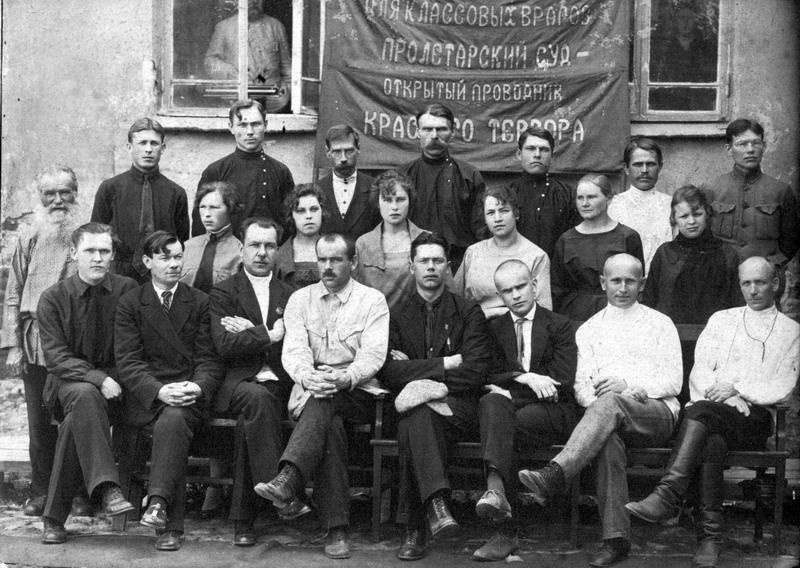
Olgin on workers’ legal recourse under the New Economic Policy.
‘Legal Status of the Russian Workers’ by Moissaye J. Olgin from Labor Herald. Vol. 2 No. 10. December, 1923.
THE labor unions of Soviet Russia are grounded in the law of the state. Their functions are twofold. As labor unions they represent the workers and employees of private and public economic enterprises and defend their interests. As part of the proletarian dictatorship they participate, through representatives, in most of the economic and political institutions of the state, including the management of the state-owned industries. It is, however, as representatives of labor that they are treated in this article.
It has already been stated that the unions are organized on an industrial basis. Their chief activities are: 1. establishment of a scale of wages for each industry by the Central Executive Committee of all Russian unions according to schedules worked out by the respective unions, (The scale of wages is being revised periodically, ordinarily once a month, to meet the changes in the prices of commodities, the fluctuations in the currency, and also to profit by improved economic conditions which allow for a rise in wages; the scale cannot go below a minimum wage established for the Republic each month by the central government the Council of People’s Commissars); 2. establishment of collective agreements between the workers on the one hand, the managers of public and private industrial enterprises on the other; 3. supervision and control over the industrial enterprises in order that the terms of the agreements, the labor laws concerning wages, hours, overtime, vacations, etc., be carried out; 4. cultural work. The latter two functions are mainly carried out through the Factory Committees.
In accordance with paragraph 16 of the Soviet Constitution, the law provides that “all state organs are obliged to render the labor unions and their combinations all possible assistance, putting at their disposal well equipped buildings for use as labor palaces, union headquarters, granting them rate reductions on the mails, the telegraph and telephone, the railways and the water transport, etc.” The headquarters of the union are, accordingly, located in the best palaces and houses requisitioned from the bourgeoisie.
The nucleus of the union is the Factory Committee. It is being elected by the workers of each industrial establishment, or their delegates, at a general meeting. The number of the Committee members is no less than three and no more than ten. It is the representative of the workers on the spot and forms the local nucleus of the industrial union. Representatives of all local Factory Committees of a certain branch of industry form the local committee of the union. The Factory Committee is the sole representative of the workers within the industrial establishment. No other committee of representatives may enjoy the same rights as the Factory Committee.
The functions of the Factory Committees are: 1. to see to it that all rules and regulations concerning wages, hours, safety, health conditions, social insurance, etc., be observed by the administration; 2. to represent the worker before public and state institutions, 3. to improve the material and cultural situation of the workers; 4. to aid (in state-owned industries) in improving the work of the industrial establishment and in regulating the economic organization in general.
The members of the Factory Committee are being elected according to rules laid down by the respective unions. The members of the Committees do not lose their regular wage provided by the employers (whether private or public) while they are serving on the Committee. Members of the Committee can be discharged by the employers (within regulations set for all workers) only with the consent of the respective union. No hindrances are to be put by the administration of an industrial establishment to the activities of the Factory Committees. The members of the union administration or their special agents, have free access to all the shops, divisions, departments, laboratories, etc., in a given industrial establishment. The administration of the establishment is obliged to put at the disposal of the Committee well equipped rooms, with heat and light, for use as Committee offices and also for general meetings of the workers or their delegates. General meetings of the workers or their delegates where public functions are being performed, such as the election of delegates to union conventions, or election of representatives to institutions of social insurance, or election of Soviet representatives, are to be held during labor hours, no reduction in wages being allowed for time thus spent. Other meetings, of a private nature, are to be held outside of labor hours.
The basic labor day for all industrial work, including the transportation system, is a maximum of eight hours. The labor day for underground work and for dangerous or especially, unhealthful occupations is six hours. The labor day for young workers between the ages of 16 and 18 is six hours, similarly for brain and office workers, excluding office work directly connected with production where it is eight hours. Seven hours of night work are considered equal to eight hours of day work. Where production allows it, the basic night shift is seven hours. Where it is impossible, a corresponding addition of one-eight or one-sixth to the wages is provided.
Overtime is prohibited unless required for the safety of the Republic, to prevent public calamities, or to make emergency repairs in the means of transportation and communication, in the lighting, heating and canalization equipment. Over-time is also permitted in order to repair industrial equipment where there is the danger of interrupting work for considerable numbers of employers. In such cases the total hours of overtime should not exceed 120 in a year and should not exceed 4 hours in two consecutive workdays. Payment for overtime is time and a half for the first two hours, double for all hours above two.
A weekly rest period of consecutive 42 hours is provided by law. Six hours of the sixth day being considered a full day. This makes a maximum of 46 work-hours weekly. Work performed in rest days (in emergency cases) is paid double. All workers whose employment was not interrupted for more than two weeks in the course of 5.5 months (even if they changed the place of employment) are entitled to two weeks vacation yearly. Workers engaged in especially unhealthful or dangerous occupations receive a month’s vacation. Persons under 18 years of age are also entitled to a month’s vacation.
Night work for women and young workers under the age of 18 is forbidden. Occupation in especially unhealthful or dangerous undertakings is prohibited for the same categories of workers. Eight weeks before and eight weeks after childbirth, women are freed from work. For women brain workers, the terms are six and six weeks. The employment of workers under the age of 16 is prohibited.
Law and practice distinguish between the collective agreement and the labor contract proper. The collective agreement is being concluded between the labor union on the one hand, the employers of labor (public or private) on the other. The agreements may be general, for the entire industry, or local, for one or several establishments. The terms of the agreement apply to all employees whether they belong to the union or not. No collective agreement may give to the members of one union privileges over the members of another union. No collective agreement is binding in those points which render the situation of the workers worse than is provided by the labor codes. No union is to pay damages for the violation by its members of the terms of the agreement.
The labor contract proper is concluded between employees or groups of employees and employers without the aid of the union. The terms of a labor contract should not render the situation of the work worse than is provided by the labor codes, the collective agreements and the shop regulations. In other words, while the law does not compel the worker to use the medium of the union for the conclusion of a labor contract, it prohibits him to go below union conditions. The change of ownership of an industrial establishment does not invalidate the labor contract. The transfer of workers from one establishment to another cannot take place without their consent. No secret information or agreements between employers concerning conditions of employment are allowed. Labor contracts can be declared null and void by the respective labor unions. The employers have then the right of appeal before the machinery for the settlement of conflicts.
Conflicts between employers (public or private) and workers can be settled in various ways, through a number of bodies. The body closest to the workers is the Tariff-Conflict Committee composed of an equal number of representatives from the Factory Committee and the administration of the industrial establishment. The jurisdiction of the Tariff-Conflict Committee embraces only the application of the terms of the collective agreements and labor contracts to local conditions. The decisions of the Tariff-Conflict Committees are final.
Questions concerning the very terms of the agreements or labor contracts, also questions where no decision could be reached in the Tariff-Conflict Committees, may be transferred by the conflicting parties to special Conciliation Chambers or Courts of Arbitration, composed of equal numbers of representatives from the workers and the administration. The decisions of those bodies are final. Their realization in practice is left to the conflicting parties in the case of Conciliation Chambers. The decisions of the Court of Arbitration are being enforced by the People’s Courts as far as the employer is concerned, and by the labor unions as far as the workers are concerned. In cases involving criminal prosecution for the violation of labor laws or collective agreements, special sessions of the People’s Courts are provided. The Court consists of one Presiding Judge, one representative of the Labor Commissariat, and one of the labor union. The Labor Commissariat has supreme control over the enforcement of the labor laws.
The Labor Herald was the monthly publication of the Trade Union Educational League (TUEL), in immensely important link between the IWW of the 1910s and the CIO of the 1930s. It was begun by veteran labor organizer and Communist leader William Z. Foster in 1920 as an attempt to unite militants within various unions while continuing the industrial unionism tradition of the IWW, though it was opposed to “dual unionism” and favored the formation of a Labor Party. Although it would become financially supported by the Communist International and Communist Party of America, it remained autonomous, was a network and not a membership organization, and included many radicals outside the Communist Party. In 1924 Labor Herald was folded into Workers Monthly, an explicitly Party organ and in 1927 ‘Labor Unity’ became the organ of a now CP dominated TUEL. In 1929 and the turn towards Red Unions in the Third Period, TUEL was wound up and replaced by the Trade Union Unity League, a section of the Red International of Labor Unions (Profitern) and continued to publish Labor Unity until 1935. Labor Herald remains an important labor-orientated journal by revolutionaries in US left history and would be referenced by activists, along with TUEL, along after it’s heyday.
PDF of full issue: https://www.marxists.org/history/usa/pubs/laborherald/v2n10-dec-1923.pdf
 Revolution's Newsstand