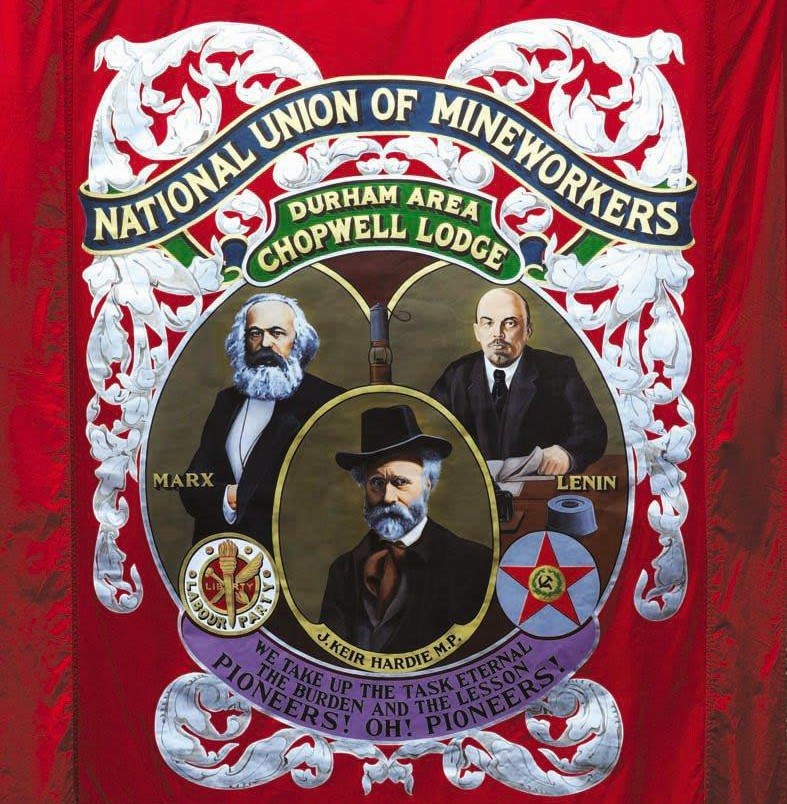
An essay of particular interest given its timing, written as it was on the cusp of Britain’s most consequential year of class struggle.
‘Lenin and the Tactical Questions of the British Labour Movement’ by Alexandr Lozovsky from International Press Correspondence. Vol. 6 No. 8. January 22, 1926.
“The proletariat needs the truth, and there is nothing more harmful to its cause than plausible, high-sounding, commonplace falsehoods.” (From Lenin’s reply to MacDonald in August, 1919). The British labour movement always interested Lenin, and therefore he studied economic and social relations in Great Britain with particular attention. A connoisseur of imperialism, Lenin could not fail to pay attention to the method by which the British bourgeoisie had succeeded throughout many decades, in holding in moral and political subjection large masses of workers and the organisations they created. Lenin understood excellently the economic reasons for the British labour movement remaining “non-political” for so many years, and why, despite the growth and development of the trade unions, the Socialist Parties of Britain were of a skeleton nature. He followed with great attention the struggle of ideas that was taking place in the British Socialist movement; even before the war he frequently commented in the Bolshevik press upon the most important events, and in his time he sharply opposed Hyndman when the latter, still before the war, made the British working class happy with the theory of Socialist imperialism or imperialist Socialism.
The war, and the role of the trade union and Socialist organisations in the war, compelled Lenin to peer still more profoundly into the labour movement, in particular into the British labour movement. The reason for the chauvinism of the majority of trade union and Socialist leaders is to be found in their attachment to the bourgeois State and their ideological subjection to bourgeois ideology; this Lenin proved in quite a number of articles even during the pre-war period. In his numerous works, he gave a Marxist explanation of this ideology which is so very hostile to the interests or the working class.
In this article I will not deal with separate periods, I will only investigate Lenin’s views on the main questions of the British Labour movement in the period following the October Revolution, when Lenin was at the same time the director of the new State and leader of the Third International.
In 1920, the British trade unions and the Labour Party sent a delegation to the U.S.S.R., with the task of becoming acquainted with the state of affairs. Some of these delegates, the most Right wing, Tom Shaw and Guest felt themselves more as the representatives of the British Government than of the British proletariat. In his Letter to the British Workers (May 30. 1920) Lenin says: “I am not surprised that a number of members of your delegation do not adopt the working class point of view, but the bourgeois point of view, that of the exploiting class, for in all capitalist countries the imperialist war has revealed deep-rooted sore: namely, the transference of the majority of workers’ parliamentary leaders to the side of the Bourgeoisie. Under a false pretext of defence of the fatherland, they have actually defended the thieving interests of one of the two groups of world robbers Anglo-American-French or German; they have entered into an alliance with the bourgeoisie against the revolutionary struggle of the proletariat; they have covered up this treachery with sentimental petty-bourgeois, reformist, pacifist phrases about world revolution, constitutional methods, about democracy and so on. This has been the case in all countries: it is not surprising, therefore, that the same thing in Great Britain also infected the composition of your delegation.” Tom Shaw and Guest asked Lenin whether he could prove that the British Government was continuing intervention, and that it really was acting by agreement with Wrangel and Poland, etc. Lenin replied to this that: “In order to get hold of secret treaties of the British Government, it would be necessary to overthrow it in a revolutionary manner, and to seize all documents concerning foreign policy, as we did in 1917”. “Those leaders or representatives of the British proletariat” writes Lenin in the same letter, “No matter whether they be parliamentary, trade union, journalists or others, who pretend that they do not know anything about the existence of secret treaties of Great Britain, France, America, Italy, Japan and Poland, concerning robbery of other countries and the sharing of the loot, and who do not conduct a revolutionary struggle for denunciation of such treaties, show by that alone once again that they are the true servants of the capitalists…In Great Britain there are also influential labour leaders’ who help the capitalists to befool the workers, and the journal the “New Statesman” which is the most moderate of moderates of the middle class journals, writes about supplying Poland with tanks more powerful than those used in the war against the Germans after that can we fail to smile at these ‘leaders’ of the British workers who, with a look of injured innocence, ask what ‘proof’ there is that England is fighting against Russia and helping Poland and the White Guards in the Crimea”.
I have cited these phrases from Lenin’s letter, in order to show what was his attitude towards those of the leaders of the British labour movement who tried to gloss over things that are evident. It was absolutely impossible not to know in the middle of 1920 that England was fighting against Soviet Russia. What then in this case was the meaning of these “naive”, if not crafty questions of Shaw and Guest? They were nothing more than an attempt to remove responsibility from Lloyd George for his anti-Soviet policy.
The members of the British Delegation asked Lenin what he considered most important: “The forming of a consistent revolutionary Communist Labour Party in Great Britain or the immediate assistance of the British working masses to the cause of peace with Soviet Russia”, Lenin replied to this as follows: “Sincere supporters of liberating the workers from the yoke of capital can by no means be opposed to the formation of a Communist Party…There is no need to fear that there will be too many Communists in England, for there is not even a small Communist Party there. But if anyone still continues to remain in moral slavery to the bourgeoisie, continues to have petty-bourgeois prejudices about ‘democracy’ (bourgeois democracy), pacifism, etc., then it stands to reason that such people would be still more harmful to the proletariat if they were to think of calling themselves Communists and joining the Third International. Such people are not capable of anything but sugary resolutions against intervention, made up of nothing but petty-bourgeois phraseology.” In concluding this letter, Lenin explained to the British workers what compelled the Soviet Power to employ the Red Terror. “The non-Communist leaders, bound by bourgeois prejudices, fear even the question: against which class is the Terror directed, against the exploited or against the oppressors and exploiters? is it a question of ‘freedom’ for the capitalists to rob, deceive, and befool the toilers, or of ‘freedom’ of the toilers from the yoke of the capitalists, speculators and proprietors?”
This letter, which touches on the general problems of the labour movement and the Russian Revolution, gives us a clear idea of Lenin’s opinion of the Right wing leaders of the British political and trade union movement. In this sharp estimation, the views of Lenin are also given, in passing, on certain questions of the British labour movement. Now we will turn to concrete problems that have arisen during the process of the formation of the Left wing in England.
In the middle of 1919 a British Communist put a number of questions to Lenin. Having given a brief outline of the situation of the British labour movement in England, the British Communist illustrated the moral and organisational scatteredness of the revolutionary elements, their disagreement as to parliamentarism. The author of the letter, himself an anti-parliamentarian, ends his letter with the following words: “If you were here, you would say: concentrate all your forces on direct action, and stop all this palaver about the political machine…In no country other than Great Britain is there a political apparatus which would be so difficult for the workers to conquer!” To this letter from a man who at that time did not know that the task of the Communists is to destroy the entire political apparatus of the bourgeoisie and not conquer it. Lenin replied in a detailed letter, in which he explained the views of revolutionary Marxists on parliamentarism.
“I do not doubt in any way”, wrote Lenin in his “Letter to a British Communist” (August 28, 1919), “that many workers belonging to the best, most honest, sincere revolutionary representatives of the proletariat, are enemies of parliamentarism and of all participation in parliament. The older capitalist culture and bourgeois democracy is in a given country, the more comprehensible this becomes, for the bourgeoisie in the old parliamentary countries has learned excellently how to play the hypocrite and to deceive the people in a thousand ways, putting forward bourgeois parliamentarism for ‘democracy in general’ or of ‘pure democracy’ and the like, while artificially concealing the millions of undercurrents between parliament and the stock exchange and the capitalists, and in employing the corrupt press and by every means setting going the strength of money and the power of capital. The Communist International and the Communist Parties of various countries would be committing an incorrigible error if they were to turn down workers who were in favour of the Soviet system, but who do not agree to participating in the parliamentary struggle. If we take the question theoretically, in its general aspect, it is just this programme, i.e. the struggle for the Soviet Republic which is capable of uniting, and must now undoubtedly unite, all sincere, honest revolutionaries from among the workers.” “What is to be done”, asks Lenin further on, “if in a certain country Communists who, by conviction, and by their readiness to conduct revolutionary work, are sincere supporters of the Soviet system, cannot unite because of disagreement on the question as to participation in parliament?” “I would consider such differences unessential at the present time”, replies Lenin, “as the struggle for the Soviet system is a political struggle of the proletariat in its highest, most conscious, and most revolutionary form. It is better to be with the revolutionary workers when they err on particular or secondary questions, than with the official Socialists or Social Democrats if they are not sincere, not firm revolutionists, and do not wish or are not able to conduct revolutionary work among the working masses, but conduct a correct tactic on this particular question.” “I am personally convinced”, continues Lenin, “that the refusal to participate in parliamentary elections is an error on the part of the revolutionary workers of Great Britain, but it is better to concede to this error, than to retard the formation of a Workers’ Communist Party in England from among all those whom you enumerate who sympathise with Bolshevism and all tendencies and elements which are sincerely in favour of the Soviet Republic.”
We see what interests Lenin most. Lenin, who can in no way be reproached with love for unclear or unformed programmes, Lenin who valued more than anything else clearness, complete agreement and full ideological unity of thought on all the most important questions, advises the British revolutionaries to form a party as soon as possible irrespective as to divergencies of view on the question of parliamentarism. Lenin understood quite well that such divergencies would soon be overcome and that the Party in the struggle with its enemies would become strengthened and emboldened. “Criticism of parliamentarism”, says Lenin, “is lawful and necessary, as motiving the transition to the Soviet system, but it is also absolutely correct as a recognition of the historical conventionality and restrictedness of parliamentarism, its connections with capitalism, the progressiveness of parliamentarism with regard to mediaeval systems and its reactionary attitude as compared with the Soviet system”. “The error of the Anarchists and the Anarchist-Syndicalists”, says Lenin in another place, “is that they are against any participation in Parliament, whereas there can be and should be Soviet propaganda in bourgeois Parliaments from within”. Certainly great difficulties lie in the path of such parliamentarism, but these difficulties must be overcome “And if the Labour Party be really revolutionary, if it is really labour (i.e. connected with the masses, with the majority of toilers, with the proletarian rank and file, and not with its upper strata) if it is really a Party i.e. strong, a serious compact organisation of the revolutionary vanguard, capable of conducting work among the masses by every possible means, then such a Party will assuredly be able to hold back with its hands its own Parliamentarians, turn them into real revolutionary propagandists, like Karl Liebknecht, and not opportunists, not perverters of the proletariat, with bourgeois lack of ideas”. Nothing had been heard of this kind of parliamentary activity in the old parliamentary countries, for all the countries of the Second International, even before their moral and political bankruptcy, have never set themselves tasks of this kind. Why did Lenin refer to the question of parliamentarism in such detail? Because he feared that, what with one thing and another, the British Communists would be late in organising the Communist Party, and although most space in this letter was given to the question of parliamentarism, the central idea, the main theme of the letter, was the necessity for forming a Communist Party. Lenin was not only for the formation of a Communist Party, but says in the same letter that a Communist Party is necessary for England. How did Lenin formulate this task? “Unbroken contact with the masses of workers, the capacity for continually agitating among them, participating in that every strike, responding to all questions of the masses is what is most important for the Communist Party, particularly in such a country as Great Britain, where up to now (as by the way in all imperialist countries) it has mainly been the narrow upper strata of the workers, the representatives of the labour aristocracy, who participated in the Socialist and in general in the labour movement, for the greater part hopelessly Spoilt through and through by Reformism, and captivated by bourgeois and imperialist prejudices. Without a struggle against this stratum, without destroying all its authority among workers, without convincing the masses of the complete bourgeois contamination of this stratum, there can be no question of any serious Communist labour movement.” This advice given to the British Communists goes far beyond the bounds of Great Britain. This may be considered as one of the main conceptions of the tactics of international Communism.
***
In “Left Wing Communism”, (written in April 1920), a book most brilliant in its compactness and clearness of thought and profound analysis, Lenin once more deals with the tactical problems of the British labour movement and alludes to opportunism and petty bourgeois revolutionism. He returns to the question of parliamentarism, and by citing examples of all revolutions he proves the disadvantageousness for the proletariat of renouncing the utilisation of the parliamentary tribune. He objects here to references to the Bolsheviks having dissolved the Constituent Assembly, and that therefore there was no use in participating in parliaments. Historical facts speak against references of this nature, for the Bolsheviks after the October Revolution did not boycott elections, but participated in them. “It has been proved that participation in bourgeois-democratic parliaments a few weeks before the victory of the Soviet Republic, and even after that victory, not only has not harmed the revolutionary proletariat, but has actually made it easier to prove to the backward masses why such parliaments should be dispersed, has made it easier to disperse them, and has facilitated the process whereby bourgeois parliaments are actually made “politically outworn.” “It is impossible to build up revolutionary tactics solely on revolutionary dispositions and moods”, says Lenin in another place. “Tactics should be constructed on a sober and strictly objective consideration of the forces of a given country (and of the countries surrounding it, and of all countries on a world scale), as well as on an evaluation of the experiences of other revolutionary movements. To manifest one’s revolutionism solely by dint of swearing at parliamentary opportunism, by rejecting participation in parliaments is very easy; but just because it is too easy, it is not the solution of a difficult, a most difficult problem…To attempt to ‘circumvent’ this difficulty by ‘jumping over’ the hard task of utilising reactionary parliaments for revolutionary purposes, is absolute childishness.”
I have referred thus in detail to these views of Lenin’s on participation in Parliament not because this question is of vital importance for the British Communist Party at the present moment, but because I wanted also to show Lenin’s method of approach to those questions, which arose in England at the dawn of the Communist movement.
Lenin paid very close attention to the infantile disorder that was to be observed then in England in 1920, because at that time “in Britain there is as yet no Communist Party, but there is a young, extensive, potent, Communist movement, rapidly growing among the workers” (Left Wing Communism). This young potent movement might pass by the Communist Party if Lenin had not drawn serious attention to it. In an article by Gallacher in which the latter wrote that “The workers feel disgusted at the idea of Parliament”, that the revolutionary comrades shall not support the Hendersons and Clynes, for “to support parliamentarians and opportunists by no matter what means, would simply mean laying into the hands of the above-mentioned gentlemen.” And Lenin replied to this heart-felt protest against the support of the Labour Party by revolutionaries and workers: “People who are able to express such a disposition of the masses, who are able to awaken in them such a mood (which often lies dormant) should be cared for attentively and every assistance rendered them. At the same time they must be told frankly and openly that mood alone is not sufficient to guide the masses in the great revolutionary struggle…This hatred of the representative of oppressed and exploited masses is indeed the beginning of all wisdom; it is the basis of every socialist and communist movement and of its success. The author (Gallacher) however, evidently does not take into consideration the fact that politics is a science and an art which does not drop from the skies, and which cannot be obtained for nothing; and that the proletariat, if it wishes to overcome the bourgeoisie, must create for itself its own, proletarian, ‘class politicians’, as capable as bourgeois politicians. The author (Gallacher) of the letter does not however even think of putting the question as to whether or not it is possible for the Soviets to vanquish Parliament without introducing ‘Soviet’ workers into the latter, without disintegrating Parliament from within, without preparing inside Parliament, the success of Soviets, in the impending struggle for the dispersion of Parliaments.” Lenin objects with particular force to the refusal to support opportunist representatives of the Labour Party at elections. “That the Hendersons, Clynes, MacDonalds and Snowdens are hopelessly reactionary is true. It is also true that they want to take the power into their own hands (preferring, however, a coalition with the bourgeoisie), that they want to govern according to the same old rules of the bourgeoisie, and that they will inevitably behave, when in power, like the Scheidemanns and the Noskes. All this is true, but it does not necessarily follow that to support them means treason to the revolution; on the contrary, in the interests of the revolution, the revolutionaries of the working class must render to these gentlemen a certain parliamentary support…
The Left Communists find it inevitable that the power will fall into the hands of the Labour Party and admit that at the present time the latter is backed by a majority of working men. From this they draw the strange conclusion which Comrade Sylvia Pankhurst expresses as follows:
“A Communist Party must not enter into compromises. A Communist Party must keep its doctrine pure, and its independence of reformism inviolate; its mission is to lead the way, without stopping or turning, by the direct road to the Communist Revolution”.
On the contrary, since the majority of the workers in Britain: still support the British Scheidemanns and Kerenskys, since they have not yet experienced a government composed of such men which experience was necessary in Russia and Germany, before there was an exodus of the masses towards Communism, it follows without any doubt that the Britain Communists must participate in Parliament. They must from within Parliament help the workers to see in practice the results of the Henderson and Snowden Government; they must help the Hendersons and Snowdens to vanquish Lloyd George and Churchill united. To act otherwise means to hamper the progress of the Revolution; because, without an alteration in the views of the majority of the working class, revolution is impossible; and this change can be brought about by the political experience of the Masses only, and never through propaganda alone. If any indisputably weak minority of the workers say ‘forward, without compromise, without stopping or turning’, their slogan is, on the face of it, wrong. They know, or at least they should know that the majority, in the event of Henderson’s and Snowden’s victory over Lloyd George and Churchill, will, after a short time, be disappointed in its leaders, and will come over to Communism or at any rate to neutrality and, in most cases, to benevolent neutrality towards the Communists. It is as though ten thousand soldiers were to throw themselves into battle against fifty thousand of the enemy at a time when a reinforcement of one hundred thousand men is expected but is not immediately available; obviously, it is necessary at such a moment to stop, to turn, even to effect a compromise.
The question as to compromises being permissible and necessary for the Communist Parties raised no doubts in Lenin…But the knowledge of British conditions and the readiness on the part of opportunists to utilise everything, to catch on to any hook in order to be able to conduct their opportunist policy, compelled Lenin to deal with this question in detail and to make it as clear as possible as to what compromises were in question. Lansbury, who visited Lenin, told him in a conversation: “Our British trade union leaders say that compromises are also allowable for them if they are permissible for Bolshevism” (a hint at Brest Litovsk). Lenin replied to this with a simple and “popular” comparison:
“Imagine that your automobile is held up by armed bandits. You hand them over your money, passport, revolver, the machine. In return you are spared the pleasant company of the bandits. The compromise is plainly there ‘Do, ut des’ (I ‘give’ you money, arms, the automobile, in order that you ‘give’ me the possibility of going in peace). But one can hardly find a sane man who would pronounce such a compromise ‘inadmissible on principle’, or would proclaim the compromiser an accomplice of the bandits even though the bandits, having got into the automobile, used it and the firearms for new robberies. Our compromise with the bandits of German imperialism was such a compromise.
But when the Mensheviks and Socialist Revolutionaries in Russia, the Scheidemanns (and to a great extent the Kautskians) in Germany, Otto Bauer and Friedrich Adler (let alone Messrs. Renner and Co.) in Austria, the Renaudels, Longuets and Co. in France, the ‘Independents’ and the ‘Labourites’ and the Fabians in England, effected in 1914-18, and in 1918-20, compromises with the bandits of their own bourgeoisie, and sometimes with those of the bourgeoisie of the ‘Allies’, against the revolutionary proletariat of their country, that is where these worthies were guilty of aiding and abetting.
The conclusion is clear–To reject compromises on ‘principle’, to reject every admissibility of compromises generally, no matter of what kind, is a piece of childishness hard even to take seriously. He who wishes to be useful to the revolutionary proletariat must be able to sift the concrete cases of such compromises which are inadmissible, which stand for opportunism and treachery and to direct all the force of criticism against these concrete compromises, mercilessly exposing them, fighting them to a finish, and not allowing ‘experienced Socialists’ and parliamentary Jesuits to dodge and shirk responsibilities by resorting to discussions of ‘compromises generally’. The ‘leaders’ of the British trade unions, as well as of the Fabian Society and the Independent Labour Party, use just this method of dodging responsibility for the betrayal they committed. Theirs was a compromise which indicated the worst kind of opportunism, treason and betrayal.” Such a reply given to the elements who want to hide their opportunism by talk about abstract compromises, leaves nothing to be added. It was no mere chance that Lenin, in replying to the British Rights and extreme Lefts dealt with this question in such detail. Lenin pursued two objects: to teach the British Communists to conduct a correct Bolshevik policy against decaying opportunism and sterile Left phraseology.
***
What was most difficult of all for the Communist Party of Great Britain while in process of formation, was to establish a correct attitude towards the Labour Party. The advantage for the Communists in the Labour Party entering power, was not clear to the majority of the leading elements of the revolutionary movement in Great Britain, and as this was the most important question of Communist tactics Lenin continually returns to this question. In order to make his ideas clear, Lenin outlined the “fundamental law of revolution”. “It is not sufficient for the Revolution”, says Lenin “that the exploited and oppressed masses understand the impossibility of living in the old way and demand changes; for the Revolution it is necessary that the exploiters should not be able to live and rule as of old. Only when the masses do not want the old regime and when the rulers are unable to govern as of old, then only can the revolution succeed. This truth may be expressed in other words: Revolution is impossible without an all-national crisis, affecting both the exploited and the exploiters. It follows that for the Revolution it is essential, first, that a majority of the workers (or at least a majority of the conscious, thinking, politically active workers) should fully understand the necessity for a revolution and be ready to sacrifice their lives for it; second, that the ruling class be in a state of governmental crisis, which attracts even the most backward masses into politics. It is a sign of every real revolution, this rapid ten-fold, or even hundred-fold, increase in the number of representatives of the toiling and oppressed masses, heretofore apathetic, who are able to carry on a political fight which weakens the government and facilitates its overthrow by the revolutionaries.
In Britain, as is seen specifically from Lloyd George’s speech, both conditions for a successful proletarian revolution are obviously developing. Mistakes on the part of the Left Communists are now all the more dangerous just because some revolutionaries show an insufficiently penetrating, insufficiently attentive, conscious and foreseeing attitude, towards each of these conditions. If we are not a revolutionary group, but a Party of the revolutionary class, and wish to carry the masses with us, (without which we run the risk of remaining mere babblers), we must first help Henderson and Snowden to defeat Lloyd George and Churchill; or, to be more explicit, we must compel the former to defeat the latter, for the former are afraid of their victory! Secondly, we must help the majority of the working class to convince themselves, through their own experience that we are right; that is, they convince themselves of the utter worthlessness of the Hendersons and Snowdens, of their petty-bourgeois and treacherous natures, of the inevitability of their bankruptcy. Thirdly, we must accelerate the moment when, through the disappointment of the majority of the workers with the Hendersons, it will be possible, with serious chances of success, to overthrow the Henderson Government which will most certainly lose its head if the clever leader of, not the petty but the grand bourgeoisie, Lloyd George himself, loses his wits so completely and weakens himself more and with himself the whole bourgeois party yesterday through his ‘collisions’ with Churchill, today with his “collisions with Asquith.”
Lenin’s idea is quite clear: to help the masses to outlive their reformist prejudices and the belief in constructive socialism, in formal democracy, and the rest. “And if the objections be raised” concludes Lenin “these are too cunning and intricate tactics, the masses won’t understand them, they scatter and disintegrate our forces, they will interfere with the concentration on the Soviet Revolution, etc.” “I shall reply to the Left’ critics ‘do not attribute your doctrinarism to the masses!’”
The political life in Great Britain during the last 2-3 years has brilliantly confirmed the correctness of Lenin’s prediction that the government of the Labour Party would play into the hands of the Communist Party, as these gentlemen would imitate bourgeois governments and in doing so denounce themselves. MacDonald realised all Lenin’s predictions by 100%, and on the other hand confirmed Lenin’s assertion that the growth of the Communist Party would proceed at a rapid rate with the advent of the reformists to power. The British Communist Party and the Minority Movement have become strengthened and become a political factor in the country only since the time of the MacDonald Government, which like all opportunists worked for Communism in spite of itself.
***
Polemising with certain ultra-Left elements, Lenin in passing touched upon one of the most important and difficult problems as to the roots and causes of opportunism. At the Second Congress of the Comintern Lenin in his report: “the International Situation and the Fundamental Questions of the Communist International” puts the question: How do we explain the stability of such opportunist tendencies in Europe and why is this opportunism in Europe stronger than in our country? And he replies: “Because the advanced countries have created and are creating their own culture by the possibility of living at the expense of millions of oppressed people. Because the capitalists of these countries receive much more than they would be able to receive as profit from plundering the workers of their own country. These milliards of surplus profit represent the economic basis upon which opportunism is maintained in the Labour Movement. In America, Great Britain and France, there is an immeasurably more stubborn resistance on the part of the opportunist leaders, the upper strata of the labour class, the workers’ aristocracy, they offer a much stronger resistance to the Communist movement and therefore we should be prepared for the liberation of the American and European Labour Parties from this malady to be much more difficult than was the case with us.”
How were these difficulties to be overcome in Great Britain, where there existed a gigantic Labour Party and a number of small revolutionary Communist groups? Firstly, by immediately forming a single Communist Party, and secondly by a correct attitude towards the Labour Party. For Lenin, the question as to the affiliation of the Communist Party to the Labour Party arose from his entire policy on the British Labour Movement. In “Left Wing Communism” he writes the following on this subject: “I have too little information on this question, which is especially complicated on account of the quite unique composition of the British Labour Party, which is so very unlike the composition of the usual political parties on the Continent. I have no doubt, however, that, on this question as well, he would be mistaken who would be inclined to draw up the tactics of the revolutionary proletariat on the principle that the Communist Party must maintain its doctrine pure and its freedom from reformism inviolate; its slogan must be to go forward without stopping or turning aside, to follow the straight read to the Communist revolution. For such principles only repeat the mistakes of the French Communard-Blanquists, who, in the year 1874, proclaimed the ‘repudiation’ of all compromises and of all intermediary positions. Secondly, it is beyond all question that the problem, here as everywhere, consists in the ability to apply the general and fundamental principles of Communism to the specific relations between classes and parties, to the specific conditions in the objective development towards Communism conditions which are peculiar to every separate country, and which one must be able to study, understand, and point out.” At the Second Congress of the Communist International Lenin speaks on this subject very definitely: “The Communist Party” said Lenin, “may affiliate to the Labour Party only on condition that it retains entire freedom to criticise that party and to conduct its own political propaganda.” In reply to a remark of Serrati that this would be “class collaboration” Lenin replied: “But in the present place, in respect of the British Labour Party, we have a case of cooperation between the advanced minority and the great mass of the English workers. All the workers, all the members of the trade unions, are members of the Labour Party. The Labour Party is a peculiar organisation having no parallel in any other country; it comprises from six to seven million organised workers of all trades. Political convictions are not required in applying for membership…This means the collaboration of the vanguard of the working class with the rearguard. It is a matter of utmost importance for the entire movement that we insist that the English Communists form a link between the Party of the Minority and the masses of the workers. When the Minority is unable to lead the masses, and incapable of getting into close touch with them, than it is no Party, and is of no significance, whether it be called Party, or National Committee, or shop stewards. As far as I know, the shop stewards in England have their national committee and central guiding organ which is already a step towards the formation of a Party. Therefore since it cannot be denied that the British Labour Party is composed of workers, it is clear that working in that Party means operation of the vanguard of the working class with the less advanced workers; and, when this cooperation is not systematically carried on, the Communist Party is worthless, and there can be no question of the dictatorship of the proletariat.”
The discussion on the question of the attitude of the Communist Party towards the Labour Party became heated, and Lenin made a speech on August 6th, 1920 with regard to entry into the British Labour Party.
“Sylvia Pankhurst” said Lenin, “asked whether it was possible for a Communist Party to join another political party which still belonged to the Second International. She says this is impossible. But we have very peculiar conditions in the British Labour Party: this is a very original party, it is not a party in the ordinary meaning of the word. It consists of the members of all the trade union organisations…We have in this party the great mass of the English workers, led by the worst bourgeois elements, by the social patriots, worse even than Scheidemann, Noske and similar gentlemen. The Labour Party admits, however, that the I.L.P., which is one of its members, should have its own organs, where the members of the same Labour Party openly declared the leaders to be social traitors…It is not correct as Comrade Gallacher states, that if we decide to accept the Labour Party, the best revolutionary English workers will not go with us. We must put it to the test.”
When we read now, five years after the Second Congress of the Communist International, Lenin’s tactical advice to the British Communists, we see how correctly and capably he traced out the correct line, fighting against all kinds of prejudice and formal revolutionarism. With the question as to the affiliation or non-affiliation to the Labour Party, the question as to the proper approach to the masses, so important for any Communist Party, was solved…
***
What occupied Lenin more than anything else, was the question of forming a Communist Party in Great Britain as soon as possible, although he only spoke of the necessary organisational steps for this, in passing. He drew the main attention of all revolutionary workers in Great Britain to the political tasks, to the methods of approach to the masses, to the nature of the work, emphasising thereby, that without a proper policy, it would be impossible to form a real Communist Party. “The Communists in Britain”, says Lenin in “Left Wing Communism”, “must continually assiduously and determinedly utilise both the parliamentary elections and every opening offered by the Irish, Colonial, and world-imperialist policy of the British Government, and all other aspects, domains and spheres of public life, working everywhere in a Communist spirit, the spirit not of the Second, but of the Third International.” To work in this new spirit was what Lenin emphasised over and over again as being necessary for Communists in all countries. A little less looking back at the old expiring Socialism and trade unionism, and remember that humanity has entered a new epoch, that tens of millions of toilers have been awakened, have been aroused by war and revolution and we must persistently set our hands to work, and yet more work.
“The Communists of Western Europe and America”, says Lenin in the same work, “must learn to create a new parliamentarism, entirely distinct from the usual opportunist office-seeking forms. This new parliamentarism must be used by the Communist Party to set forth its programme; it must be used by the real proletarian, who, in cooperation with the unorganised and very much ignored poor, should go from house to house of the workers, from cottage to cottage of the agricultural proletariat and isolated peasantry, carrying and distributing leaflets. (Fortunately, in Europe there are fewer isolated peasants then in Russia, and fewer still in England.) The Communist should penetrate into the humblest taverns, should find his way into the Unions, societies and chance gatherings of the common people and talk with them, not learnedly, nor too much after the parliamentary fashion. He should not for a moment think of a “place” in parliament; his only object should be everywhere to awaken the minds of the people, to attract the masses, to trip the bourgeoisie up on their own words, utilising the apparatus created by them, the election contests arranged by them, the appeals to the whole people issued by them, to preach Bolshevism to the masses. Under the rule of the bourgeoisie this is possible only during an election campaign not counting of course, the occasion of great strikes, when a similar apparatus of general agitation may be utilised, as we utilised it, more intensely. It is exceedingly difficult to do this in Western Europe and America, but it can and must be done, for without labour the problems of Communism can in no way be solved. It is necessary to work for the solution of all practical problems which are becoming more and more varied, more and more involved with all branches of public life, as the Communists tend to conquer one field after another from the bourgeoisie.
Likewise in Britain it is necessary to put the work of propaganda, of agitation and organisation in the army, and among the nationalities oppressed and deprived of equal rights in their Empire (e.g. Ireland, Egypt, etc.), on a new basis. This work must be carried on not on Socialist, but on Communist lines, not in the reformist but in the revolutionary manner. For all these spheres of public life are especially filled with inflammable material and create many causes for conflicts, crises, enhancements of the class struggle. This is especially true in the epoch of imperialism generally, and particularly now when war has exhausted the peoples and has opened their eyes to the truth namely, that tens of millions have been killed and maimed solely to decide whether English or German plunderers should rob more countries. We do not know, and we cannot know, which of the inflammable sparks which now fly in all countries, fanned by the economic and political world crisis, will be the one to start the conflagration (in the sense of a particular awakening of the masses); we are, therefore, bound to utilise our new Communist principles in the cultivation of all and every field of endeavour, no matter how old, rotten and seemingly hopeless. Otherwise we shall not be equal to the occasion, shall not be comprehensible, shall not be prepared to master all the types of weapons in the struggle, shall not be ready for victory over the bourgeoisie, which is responsible for the creation of all the aspects of public life, but which has now disrupted them, and disrupted them in a purely bourgeois manner. Not without careful preparation shall we be ready for the impending Communist reorganisation of society after our victory.”
**
In April 1919 MacDonald wrote an article, “The Third International”, in which he definitely opposed the formation of the Communist International. MacDonald acknowledged that at the Conference of the Second International in Berne, the discussion on the question of war responsibility “was only a concession to non-socialist public opinion”, but he nevertheless considered existence in one International as being possible. “We must establish our socialist principles”, wrote MacDonald. “We must lay the solid foundations of International Socialist policy. After this, if we find that we are in essential disagreement over these principles, if we do not see eye to eye as regards liberty and democracy, if we have definitely divergent views about the conditions in which the working class can exercise power, if the war has tainted certain sections of the International with imperialism, then the split can take place. However, I do not think that such a calamity will occur. Consequently, I regret the Moscow manifesto as being at least premature and certainly useless.”
And Lenin replied to these narrow-minded melancholy arguments in an article “On the Tasks of the Third International” in which he revealed with vivid clearness the difference between opportunism and Communism. “Ramsay MacDonald declares, with the entertaining naivete of a parlour Socialist, who speaks in the air without the least notion in the world that his words have a serious bearing, without in any way understanding that words compel action. At Berne a concession was made to non-Socialist public opinion”.
Lenin, in replying to MacDonald, refers to imperialism and its connection with opportunism in the labour movement.
“’Fabian Imperialism’ and ‘Socialist Imperialism’ are one and the same thing. It is Socialism in word and Imperialism in deed. It is the transformation of fully developed opportunism into imperialism. Today, during and after the war of 1914-1918, this phenomenon has become universal. The failure of the yellow Berne International to understand this is the result of its extreme blindness and constitutes its greatest crime. Opportunism or reformism inevitably developed into Socialist Imperialism or social patriotism, with world-historical significance. For Imperialism brought to the fore a group of very rich, highly developed countries, who plunder the whole world, and whose bourgeoisie is able, by that very fact, to buy with the surplus of its monopolist profits (for Imperialism means monopolist capitalism) the upper strata of the working class of these countries.
Only complete ignoramuses or hypocrites, who deceive the workers by repeating commonplaces on capitalism, concealing in this way the bitter truth of the passing of an entire Socialist tendency to the side of the Imperialist bourgeoisie, can fail to see the economic inevitability of this fact.
Two indisputable conclusions are to be drawn from this fact:
The first conclusion is that the Berne “International” is in fact, by virtue of its actual historical and political role, independently of the goodwill and the innocent desires of such and such of its members, an organisation of agents of International Imperialism, acting in the midst of the working class, infusing the working class with bourgeois influence, bourgeois ideas, bourgeois lies, and bourgeois corruption.”
Lenin counterposes to MacDonald’s concession on Socialist Parties and the International, the Bolshevik understanding of the Party and the International. Here is this striking juxtaposition of Communism to reformism, of the Third International to the Second:
To defeat opportunism, which was the cause of the ignominious death of the Second International, and to assist effectively the revolution, the approach of which is recognised even by Ramsay MacDonald, the following must be done:
***
First: All propaganda and agitation must be directed towards revolution as opposed to reforms. This distinction must be systematically made clear to the masses, both theoretically and practically, in every instance of parliamentary, cooperative, trade union, and other work. There must be no refusal (except in rare special cases) to make use of parliamentarism and all the “liberties” of bourgeois democracy. Reforms must not be renounced, but should be looked upon only as subordinate issues in the revolutionary class struggle of the proletariat. Not one of the parties of the Berne ‘International’ satisfies these demands. Not a single one of them even evinces an understanding of how all propaganda and agitation must be directed towards making clear the difference between reforms and revolution, and of the necessity for the most strict and constant preparation, both of the Party and of the masses, for revolution.
Secondly, it is necessary to combine legal and illegal work. This was taught by the Bolsheviks at all times and particularly during the war of 1914-1918. It was ridiculed by the despicable opportunist heroes, who in their self-satisfied manner praised the ‘legality’, the ‘democracy’ and the ‘freedom’ of the West European countries, of republics, etc. At the present time only avowed scoundrels, who deceive the workers by phrases, can deny that the Bolsheviks have been proved right. There is not a single country in the world, even the most advanced and ‘freest’ of bourgeois republics, where there is not a reign of bourgeois terror and where agitation, propaganda and organised work for the Socialist revolution is not prohibited. The Party which up to now has been unwilling to recognise that this is so under bourgeois domination and which fails to carry on systematic illegal work all along the line, in spite of bourgeois laws and bourgeois parliaments, is a party of cowards and traitors who deceive the people by only recognising the revolution in words. Such Parties have a place marked out for them in the yellow Berne ‘International’. No place will be given them in the Communist International.
Thirdly, a ruthless struggle must be carried on in order to clear right out of the Labour Movement these opportunist leaders who showed their true characters before and especially during the war in politics, and particularly within the Trade Unions and Cooperatives. The theory of ‘neutrality’ is a false and mean subterfuge which helped the bourgeoisie to bulldoze the masses during the war of 1914-1918. Those parties which verbally assert that they are in favour of revolution, but which do not in fact carry on a relentless struggle for the supremacy of the one genuinely revolutionary party in all working-class organisations such a party is a party of traitors.
Fourthly, it is not enough to condemn Imperialism in words, with the fixed intention not to conduct a revolutionary struggle for the liberation of the colonies (and the dependent nationalities) enslaved by their Imperialist bourgeoisie. That is hypocrisy. That is the policy of Labour lieutenants of the capitalist class. That party English, French, Dutch, Belgian or any other which is opposed in words to Imperialism, but which does not in fact carry on the revolutionary struggle within its ‘own’ colonies for the purpose of overthrowing its ‘own’ bourgeoisie, which does not systematically and in every possible way assist the revolutionary work which has already begun in the colonies, which does not provide the colonies with arms and literature for the work of the revolutionary parties that party is a party of cowards and traitors.
Fifthly, a phenomenon typical of the parties of the Berne ‘International’ and which is the height of hypocrisy, consists in recognising the revolution in words, and parading this recognition before the workers in pompous phrases, whilst as a matter of fact they behave in a purely reformist manner towards the first signs and manifestations of revolutionary development, such as all mass movements which, by smashing bourgeois law, take on an illegal character; for instance, mass strikes, street demonstrations, soldiers’ mutinies, meetings among the troops, the distribution of leaflets in barracks and camps, etc.
These five points excellently determine the tasks of the Communist Party and are more than ever opportune for Great Britain. The second point concerning illegal work and the terror of the bourgeoisie against revolutionary workers, would appear not to be written at the commencement of 1919, but at the end of 1925. Many problems which were presented by Lenin a few years ago have been settled in Great Britain. A Communist Party now exists there, it is excellently connected with the masses, it has already long ago outlived the infantile disorders of Leftism, and, despite all persecutions, is going further and further ahead. But why is it that during the last two years the Communist Party of Great Britain has grown into a serious political factor? Because it has ably applied the Leninist tactic of winning the masses. Now, when the Communist Party of Great Britain has entered a phase of persecutions, when simultaneously with the increase of repressions, the sympathy of the workers towards the Party also grows, now Leninist strategy must be studied with particular attention, so that despite illegality, the Party will be able to become still more strongly and still more closely linked up with the masses. The objective position is favourable for turning the Communist Party into a mass Party. The movements now taking place at the very heart of the masses of the British proletariat, the increase of left wing moods, which have found expression in the formation of an Anglo-Soviet Trade Union Bloc, the formation of Left wing in the Labour Party and the sharpening of the struggle in the trade unions and in the Labour Party against the opportunist policy of the MacDonalds, Thomases and Clynes all these factors bear witness to the fact that neither the bourgeoisie nor the reformists will be able to strangle the growing Communist movement. They will not be able to strangle it, because Lenin stood at the cradle of the British Communist movement, and because the British Communists remember Lenin’s advice: “It is necessary to coordinate the strictest devotion to the ideas of Communism with the ability to accept all necessary practical compromises, manoeuvrings, temporisings, zig-zags, retreats and the like. This coordination is essential in order to hasten the rise and fall, the realisation and the withering away, of the political power of the Hendersons…It is essential in order to facilitate their inevitable practical bankruptcy, which enlightens the masses precisely after our ideas, precisely in the direction of Communism. One must precipitate the inevitable quarrel and conflicts between the Hendersons, Lloyd Georges and Churchills, and choose correctly the moment of the maximum disintegration between all these ‘buttresses of sacred private property’ in order to defeat them all in one decisive offensive of the proletariat, and conquer political power.”
International Press Correspondence, widely known as”Inprecorr” was published by the Executive Committee of the Communist International (ECCI) regularly in German and English, occasionally in many other languages, beginning in 1921 and lasting in English until 1938. Inprecorr’s role was to supply translated articles to the English-speaking press of the International from the Comintern’s different sections, as well as news and statements from the ECCI. Many ‘Daily Worker’ and ‘Communist’ articles originated in Inprecorr, and it also published articles by American comrades for use in other countries. It was published at least weekly, and often thrice weekly.
PDF of full issue: https://www.marxists.org/history/international/comintern/inprecor/1926/v06n08-jan-22-1926-inprecor.pdf
 Revolution's Newsstand