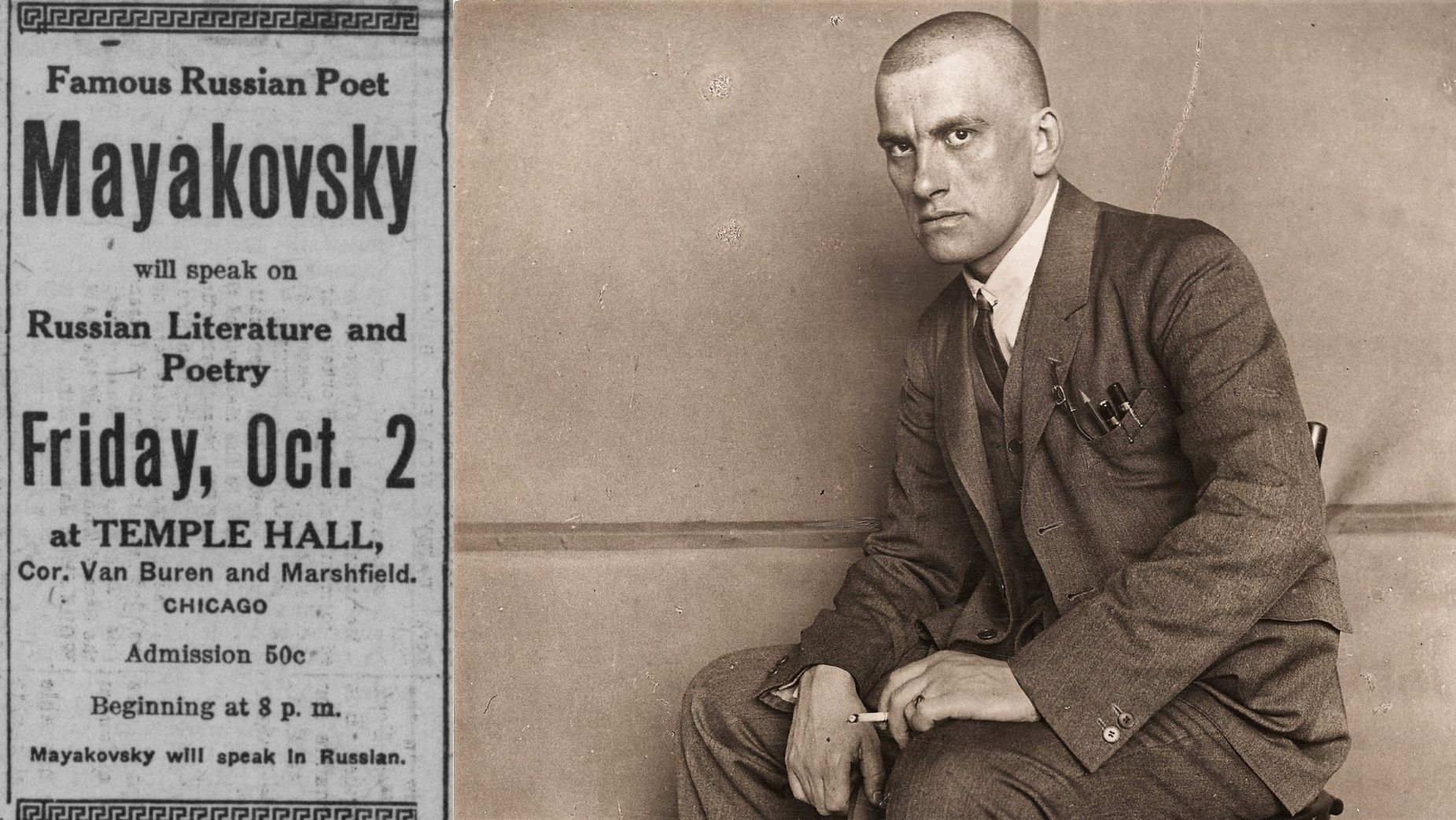
Mayakovsky lectures in Chicago.
‘Mayakovsky Tells of Soviet Culture’ by M.A. Skromny from The Daily Worker. Vol. 2 No. 227. October 6, 1925.
GREAT RUSSIAN POET INSPIRES LOCAL CROWDS
One of the most enthusiastic meetings ever held In the Russian colony of Chicago took place Friday night, Oct. 2, when a crowd of about 1,600 people jammed the Temple Hall to listen to the famous Russian poet, Vladimir Mayakovsky. Before the meeting was over the crowd unanimously voted to invite Comrade Mayakovaky again to Chicago before he leaves this country.
The meeting was opened with the International by the Freihelt Singing Society, and after a short introduction by the chairman, Comrade Stolar, Vladimir Mayakovsky began to talk. From the start until the end he held the crowd spellbound. At times they were cheering and at times they were laughing until tears streamed from their eyes.
Plays With 40,000 Actors.
He described the new theater, where Comrade Meyerhold, the great impresario, perhaps the greatest in the world, is staging shows in which 40,000 people are participating as actors.
He described a play about the gas workers which was staged at the gas works instead of an artificial stage with painted machinery. He told about many other things that are taking place in the Union of Socialist Soviet Republics, that would look grotesque and fantastic to the “sane and respectable” playwrights, poets and actors.
Comparing Culture.
Comparing the interest that is shown by the wide masses to literature and poetry in the “barbarous” land of the Bolsheviks with that of the “civilised” countries, he cited the fact that the powerful Chicago poet, Carl Sandburg, was able to draw a crowd In New York of only about 300 or 400 people, while the Russian poets usually speak to crowds of thousands. As a matter of fact, there were about 1,500 people in the hall while he was talking.
He said that when he tried to find out how big the output of poetry was in this country, he was informed by a publisher that the so-called “intellectuals,” the dentists, physicians, lawyers, etc., are sometimes buying books of poetry, not to read, but keep it as furniture, to show “a good taste.”
This, while the Russian poet Denijan Bedny has had over 2,500,000 copies of his works printed since 1917, while the speaker (Mayakovsky) has over 1,500,000 copies of his books published since 1917, the bonks of the poets of the “civilized” countries are printed only by the thousands and even by the hundreds.
Writes Poems on America.
After a short intermission, between the sips of Russian tea, he answered questions, and read some of his own poems, not published yet. The audience almost raised the roof by wildly cheering his American poems, The Discovery of America, The Woolworth Building and the Girl, and Havana Willie. Five hundred copies of his poems that were on hand, were sold out.
To Speak Here Again.
The next lecture by Comrade Mayakovsky in Chicago, will be held Tuesday, Oct. 20, at Schoenhoffen Hall, corner Ashland and Milwaukee Aves. It will be his last lecture in the United States as he has to return home. The request to speak here again postponed his home going, as he was to leave this country in about a week Comrade Mayakovsky promised an article for the DAILY WORKER on Russian literature, art and poetry.
The Daily Worker began in 1924 and was published in New York City by the Communist Party US and its predecessor organizations. Among the most long-lasting and important left publications in US history, it had a circulation of 35,000 at its peak. The Daily Worker came from The Ohio Socialist, published by the Left Wing-dominated Socialist Party of Ohio in Cleveland from 1917 to November 1919, when it became became The Toiler, paper of the Communist Labor Party. In December 1921 the above-ground Workers Party of America merged the Toiler with the paper Workers Council to found The Worker, which became The Daily Worker beginning January 13, 1924.
Access to PDF of full issue: https://www.marxists.org/history/usa/pubs/dailyworker/1925/v2n227-oct-06-1925-TDW.pdf
 Revolution's Newsstand