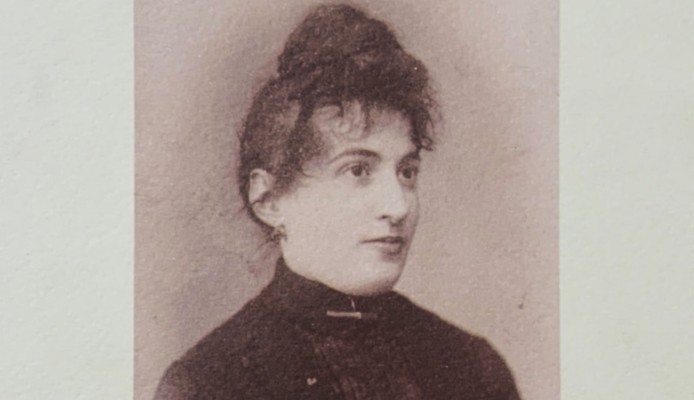
An interview with Argentina Altobelli, General Secretary of the Land Workers’ Federation, on the history of peasant organizing in Italy and the consequences on the union of the rise of Fascism.
‘Argentina Altobelli, a Woman Leader of 700,000 Workers’ by Marion Lucas from Justice (I.L.G.W.U.). Vol. 3 No. 19. May 6, 1921.
Rome, April 5, 1921
During sixteen years of twenty years’ existence as a labor organization, the Federasione Nasionale del Lavoratori della Terra d’Italia (Agricultural Workers’ Union of Italy) which today numbers 700,000 members, has unanimously retained as general secretary Signora Argentina Altobelli. A woman directs the negotiations of one of the largest and most militant labor organizations of Italy.
Signora Altobelli is a forceful, elderly woman, whose vigorous manner of speaking gives the impression of tremendous reserve energy. I interviewed her in French, which she speaks well, in the branch office recently established by the organization in the headquarters of the General Confederation of Labor, in Rome. The main office of the Union of Agricultural Workers is located at Bologna, as it has been for 16 years. Rugged Italian strength typifies this remarkable leader of the agricultural workers. She seems to have something of the vitality of the worker of the earth, the peasant, in spite of the fact that she has been, since the age of 18, an organiser and executive. She was one of the first women of Italy to work for the admission of women to the Socialist Party. Capable of tremendous concentration, she is energetic, quick of motion, articulate and graceful in gesture.
“I have to have the energy of a man!” she exclaimed, as one of the many important visitors who interrupted our interview claimed her attention.
“She is better than a man,” commented an official of the General Confederation of Labor, who accompanied the visitor.
“My hair was black when I first began work with the organization,” said Signora Altobelli, running a hand rapidly through her hair. “It has grown gray with service. I am impassioned with love for the workers of the earth. I love all peasants. They have their faults, which I, perhaps more than any other person, know. But I accept them as they are, and I love them. I love them and I love the earth they work. Whatever little ability I have, I want to give entirely to them. I do not want to spare my energy. It is all theirs.
“I was born in Imola, in the district of Romagna. At the age of 18, I became a Socialist organiser. I have always worked with the workers, and it is quite natural that, when the agrarian movement began to be organized, I should have been called upon to help in the work of that association. During my work with the organization I was married, had children, and lived the ordinary woman’s life. Nothing in my personal life, however, has ever interfered with my work.
“The agrarian movement in Italy began at Mantua in 1884, when the misery and sickness of the peasants caused the first strike. After the beginning in Mantua, a large cooperative movement spread over the country, even reaching Sicily. In 1894, the reactionary government succeeded in stifling all economic movements for a long period of time.
“The movement went through various stages, sometimes diminishing, sometimes growing, until 1893, when a tremendous growth was caused by the high cost of bread. This growth in 1898 followed a period of reaction and was partially, perhaps, the effect of Socialist propaganda. In the beginning of 1900 the first combative organization of the workers of the earth was formed. This organization was called the Leghe di Miglioramento, the League for Improvement. This League began and grew especially in the regions of Emilia, Lombardia and Veneto, and later formed the nucleus of the present federation.
“The first congress of the agricultural workers of Italy was an historical event because it was the first gathering of the proletariat of Italy where they met, to the surprise of the bourgeoisie, for the purpose of extending an organized movement of workers. At this congress, under the chairmanship of Andrea Costa, 704 leagues were represented, with a Combined membership of 152,022 workers from practically all districts of Italy. At this congress were discussed all the most important problems of the agricultural workers, like Internal emigration, tariff, workers’ contracts and agrarian legislation.
“The discussion rapidly led to “Socialization of the land, and the vote in favor of this raised a protest from the Republican Leagues, exclusively from the colonies, which were alienated from the national federation because of this.
“The congress ended triumphantly with the establishment of the Federazione Nazionale del Lavoratori Della d’Italia. This begins the story of the organized movement. Carlo Vesrani, who had been one of the first organizers at Mantua, was elected secretary.
“From its beginning, the federation wished to have an explicit class character, with its members from the real proletariat. It represented the interests of the agricultural proletariat in the legislative assembly, promoted the formation of further locals, and carried on written and oral propaganda. The executive power of the federation lies in the congress, the national council, the federal commission, the secretary and the referendum.
“From the moment when the constitution of the Federation was writ ten, the organization began its struggle to elevate the miserable conditions of the workers in the fields, to raise the starvation wages which they received (1.50 lire a day for men and 60 centimes for women) and to diminish the burden of long hours (about 14 hours a day).
“In 1905, the secretary died. In April, 1905, I was appointed secretary in his place. In 1906, the general headquarters of the Federation were established in Bologna, where they are today.
“The most important technical questions have been discussed by the National Counell and at the congress of the organization. The first congress took place on November 24 and 25, 1901, in Bologna. At the second congress, which took place on April 7-8, 1906, we had lost some of our members and therefore had a membership of only 17,500. Our third congress, which was held in Reggio in March, 1908, witnessed a gain in membership as 136,067 workers were represented there. In 1911, we had risen to 200,000 when we held our congress at Bologna in March. Four hundred thousand members were represented at the congress held in June, 1919, at Bologna.
“In 1920, we had attained the enormous number of 800,000 members. That is the greatest number of workers that have ever belonged to the federation. We hoped to gain enough more members in 1921 to make a round million. Unfortunately political events have made us lose instead of gaining.
“The continued attacks of the fascisti on the institutions of the workers have frightened the agricultural workers as well as the Socialists and Communists. The fascisti never attack the agricultural workers directly. They attack, instead, the deputies elected by the workers, the Chambers of Labor and the meeting places of the people. They have burned thirty Chambers of Labor in Italy during the last year.
“We expect that, by the end of 1921, we will have a membership of only 700,000. That is a drop of 100,000 workers and is due greatly to the attacks of the fascisti.
“We are still a militant organization, however, and we expect that the present strike of workers in Rovigo will be followed by other combats with the employers. Most of our contracts with employers terminate in December or in February. That means that there will be more fights in the fall.
“The employers are seeking to replace the present system of employment exchanges, established by the Federation, by private agencies. Where private agencies are established, the employers give the preference to fascisti. The workers have a tremendous battle before them, but the great majority have remained firm, even in the face of the intimidation by the fascisti. We are not afraid of the approaching storm.”
The weekly newspaper of the International Ladies Garment Workers Union, Justice began in 1909 would sometimes be published in Yiddish, Spanish, Italian, and English, ran until 1995. As one of the most important unions in U.S. labor history, the paper is important. But as the I.L.G.W.U. also had a large left wing membership, and sometimes leadership, with nearly all the Socialist and Communist formations represented, the newspaper, especially in its earlier years, is also an important left paper with editors often coming straight from the ranks radical organizations. Given that the union had a large female membership, and was multi-lingual and multi-racial, the paper also addressed concerns not often raised in other parts of the labor movement, particularly in the American Federation of Labor.
PDF of full issue: https://www.marxists.org/history/usa/pubs/justice/1921/v03n19-may-06-1921-justice.pdf
 Revolution's Newsstand