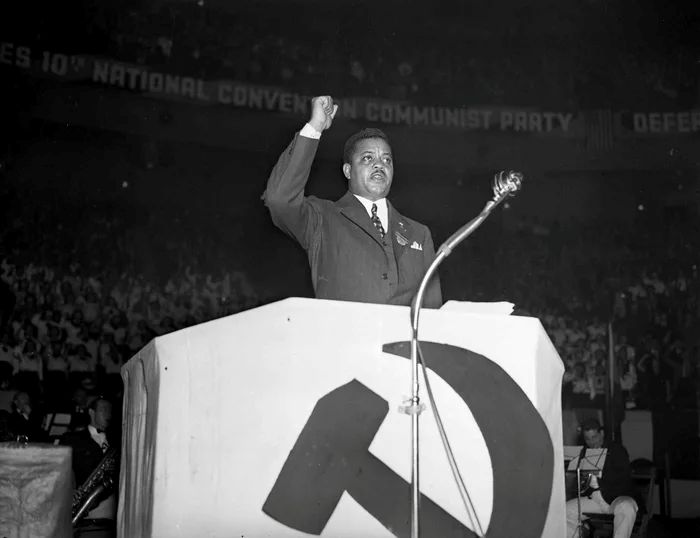
Ford on developments in South Africa’s workers’ movement as a direct challenge to Clements Kadalie’s Industrial and Commercial Workers’ Union (ICU) is launched.
‘The Affiliation of Non-European Trade Unions of South Africa to the R.I.L.U.’ by James W. Ford from The Negro Worker. Vol. 2 No. 1. January-February, 1929.
The Workers (White and Black) on the Offensive Against Capitalist and Imperialist Exploitation.
In the latter part of January, the Federation of Non-European Trade Unions of South Africa made application for affiliation to the Red International of Labor Unions, which was accepted by the Executive Bureau in regular meeting of February 14, 1929. The Federation is composed of the following unions:
Name–Membership
Native Laundry Workers—900
Transport Workers—300
Clothing Workers—400
Food and Drink Workers—100
Mattress and Furniture Workers–600
Motor and Mechanic Workers—200
Native Baker Workers—300
Meat and Cold Storage Work–314
Cotton and Rope Workers—98
Steel and Engineering Work–200
Dairy Workers–200
These unions have been organised since the beginning of 1928. New unions are in the process of organisation, especially in the basic industries, which will eventually affiliate with the Federation.
According to reports from South Africa, the I.C.U., a semi-trade union organisation, is falling off in numbers and influence, because of its failure to fight for the economic demands of the workers and to lead them in militant struggle. The reformist leadership of the I.C.U. recently invited the assistance of Ballinger of the Independent Labor Party of England.
The Unions of the Federation have led many militant strikes; they have successfully negotiated for the elimination of the color-bar in some of the white unions and held joint meetings of black and white workers Recently there was an amalgamation of the native and European Laundry Workers’ Union, solely through the efforts of the Federation. Native unions have, in most industries, 100% membership. The leaders of the I.C.U., seeing that they are losing ground, are beginning splitting tactics by organising native unions in the same industry.
The affiliation of the Federation of Non-European Trade Unions of South Africa to the Red International of Labor Unions is of significance not only to the proletariat of South Africa white and black, but to the international labor movement as a whole. Recently we saw a general strike wave sweeping Europe. It was the struggle of the European workers against the effects of capitalist rationalisation. We now witness a wave of strikes in South Africa and particularly in Rhodesia. On the top of this comes the news of the native uprising in Equatorial Africa.
South Africa is slowly rising from the position of a supplier of raw materials (mainly to the British Empire), to that of a competitor on the world market, in coal, iron and steel. The recent industrial developments are quite significant–the completion of the big steel mill at Pretoria, the large exportation of coal, a part of which passes through the Port of Delagoa Bay, the Government decision to proceed with the erection of diamond-cutting works in South Africa, which threatens the diamond-cutting industry in Europe. Politically, the South African Government is struggling for formal independence. These events point to the general tendency of South Africa to “strike out for itself”. Very notable in this respect are the negotiations between the Steel and Iron Corporation (formed with the object of carrying into effect the South African Government Scheme of developing the metal industry in South Africa) and the German Firm “Gute-Hoffnungshuette” as to cooperation in the general scheme. This has caused alarm in leading quarters of British Imperialism. Of course, Britain still holds away over South Africa. However, the struggle between Great Britain and the South African Government undermines British Imperialism and influences the workers accordingly.
The Position of Native Workers
Wages of native workers are from one to two shillings per day lower than the requirements for the bare necessities of life, and out of this miserable pittance rents and taxes are to be met. In spite of the shortage of native farm labor, hut-taxes and deplorable conditions in the farming districts are driving the peasants into the industrial and urban centers, making the competition in the labor market keener, producing unemployment, especially among the white workers. Pass-laws and repressions of all sort are instituted against the native workers. The bourgeoisie is hindering the organisation of the native workers, and is hindering especial the advent of militant organisation. The bourgeoisie finds helpers among native labor leaders of the type of Kadalie, who together with their white reformist friends, as for instance Ballinger of the Independent Labor Party of England, are doing their utmost to make the native trade union movement as harmless as possible for the capitalists.
Position of White Workers
The color-bar designed to protect the white workers and to assure them “most favourable positions” has proved of no avail. White workers are being forced out of work and replaced by low paid natives. In many cases native workers are employed contrary to the provisions of the Color-Bar Act There were 53,000 applications for work at the Labor Exchange by white workers in 1926, out of which only 7,936 were supplied with work; the white workers are also being forced to accept work in many lines, jobs formerly considered fit only for native workers, particularly is this true in some cases on the railroads.
Change in Attitude of the Workers–Class Struggle
The conditions of the “poor whites” of South Africa is deplorable. Native workers are invading the skilled trades, thus threatening the position of the “most favoured white workers”. The white workers are beginning to understand that only hand in hand with the native workers can they fight the employers for a better living. Significant was the relatively large vote recently cast in the Johannesburg Trades Council in favour of opening their unions to native workers.
This is the situation which gave rise to the formation of the Federation of Native Trade Unions and its affiliation to the RILU. Our comrades from the Federation write:
“These unions have already been baptized in the capitalist fire. The laundry workers have won six strikes, lost one; furniture workers won two strikes, clothing workers won one and lost one, drivers won one strike. Previously native strikes in South Africa were unknown with perhaps one exception”.
Lowering of Color-Bars
This shows that the workers are on the offensive. Most of these strikes have been wage-strikes. We have here a clash of class interests. Another quotation from our comrades reads:
“The existing parallel white unions have more or less broken, consciously broken the color-bar; meetings between black and white workers in the laundry, furniture and clothing industries are a very common occurrence. Unfortunately, there are no white drivers’ union, or food and drink workers’ union, or we might come to some agreements. Negotiations are going on between the white miners’ union and the colored mine workers’ union.”
This is also is symptomatic and shows that economic conditions are breaking down the antagonisms of color, that in South Africa the white and black workers are beginning to unite upon the basis of the class struggle. In the course of 1928 we saw for the first time in the history of South Africa joint strikes of black and white workers, we saw black workers coming to the support of strikes of white workers and vice-versa. This new tendency towards Unity is undeniable. It even compelled the so-called “Left” laborists to make some radical gestures. Thus, Medley, Labor member of the Government and Minister of Posts, received a deputation of native workers, and the Johannesburg Trades Council where there was quite a large vote in favour of admission of Negro workers in the unions. However, in the unity and the joint strikes of white and black workers we have the real thing, the recognition of the class struggle. What we are witnessing here on this far-flung sector of the international labor front, is the beginning of an offensive against the intolerable conditions prevailing in South Africa.
Political Situation
The situation in South Africa for the militant workers has its political side and its political significance. A bitter struggle is going on now preliminarily to the forthcoming elections, and however much the question of the natives is thrust into the background or whatever little underhand political tricks are made to confuse the issue, the BIG political issue, THE QUESTION OF THE NATIVES, faces the whole working class of South Africa. Hertzog declares for an “All-White South African Government”. The strikes of the workers in South Africa cannot remain purely economic struggles, they become unavoidably political ones; there are clashes with the police, with the courts and with the Government. The big question of Native Labor is the biggest political issue. The Labor Party is at one with the capitalists and against native labor, which is deprived of all political rights in South Africa
Decisions of the Fourth Congress of the RILU
The Sixth World Congress of the Communist International has advanced the slogan of a Workers’ and Peasants’ Government, which as applied to South African conditions means: “a Native Republic”, a “Black Republic”, since the great bulk of the South African’s proletariat is black, with safeguards and protection for all sections of the working population. The provocative abuse in the capitalist press, not only in South Africa but throughout England, and even in the petty-bourgeois Negro press of America, further demonstrates the soundness of this slogan. The question of labor in South Africa is not only a question of industrial labor but also of agricultural labor closely connected with the agrarian situation.
The Fourth Congress of the RILU summed up the situation in South Africa in the following resolution: “The central problem of the trade union movement in South Africa is that of COLORED LABOR and the relations which exist between the organisations of the white workers and those of the colored workers, the latter constituting the great majority of the South African proletariat.
“The antagonism and hostility between white and colored workers are advantageous only to the capitalists and are being fostered by them in every way. Beginning with 1922 (the strike lost by the white trade unions) the condition of the white workers is getting continually worse, in consequence of the attraction of ever-larger numbers of cheap SKILLED colored workers to the mining enterprises. There is only one way out of the situation, the single organisation of the white and colored workers, the united front of the whole of the South African proletariat against Capital”.
Subsequent events have proved the correctness and the soundness of this resolution. We see the rise in South Africa of militant trade unions, their successful efforts at unity, and their appeal for affiliation to the RILU. The reformists are for class collaboration, against the class struggle. However, the reformists are fast losing ground in South Africa, the workers are deserting the reformists and are going over to those who lead a militant struggle. Here too, on the question of reformism, the Fourth Congress of the RILU pointed out that the reformists were agents of the bosses, that the workers would have to repudiate their leadership and fight them as they fight Capital. In South Africa the workers struggle against their Ballingers, as elsewhere they struggle against their Thomases. There is the greatest need too for the native to fight Kadalie and his group who by their affiliating the I.C.U. to the Amsterdam International have betrayed the workers and led them into the camp of the capitalists and imperialists. The Fourth Congress in its resolution on the Amsterdam International says:
“In the last few years the Amsterdam International and the International Industrial Secretariat, led by the former, have particularly shown their dependence on the international bourgeoisie.
“The colonial policy of the Amsterdam International betrays the interests of the workers of the imperialist countries and colonies alike. Instead of aiding the movement of the colonial workers and endeavouring to raise their living standards–in which are also vitally interested the bulk of the workers in the imperialist countries–the Amsterdam International and the leaders of its important sections are either holding aloof when it suits them, or they try to take the labor movement under their wing in order to render it harmless from the standpoint of the interests of imperialism…
“Quite clearly the role of Amsterdam is that of a tool of imperialist capital in its struggle against the national-revolutionary and labor movement in the colonies and semi-colonies.”
Indications as to the loss of influence of the reformist leadership of Kadalie is shown by the loss of support in the ICU and also by the fact that large sections of the workers of the ICU are coming into the new Federation. Ballinger has been brought to South Africa to save the semi-trade union ICU from further disintegration. Kadalie is making frantic efforts to regain his lost prestige. The workers find the money-changers fighting over the spoils of office, the main fight being between Champion, who is in leadership of the Natal Branch, and Kadalie. So the reformists are on their last leg and the workers must give them the final kick.
The Tasks of the New Federation of Trade Unions
The most important task of the Federation is to bring the great mass of native workers into their organisation. Only with the mass organisation of the native workers can there be an effective and successful struggle against Capital. This organisation must become the vanguard for revolutionary struggle in South Africa. The mass organisation of the native workers can beat down the oppressive measures of the Government and the Bourgeoisie.
At the same time the Federation must struggle more and more for the unity of the trade union movement upon the basis of the class struggle, it must more and more bring about the consolidation of native and white organisations, and the native and white workers. This is a basic task. The many tendencies towards joint meetings and joint strikes of the white and black workers show the feasibility and possibility of this unity. The Federation must achieve the bringing together of all the workers of South Africa, white and black. There must be one and only one Federation of Workers of South Africa.
Unity of Black and White Workers
The reformists pretend and are seemingly defending the standards of the white workers by opposing the black workers; they refuse to bring the black workers into the organisations of the white workers, pretending all the time, that they are securing the position of the white workers, defending the lowering of the standards of the white workers against the competition of the black workers. But what is actually taking place is precisely the opposite. The bosses are freely using the black workers against the white workers, thus the tactics of the reformists play into the hands of the capitalists against the interests of the white and black workers,
The main object of the black workers is to overcome this. They mean still further to struggle, not alone to achieve equal wages and conditions but to raise the general standards of all the workers above the prevailing standards, fighting continually for higher wages and better conditions. It is quite clear that black workers must struggle to raise the position of the whole proletariat to struggle jointly in strikes, etc., for this objective. But without common struggle of the black and white workers, this cannot be realised. Thus, the black workers, whose interests are insolubly bound together, must struggle to achieve and raise the standard of wages and of working conditions of the whole proletariat. This is the basic task of the working class of South Africa.
The Federation must strengthen its present affiliated unions and penetrate more and more into the basic and principal industries, particularly mining. It must extend its operations into the countryside and organise the agricultural workers and peasants, bringing them into close unity for a united struggle of workers and peasants against Capital.
A merciless struggle must be carried on against reformism and the reformist bureaucrats. Kadalie-ism must be swept out of South Africa; Ballinger must also be swept away. No trace of reformism must be left. The whole reformist tactics must be explained to the workers, the role of the Amsterdam International, of collaboration and betrayal must be pointed out to the broad working masses. The connection between Amsterdam and every bourgeois State must be pointed out, the role they are playing at the present moment in bringing Kadalie to Europe to receive his instructions from the British bourgeoisie. The Federation must point out to the workers the relationship between Thomas’ trip to China and the East, and Ballinger’s into South Africa. Despite the fact that large numbers of workers are coming over from the ICU into the Federation, it must do all in its power to win over the remaining members individually and collectively by explaining to them the real role of the leaders of the ICU, and giving them a militant lead. There is no fight with the members of the ICU, the Federation has a militant and correct Programme of Action for them.
A Programme
The basis of the struggle in South Africa is the day to day on struggles against the repressive and oppressive measures of Capital, therefore some of the basic day to day tasks and demands must be the following:
1. EQUAL PAY FOR EQUAL WORK: Negro workers as a rule are working at lower wages than white workers. In South Africa the wages of native workers are from 4 to 5 times lower than the wages of European workers in most fields of work; in order to raise the standards of living and subsistence of Negro workers it is necessary to struggle for equal pay for equal work, regardless of race, color or sex. At the same time the Negro workers together with all other workers must wage a common fight for higher wages, raising the general standard of living of all the workers
2. AN EIGHT-HOUR DAY: One of the main tasks of the Negro workers should be to obtain an 8-hour day and ultimately together with the rest of thr working class a 7 and a 6-hour day.
3. FORCED LABOR: In South Africa forced labor takes the form of contract labor, natives being conscripted and recruited in Mozambique (Portuguese East Africa) and transported long distances to work in the mines of South Africa, where they live in compounds and cattle pens. This system is legallised through the so-called “Mozambique Treaty”, which exists between Portugal and the South African Government.
4. WORKERS’ LEGISLATION (INSURANCE, ETC.): As one of the means of raising the living standard of the workers we must demand the adoption and enforcement of insurance laws that provide for the care, at the expense of the employers, of all workers in case of unemployment, accidents, sickness and also the paying of old age pensions and death benefits.
5. CLASS COLLABORATION: We must wage a militant fight against Government coercion, compulsory arbitration, company unions; against all reformist class collaboration.
6. RACIAL BARRIERS IN THE TRADE UNIONS: We must conduct a relentless fight against racial bars in some of the existing white unions, and for the opening of the unions to all workers regardless of race and color, as well as against the division of unions on national, racial and religious lines.
7. AGAINST WHITE TERRORISM:
We must carry on a resolute fight against terrorism in all its forms–against lynchings, police and soldier terrorism, against the assassination of trade union leaders and social workers, against their arrest and deportation.
8. HOUSING AND SOCIAL CONDITIONS: We must demand that adequate attention be paid to the protection of the health and well-being of the Negro workers and their families and that proper houses and social surroundings be provided for.
9. COLOR-BARS: All “Color-Bars” and caste systems, which split the ranks of the workers must be abolished.
10. AGAINST LAND CONFISCATION, POLL AND HUT TAXES: A special problem is the land question and particularly the agrarian policy of the South African Government. We must therefore fight against confiscation of native land and for the restitution of all land confiscated in the past to the native communities, as well as for the abolition of all special taxes and laws which result in the driving of the peasants from the land.
11. CIVIL RIGHTS: A basic task for agitational and organisational activities necessary in our main struggle against imperialism, is to achieve elementary civil rights, universal suffrage, freedom of speech, freedom of workers’ press, the abolition of all racial discriminations, abolition of “Pass-Laws”, and of all other laws and regulations depriving the Negro worker of his rights.
12. SELF-DETERMINATION OF NEGROES: In South Africa the trade unions must become the leading elements and transform the economic struggles into political struggles, into the struggle for political power and self-determination.
With this Programme and a relentless struggle to realise it the Federation will grow from strength to strength and will be able to lead the working masses of South Africa victoriously against the forces of Capitalism and Imperialism.
First called The International Negro Workers’ Review and published in 1928, it was renamed The Negro Worker in 1931. Sponsored by the International Trade Union Committee of Negro Workers (ITUCNW), a part of the Red International of Labor Unions and of the Communist International, its first editor was American Communist James W. Ford and included writers from Africa, the Caribbean, North America, Europe, and South America. Later, Trinidadian George Padmore was editor until his expulsion from the Party in 1934. The Negro Worker ceased publication in 1938. The journal is an important record of Black and Pan-African thought and debate from the 1930s. American writers Claude McKay, Harry Haywood, Langston Hughes, and others contributed.
PDF of full issue: https://www.marxists.org/history/international/comintern/negro-worker/files/1929-v2n1-jan-feb.pdf
 Revolution's Newsstand