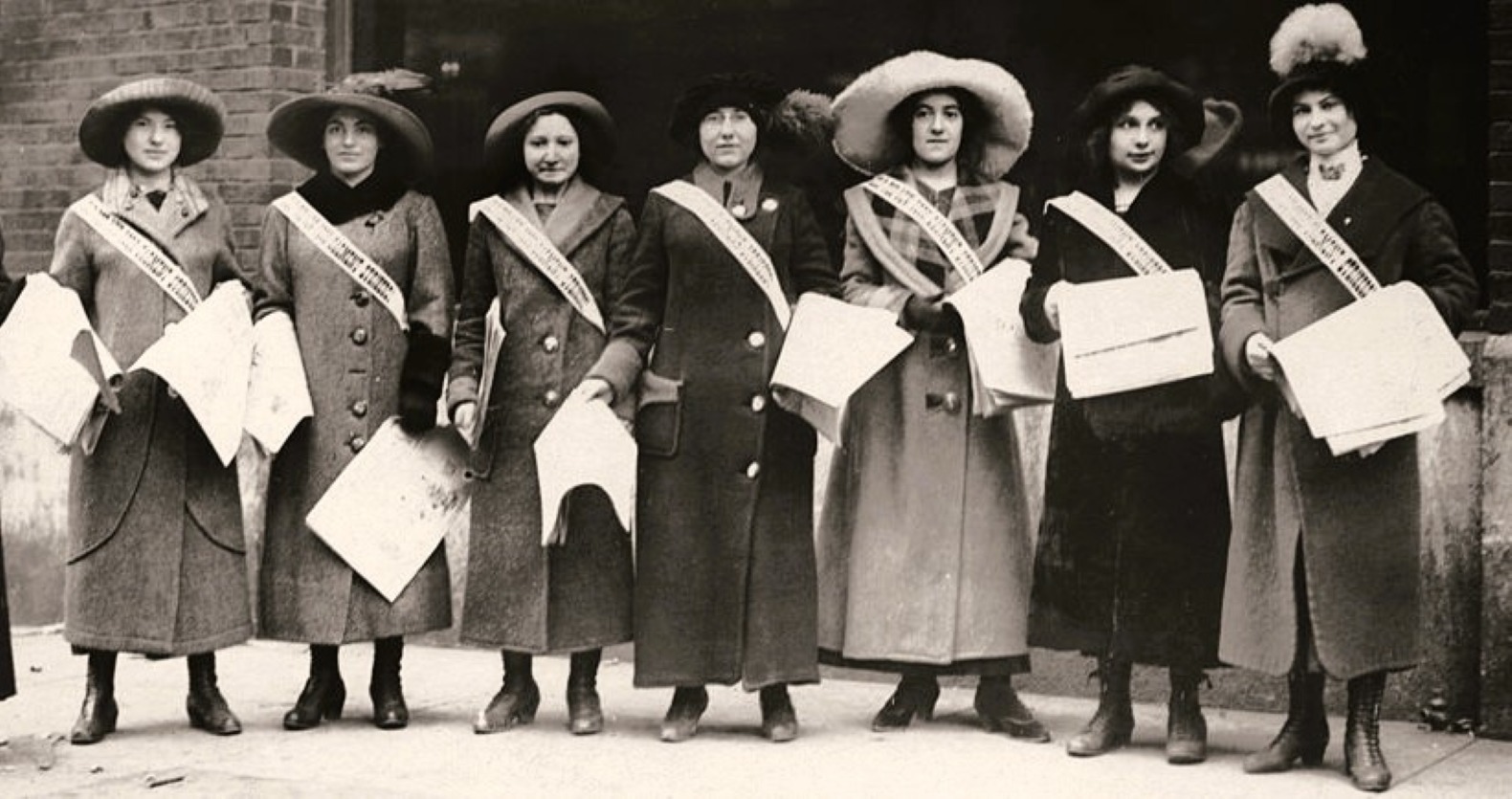
Almost no union movement was as divided by craft specialty, down to each type of clothing being made, than the textile industry. In the 1920s, the two largest federations were the Amalgamated Clothing Workers and the International Ladies Garment Workers, with others being the International Fur Workers’ Union, the United Garment Workers Union, the Journeymen Tailors’ Union, and the United Cloth Hat and Cap Makers along with dozens of local unions and masses of workers, the majority, unorganized. Not a better comrade to navigate the divisions than Marxist economist and labor activist Jacob M. Budish. Born near Kiev in 1886 where he began his economic studies, Budish emigrated to the U.S. in 1912. Continuing his education at the University of Chicago and later Columbia, Budish became involved in the Yiddish-speaking workers’ movement, particularly the Cloth Hat, Cap and Millinery Workers International Union, for which he was editor of The Headgear Worker between 1916 and 1930. In the 1920s and 30s he was was also involved in Brookwood Labor College and the Committee for Progressive Labor Action, as well as a founder of Ambijan, and organization in support the Biro-Bidjan, the former autonomous Jewish Soviet region, and author of a number of books on labor and the Soviet economy.
‘Amalgamation in the Needle Trades’ by J.M. Budish from Labor Age. Vol. 12 No. 7. August, 1923.
Moves Toward Closer Union, Step by Step
THE case for a closer combination among the needle trades workers was first officially stated by the United Cloth Hat and Cap Makers at their convention in May, 1919.
Their resolution gums up this case in the following terms:
“All the needle trades have many problems in common. They all suffer to a great extent from the periodical dull seasons, from the system of contracting and sub-contracting, and they are all more or less subject to the whims of fashion. They are also all immediately affected by every change in the purchasing power of the big masses of the people.
“The processes of production in the different needle trades are to a large degree similar, so that workers can easily pass from one trade to another. The seasonal character of the industry and the overlapping of the busy seasons of the different trades create a class of migratory workers who pass from one trade to another, being attached to none and creating in each difficulties for the respective organization.
“The similarity of conditions, of the processes of production, of machinery and materials, brought about a close cooperation among the employers of the various needle industries…It is now an established fact that in our struggle for the betterment of our conditions we are facing not merely the employers of our own trade but must also reckon with the combined assistance they receive from the employers of all other needle industries.”
Because of these conditions, the resolution calls for an effective combination among the various needle trades organizations “for the defense of their common rights, for the promotion of their common interests, for the solution of their common problems and for their mutual support against the combined employing interests.”
The convention of the International Ladies’ Garment Workers’ Union held a year later, in May, 1920, went a step farther. It declared that “the interests of all the workers in the needle trades industries in the United States and Canada are similar and identical, and it will be possible to carry on much more efficient organization work if it will be united into one central body.”
In 1920
This action arose out of the grave conditions which the needle trades were then facing. The war had come and gone. “Prosperity” had come and gone with it. Each one of the unions was confronted with the enormous task of checking the attacks of the employers. They had to meet the repeated attempts to cut wages. They had to take up the problem of organizing the new and growing non-union centers. In 1920 it was already evident that this gigantic job would demand the united strength of all the organized workers in the needle trades. A spirit of cooperation has always prevailed among their unions. But it was now felt that this cooperation must be made fully effective. The way to do that was to set up efficient machinery. It was generally agreed that this could be brought about only by uniting all of the existing unions into one central body—”for offensive and defensive purposes.”
The Ladies’ Garment Workers took quick action on the decision of their convention. They called a conference of all the needle trade organizations, “without regard to their affiliation.” The meeting took place at the Hotel McAlpin, New York City, on December 9-11, 1920. The United Garment Workers of America declined to take part. They stated that they could not meet with unions not affiliated with the American Federation of Labor. All the other organizations of the needle trades—the Amalgamated Clothing Workers of America, the International Fur Workers’ Union, the International Ladies’ Garment Workers’ Union, the Journeymen Tailors’ Union and the United Cloth Hat and Cap Makers—were represented.
A serious cleavage appeared at the conference on the question of Federation vs. Amalgamation. The International Ladies’ Garment Workers, supported by the Furriers, favored a federation of all the international unions present. The various internationals, under this plan, would preserve their full autonomy as before and should not be interfered with in their internal affairs in any way. The Amalgamated Clothing Workers, supported by the Journeymen Tailors’ Union, came out squarely for the amalgamation of all these organizations into a single international union. This union would work on the department plan, the “departments” to take in such branches of the trade as could be classified in one department. Each department would have a certain degree of self-government. The United Cloth Hat and Cap Makers made an effort to reconcile these two points of view. It tried to find a basis on which the conference could get together on a program of action.
Hillman and Sigman
It is worth while to dwell a moment on the reasons behind this division of opinion. President Sidney Hillman of the Amalgamated, in insisting upon amalgamation, protested: “We are confronting a general attack upon the workers of the clothing trades…I am for exercising or putting the organization in a condition where it may yield its utmost power. I do not believe we are justified in losing one ounce of power if we can help it…I would not like to see that if something happens in the needle trades which might materially weaken—the labor movement that any of us should feel we have not used all the power at our disposal. What is our actual power? Moral and financial—the first even more than the second…As I said, I am more worried about the morale. We will try to get the most money but of that we cannot get more than we really can. The big thing today is to get the morale…In my judgment, if it should be brought to them (the membership) that all these trades have actually combined into one organization, our people would get the conviction that we cannot be beaten.”
Vice-president (now President) Sigman of the International Ladies’ Garment Workers spoke in favor of federation. He laid stress upon the conviction that if it would be possible to accept amalgamation “the moral effect as well as the financial effect would be the identical one as if you organized the alliance on the form and basis” of a federation.
“You cannot expect, even if you would adopt the plan of amalgamation, to really effect or enforce or create the effective organization that would be possible if it had been in existence for the last two, three or four years. The only thing we really can do at this present time is probably to get busy with the reformation and reconstruction…As far as moral prestige is concerned, I absolutely do not see any advancement in the amalgamation plan. The inspiration, in my judgment, will be stronger if we form an alliance as we have suggested.” He further stated that the last convention of the International Ladies’ Garment Workers expressed itself in favor of federation. The organization was in any case bound by this action of the convention. “It is my impression,” he said, “that all of us here have the hope of having that form of organization as presented by Brothers Hillman and Sweeney effected in the American Labor Movement.” He put the accent on the American Labor Movement, emphasizing that his union “does not feel ready to withdraw and does not feel ready to create a condition that may make them to withdraw” from the American Federation of Labor. The implication was that amalgamation with non-American Federation of Labor unions might create a rather delicate situation for the organizations in the American Federation of Labor.
“Cannot Build Over-Night”
President Zaritsky of the United Cloth Hat and Cap Makers assumed “that all of us are in perfect accord with the principle of amalgamation…In fact, as I told the committee yesterday, I am for both reports. The question is only of practicability, of what can or cannot be done now. No organization is being formed over-night. Organizations have to be built.
“If the alliance is not to be an alliance merely on paper, it makes no material difference whether it is the alliance in conjunction with the component organizations that assists its members or whether it is the General Executive Board of the amalgamated body that does so. On the other hand, if it is a question of considering the interests of certain organizations in this group we must give them that consideration.”
The conference finally adopted the federation plan. For, as President Schlesinger of the I.L.G.W.U., put it, majority and minority votes cannot apply to such conferences. Decisions must be made by the consent of all unions participating. It was clear that unless the conference was ready to adjourn without taking any action (a result which all present were anxious to avoid) the minimum program had to be adopted. The conference agreed that the federation should be called the Needle Trades Workers’ Alliance of America. It was to be governed by an Executive Council, consisting of three representatives from every affiliated organization.
From every affiliated organization a per capita tax of one-half cent per month per member was to be paid, to keep the Alliance afloat.
With these mere “first steps” agreed upon, the conference adjourned. The frame-work of the constitution was left, to be worked out by a special committee. This adjournment without having adopted a definite constitution was unfortunate. It left the Alliance more or less “up in the clouds.” Even more so was the failure of the conference to appoint an executive officer, able to devote all his time to the newly launched venture. The officers chosen held high positions in their own unions. They had their hands full with the affairs of these unions. Almost immediately after the conference, all the needle trades became engaged in serious troubles. This tied the hands of the officials of the Alliance still more. They had neither the time nor the opportunity to push its affairs. The subject was permitted to drift into oblivion. No doubt this gave a serious set-back to the whole movement.
Reviving the Idea
But the idea was far from dead. Two years later an effort was made to revive it. The United Cloth Hat and Cap Makers took the first step this time. They sent a communication to the conventions of all the other needle trade unions, urging action. They pointed to the failure of the first conference as being due largely to the difficulties through which all the unions had been passing during the years 1920 to 1922. They asked for another conference, now “that the crisis is about passed.”
The conventions of the Ladies’ Garment Workers and the Amalgamated Clothing Workers “stuck to their guns” on their opinions of what should be done. The former declared for federation. The latter demanded amalgamation. But both gave power to their general boards to take part in the conference which the Cap Makers were urging.
This encouraged this latter body to continue the effort for united action. In December, 1922, it sent another suggestion to the boards of the unions taking part in the first conference. in order to avoid the mistakes of the previous meeting, it asked that the various unions come prepared to discuss the entire frame-work of the Alliance and the machinery for putting it into effect. For that purpose, the Cloth Hat and Cap Makers themselves submitted a draft of a constitution, based on the following principle:
“While refraining from interfering in the structure of the existing organization or in the practices that may have become rooted in the life of their respective trades, and which they may feel essential for the success of their work, it aims to give the Alliance enough cohesion and strength to enable it to promote the organization of all the needle workers and to become a really helpful and effective factor for the branches of the needle trades industry in which the separate international unions now function.”
A Needle Trades’ Constitution
The constitution provided for the holding of annual conventions. The representation was to be based on the membership of each organization. An Executive Council was suggested, to consist of some members elected by the convention and some to be appointed directly by every affiliated organization. It also provided for the establishment of Local Branches in all cities where there are two or more local unions belonging to two or more international unions affiliated to the Alliance. It finally provided for the appointment of a paid executive secretary, to devote all his time to the business of the Alliance.
This suggestion, so far as a new conference went, was acted upon favorably by all the organizations. With these replies at hand, the Cloth Hat and Cap Makers sent invitations to all the unions, asking them to meet on March 30 of this year. Again union affairs stepped in to prevent action. Some of the organizations became wrapped up in negotiations with their employers. This caused postponement. Then, the convention of the Cloth Hat and Cap Makers themselves led to a further wait. Now it appears that the meeting will finally be held sometime in September.
There can hardly be a better time for a serious effort to carry out this experiment than the present. There is a lull in practically all the trades. While conditions are not at their best, a period of comparative quiet is more or less assured. This period of peace may not last very long. It certainly should be taken advantage of for the great task of building up an effective combination of all the needle trades workers. It is a task which cannot be accomplished by the mere working out of a fine scheme of organization. Such a combination can be made worth while only by actually being put into practice.
Action for unity, in a clear-cut way, is now in order.
Labor Age was a left-labor monthly magazine with origins in Socialist Review, journal of the Intercollegiate Socialist Society. Published by the Labor Publication Society from 1921-1933 aligned with the League for Industrial Democracy of left-wing trade unionists across industries. During 1929-33 the magazine was affiliated with the Conference for Progressive Labor Action (CPLA) led by A. J. Muste. James Maurer, Harry W. Laidler, and Louis Budenz were also writers. The orientation of the magazine was industrial unionism, planning, nationalization, and was illustrated with photos and cartoons. With its stress on worker education, social unionism and rank and file activism, it is one of the essential journals of the radical US labor socialist movement of its time.
PDF of full issue: https://www.marxists.org/history/usa/pubs/laborage/v12n07-aug-1923-LA.pdf
 Revolution's Newsstand