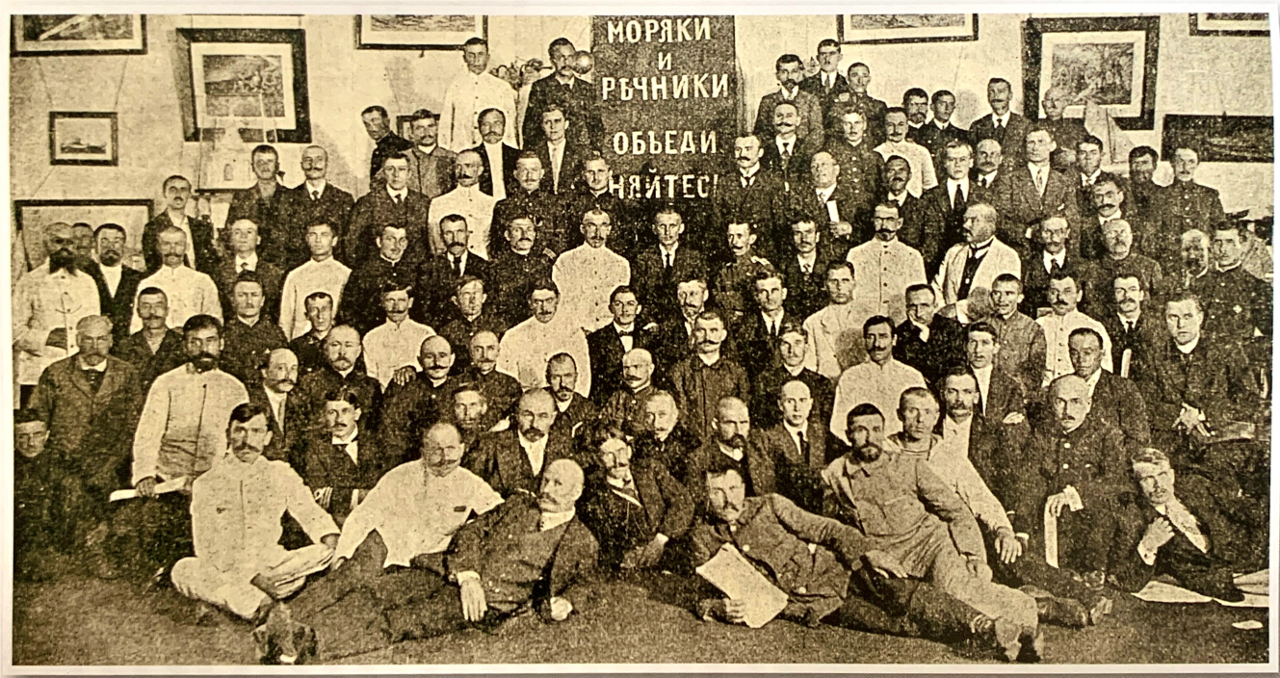
How the proletarian dictatorship was exercised aboard Soviet ships.
‘Ship Committees on Soviet Vessels’ by J. Canty from The Daily Worker. Vol. 4 No. 38. February 26, 1927.
THE tasks of the ship committees, as the primary organizations of the union on board the ships, are determined both by the statutes of the Water Workers’ Union of USSR and by the general tasks with which the working class of the Soviet Union became confronted ever since the overthrow of the bourgeoisie and the establishment of the proletarian dictatorship.
The fundamental and immediate task of the ship committee is the protection of the economic interests of the ship’s crew and of their working conditions, as well as the satisfaction of their cultural needs.
For these purposes the ship committee:
1. Looks after the faithful observance of the collective agreement and of the wage agreements, both on the part of the administration and crew of the ship;
2. Looks after the proper hiring and discharging of crews on the basis of the collective agreement signed between the parties;
3. Sees to the timely payment of wages, to the observation of all the rules concerning labor protection and social insurance on the part of the administration, takes care of improving working and living conditions aboard ship, looks after the quality of the crew’s food, and also co-operates with the labor inspectors in their work, and
4. Carries on cultural and educational activity among the crew, assists in the illiteracy campaign, by arranging during leisure hours: talks, readings, courses, lectures, etc., looks after the activity and content of the ship’s wall-newspaper, and takes charge of the ship’s library.
In the domain of professional organization, the task of the ship committee is: to get the workers on board the ship to join the union; to develop the revolutionary class consciousness among the members of the crew; to make propaganda for organizational proletarian discipline: to represent the members of the crew before the various organizations and institutions, including the organs dealing with any conflicts arising between members of the union and the administration.
Furthermore, on ships owned by the Soviet government it is also one of the tasks of the ship committee to encourage in every way the profitable running of the ship, to assist in promoting efficiency and labor discipline.
The last task arises from the fact that the working class, during the period of the proletarian dictatorship, has for its important purpose to take part in the building of the socialist commonwealth, and in the first place, in the organization and improvement of the state industries and transports. In this connection the trade unions of the USSR, incidentally, furnish a school for the management of socialized industries.
Of course, this last task does not in any way concern the ship committees on board ships owned by private people or by concessionaires. Aboard such ships the only task of the ship committee is to look after the economic interests of the members of the union and to take charge of cultural and general educational work.
Thus, the ship committees, although only constituting the primary organs of the union, are charged with very responsible, complex and varied tasks and functions. Of particular importance becomes the activity of the ship committees aboard oceanic vessels going out on long journeys, where the members of the crew are for many months detached from the direct influence of the leading organs of the union.
These tasks are not only recorded on paper, but in the overwhelming majority of cases are being carried into effect by the ship committees of the USSR, in which they are aided to a considerable extent by the labor legislation of the USSR–the world’s first proletarian state–which encourages in every way the consolidation and growth of the trade unions. A further contributing factor is furnished by the centralized industrial structure of the union which embraces 95% of all the workers employed on the water transport. On the water transport there is no other trade union organization besides the Water Transport Workers’ Union, and this ensures unity of action in protecting the economic interests of the members.
Organizational Structure of Ship Committees.
The ship committee is an elected body composed of from 3 to 5 members and 1-2 candidates, elected at general meetings of the ship’s crew.
Part is taken in these elections by all those working aboard ship who have the right of becoming members of the union, whether they are members or not. On the other hand, only members of the union may be elected on the ship committee, and not under 18 years of age.
The election meeting is considered valid if attended by not less than two-thirds of all the people employed aboard the ship. Those are considered elected who obtained an absolute majority of the votes, i.e. 51% or over, of all the votes recorded in the meeting. The election is carried out by means of personal and open voting. In this respect the principles of trade union democracy are fully applied.
The term of office for the ship committee aboard ships navigating throughout the year is for 6 months, and on board ships engaged in seasonal navigation, the term is for the duration of the period of navigation.
On a request being made by not less than one-third of the members of the crew, the question of re-election of the ship committee before the expiration of their time may be raised at a general meeting of the crew.
In order to audit the finances of the ship committee an auditing committee is elected at the same meeting of the crew in the same manner, composed of three members, and serving for the same period as the ship committee. The auditing committee examines the financial activity of the ship committee at least once a month, and furnishes its report both to the general ship’s meeting and to the leading organ of the union.
The ship committee chooses its officers, consisting of the chairman, secretary and treasurer.
In order to cope with its tasks, the ship committee may organize sub-committees for labor protection and educational activity, composed of 3 to 5 people each. Furthermore, on large sea vessels and dredges owned by the state, a production committee may also be organized, having for its purpose the discussion of problems relating to the best organization of work aboard ship, and so on. The members of this committee are chosen by the ship committee from among its members and from among the more active and efficient members of the crew. The production committee is an auxiliary organ of the ship committee working under its guidance.
The ship committee carries on its work during the time that they are free from their regular duties or board. For any additional work upon the ship committee, either all the members or those that are most charged with work, are getting a special compensation of from 8 to 22 roubles per month, according to the size of the crew.
The funds for the maintenance of the ship committee and for the conduct of cultural and educational activity are obtained from the ship’s administration in the shape of contributions of from 1% to 3% of the total wages paid to the crew, according to the terms stipulated in the collective agreement.
In 1926 the Water Workers’ Union of the USSR had 706 ship committees, which organized over 2,000 sub-committees and attracted about 8,000 people into active work in the union.
In the capitalist countries the living conditions of the seamen are different from those prevailing in the USSR. In those countries the trade unions: are hampered by the ship owners at every step in the conduct of their work. But the seamen must insist on the formation of ship committees aboard every ship. Only the ship committees will help them to become organized, only under the existence of the ship committees the seamen will be able to build up the organization in the proper way and on sound democratic principles.
On the other hand, none other than the ship committee can look after the faithful observance of the working agreements, the labor protection rules, etc., on the part of the administration.
The organization of ship committees aboard the Soviet ships should serve as an example for the seamen of all countries to emulate.
The Saturday Supplement, later changed to a Sunday Supplement, of the Daily Worker was a place for longer articles with debate, international focus, literature, and documents presented. The Daily Worker began in 1924 and was published in New York City by the Communist Party US and its predecessor organizations. Among the most long-lasting and important left publications in US history, it had a circulation of 35,000 at its peak. The Daily Worker came from The Ohio Socialist, published by the Left Wing-dominated Socialist Party of Ohio in Cleveland from 1917 to November 1919, when it became became The Toiler, paper of the Communist Labor Party. In December 1921 the above-ground Workers Party of America merged the Toiler with the paper Workers Council to found The Worker, which became The Daily Worker beginning January 13, 1924.
PDF of full issue: https://www.marxists.org/history/usa/pubs/dailyworker/1927/1927-ny/v04-n038-new-magazine-feb-26-1927-DW-LOC.pdf
 Revolution's Newsstand