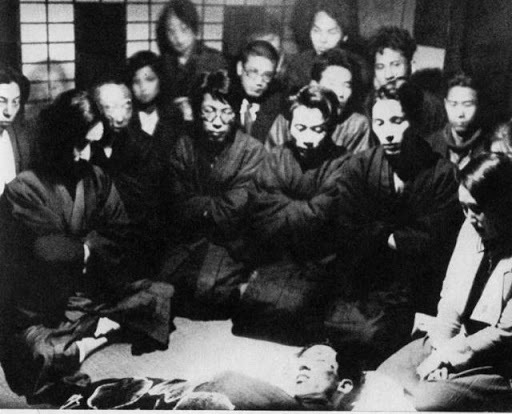
Author of the Crab Fishing Boat, Takiji Kobayashu, one of the leading voices of Japan’s proletarian literature movement, dies of ‘heart failure’ while in police custody.
‘The Murder of Takiji Kobayashi’ from International Literature. No. 2. 1933.
On February 20, 1933, comrade Takiji Kobayashi, one of the most talented revolutionary writers of Japan was murdered by the Tokyo police. His body was found in police headquarters one hour after his arrest. The cause of his death was given as “heart failure”—the same cause was given for the murder of comrade Iwata, member of the Central Committee of the Communist Party of Japan, four days after his arrest in October, 1932.
The murder of Kobayashi follows the arrest of more than 100 leading members of the Japanese revolutionary cultural movement since March, 1932 and is part of more than 6,000 arrests of revolutionary workers and intellectuals by the Fascist government of Japan during 1932.
Although Takiji Kobayashi is one of the outstanding Japanese authors he was only 29 years old at the time of his murder. His novel Crab Fishing Boat is internationally known, appearing in a number of languages. In a dramatized version it was a tremendous success in one of Tokyo’s leading theatres.
An even greater success was scored with a dramatization of his following novel The Absentee Landlord.
Despite government suppression 20,000 copies of the novel were sold within six months of publication.
When it was discovered that Kobayashi was the author of the book he was discharged from his work as a bank-clerk at the Hokkaido Colonial Bank in which he had worked since graduating from high school in 1924,
This was in 1930. He then came to Tokyo and three months later was in prison.
His first novel March 15, 1928, dealt with the suppression of the Communist Party. It was published in Senki (The Militant Banner). As a result of its publication the magazine was suppressed.
Crab Fishing Boat appeared in 1929 and was followed by the novels: The Supplement to Num-18 of the International Red Aid News, Signs of Storm, Factory Unit, Bound for Hihashi-Kuchian and The Organizer.
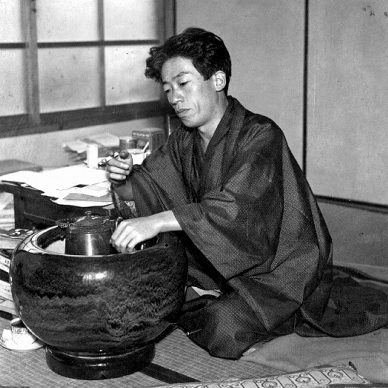
Kobayashi was imprisoned for seven months in 1930 for his revolutionary activities and after his release wrote People of the Transitional Period which appeared in International Literature organ of the Union of Proletarian Writers of Japan of which he was a Central Committee member.
Kobayashi was the son of a tenant farmer. He writes of himself: “When I was four, my family moved to Otaru, one of the largest seaports of Okkaido, as it became impossible to exist any longer in our little village. I lived in Otaru some twenty years. Very often we had no food. I still recall how it took my sister many hours to get her hair washed of lava dust after a day’s work in the factory where lava was used for commercial purposes. I also recall my little sister picking coal for the stove, for which we had no money. One of my relatives sent me to a commercial high school and during this time I also worked at a bakery and as an air-pressure pumper for divers. I often dreamed of the day I would be rich. While working as a bank clerk I began to study the works of Marx and Lenin and to take part in the revolutionary movement. No longer did I dream of riches. Now I saw the path clear before me.”
With the brutal murder of Takiji Kobayashi, by the fascist government of Japan, not only the Japanese revolutionary cultural movement, but also proletarian literature of the world, has lost one of its most brilliant members.
Literature of the World Revolution/International Literature was the journal of the International Union of Revolutionary Writers, founded in 1927, that began publishing in the aftermath of 1931’s international conference of revolutionary writers held in Kharkov, Ukraine. Produced in Moscow in Russian, German, English, and French, the name changed to International Literature in 1932. In 1935 and the Popular Front, the Writers for the Defense of Culture became the sponsoring organization. It published until 1945 and hosted the most important Communist writers and critics of the time.
PDF of full issue: https://www.marxists.org/subject/art/literature/international-literature/1933n02-IL.pdf
 Revolution's Newsstand