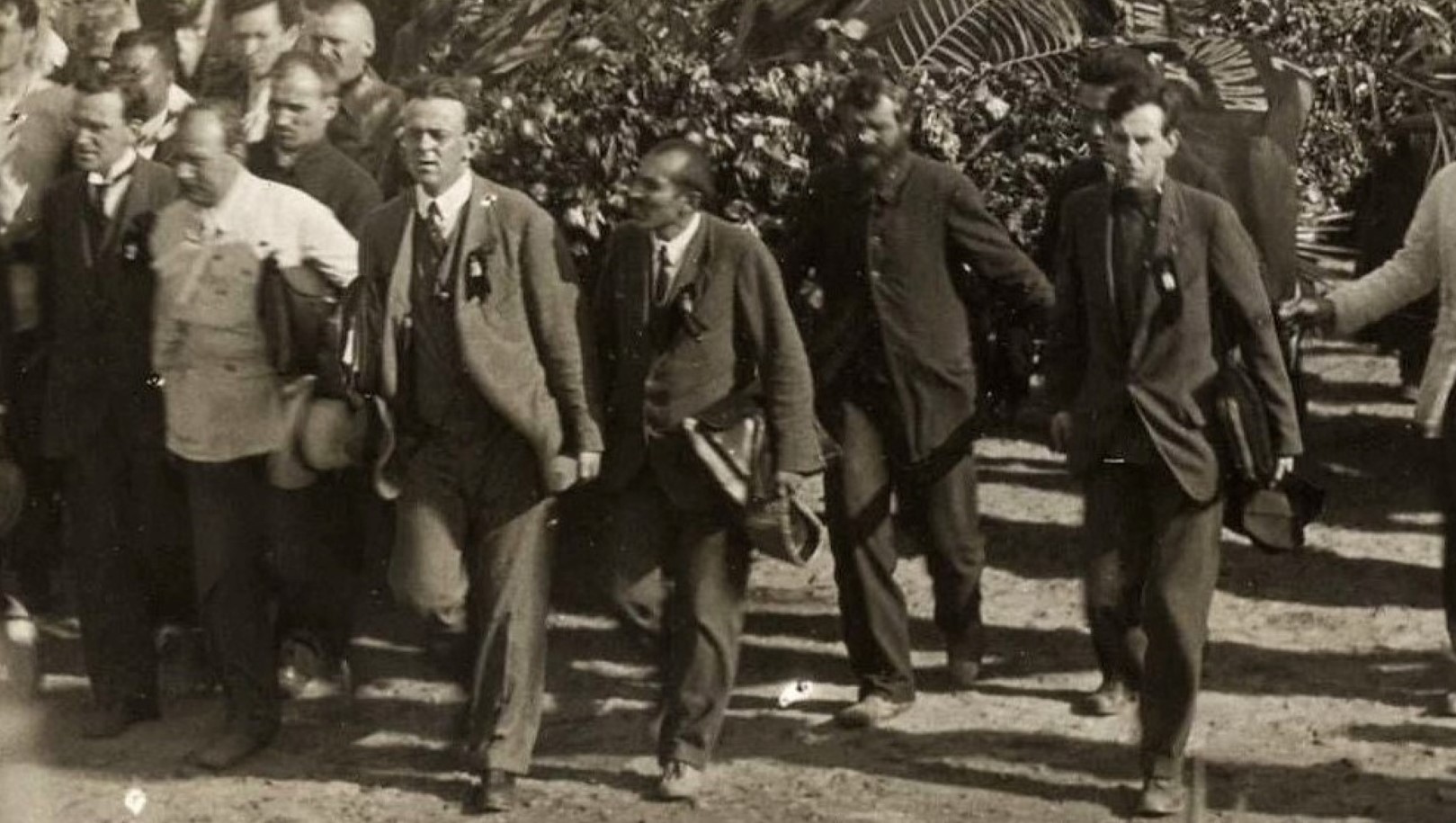
John Reed doing what he does best in these vignettes from the early Revolution written shortly after his return to the United States. Sections on housing, charity, justice, education, news, the press, Marie Andreeva and the People’s House, and the case Kollontai and Countess Panina. Fantastic.
‘How the Russian Revolution Works’ by John Reed from The Liberator. Vol. 1 No. 6. August, 1918.
(All my Russian notes, newspapers and documents are still in the hands of the Government authorities at Washington. Therefore I cannot give the texts of the various decrees, or the exact words of quotations.)
The most desperate resistance to the Soviet power came from the “moderate Socialists, and middle-class radicals.” Curiously enough, much of it was unexpected, springing from obscure social impulses. A case in point is that of Marie Andreeva, wife of Maxim Gorky, who had been Commissar of the Provisional Government in charge of the Narodny Dom–People’s House–the huge combination of theater, opera-house, restaurant and amusement park erected by Nicholas II to prove how he cherished the interests of his people.
The Kerensky Government had put Marie Andreeva at the head of Narodny Dom. She surrounded herself with theatrical directors, artists, musicians and other intelligentsia, and worked very hard to get “the best for the people.” It was not what the people wanted; it was what Marie Andreeva thought the people ought to want.
I went through it with her one night. The great opera hall was full of middle-class people–opera was too expensive for the masses, and Marie Andreeva wanted the best of opera. In the theater was a huge mass of workingmen and peasants, thrilled intently by one of Tolstoy’s plays. In another place was going on a vaudeville performance to the delighted roars of the audience.
“I’m going to do away with all this cheap sort of thing,” said Marie Andreeva. “We’re going to have here an experimental stage to produce medieval drama.” It occurred to me that the worker and soldier masses might not appreciate pre-Elizabethan revivals, and I said so, but got snubbed for it.
In another enormous hall Marie Andreeva paused. “We are going to have this place decorated by the best modern Russian painters.” She mentioned what it would cost, and I couldn’t help wondering whether the people might not prefer to spend that money some other way.
As we passed through the place Marie Andreeva shouldered the people out of the way, criticized freely and openly their manners, morals and their honesty, and gave me the impression that they were of a low order of animal life. And the other directors of Narodny Dom, well-dressed, cultivated people, seemed to be occupied in somewhat contemptuously carrying out their own ideas of what they thought the populace wanted.
When the Bolshevik revolution came Marie Andreeva and her associates refused to submit to a Bolshevik commissar, and went on strike. Whereupon Smolny Institute asked the people to elect their own committee of management, and turned the funds of Narodny Dom over to the committee.
The Soviet Government suppressed the Imperial Ballet, and the groans of the outraged intelligentsia ascended to heaven. What! These ignorant brutes destroy beauty, suppress art! But Lunacharsky, Commissar of Education, had good reasons for his action. In the first place the Imperial Ballet cost a fortune to maintain, with its training-school; and in the second, the masses of the people had no chance to see it for the tickets were sold by subscription to wealthy people who left them to their heirs in their wills; a close corporation.
But under the Soviets there was the School of Proletarian Drama, established by Lunacharsky. There was a free people beginning to create its own theater, in the scores of stages which sprang up in every barracks, every factory. The last week I was in Russia the theater of the soldiers of the Preobrashensky Regiment produced Shakespeare’s “Two Gentlemen of Verona”–but brought down to date, with Russian characters! In the Obukhov factory the workmen gave Gogol’s “Marriage”; but just to show their state of mind, consider the heading of their program:
“Nicolai Gogol. ‘A Marriage Under the Old Regime.’”
A similar type of mind to that of Marie Andreeva was displayed by the Countess Panina, who, under the Kerensky Government, was in charge of the Ministry of Public Welfare–the department of Government Charities, of institutions for cripples, insane, orphans and old people.
Countess Panina had been a very wealthy woman, a “practical philanthropist” and student of sociology. She had built and endowed a Narodny Dom of her own, a sort of glorified settlement house, where there were courses of elementary education, help for poor families, soup-kitchens and nurses for the indigent sick.
When the Bolsheviks seized the power, Countess Panina “struck,” and took with her the funds of the Ministry of Public Welfare, some 93,000 roubles, which she declared she would deliver only to the Constituent Assembly. Madame Alexandra Kollontai was appointed Commissar of the Ministry of Public Welfare by the new Government, but she was unable to continue the charities upon which so many of the poor people had come to depend, or to appropriate enough money for the institutions. Countess Panina was arrested, and brought to trial in the first case before the newly appointed Supreme Revolutionary Tribunal.
Justice
The name “Revolutionary Tribunal” suggests fierce sans-culottes sitting in judgment with blood-stained sabers at their sides, and the guillotine champing up and down outside. The Russian Tribunal was different. It was composed of seven men–three soldiers and four workmen, headed by Jukov, a revolutionist, who had been imprisoned in Schlüsselburg fortress for years. The only qualifications for members of the court were: first, that they must be members of the working-class–and second, that none of them should have studied law.
The court sat in the music-room of the palace of the ci-devant Grand Duke Nicolai Nicolaievitch, the audience being composed almost entirely of members of the nobility and the bourgeoisie, a large proportion of them teachers and settlement-workers. These people hissed the court, cheered Countess Panina and her defenders, and sneered continually at the whole performance. And although the place was patrolled by armed Red Guards, and one or two half-hearted attempts were made to clear the court-room, no violence was done.
A prosecutor was appointed by the Government, but any one in the audience was allowed to speak in accusation or in defense of the prisoner; one man, who insulted the court and the Soviets, and screamed at the top of his voice, was finally ejected. That was all.
Countess Panina was defended in a smooth speech by one of the cleverest lawyers of Petrograd. Among other witnesses she called a workingman, who testified that he had been fed in her Narodny Dom, and that her school had “flooded with light his dark mind.” Other people told what a charitable life she had led, and how much the working people owed to her good deeds.
Then up rose a young worker, a fresh youth who spoke badly. But he said, “Comrades, all this is true. This woman has a good heart. Probably she did not realize that by withholding the money from the Ministry she was causing great suffering among the people. But she is all wrong. She has helped the people out of her riches. But where did her riches come from? Out of the exploited people. She tried to do good, with her schools, her nurses, and her soup-kitchens. But if the people had the money she received from their blood and sweat, we could have our own schools, our own nurses and our own soup-kitchens–and we could have them the way we want them, and not the way she thinks we ought to have them.”
Amid great booing and hissing the Tribunal delivered its verdict. Guilty. But because of this lady’s good deeds in the past, she should merely be kept in jail until the money was paid over, and then be “liberated to public censure”–which meant, be free to return to her palace!
Charity
How would a revolutionary Socialist Minister of Public Welfare act? Madame Kollontai did not believe in charity. She thought that society should take care of its misfits, but that the disabled or broken-down worker should be pensioned, and that there ought not to be any poor. But still, the immense work of poor relief carried on by both the Imperial and Provisional Governments could not be broken off short.
The most important innovation she introduced was the immediate granting of self-government to all the state institutions–hospitals, old people’s homes except, of course, insane asylums. She dismissed the tyrannical and corrupt administrators and directors, and called upon the inmates to elect their own committees, administer their own funds to suit themselves, and make their own rules. For weeks afterward delegations came with tears in their eyes thank her. The orphan asylums she gradually began to do away with, distributing the children among peasant families in the villages. The care and vocational training of the hundreds of thousands of wounded and crippled soldiers and sailors, who were without adequate care, she took under her direction. Beginning in Petrograd, with similar places planned for other cities, she took over a huge Government building and turned it into the Palace of Motherhood–a place where working-women about to have children could go to rest before, and after confinement.
This institution was in no sense a charity, but a place where the people had a right to go, self-governing. While there the prospective mothers were given expert instruction by physicians on motherhood, how to feed their babies, teach them and keep them well. So the new Soviet State acknowledged its primary obligation to care for its children…The women remained in the Palace four weeks before and four weeks after their confinement. Vast schemes of motherhood pensioning were also being worked out.
Madame Kollontai collaborated with Lunacharsky, Commissar of Education. Inmates in orphan asylums, and even child delinquents, were nevermore to be herded apart from other children. It was arranged that at last they were to attend the public schools and mingle with their young fellow-citizens, so that they should grow up with the rest of new Russia, and share its beliefs and its hopes. On the other hand, the snobbery of private schools was abolished. Take for example the “Institutes”–private boarding-schools for young ladies of the upper classes. While it was felt that orphan-asylums and reform-schools could not be entirely done away with at once, the same thing applied to the Institutes. The girls were allowed to segregate themselves–they were allowed to live together in exclusive Institutes, but a decree of the Government forbade that school should be taught there–the aristocratic young ladies must go to the public schools.
Education
Compulsory religious instruction was done away with. And more shocking than anything else–after school hours the school-buildings became the property of the scholars’ committees, to do with as they pleased!
The awful thirst of the Russian masses for education spurred on the Soviet Government in its grandiose plans for a popular school system unequaled in the world. Of course everything in those first days had to be done hastily, sketchily; a start had immediately to be made. At the Third Congress of Soviets Lunacharsky placed on each delegate’s seat a questionnaire:
1. How large a city, town, volost or village do you come from?
2. Approximately how many school-children are there? How many adult illiterates?
3. How many schools have you? How many teachers? What are their qualifications?
4. What do your people want most to learn?
5. Will your local Soviet send to Petrograd to attend an Emergency People’s University, and support for a six months’ emergency course, one teacher for each two hundred students in your district?
The answers came. Of them an average was struck. It seemed that the Russian people wanted to learn three things: Reading and writing. Elementary scientific agriculture. Sanitation. When I left Petrograd the Emergency People’s University was beginning; several thousand teachers had come to learn what the Russian people wanted to be taught.
Religion
Closely allied with education has always been the Russian Orthodox Church, with all its symbolic pageantry, with its immense hold over the masses of the people.
Three years ago in Russia I saw the immense religious processions which filled the streets of cities with living seas. I attended services in cathedrals gorgeous with altar-screens of gold, and ikons studded with emeralds, where the tides of people flowed endless. I saw the great lavras, with their treasures and their wide lands, tenanted by thousands of monks living fatly, and thronged with hundreds of thousands of pilgrims at miracle-time. I saw the villages crowd into the churches on holy days.
Now all is different. The churches and all their treasures have become the property of the State. The peasant Land Committees have taken over the church lands. In certain monasteries the local Soviets have ordered that the monks shall go to work at something, or else lose their stipend. The great pilgrimages have stopped. In the cities the religious processions have dwindled so that only very rarely are they held. The blessing of the Neva, which used to take place with such imperial pomp, was reduced this year to a rapid procession around the Cathedral of St. Isaac of a few priests and about fifty people.
In January the Government needed the Alexander Nevsky monastery–partly for schools and partly as barrack-space for the Red Guards. The monks violently resisted the seizure of the place, and in the scuffle two or three of them were killed. Two years ago this would have aroused all Russia. But under the Soviets a monster religious procession of protest by all the clergy only brought out a few hundred people, mostly old women, while the population stood banked along the sidewalks, curiously aloof.
I attended the Christmas service in St. Isaac’s at four o’clock in the morning. There were about a hundred worshippers present–in former days there had been ten thousand–and along the wall stood a group of soldiers, watching, as if they had waked out of a dream, and were reviewing their dream…
After the first outbreak of Revolution in March, the Church held a great Congress at Moscow, the first since the days of Ivan the Terrible, and tried to democratize itself. A Union of Democratic priests was formed, which sent delegates to the Democratic Conference at Petrograd in September. At Colpinno I have seen an ordained priest taking the Socialist side in a debate with an Anarchist before a body of workers…
But the Church was too slow. Out of the depths rose suddenly a new ideal, consumed with a burning fire of internationalism, which replaced the spiritual food provided by the Church to the hungry masses.
What could be a more significant sign than the indifference of the people when the thrice-sacred Kremlin of Moscow was bombarded during the civil war there? But on the other hand, there was something terrible in the Red Funeral as Moscow, when the revolutionary dead were buried under the wall of the Kremlin, beneath a crimson banner bearing the legend, “The first martyrs of the International Social Revolution.” A burial without priest or service, a funeral procession through streets whose churches were closed, whose ikon-lamps were extinguished…
This fervor of Internationalism, this deep sinking in of the Socialist doctrine–one noticed it everywhere. I remember an old half-Mongolian peasant, who came as delegate to the Constituent Assembly from the border of Outer Mongolia, sixty-odd days from the railway, he said. One of his demands was, “That the Russian Republic shall lend not only moral but financial aid to the left wing of the Socialist movement in other countries.” In the gaunt, dim Mikhailovsky Manege, where the Red Army was drawn up in thousands, ready to go to the wars, I asked some young workmen their destination.
“The internal front or the external front, what does it matter? Whether we fight the counter-revolution or the Germans, there is no difference. Our battle is against the bourgeoisie of the world.”
“News”
What an education the Russian masses have had! In every town scores of newspapers, of all shades of political and economic opinion. Every unit of the old army with its official organ and its journals of the different political groups. Every village, almost, with its daily press. And the hundreds of tons of pamphlets shipped out from the cities–from all the cities: translations, reprints of Kropotkin and Plekhanov, and Bakunin, exhortations, treatises by Lenine, screeds on every moral, political, scientific subdivision of doctrine, appeals, arguments, denunciations. Who can measure the trainloads and trainloads of reading-matter, on sale at every street corner, at every meeting-place, in the headquarters of the popular organizations, in the Government Ministries themselves, even in the churches?
I went down to the Riga front in September, and the rough, dirty, gaunt and freezing soldiers came shoeless from the trenches, and asked us–not for food, not for clothing, but for “news.”
At the beginning of the Revolution about two per cent of the Russians were literate; by November about thirty per cent had learned to read–learned to read because they had to know; and not on the Saturday Evening Post and Snappy Stories, but on basic politics, economics, philosophy, written by the world’s greatest.
Then the floods of talk–a year of speeches–speeches everywhere, in the Soviets, in the All-Russian Congresses which met at Petrograd one after another, Peasants, Workers, Army, Railwaymen, Co-operatives…Speeches in the factories, the barracks, on the street-corners, in the tram-cars; speeches on anything a speaker liked to talk about, as long as he wanted to talk.
At one Soviet meeting a delegate from the floor made a motion to limit speeches to three hours–and was voted down!
A nation dumb all its history, trying its voice and saying beautiful things.
“Comrades!” said a soldier, in his first public speech. “I come from the place where men are digging their graves, and call them trenches!”
City Housing
It was not only landed estates which were confiscated, but city property as well. Imagine that a revolutionary proletarian Government of New York City took over the sky-scrapers, the residences of upper Fifth avenue, the apartment houses of Riverside Drive, and you will realize something of what happened in Petrograd, a modern city of two million inhabitants.
At that time there was a surplus population in Petrograd of almost a million people. Many had no place to sleep. The Petrograd Soviet ruled that henceforth rooms were to be apportioned to the number of people occupying them. Thus, two persons were entitled to three rooms, two persons and two children to four, and so on. It made no difference whether the rooms were in your own house or apartment. The remainder of the rooms were allotted to people who had no rooms.
If you owned your own house or the house in which your apartment was, you could retain free enough rooms for your family, provided the rent for them did not amount to more than eight hundred roubles a year; all rent over that sum must be paid into the treasury of the city.
The rents of city real estate were employed as follows: ten per cent to the National Housing Fund; thirty-three and a third to the Local Housing Fund; the rest for upkeep and repairs and necessary service, such as paying dvorniki, fuel for heating, light, etc. The Local Housing Fund was used to erect new cities in place of the slums and the working-class quarters–cities much more splendid than the old ranks of palaces where the nobility of ancient Russia lived.
The Imperial Palaces were declared “people’s museums,” and by decree solemnly forbidden to be used anymore as places of Governmental activity. Ranks and titles, the whole iron frame-work of distinctions so carefully built up by Peter the Great, were abolished at one stroke of the pen. The calendar was reformed, and this one measure dealt a mortal blow at the hierarchy of the Orthodox Church, which has always denounced the Gregorian calendar as “Catholic” and heretical. The Government Ministries were full of workingmen in their working clothes, dealing with affairs of state openly and according to the dictates of common sense. As one walked down the streets past the great banking institutions, whose power under the Tsar, had held the people in a vise, one saw over the doors, “People’s Bank. Branch Five, Five,” or “People’s Bank. Branch Six.” In the restaurants, where the unionized waiters made a decent living because they received a percentage of the charges, hung signs, “Just because a man has to make his living waiting on table, is no reason to insult him by offering him a tip.”
The Press
What about the Press? What about the “suppressed” newspapers? This. At the time of the November Revolution Lenine proposed a decree concerning the press, which limited the amount of print-paper, presses and offices owned by each newspaper to the proportion of votes cast by each political party at the latest municipal elections. There was only a certain amount of paper, ink and presses in Russia. Lenine said in effect: “The press is as powerful a weapon as the bayonet. We are not going to allow the bourgeoisie, because of economic advantage, to continue its monopoly of the press. If the bourgeois parties cast one-third of the votes in Petrograd, the bourgeois papers will get one-third of the paper, ink and machinery.”
As a matter of fact, attempts to control the press by force failed. I have in my possession copies of the bourgeois papers for almost every day of the time they were supposed to be shut down. In the heat of insurrection, certain papers were stopped for a few days because they were inciting to open bloodshed. The printing shops of others were seized.
For the most part, however, the so-called suppression was due to the new law which made advertising a Government monopoly, and which led to the voluntary closing down, not only of the bourgeois papers, but of the “moderate” Socialist organs, for some weeks.
But the Soviet Government is frankly a dictatorship of the proletariat, of the many over the few. It gives no “constitutional guarantees”; its object is the seizure of the property upon which capitalist rule is based. Until that is done, and all are leveled in the working-class, democracy is impossible.
The Liberator was published monthly from 1918, first established by Max Eastman and his sister Crystal Eastman continuing The Masses, was shut down by the US Government during World War One. Like The Masses, The Liberator contained some of the best radical journalism of its, or any, day. It combined political coverage with the arts, culture, and a commitment to revolutionary politics. Increasingly, The Liberator oriented to the Communist movement and by late 1922 was a de facto publication of the Party. In 1924, The Liberator merged with Labor Herald and Soviet Russia Pictorial into Workers Monthly. An essential magazine of the US left.
PDF of full issue: https://www.marxists.org/history/usa/culture/pubs/liberator/1918/06/v1n06-aug-1918-liberator-hr.pdf
 Revolution's Newsstand