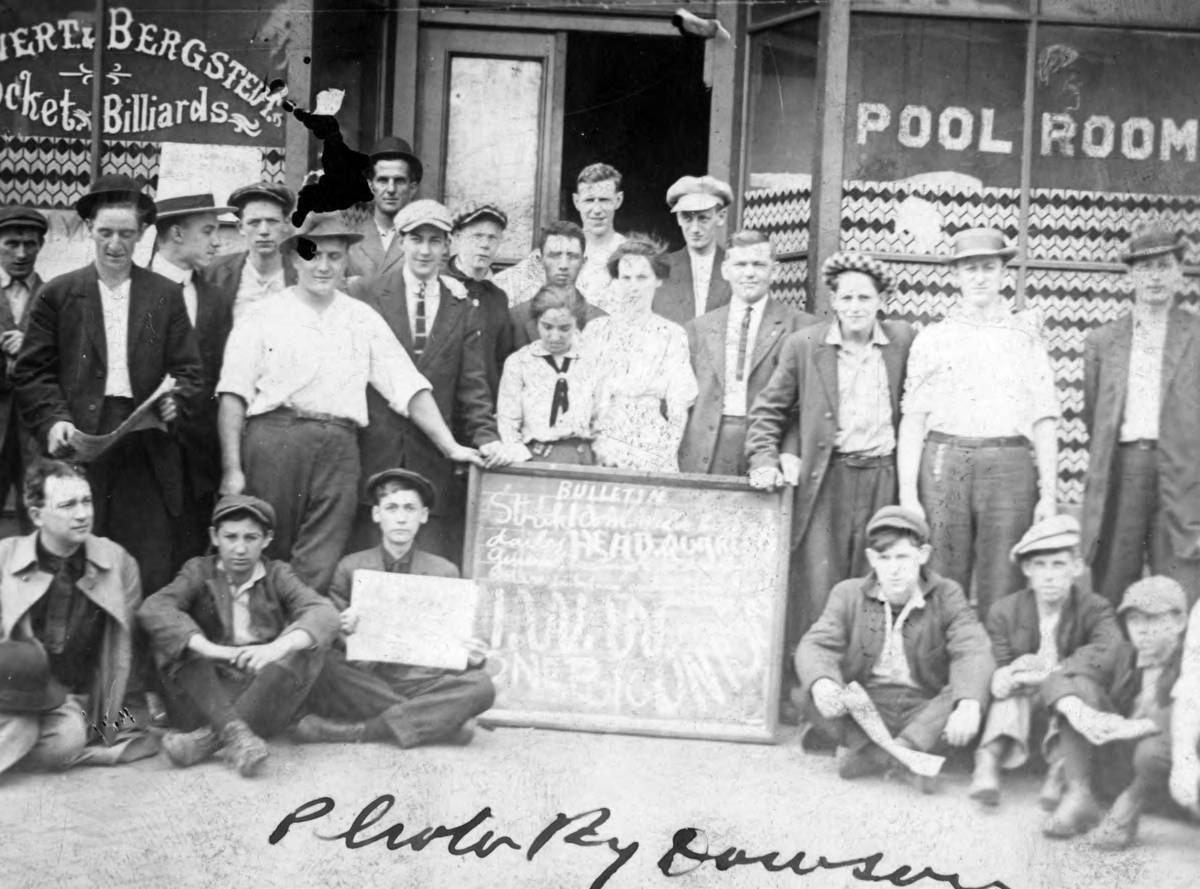
In the midst of fierce class battles, repression, and opportunity the I.W.W. of 1913 again found itself in a factional fight–this time between ‘decentralizers’ and the ‘national center’. Organizer Rabinowitz tells comrades to cool it, and wage the class war.
‘What’s the Matter with Us?’ by Matilda Rabinowitz from Solidarity. Vol. 4 No. 46. November 22, 1913.
From all quarters we hear the enemies of the I.W.W. counting our “loss.” Our lukewarm sympathizers and professed friends are shaking their heads in disapprobation of our “blundering ways,” and with skeptical mien beginning to tell us that we are doomed to defeat. The capitalists are watching every move we make. They keep close tab on the numbers of our membership, the extent of our agitation, the quality of our education, and the militancy of our tactics applied to the everyday battle between worker and master.
The capitalist press writes pointed editorials on the instability of the I.W.W. and its declining power as well as of actual membership, which they tell us is indicative of our untenable condition as a labor organization. They give prominence to what they call lost battles,–going no deeper, of course, than mere external appearances and placing a superficial value on the uprisings of the workers who have adopted the militant tactics of the I.W.W.
The Catholic Church, ever true to its policy of reaction, never loses an opportunity to attack the I.W.W. and endorse and sanction the God-fearing, flag-loving, American Federation of Labor.
Politicians great and small propose planks for their platforms to curb the influence of a militant labor organization upon the minds and deeds of the workers. Legislation is proposed against us and at the same time arbitration is proclaimed a cure for the unrest and struggle against oppression among the millions of toilers. To do something against this new and threatening force of a revolutionary organization like the I.W.W. is the desire of every parasite and beneficiary of the present system, and the weak- kneed, step-at-the-time reformer.
All this turmoil and fear in the enemy’s camp and the hatred directed against the I.W.W. only go to show that this new force is seriously undermining the security of the ruling class by rallying the workers around the standard of proletarian solidarity.
Essentially a fighting organization, we compel the attention of the enemy, because we are uncompromising and fearless. The master class recognizes in the I.W.W. a movement of the disinherited who are being organized and drilled for self-esteem and self- help.
The uprisings in Lawrence, Little Falls, Akron, Paterson, Detroit and other places have shown us that the masters appreciate our influence and methods of warfare, because of the concessions made to the workers, even when apparently defeated.
In Akron, after the great strike of 17,000 rubber workers was proclaimed as a failure and the I.W.W. severely criticized, several weeks after the workers returned to their jobs, wages were raised in nearly every rubber factory in Akron. The workers were applying the lessons taught to them by the I.W.W. to their everyday tasks, and what striking on the outside failed to do, sabotage on the inside did successfully.
The great battle in Paterson, which the capitalist press hastened to proclaim a complete defeat for the I.W.W., and even our socialist friends ridiculed and misrepresented, has brought and is bringing results, if not commensurate with the suffering and sacrifice of those valiant thousands of silk workers, still results which are by no means trifling. So alert and undismayed are the silk workers in Paterson, and so zealously do they guard against the traitors of the working class, that only now the masters have begun to realize, that in the I.W.W. they have encountered a fighting force not only for a few weeks in time of strike, but for all time.
In one of the largest mills in Paterson, the owners of which were particularly brutal against the strikers, the workers discovered one day some of the contemptible creatures who served the master class in the capacity of special deputies and armed thugs. The workers, whom the mill owners thought they have silenced and cowed forever, went to the manager and told him that unless these tools of the mill owners were sent out, they were ready to leave the mills again and call another strike. These tools were discharged and they find it mighty hard to get a job in any of the mills in Paterson.
In another instance the workers have called a shop meeting right in the mill and on the bosses’ time, to discuss certain conditions of work. The foremen and overseers protested against such bold move on the part of these erstwhile strikers, but the workers stuck to their guns and demonstrated that they can fight inside of the mill as well as outside. In many of the mills in Paterson the workers are only now beginning to reap some of the fruits of their long struggle. In one mill the weavers have set a minimum wage of $15.00 a week, and the boss had to grant it or have another strike on his hands.
When such a wonderful spirit can be demonstrated by workers, who went through one of the most sacrificing battles ever waged by America’s proletariat, we can, indeed, understand why the I.W.W., which is able to instill this feeling of class conscious solidarity, is so feared, hated and persecuted by the capitalist class and its apologists.
In Lawrence and surrounding mill towns one can hear the reactionary elements, talk of the I.W.W. with awe, and from the enemy’s camp come the satisfying rumors, that the I.W.W. is out to plan a general strike for the eight hour day.
Wherever the Industrial Workers of the World have come, they have changed and are changing the established order of things so rapidly, as to make the masters quake with fear and apprehension. The capitalists are ever watchful and alert in devising new ways and means to break our influence upon the working class. They still find it profitable to appeal to prejudice, to patriotism, to religious and racial differences, and along with these subtle lies they are ever ready to use the club, the gun, the bayonet and all the organized force of institutions which they control.
In face of this hydra-headed monster, with his many-sided avenues of attack we can ill afford to lose any time away from the real task. We cannot permit ourselves to waste our energies in petty, insignificant, personal sham battles.
Never before was there so much to do for us as there is now. Never before were we called upon to such an extent to make good our professions of solidarity, as we are now. And never before were the enemies of industrial freedom so closely allied and so bitterly combatant as they are now. The time when the I.W.W. meant a mixed local and theoretical hair-splitting is gone by. Now we must make good. We must concentrate upon agitation and organization. Everywhere there are opportunities for us to turn the spirit of discontent among the workers into the most magnificent proletarian onslaught that history has ever known.
Organizations like the A.F. of L. can never again win the respect or the adherence of the struggling masses of toilers. But the young and militant I.W.W. must make good its profession of solidarity by guarding against the internal factional wrangles which will only sap our energy and weaken our position.
Thousands are waiting to be educated and organized into fighting battalions. This is our work. Can we line up our forces to do it? Can we back up our words with deeds?
Fellow workers! let’s begin to carry out some of our plans of action. Let’s put some of our theories into practice. Let us not divide against ourselves and attack imaginary foes, while the real enemy is fortifying against us. Let’s declare ourselves anew for the complete overthrow of wage slavery.
The most widely read of I.W.W. newspapers, Solidarity was published by the Industrial Workers of the World from 1909 until 1917. First produced in New Castle, Pennsylvania, and born during the McKees Rocks strike, Solidarity later moved to Cleveland, Ohio until 1917 then spent its last months in Chicago. With a circulation of around 12,000 and a readership many times that, Solidarity was instrumental in defining the Wobbly world-view at the height of their influence in the working class. It was edited over its life by A.M. Stirton, H.A. Goff, Ben H. Williams, Ralph Chaplin who also provided much of the paper’s color, and others. Like nearly all the left press it fell victim to federal repression in 1917.
PDF of full issue: https://www.marxists.org/history/usa/pubs/solidarity-iww/1913/v04n46-w202-nov-22-1913-solidarity.pdf
 Revolution's Newsstand