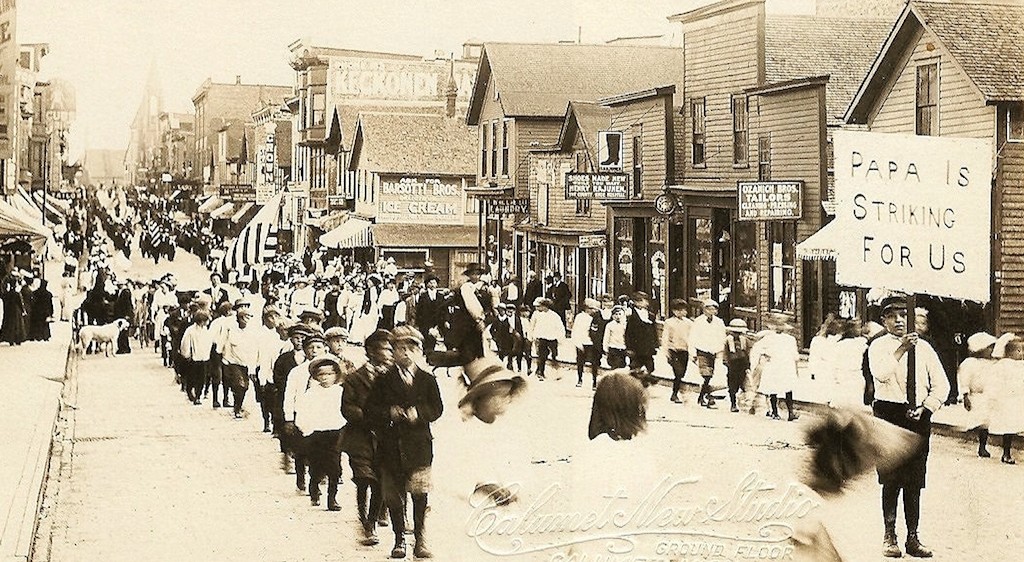
Lessons on the political realities of life under capitalism as Turner travels through Northern Michigan during the Copper Strike and sees nothing but ‘government by gunmen.’
‘Class War in Michigan’ by John Kenneth Turner from Appeal to Reason. No. 978. August 29, 1914.
AFTER I left the train at Hancock, Mich., the first thing that attracted my attention was a banner, leaning against the brick wall of a business house. The inscription on the banner reads: “Socialism is anarchism; they are loafer agitators.” Decidedly ungrammatical, but there was no question as to the meaning.
Directly across the street from this banner was a tiny store. Instead of merchandise in its single window, I saw an American flag, a lettered card, “Citizen’s Alliance,” and a “bulletin” scrawled in a black pencil beginning: “Agitator C.E. Russell is a bigger liar than the red editor of the Miners’ Magazine.”
As the congressional committee was just then in Hancock, listening to testimony on the copper strike, an unusual number of strangers happened to be in town. Yet I noticed various persons on the street staring at me, as if to determine whether I might be a spy of some hostile army about to invade the country.
At the hotel I picked up a local newspaper and read an impassioned dissertation on law and order. Opening another local publication, I perused an editorial appealing eloquently to patriotic citizens to rally ’round the flag and save the copper county from the “foreign agitator.”
Daily, as long as I remained, I ran across evidences of a holy war of extermination against a certain hideous monster that had recently appeared in that region–namely, an assertion of the right to organize by some thousands of human beings who worked in the mines.
Moreover, this holy war was not all of banners, impassioned editorials and suspicious glances. A professional gunman, returning to New York after a season in the copper country, told of riding horseback beside James McNaughton, general manager of the Calumet & Hecla Mining Company. According to the gunman’s story, McNaughton commanded another armed guard to kill a certain organizer, which he did–and a second miner with him was killed for good measure.
I have been unable to find any confirmation of this tale, and believe it to be a fabrication of one who only wished to boast too well. But the point is it could have been true. For James McNaughton was–and is–in a position to order the killing of miners and to feel no fear of the consequences. Indeed, miners were killed by James McNaughton, vicariously: that is, by persons in his employ or over whom he exercised control. President Moyer of the Western Federation of Miners was certain that the individual who went through his pockets at the railroad-station, after Moyer had been shot, kicked, beaten and dragged through the streets–the individual who was addressed as “Jim” and who apparently directed the mob from his automobile–was none other than James McNaughton. McNaughton “proved” an alibi that passed muster with the newspaper correspondents. But it did not pass muster with the miners. Listening to the testimony before the congressional committee, I learned of others whose deportation had been decreed by McNaughton, and of still others who were forced to work for him at the point of guns.
But no one thought of punishing McNaughton. For it was all a part of a war, and a patriotic and holy one.
In the war of the copper country powers upon the human right to organize, constitutions, statutes, oaths of office and established notions as to right and wrong, were contemptuously swept aside. Previously it was permissible to quit work when wanted to, to walk quietly upon the streets, to rent a hall and meet in it, to own a pistol and keep it in one’s own house; suddenly these became punishable offenses. Previously it was crime to shoot defenseless and unoffending persons upon the public streets, to drag women about by the hair, to force the doors of private homes without legal process, to seize property and carry it away, to drive men to work at the rifle point: suddenly these things became permissible, provided they were done in opposition to that assertion of the right to organize.
In other words, over night and without a single political change or legislative enactment, what was once lawful became lawless; and vice versa, what was once lawless became lawful. The change was brought about by the toilers in the mines, in insisting on the right of association. Once they took that step, they became outlaws: an open season for them automatically went into effect.
Many writers and others have expressed surprise and indignation that, on the outbreak of the copper strike, the duly constituted authorities of the state of Michigan and the copper country, instead of enforcing the laws in accordance with their oaths of office, threw the machinery and the weapons of the law into a brutal and lawless warfare, under the name of law and order.
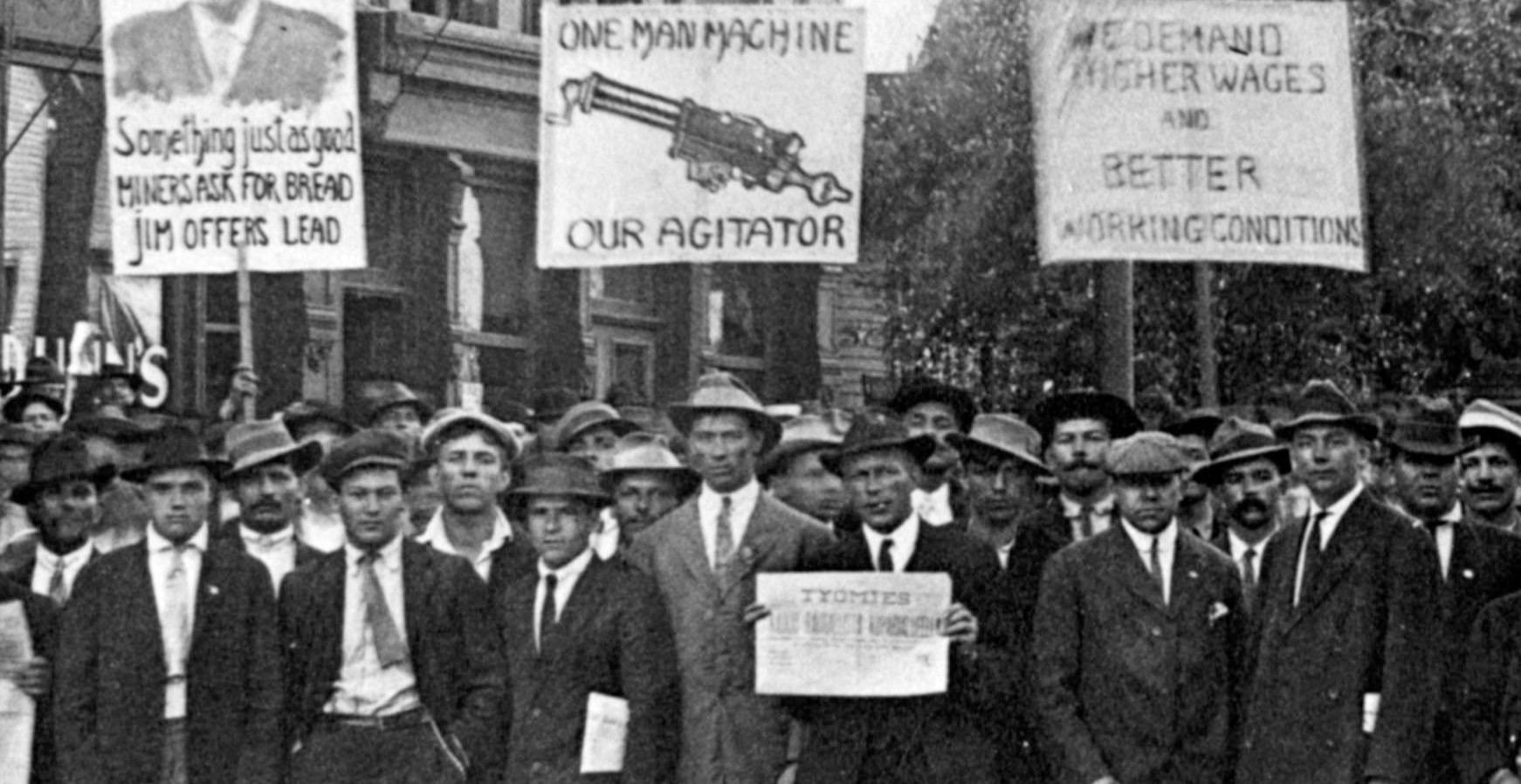
What surprises me is that anyone who professes to be well informed should be surprised at this. For Michigan is the rule and not the exception. In not one case in fifty where an industrial struggle is at all stubborn and prolonged does the state remain neutral, and in not one such case in ten does it fail to go, through the performances similar to those of Michigan.
The logic of it all is very clear. In spite of some enactments intended to safeguard human rights–which the masses through centuries of struggle have succeeded in making a part of the written law–society is based primarily upon profits. Government is primarily a repressive scheme for the protection of profits. Any organized effort of workingmen to improve their condition is an attack upon profits, and, therefore, an attack upon government. Few are the office-holders who do not know their masters–and those few are soon shifted to the discard. As between profits and constitutions there is no choice. To the office-holders and to society as it is an attack upon profits is an attack upon the flag. It is treason; it is anarchism. Patriotism is to crush any person or association that endangers profits. There crime becomes honorable, murder holy.
A strike is, in every real sense, an assault upon capitalistic law and order, an insurrection against the capitalistic state. Among “the best people,” not only of the copper country, but everywhere else, respect for law and the flag in any other sense than this does not exist; patriotism except for profit is unknown; humanity for humanity’s sake is a monstrous hypocrisy.
When workers go on strike–when they suffer long and are true–American history gives them no right to expect any thing from the state except a war of extermination, such as they encountered in Michigan.
When I was on my way home, after my travels in investigation of government by gunmen. I met a well-known Socialist lecturer–also on his way home who remarked of my discoveries: “These are only isolated cases. This is not general; it cannot become general.”
I answer that government by gunmen is general. It is not applied to the business classes–no: but it is applied everywhere to all workers whatsoever who are struggling to gain better things through organization. While the worker is quiescent and uncomplaining the gunman works in the shadow, but the moment he strikes or threatens to strike the revolver and black-jack appear. Michigan is only one instance, and while the story of Michigan is a vast and awful tragedy, still it is not the worst.
The Appeal to Reason was among the most important and widely read left papers in the United States. With a weekly run of over 550,000 copies by 1910, it remains the largest socialist paper in US history. Founded by utopian socialist and Ruskin Colony leader Julius Wayland it was published privately in Girard, Kansas from 1895 until 1922. The paper came from the Midwestern populist tradition to become the leading national voice in support of the Socialist Party of America in 1901. A ‘popular’ paper, the Appeal was Eugene Debs main literary outlet and saw writings by Upton Sinclair, Jack London, Mary “Mother” Jones, Helen Keller and many others.
PDF of full issue: https://www.marxists.org/history/usa/pubs/appeal-to-reason/140829-appealtoreason-w978.pdf
 Revolution's Newsstand