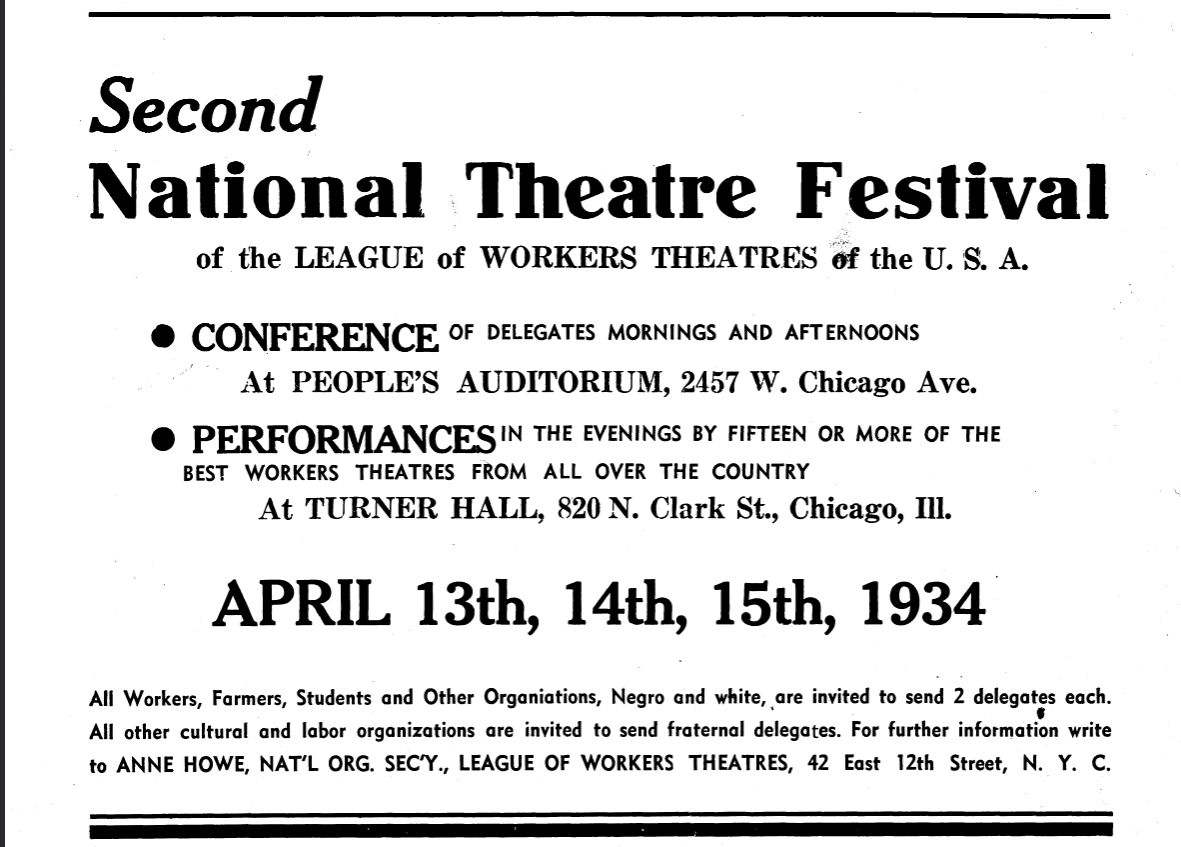
A rich world of working class arts in the 1930s is exemplified by the dozens, no hundreds, of radical theater collectives the emerged. Here, 120 delegates meet in Chicago to discuss and perform in front of thousands in a competition and conference of workers theater groups. Below is a report by Ben Blake and a critique by Anne Howe.
‘The Revolutionary Theatre Holds its Second National Festival’ by Ben Blake and Anne Howe from New Theatre. Vol. 3 No. 6. May, 1934.
Two years ago in April, 1932, delegates of workers theatres met on a large scale for the first time in a National Workers Theatre Festival. The place was New York City. One afternoon and evening was given over to a dramatic competition, with some twelve of the best workers theatre groups from the eastern half of the country presenting short plays and recitations. A second day was given over to a theatre conference which discussed the experiences and problems of the workers theatre and formulated a program for future work. To this conference delegates came from groups as far west as Illinois.
The most important work done by, that conference was to establish the League of Workers Theatres of the U.S.A. and affiliate it as a section with the International Union of the Revolutionary Theatre. This for the first time established a national center for guidance, exchange of experience and repertory, and organizational assistance to the many scattered workers theatre groups throughout the U.S.A. The festival took place, significantly, in the same spring when for the first time in many years the annual Little Theatre Tournament of the bourgeois amateur theatre was cancelled because of the economic situation. The Little Theatre Tournament was not held last year, either, although several sections of the League of Workers Theatres held successful local festivals (New York, Cleveland, Los Angeles, etc.) A recent announcement stated that the Tournament would not be held this spring, also.
Now, after two years, the second National Theatre Festival of the League of Workers Theatres has been held. The growth of the revolutionary theatre movement in America is indicated by many facts: The Festival was held from April 13 to 15 in Chicago–a sign that New York is no longer the one strong center of the revolutionary theatre. Delegates came this time from as far east as New Jersey, New York, and Boston, as far south as Louisville, Kentucky, and as far west as Los Angeles. A good delegation came from the Progressive Arts Clubs of several cities and towns in Canada. There were delegates from Detroit, Cleveland, Grand Rapids, Milwaukee, Gary (Indiana), Kansas City (Missouri), Moline, and other cities. New Jersey and Boston delegates thumbed their way.
Entire performing groups came to participate in the dramatic competition at the festival from New York, Cleveland, Gary, Detroit, Moline and Los Angeles. The Shock Troupe of the Workers Laboratory Theatre of New York toured to Chicago, performing in four cities on the way. The Blue Blouses of Los Angeles rode a bus for four days and nights without stopovers for sleeping, in order to perform at the festival!
Another important feature of the festival was the attendance of delegates from a number of stationary theatres, both semi-professional and professional, previous reports, including theatres of high standing nationally. The Workers Theatre of Chicago, the New Theatre of Hollywood, and the Theatre Collective of New York were represented, as were the Theatre Union and the Group Theatre, the latter two among New York’s best professional theatre organizations.
Absent were representatives from farmers theatres, students theatres, and all-Negro theatres, though there were Negro players in at least three of the seven English-speaking groups that performed. Two Chicago Negro choruses (one of the Unemployment Council and one of the International Labor Defense) appeared as guests on the program, as did a Ukrainian Workers Ballet and a Bulgarian workers children’s dance group.
The conference of delegates met mornings and afternoons for two days. Three evenings were devoted to performances.
The business of the conference was as follows:
“From a Mass Movement to a Mass Organization,” a report on the present political situation and the work of the League of Workers Theatres (LOWT) in its two years of existence by Harry Elion, National Secretary of the LOWT.
“Creative Problems of the Revolutionary Theatre”–a report by John E. Bonn, member of the National Executive Committee of the LOWT.
Reports of the work of the various districts and sections of the LOWT.
General discussion on all reports.
“The Theatre and the Press,” a report with main emphasis on the development of New Theatre, official organ of the LOWT by Ben Blake, editor of New Theatre.
Discussion on press report.
“Organizational Problems of the LOWT,” a report by Anne Howe, National Organizational Secretary of the LOWT.
“Workers Theatre in Canada,” a report by Ed Cecil-Smith, of the Progressive Arts Club of Toronto.
After the reports and discussions, the conference divided up into commissions for intensive study, exchange of concrete experiences, and formulation of future programs. Each commission was devoted to one specific aspect of the revolutionary theatre. Commissions met on the following subjects:
“Concentration Work”—the development of workers theatre groups in the most important industrial centers, of farmers theatre groups, of Negro theatre groups, etc., the development of a movement to attract professional theatre workers to the revolutionary theatre, the development of a program in defense of the interests of theatre workers in their unions. Chairman, M. Gorelik.
“Repertory”–Chairman, B. Blake.
“Production and Training”–Chairman, S. Karnot.
“Theatre Management”–Chairman, A. Saxe.
“Stationary Theatre”–Chairman, J. E. Bonn.
“Children’s Theatre”–Chairman, W. Lee.
“Organizational Matters of the LOWT”–Chairman A. Howe.
A special report on radio work was submitted by E. Kazan.
The commissions met simultaneously for a three-hour period. Then the conference reassembled to hear the resolutions and recommendations of the commissions. Sentiment was outstanding among the delegates that the most fruitful work of the conference was accomplished in the commissions, for there actual experiences were told in detail. It was felt that the commissions had been far too brief, that in the future a much greater part of such conferences should be devoted to the work of commissions. The time of the commissions was too short to allow for the drawing up of satisfactory resolutions for the theoretical guidance of the various phases of theatre activity. Therefore the commissions submitted only resolutions on definite practical organizational steps to be taken.
The conference voted to as sign the task of formulating resolutions summarizing the experiences and sentiments of the commissions to the National Executive Committee, which was to mimeograph and distribute these resolutions as well as the entire proceedings of the festival.
The commission on LOWT organizational problems thru its chairman Anne Howe recommended that a coast-to-coast National Executive Committee be established instead of the present one which is composed of New York members only. Two members of each section, plus a National Buro at present to function from a National Office in New York but later to be moved to a more central point, would constitute the National Executive Committee. It also recommended the re-election of Harry Elion, John E. Bonn, and Anne Howe to the Committee in their present functions. It proposed to recommend that a new editor of New Theatre be chosen. All these proposals were adopted by vote of the delegates.
The Presiding Committee elected at the beginning of the conference included Meislin (Los Angeles), Marvin (Moline), Romaine (Milwaukee), Holt (Chicago WLT), Simon (Chicago Workers Theatre), Tann (Artes, Chicago), Mitchell (Cleveland), Block (Gary), Tepp (Newark), Bonn (NEC and Presidium of IURT), Howe (NEC), Saxe (WLT-NY), Trufin (Ukrainian Dramatic Circle, N.Y.), Kazan (Group Theatre, N.Y.), and a delegate of the Theatre Union, N.Y.
Greetings were received and read from the International Union of the Revolutionary Theatre and the New York District of the Young Pioneers of America.
In the three evenings devoted to performances, nine theatre groups appeared in competition, together with guest performances by the chorus and dance groups as noted above, and a guest performance of a scene from “Fortune Heights,” presented by the Chicago Workers Theatre, a stationary theatre. Some of the competing groups also gave guest performances which were not included in the competition but which afforded an opportunity to see more of the work being done by them.
Guest performances of this nature included the Workers Laboratory Theatre of New York in “LaGuardia’s Got the Boloney,” a satirical musical revue dealing with New York’s demagogic mayor; and the Blue Blouses of Los Angeles in “Recruit” by M. Leon, a mass recitation against war and for solidarity between workers and soldiers.
The dramatic competition consisted of the following performances:
“The Blue Eagle,” presented in Jewish by the dramatic group of the Hirsh Leckert Workers Club of Chicago. This was a realistic play showing a worker’s determination to continue and win a strike against lower wages brought on by the NRA.
“Troops Are Marching,” presented by the John Reed Club Dramatic Group of Detroit. A montage-play, made up of incidents and recitation showing the suffering of the workers in the last war and declaring for revolutionary struggle against the threatening new imperialist war. Done with blackouts and rhythmic movement, as well as realistic elements.
“Oh Yeah,” presented by the Ukrainian Dramatic Circle of New York. A highly stylized satire picturing the various nationalist factions of the Ukrainian chauvinists and their failure to dupe a Ukrainian worker in this country, who finds that only the “red” Ukrainian tells him the truth and helps him fight for bread. Simple movements, skillful caricature, good make-up, varied rhythmic action.
“America, America,” presented by the Workers Little Theatre of Cleveland. Adapted the poem by Alfred Kreymborg. Done in the interesting medium of the shadow play.
“Courtroom Scene,” presented by the Workers Dramatic Club of Gary. A realistic play showing the trial of an organizer of the Steel and Metal Workers Industrial Union, framed up by company dicks on the charge of throwing a rock at a detective from the picket line.
“Post Mortem,” staged by the New Theatre of the Tri-Cities (Moline, Davenport, & Rock Island), a symbolic fantasy showing J.P. Morgan, aided by Franklin D. Roosevelt, and Norman Thomas, as the real dead (out of the grave for a little while) attempting to rule the living (the workers and farmers) for a little longer–but sent back to the grave by the aroused masses.
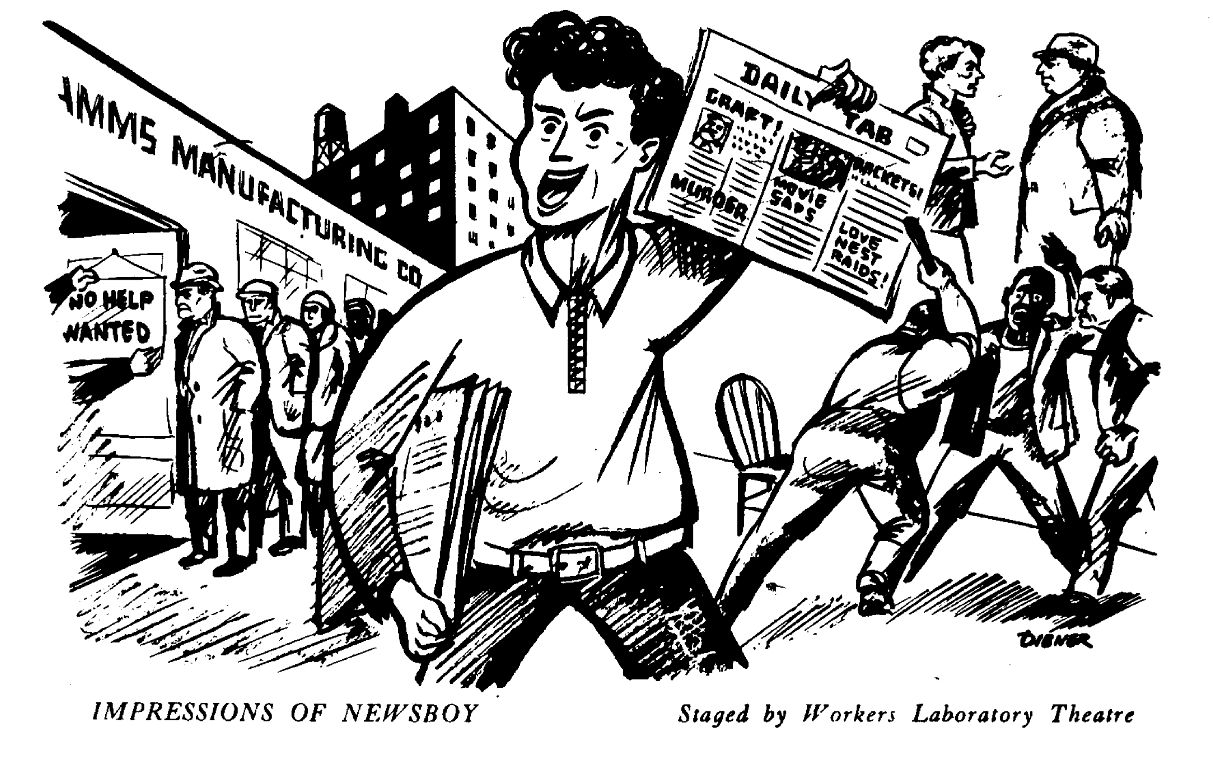
“Newsboy,” presented by the Workers Laboratory Theatre of New York. A dramatic montage from a poem by V.J. Jerome, scenes from “1931” and the Jooss ballet plus original material. With music and dance movement, blackouts.
“A-Shopping We Will Go,” presented by the Blue Blouses of Los Angeles. Semi-stylized Hindu magician show, with the A.F. of L. rank-and-file coming up thru the audience to assert its determination to strike for better conditions in spite of its leaders, in spite of Roosevelt’s baloney, in spite of the treacherous NRA. treacherous NRA. Concluding with a mass recitation.
“In The Hog House,” presented by the Workers Laboratory Theatre of Chicago. Realistic play showing the Negro and white workers in the stockyards, united in the Packinghouse Workers Industrial Union, winning a strike.
The judges awarded first place to the Workers Laboratory Theatre of New York (“Newsboy”), second place to the Ukrainian Dramatic Circle of New York (“Oh Yeah”), and third jointly to the Workers Dramatic Club of Gary (“Courtroom Scene”) and the Blue Blouses of Los Angeles (“A-Shopping We Will Go”).
A critical evaluation of the performances, together with full accounts of various aspects of the second National Theatre Festival, will be published next month and in succeeding months in the pages of New Theatre. The National Executive Committee of the LOWT is also preparing to issue a series of mimeographed bulletins containing in detail the proceedings and results of the festival.
‘The Stage Was Not Set’ by Anne Howe from New Theatre. Vol. 3 No. 7. June, 1934.
“THE League of Workers Theatres (L.O.W.T.) of the U.S.A., in the short period of its existence, has grown into a mass organization and has become one of the most advanced detachments of the international revolutionary theatrical movement.”
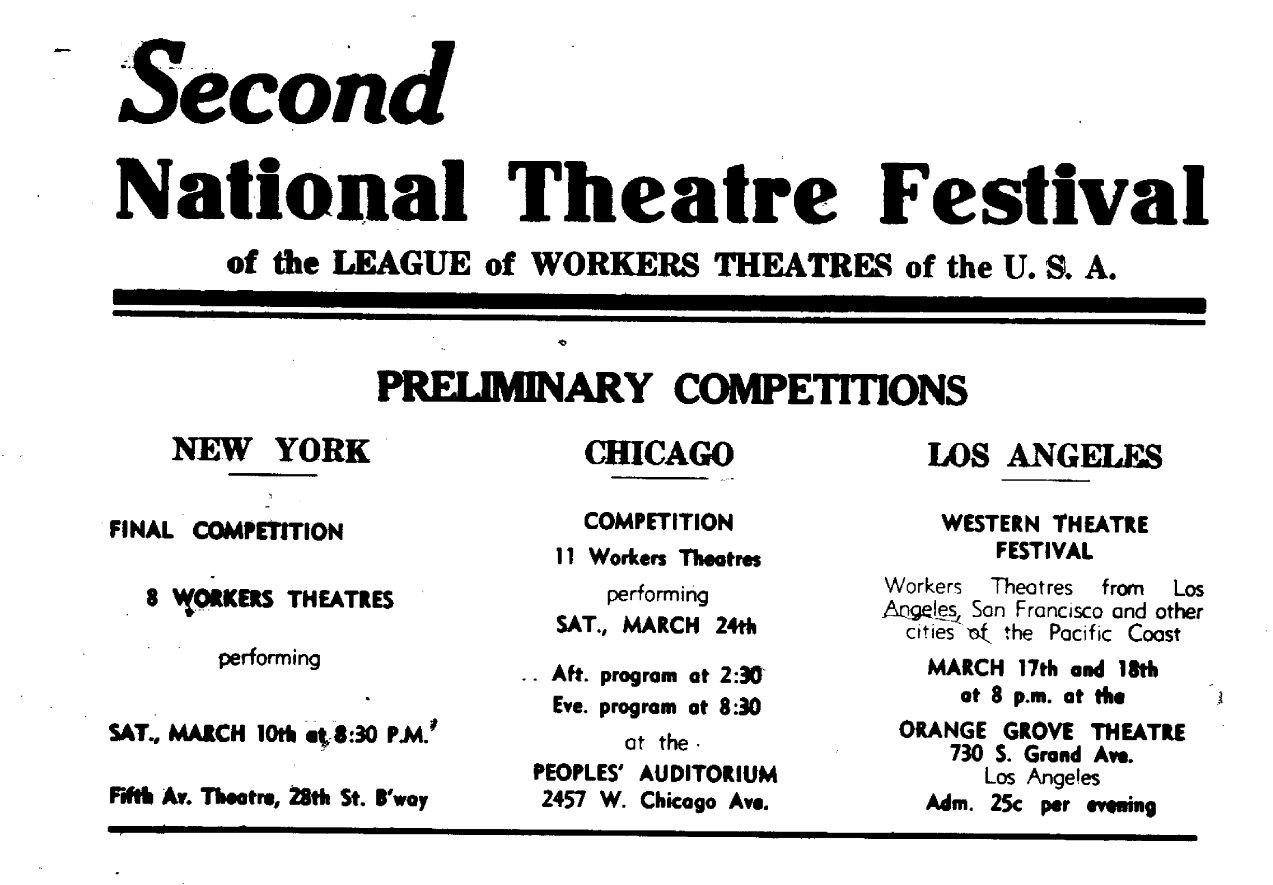
This is what the International Union of the Revolutionary Theatre (I.U.R.T.) wrote in its greetings to the Second National Festival of the L.O.W.T. How true this is illustrated by the Festival itself, which was attended by an audience of almost 3,000, and by more than 120 delegates representing more than 5,000 members, and by the preparations for the Festival. We have actually carried out our plan laid down in August, 1933, something quite a few of our members at the time considerable impossible. Thirty independent workers theatre groups, both theatres of action and stationary groups, have paid up their dues since January, 1934. Thirty-five dramatic sections of the Jewish Workers Clubs have affiliated with the L.O.W.T on their National office. Contact was established with and delegates were sent from many more groups who consider themselves affiliated but have not yet paid dues. New sections were organized in New Jersey, Chicago, and on the West Coast. The Middle West and the West Coast organized into districts. Three regional conferences, the Eastern, Mid-Western, and the Western have been held with as many delegates at each as at our first national conference. Preliminary local contests were held in New York (4), New Jersey, Cleveland, Chicago and on the Pacific Coast, involving approximately fifty theatre groups and drawing audiences of thousands of workers and intellectuals. Seven groups raised enough funds to come to Chicago, where they gave surprisingly good performances. The tour of the Shock Troupe of the Workers Laboratory Theatre of New York was not only a great experience for the audiences in the cities where they performed but was also a source of inspiration to the group itself. The Ukrainian Dram Circle of New York, and the Blue Blouses of Los Angeles toured back to their hometowns, performing in various cities and making valuable contacts. The presence of the Canadian delegates at the Festival may soon result in a national organization of the Workers’ Theatre groups in Canada.
So far, so good. The League of Workers Theatres is on the right track. But we must not be blind to our shortcomings, for there are still many. Our preparatory work which was part of our general work serves as a god example.
Although the groups finally reached Chicago, it was a hard struggle. The organizational preparations were started too late, and were not always carried through with the spirit and enthusiasm which the situation demanded. Thus, the Jack London Dramatic Group of Newark, N.J., could not get to Chicago to participate in the Festival, although their preliminary competition was held as early as March 7. Delegates from Philadelphia and San Francisco did not reach Chicago. And this in spite of the fact that the National Office sent out the plan of preparation, which included the tasks of the groups and sections, as early as August, 1933.
The basis for these mistakes is the same, as for a far more serious and almost fatal one: the complete failure of the Chicago section in preparing the Festival until the National Office sent somebody there. It is true, the Chicago section was very young and inexperienced. But the Chicago groups, when organizing their section last November, had voted to arrange for the Festival in their city, and had pledged full co-operation. Because of their inexperience, certain shortcomings and mistakes of the leading members in Chicago, have to be excused. But there were also in stances which were cases of pure negligence. Three weeks before the Festival, no attempt had been made to get housing for the out-of-town delegates, and no tickets, posters, or leaflets had been printed. The preparations for the Chicago local contest was bad, and the affair was a failure. No funds had been raised. A few functionaries proved irresponsible, let the work slip, and finally dropped out. The others did not check up on them well enough, and didn’t know how to help themselves.
And here we come to the basic problems. One of the main reasons for the organizational difficulties is the failure of our local functionaries to develop initiative, to plan their work, and carry it through. Too many groups are still waiting for letters from the National Office, when they have to determine the price of a ticket, or similar things. Too many of the groups did not learn how to adapt a theoretical article, a change of policy, an outline for organization, to their local conditions, and transform it into action.
But there is also the lack of co-operation and the lack of confidence of the groups in their local leadership, a factor which hampers the work and keeps the local leadership from developing. The groups have a tendency to take a negative attitude towards local leaders whom they either know for a long time or sometimes do not know at all. This attitude, which right from the start creates a barrier between the new leadership and the groups, has to be abandoned. Co-operation and comradely criticism, too, has to take its place. For, how can we expect to develop new leaders (and we need ever more), if we do not give them a chance.
These problems, unsolved, were the cause of the failure of the Chicago section in preparing the Festival. But the situation changed immediately after work was started with the proper plan and division of activities. The co-operation of those groups that could be reached during the last three weeks was splendid, the Jewish, German, Slovak, Finnish, English speaking groups, and others, giving financial contributions, providing housing, and supporting the Festival to the greatest extent. I doubt whether any out-of-town delegates or groups at the Festival would have guessed the previous situation, if they hadn’t been told.
And now we come to a bit of self-criticism on the part of the National Office. Although some progress has been made during the past year in giving the groups service and guidance, it still is entirely inadequate for the needs of the groups. Repertory service, supply of directors, teachers, and speakers, outlines for training, etc., are not meeting the demand. (These problems will be taken up in more detail in another article). The contact of the National Office with the Sections, and also the sections with the groups, has been based too much on purely organizational work. We have been asking the groups constantly for one or the other thing, demanding work and cooperation from them, and have not given enough in return. And while we have to overcome our organizational difficulties, and have to keep on asking the groups for cooperation, it can only be done if we give the groups better aid, train and develop them better artistically and politically. The basic problem is rather to give the groups the much demanded service than purely organizational arrangements. Thus, the attitude in our National work and section work has to take a sharp turn. Groups should not be called to section meetings too often, just for the sake of the meeting, or to arrange one or another affair. The groups will come and cooperate much more readily if they know they are learning and gaining something by attending section meetings and affiliating with the L.O.W.T.
We have made a start in the right direction. We have functioning repertory committees in New York and Los Angeles. We have started training classes. The local and national competitions cannot be overestimated as a good opportunity to gain by the experiences, ideas, and experiments of other groups. The sections will have to arrange more such combined affairs or exchange performances, lectures and discussions at section meetings, training courses, etc. The help of sympathetic professional theatre workers has to be secured and put to use for the benefit of the groups. The National Executive Committee has to be reorganized to lead more phases of our activities. The former small Nat. Ex. Comm., consisting of only New York members who were already overworked, had to be enlarge. Not only the fact that it was too small, but also that it consisted of members of one city only, who never or very seldom had a chance to get in direct contact with groups from other cities, accounts for our tendency to over emphasize the work of the New York groups, and to base our policies on the level of their work. Our change to a nationwide Ex. Com. will eliminate this condition.
Not all has been said yet. There will be more detailed articles on other problems and phases of the work. We want the response of the groups to these articles, so that we can have a good after-conference discussion which at the same time will be pre-conference discussion for the next one. We cannot separate our National Festival from our day-to-day work, although it has been a high-spot, a big step forward to more and better work. It has been the end of a large campaign, and the beginning of a larger one.
The New Theatre continued Workers Theater. Workers Theater began in New York City in 1931 as the publication of The Workers Laboratory Theater collective, an agitprop group associated with Workers International Relief, becoming the League of Workers Theaters, section of the International Union of Revolutionary Theater of the Comintern. The rough production values of the first years were replaced by a color magazine as it became primarily associated with the New Theater. It contains a wealth of left cultural history and ideas. Published roughly monthly were Workers Theater from April 1931-July/Aug 1933, New Theater from Sept/Oct 1933-November 1937, New Theater and Film from April and March of 1937, (only two issues).
PDF of full issue: https://www.marxists.org/history/usa/pubs/workers-theatre/v1n06-may-1934-New-Theatre-NYPL-mfilm.pdf
 Revolution's Newsstand