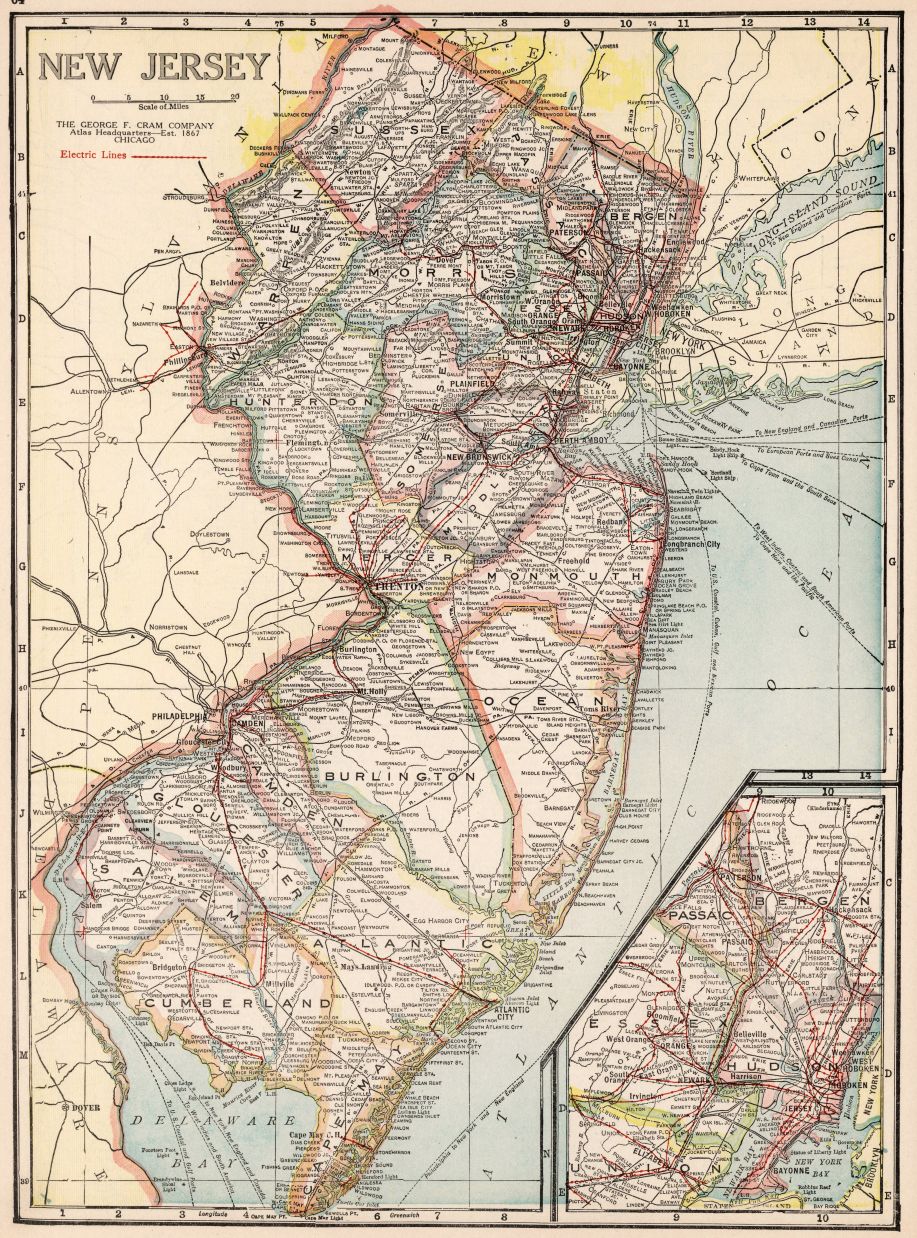
140 delegates representing 3,800 dues-paying members in 32 branches met at Newark’s Labor Lyceum in State Convention where they solidly endorsed the Left Wing while at the same time were adamant that no split should occur in the Socialist Party. Future leading Communist from New Jersey included the incoming and outgoing State Secretaries below, with Fred Harwood joining the C.L.P. and Walter Gabriel the C.P., Henry Petzold, Morris Langer, and Louis Woff.
‘Jersey Socialist Convention’ from the New York Call. Vol. 12 No. 152. June 1, 1919.
Names Farr for Governor; Harwood Offers Resignation: Resolution Introduced to Condemn Expulsion of Slavic Language Federations—New International of Left Wing European Parties Endorsed.
Albert Farr, a farmer of Whippany, former Episcopal minister in Chatham, N.J., was nominated for Governor of New Jersey by the 19th Annual Convention of the Socialist Party of New Jersey, which closed Friday night after a one day session at the Newark Labor Lyceum.
It was a Left Wing convention according to Fred Harwood, State Secretary, moderated by organization influences.
A resolution to condemn the action of the National Executive Committee of the Socialist Party for expelling the Slavic Language Federations and the Michigan state organization was deferred, in view of the absence of official confirmation of the press reports.
The platform which the candidate for Governor was pledged to uphold is largely a restatement of the position of the party during the war, accentuating the fact that the emancipation of the workers will be achieved only by the mastery of the capitalists by the organized workers.
About 140 delegates took part in the deliberations, representing 12 locals, 32 branches, and 3,800 dues-paying members in the state organization.
Secretary Harwood, in the financial report for the 9 months he served, stated that there was a 50 percent decrease in the number of stamps sold to the English branches and about a 25 percent increase in stamps sold to Language Federations, when compared with the previous 9 months.
Harwood offered his resignation as Secretary, saying he was unable to continue in the arduous duties of State Secretary, county organizer, and business manager of the Newark Leader, the party paper, activities which compelled him to work 15 hours a day.
Gabriel Elected.
Walter Gabriel of Newark was elected Secretary for the year, to succeed Harwood.
The convention sent telegrams to Eugene V. Debs, Kate Richards O’Hare, and William D. Haywood, congratulating them on their fearless stand regardless of persecution.
One of the significant resolutions passed with but little opposition from trade unionists present as delegates was that criticizing the American Federation of Labor for its passive labor policy during the war, when economic conditions were favorable for labor to seize a greater portion of the wealth it produced while the employing class was securing millions in war profits.
Valentine Bausche of Jersey City was elected chairman of the convention. In his address, he cautioned the delegates against giving way to hysteria as the result of the revolutionary ferment in Europe, urging them to bear in mind that the necessity was never greater for a united and effective party organization.
One of the most interesting resolutions offered was that suggesting that the party be centralized by permitting the election of a Central Committee in each local from the membership, the Central Committees to elect the County Committee, and the County Committee to elect the State Committee. The resolution was referred to the State Committee for investigation.
Shop Committees Urged.
Another resolution that was adopted declared that workers must be taught the necessity of securing the control of the industries they are engaged in before they can hope to secure political or economic justice. It recommended the formation of shop committees, organization by industries, and election of industrial councils to prepare for taking over the large enterprises now in capitalist hands.
Approval of the action and adherence to the ideals of the Lenin group, the Spartacans, and other similar revolutionary Socialist factions was voiced by the convention, and the manifesto of the Left Wing faction of the local movement was endorsed, with a decided disapproval of any separate organization. The convention took the stand that all differences could be adjusted within the party.
The resolutions are summarized as follows:
That the Socialist Party of New Jersey teach, propagate, and agitate exclusively for the overthrow of capitalism and establishment of Socialism through a proletarian dictatorship.
Instruct every officer of state and country to fight aggressively every attempt of the authorities to bar public meetings where foreign languages are spoken.
To study revolutionary Socialism and tactics.
Favoring participating in the new international with which are affiliated the Communist Party of Russia, the Communist Labor Party of Germany, and all Left Wing parties and groups.
Against race and national persecution of Jews in Europe, Korea, India, Ireland, and the Negro in the United States.
Non-intervention in Russia and Hungary and denunciation of Admiral Kolchak.
Favoring a uniform declaration of principles in all party platforms, both local and national, to consist of a clear statement that the issues is the class struggle or the conflict between labor and capital for the control of industry and a clear statement of the policy the workers should pursue in order to obtain control of industry.
Pledging the party to bend all its energies exclusively to teaching the workers that they must obtain control of industry entirely before they can have either economic or political freedom.
Non-participation in reform measures that becloud the class issue.
Support of industrial unionism, shop committees to prepare the workers for the control of industry, and the formation and union of industrial councils.
Use of political campaigns and political office merely for propaganda for the complete change of the state to an industrial democracy.
Approval of the Left Wing program and principles, but unalterable opposition to a white card and separatist organization within an organization and condemnation of the methods used in handling the manifesto which is declared to be a splendid document and a recommendation to settle all differences within the party.
Protest against depriving Congressman Victor Berger of his seat in Congress, as well as against brutality of the government to military prisoners and conscientious objectors Disapproval of the League of Nations and approval of a propaganda for the League of Workers.
The party platform adopted for the coming campaign contains the following appeal to the workers of New Jersey:
“Events have developed in the great capitals of the world that show the recent clash of arms was as we always maintained—not a conflict of peoples, but the grand climax of the historic struggle between great imperialistic and commercial interests.
“We therefore appeal to the workers of New Jersey to return to sanity and forget the jingoistic clamor of soulless politicians and the howls of the profiteering press and return to first—the cooperative commonwealth of the land and means of production and distribution.”
The largest delegations were from Bronx, Hudson, Mercer, Passaic, and Camden Counties. Rose Weiss acted as vice president of the convention, and J. George DeKoven and C.J. Hendley, secretaries; Fred Pickering, Bernard Miller, and Ernest Linke, sergeants-at-arms.
The following committees served:
Resolutions—Albert Farr, Theodore Schwartz, Jacob Rauscher, Henry Petzold, Chris Mandaw.
Ways and Means—Ben Cooper, Edward H. Mead, William Mead, Bert Silcox, Peter Hueck, George Kuhn, Anna E. Fisher.
Platform—Walter Gabriel, Isidore Beyer, Otto Wilson, C.J. Hendley, Frederick Hubschmidt, Julia Bistragune, John Weiss.
Organization and Propaganda—Rose Weiss, Samuel Rueben, Sarah McLoughlin, Milton Goldfarb, Daniel McAllister.
The New York Call was the first English-language Socialist daily paper in New York City and the second in the US after the Chicago Daily Socialist. The paper was the center of the Socialist Party and under the influence of Morris Hillquit, Charles Ervin, Julius Gerber, and William Butscher. The paper was opposed to World War One, and, unsurprising given the era’s fluidity, ambivalent on the Russian Revolution even after the expulsion of the SP’s Left Wing. The paper is an invaluable resource for information on the city’s workers movement and history and one of the most important papers in the history of US socialism. The paper ran from 1908 until 1923.
 Revolution's Newsstand