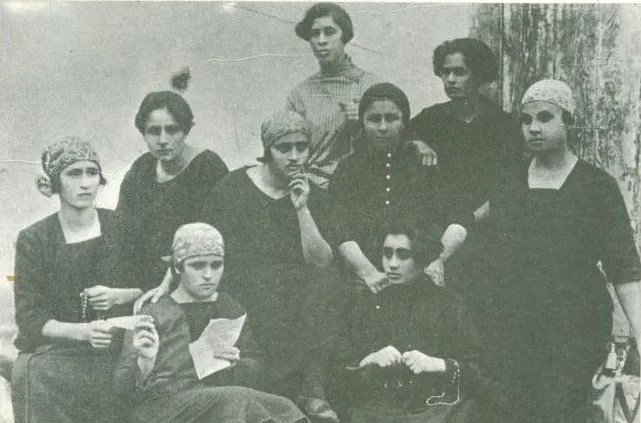
A mass hunger strike against Bulgaria’s monstrous prison regime as that country’s formidable insurgent workers’ and peasants’ movement continues its desperate struggle from behind bars.
‘The General Hunger Strike of 2500 Political Prisoners in Bulgaria’ by D. Ivanov from International Press Correspondence. Vol. 7 No. 20. March 17, 1927.
For a week the public of the whole world has had its attention arrested by an event which is unique in its nature.
General hunger strike in the whole of the 22 district prisons of Bulgaria, behind the walls of which there are, in round numbers, 2500 political prisoners.
On the 28th February last all political prisoners in the Sofia Central prison, numbering 133, went on hunger strike. The demands which they have put forward are: 1. complete, unconditional amnesty; 2. immediate discussion of the amnesty Bill introduced into parliament by the Opposition; 3. against the unbearable prison regime which is worse than that for common criminals.
On the 2nd and 3rd March, 1927, a hunger strike of the political prisoners, was proclaimed in the district prisons of Philippopolis, T. Pazardshik, Schumla and Plevna with the same demands.
Soon afterwards the hunger strike extended to all the 22 district prisons of Bulgaria and embraced the whole of the 2500 political prisoners. All the political prisoners, without exception, joined in the hunger strike, women, old people and children, including in the district prison of Sofia a mother with a child of 18 months who was born in prison.
In the first days the government press denied that there was a hunger strike and characterised the reports of the Labour press concerning it as a provocation. At the same time, however, the Ljaptcheff government commenced reprisals against the prisoners on hunger strike. After the Sofia Public Prosecutor had cross-examined all the political prisoners in the Sofia Central prison they were all punished, on his orders, with one month’s strict solitary confinement. This punishment was rendered more severe by the prohibition of all visits, all correspondence and the sending of food, tobacco and cigarettes from outside, i.e. from the relatives of the prisoners. Not content with that the political prisoners kept in solitary confinement were forbidden to leave their cells to go to the lavatory! These barbarous punishments and threats could not, however, break the spirit and the solidarity of the tormented and exhausted political prisoners of Bulgaria. The hunger strike is still going on. Even criminal prisoners joined in the hunger strike out of sympathy.
In spite of the conspiracy of silence of the whole of the bourgeois and also the social democratic press in the first days, the news regarding the general hunger strike spread like wild-fire, not only within the country but far beyond the borders of Bulgaria. The government press then began to “work on” the public. The government press, which at first denied the hunger strike, commenced an incitement against the political prisoners on hunger strike by stating:
“Prisons are not political clubs and the political prisoners have no right to carry on politics in prison. By declaring a hunger strike they only make matters worse for themselves…”
The government press then hastened to declare that the hunger strike was at an end. And finally, on the eighth day of the hunger strike in Sofia, as nothing else would avail, the independent paper “Novini” was confiscated and the whole of the editorial staff, right up to the last proof reader, was arrested! In this brutal manner the hangmen’s government of Ljaptcheff is trying to throttle this paper which stood wholly on the side of the hunger strikers and constantly supplied the public with news and the appeals of the strikers and of those in sympathy with them.
In order to understand the general hunger strike of the political prisoners of Bulgaria who are in an advanced stage of physical exhaustion, one must call to mind the course of events regarding the fight for the amnesty. Already for months past a powerful movement for an amnesty has been spreading in Bulgaria. Not only the political prisoners and their relatives, but thousands of other people, in many cases including whole villages, have uninterruptedly demanded, in numerous memoranda and protests to the government and the press, a speedy and unconditional amnesty.
Even the bourgeois opposition parties were compelled to raise the demand for the amnesty and to introduce a bill providing for an amnesty even if only a limited one, the government, however, declared that it did not even think of passing an amnesty law, and its press declared that so long as the political prisoners did not show any signs of “remorse” they were “not worthy” of a political amnesty.
The Bulgarian parliament will rise on the 28th of March. This parliament, which approved all the bloody acts of terror, the blood baths and all the cruel deeds of the Zankov-Ljaptcheff governments, this parliament which shares the responsibility for the numerous victims of the white terror in Bulgaria and especially for the martyrdom of the political prisoners numbering more than 2000 who are now pining in prison, refuses to discuss an amnesty. The demand of the Bulgarian people and especially the demand of those who are now on hunger strike is, that this parliament settles the question of the amnesty before it separates.
A great movement for an amnesty and against the exceptional laws in white Bulgaria has been proceeding for weeks past in the most important countries of Europe and America. Not only the international proletarian public is conducting this movement, but also broad sections of the bourgeois intelligentzia, the Left bourgeois press and various cultural associations and organisations are being swept along by the stream of this movement.
Under the influence of this powerful movement, the question of the amnesty in Bulgaria was discussed even in the League of Nations. And when M. Vandervelde, in delivering his report on the Bulgarian refugees question raised an appeal for a general amnesty in Bulgaria in connection with the question of “normalising the political life in Bulgaria”, it came, as the bourgeois big telegraphic agencies report, to an “extremely painful incident”. This “incident” is, however, very significant, for it shows who is actually behind the scenes and who is the most powerful supporter of the white regime of murder and cruelty in Bulgaria no other person than Sir Austen Chamberlain, the British Foreign Minister. For Chamberlain held this question, which in comparison with the great questions of world politics appears so insignificant, to be of such importance that he did not leave the reply to the Bulgarian representative but, foaming with rage, himself protested against intervention in the inner affairs of a “sovereign people”.
Now, when the source of the international terror is clearly laid bare before all the world, solidarity with the victims of the white terror in Bulgaria as well as in all other countries where the fascist reaction has the upper hand is all the more an undeniable duty. And especially for the working class in “democratic “England, the government of which stands exposed as the actual wire-puller of murderous fascism in all countries, there arises now the responsible task of proclaiming their will with all means and with the greatest energy, and to arrange effective protest measures against the white terror and international fascism.
“Enough of the gallows, chains, dungeons, exceptional laws and political wholesale persecutions in this unhappy country! Give full, general, unconditional amnesty!” this cry of the political prisoners which they issued in their hunger strike proclamation, must everywhere find a response, and the fight for these demands must not cease until success has been achieved.
International Press Correspondence, widely known as”Inprecorr” was published by the Executive Committee of the Communist International (ECCI) regularly in German and English, occasionally in many other languages, beginning in 1921 and lasting in English until 1938. Inprecorr’s role was to supply translated articles to the English-speaking press of the International from the Comintern’s different sections, as well as news and statements from the ECCI. Many ‘Daily Worker’ and ‘Communist’ articles originated in Inprecorr, and it also published articles by American comrades for use in other countries. It was published at least weekly, and often thrice weekly.
PDF of full issue: https://www.marxists.org/history/international/comintern/inprecor/1927/v07n20-mar-17-1927-inprecor-op.pdf
 Revolution's Newsstand