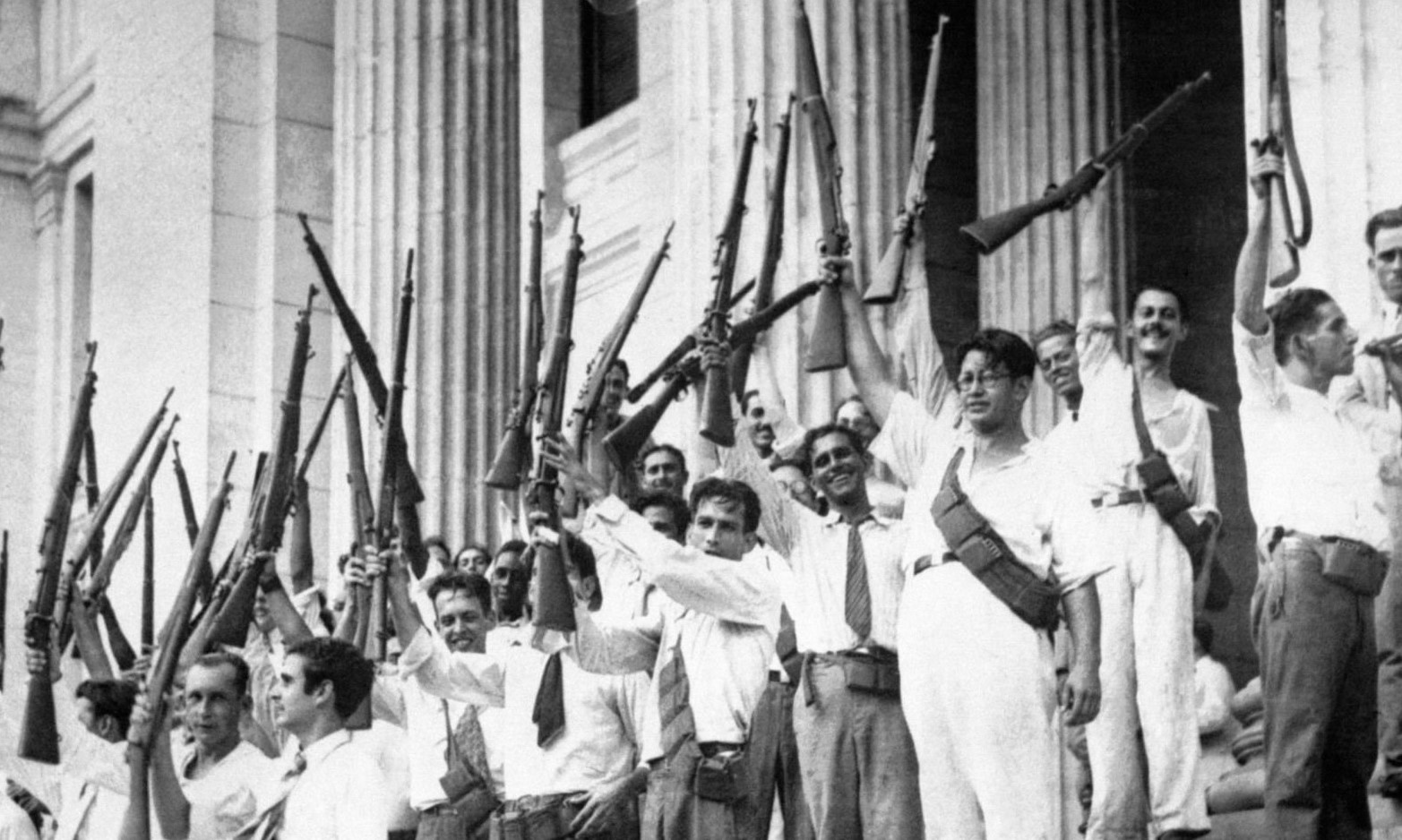
A survey of the early 1930s student movement in Central and South America for the C.P.-aligned National Student League’s magazine.
‘In the Midst of Revolutions’ by S. Small from Student Review (N.S.L.). Vol. 2 No. 3. December, 1932.
THE average American student, who cannot recognize the economic forces behind our own politics, can hardly be expected to recognize the extremely involved, imperialist maneuvers in Central and South America. A general ignorance about these countries exists even among our more internationally minded students. Even they, who should understand the vital importance of our imperialist possessions, the connection between conditions of workers and students in the United States and their condition in the colonies, very often fail to realize the significance of this relationship.
The active participation of the students in Latin American revolutionary movements has led to the erroneous conception that all students who take part in these “revolutions” are revolutionary students. They are no more “revolutionary” than the revolutions themselves. Most of the official student organizations are simply sets of puppets going through their parts in a marionette show staged by American or British Imperialism and engineered by native showmen.
In Mexico, the biggest student organization is called Confederacion Nacional De Estudiantes, a numerically large and very powerful group. It is assisted and recognized by the government, and its leaders are all reformists, using radical phrases to gain their ends. Since the general sentiment of Latin American students is genuinely anti-imperialistic, these valuable assistants to the government are very loud in their anti-imperialist talk, but their propaganda is not directed against the source of their imperialist oppression, American capitalism. Instead they howl against the individual tyrants and dictators, like Serra of Colombia, Machado of Cuba, or Gomez of Venezuela. Instead of calling upon the students to support the real struggle of the workers and poor peasants against American Imperialism, they turn the fight into a campaign for replacing the men in power with national reformists.
As for their role as student leaders of student fights: when the Mexican government cut the University budget by 500 pesos a year, the student leaders immediately organized a campaign for raising money from individuals. This aid to the government was dressed up to look like an attempt to free the University from government control. If the schools received no support from the government they would really be autonomous.
Another example of the misleading character of these student leaders in their so-called anti-imperialist program is their behavior during the fearful slaughter that followed the attempted insurrection in Salvador. When the revolutionary workers and peasants organized an armed rebellion against their rulers, open servants of American imperialism, these Mexican students did not even organize a demonstration to protest the terror exercised against the rebels, supposedly fellow fighters against the common enemy, Wall Street domination.
The Mexican student organization, along with student movements in all Central America, belongs to a higher body called the Ibero-American Student Conference. This central body was the organization which refused to participate in the Pan-American Conference called by the American Intercollegiate Association to protest the presence of American marines in Nicaragua and Yankee Imperialism in general. The demagogical character of this step was later clearly exposed by the fact that they permitted representatives of the American student body to come and speak before student groups in their own countries.
The Ibero-American Student Conference has recently issued a statement supporting the war of Colombia against Peru. These revolutionary student leaders issued no call of any kind protesting against the war, to say nothing about calling for a struggle by the workers, peasants and students against the war, an imperialist war resulting from British and American rivalry in South America.
In Cuba, the official student organization is called Directorio Estudiantil. This is the organization in which Julio Mella was a leader. After he was expelled, for being too revolutionary, the organization split into two factions, calling themselves Ala Derecha (right wing) and Ala Izquierda (left wing). The Ala Derecha, like its Mexican counterpart, supports the nationalist reformist opposition in Cuba against Machado. It also takes no part at all in combatting the repressions to which students must submit. Two years ago the Cuban University was closed by Machado after the students organized systematic protests against him. The Ala Derecha carries on no fight for the re-opening of the University. Their line is to get rid of Machado, since they cannot have any culture while he exists anyway. And so the University stays closed while these student leaders help the national reformists in their attempt to get the contract from the United States to run Cuba.
Many members of Ala Derecha support the terrorist ABC organization, the organization responsible for the assassination of many government officials. Consciously or unconsciously, these students are once more aiding the government in its anti-working class campaign. The removal of a few corrupt and hated officials and their subsequent replacement by men of the same ilk tend to dissipate the energy of the revolutionary movement. As a result of these useless acts of terror, the government has reacted with three-fold terror against the revolutionary peasants, workers and really revolutionary students.
In Panama and Costa Rica, the student movement is completely reactionary. There are, however, some real revolutionary student groups which have definitely allied themselves with the revolutionary workers and peasants of Latin America. In Mexico this group is known as the Federacion De Estudiantes Proletarios. It is comparatively new and composed almost entirely of revolutionary elements. There is another Mexican group known as the U.E.P.O.C., (the Union of Workers and Peasants). This was organized by the Mexican government in its days of genuine anti-imperialist struggle. It was to conduct an educational campaign among the Mexican people, to arouse in them a sort of cultural nationalism. It employed well known artists as well as students to carry out this work. Now that the Mexican government has once more become a puppet of American Imperialism, the revolutionary students have continued to utilize the apparatus set up in the old days for the purposes of revolutionary and anti-imperialist propaganda. One part of this apparatus is the system of factory evening schools. The entire organization of these two groups is genuinely anti-imperialist and left wing in composition. For this reason they are continually being thrown out of their headquarters, persecuted, arrested and terrorized in every way.
There are also regional revolutionary groups as in Jalapa and Vera Cruz, where all the students of the Normal School took part in an anti-imperialist, anti-clerical strike on Nov. 7, 1931. These groups have newspapers which state their program and serve as agitational mediums. One of the best known of these papers is the Grito (the Call) issued by the U.E.P.O.C.
In Cuba, the left wing of the former Directorio Estudiantil, the Ala Izquierda, is the group which organizes the students to struggle against Machado as a tool of colonial exploitation and not merely as a personal tyrant. It raises specific student demands and fights for student rights. It also mobilizes the students to fight with the working class in the anti-imperialist, anti-feudal revolution. “These students are facing the greatest terror at the hands of Machado. Great numbers of them are constantly being imprisoned and many have lost their lives in this struggle against tyranny.
In Chile, Argentina and Uruguay the student movements are definitely left-wing. In Venezuela, all student organizations are banned. In Peru, there is the APRA, a Nationalist organization whose leader, Haya de la Torre, is one of the greatest of Latin American demagogues. This organization has come out openly supporting the Peruvian government in its war against Colombia.
With this bare outline of the alignment of forces, the tasks of the N.S.L. in regard to the Latin American student movement become very clear. The broadest united front among students must be started on the basis of unconditional struggle against foreign domination, by American students here and Latin American students in their own countries. It is important to remember that it is only the leaders of the official student movements who are open to attacks as hypocrites and reformists. “The rank and file is ardently antiimperialist and can be won over to any program which will help them in their fight against Yankee imperialism.
There is no revolutionary student center in South and Central America. There are only scattered left wing groups. The National Student League Conference in December can take the first steps toward creating such a center. Every effort is being made to see that student representatives from Panama, Honduras, Cuba, and Mexico arrive at the conference. The student groups in these countries have expressed their eagerness to send delegates but they are very poor and must have financial assistance to get there.
This is not the only task of the National Student League in this connection. We must educate our own student body to the realization that the struggle against Yankee imperialism here at home is one of our most important tasks. Only in that way can we help cur fellow students in Latin America in their fight against terror and economic exploitation. We are trying to win over the Latin-American students in this country to an anti-imperialist program.
Only by taking such action will we prove to the revolutionary student bodies of Latin America and the rank and file of the official student organizations that we are not merely another trick out of Wall Street’s bag to keep them in subjection and terror, that their fight is also our fight. Only by uniting with the students and exposing their false leaders will we be able to show our solidarity with revolutionary students in Central and South America and build a real All-America revolutionary central student organization.
Emerging from the 1931 free speech struggle at City College of New York, the National Student League was founded in early 1932 during a rising student movement by Communist Party activists. The N.S.L. organized from High School on and would be the main C.P.-led student organization through the early 1930s. Publishing ‘Student Review’, the League grew to thousands of members and had a focus on anti-imperialism/anti-militarism, student welfare, workers’ organizing, and free speech. Eventually with the Popular Front the N.S.L. would merge with its main competitor, the Socialist Party’s Student League for Industrial Democracy in 1935 to form the American Student Union.
PDF of full issue: https://www.marxists.org/history/usa/pubs/student-review/v02n03-dec-1932-student-review.pdf
 Revolution's Newsstand