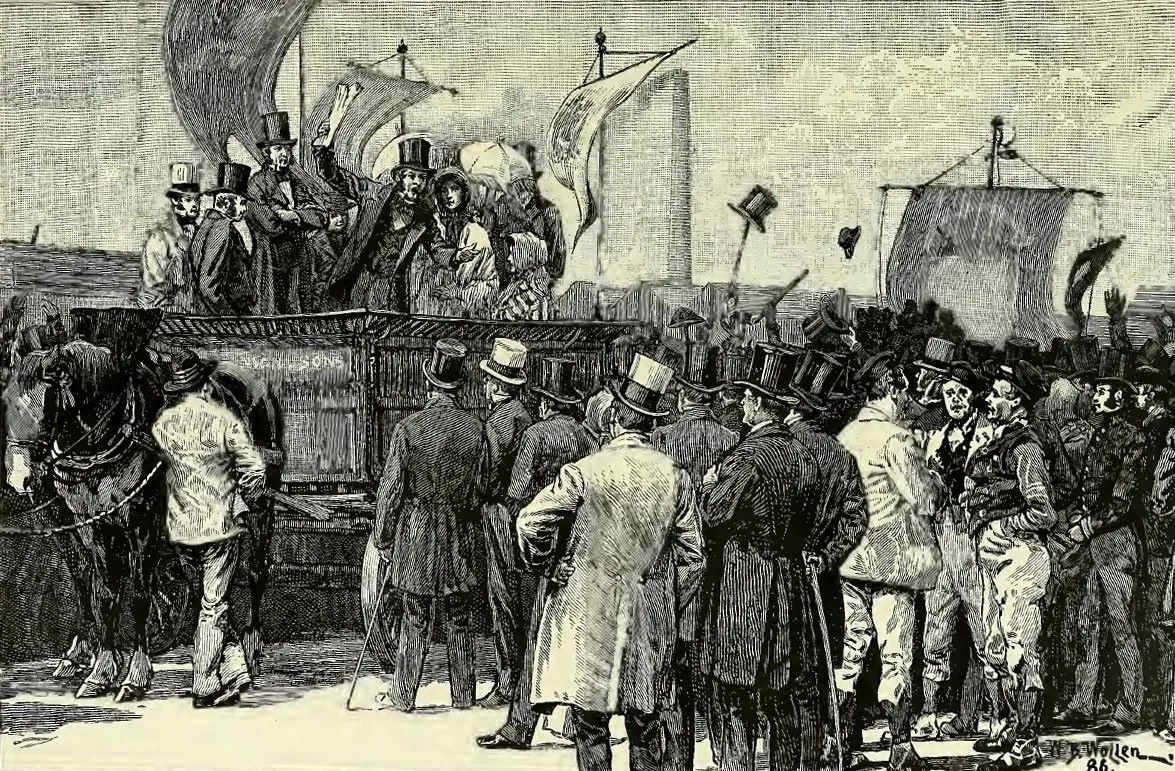
Marxist historian and journalist Max Beer was the long-time London correspondent for Vorwäerts, and would spend much of his intellectual life researching and recording British working class history. A key chapter from his 1921 tome.
‘The Birth of Chartism’ by Max Beer from A History of British Socialism, Vol. 1. Harcourt, Brace and Howe, New York. 1921.
1. ESSENCE, AIM, AND NAME
The two currents of social economic thought generated and developed by the school of Owen and the anti-capitalist criticism reached, in the years from 1825 onwards, the thinking portion of the British working class and created Chartism, which constituted a series of social revolutionary attempts to re-organise the United Kingdom on a socialist and labour basis. This movement assumed gradually national proportions, and was in full activity in the second quarter of the nineteenth century, but it was only in the year 1838 that it received the name “Chartism,” which merely signifies democratic parliamentary reform. The name, like that of many of the great movements and parties of the United Kingdom, does not cover, either chronologically or intrinsically, the history and essence of this movement. The years 1825 to 1830 were the period of its incubation; from 1831 to the end of 1834 developed its theories and exhibited great intellectual vigour; from 1837 to 1842 it received, as far as the Corresponding Act permitted, its practical and organised form; and from 1849 onwards its vitality was rapidly ebbing away and it died in 1855, leaving only here and there scattered stragglers who obstinately refused to believe that Chartism was extinct. Its theories, traditions, and legacies were either taken up by continental socialists, like Karl Marx and Frederick Engels, who, ten years later, formed the International Working Men’s Association, or by the co-operators and trade unionists of Great Britain, who transformed them according to their education and experience.
Chartism, in its essence and aim, resembled the international socialist and labour movement of the present day. But, having had no precedent to be guided by, and, indeed, forming a kind of socialist seminary and an experimental laboratory of working class revolution, it was deficient in coherence of thought and systematic policy. It presents itself as an elemental class-war, rising and falling in curves between enthusiastic upheavals and apathetic inertia, between riotously profuse creations of ingenious ideas and pitiful relapses into barren and obsolete theories; only its immediate aim—the conquest of political power—appears to have been grasped with unmistakable distinctness and energy, but owing to lack of a national organisation and popular education it was impossible for it to become a permanent and victorious movement. To the eye of the historian it takes the form of a pioneer movement of socialists and masses of workmen—a valiant and desperate contest for the material, moral, and intellectual uplifting of Labour. From its experimental and, on the whole, practical character it follows also that there could be no uniformity of opinion as to the ultimate shape of the social revolution and social reconstruction. During its theoretical period (1831-34) illuminating ideas flashed out with meteoric suddenness and disappeared just as abruptly, leaving scarce a trace behind; and even to the present day doubts, erroneous assumptions, and misunderstandings are still prevalent with regard to the originators and the import of their ideas. And during the practical period (1837-49) theoretical discussions were not favoured, lest they should be a hindrance in the struggle for the immediate aim—to seize the reins of government as quickly as possible: “Peaceably if we may—forcibly if we must.”
As already indicated, the ultimate socialist aim was not established with unanimity. A judgment on this point can only be formed by a study of Chartist newspapers and pamphlets, and of their intellectual sources and ramifications. There were three lines of policy in the question of the ultimate aim: one was communistic and parliamentary, at any rate up to the year 1845, until the disastrous break-up of Queenwood, the last Owenite colony; it strove for political power in order to transform Great Britain into a certain number of communist colonies; and with its adherents the question of the common ownership of the land took precedence of every other consideration. This line of policy dominated among the working classes of the North of England. The second was, indeed, Owenite in its critical attitude to social problems, but it aspired after political power in order to utilise it for paving the way for social reform, for trades unionism and the political organisation, education and enlightenment of the working classes, so as to fit them for reforming the country in a socialistic sense. These were the ideas which centred in the intellectual working men of London and Scotland, who probably did not form more than ten per cent, of the British working classes. The third line of policy was in the direction of trades unions, and adhered to the theory of natural rights, viz. that the workman should receive the full produce of his labour, and in actual practice made the demand: “A fair wage for a fair day’s work.” A sharp separation of these lines of policy was never attained. Excepting for the years 1833 and 1834, in which economic action in the syndicalist sense was most strongly marked, the organised workers and the Chartists were of opinion that the fundamental condition for emancipation from wage slavery lay in the conquest of political power, and that therefore all their energies ought to be concentrated on this purpose. The parliamentary and democratic idea dominated the movement so completely as to give it its name. The movement received the name Chartism from its democratic programme: the People’s Charter, which was originated in the year 1837 to 1838 by the London Working Men’s Association, and was drawn up by the joiner, William Lovett. The People’s Charter was nothing more than a plain and clearly written Bill, containing the following six points in the form of sections and paragraphs: (1) Universal Suffrage, (2) Equal Electoral Districts, (3) Abolition of Property Qualifications for parliamentary candidates, (4) Annual Parliaments, (5) Ballot, (6) Payment of Members of Parliament.
2. STAGES OF DEVELOPMENT
Chartism, as a collective term for the revolutionary struggle of the British working class, passed through several stages, as already stated in the preceding section. The years 1825 to 1830 formed its period of incubation. They were years in which Great Britain cast off its agricultural character, and passed over to industrialism on a large scale. To the revolution in production was added that in commerce and transport. Through the repeal of the Bubble Act (1719) in the year 1825, capital could henceforth form joint-stock companies and inaugurate the era of extensive and collective enterprise which revolutionised commerce and transports. The middle classes became intoxicated with the prospect of infinite possibilities; and it flashed upon the working men that, as a class, they played a more indispensable part even than capital in the process of production. At the same time the operatives gained the depressing conviction that there was no possibility of their ever becoming capitalists themselves; they saw the vast scale of industrial production, with which no independent craftsman could compete. The middle classes hastened towards their political victory, the working classes began their class war. This great transition period was depicted by a Conservative writer in 1826 in a naive yet broad and fascinating manner:
“The age which now discloses itself to our view promises to be the age of industry, to which no monarch shall affix his name—it shall be called the age of comfort to the poor—if the phrase had not been so ill applied of late, we should say—the age of the People. By industry alliances shall be dictated and national friendships shall be formed…The prospects which are now opening to England almost exceed the boundaries of thought; and can be measured by no standard found in history…The manufacturing industry of England may be fairly computed as four times greater than that of all the other continents taken collectively, and sixteen such continents as Europe could not manufacture so much cotton as England does…”1
At the same time the working classes appeared upon the stage of history, self-conscious economically, but with hesitation from a political point of view. The following declarations are characteristic of this appearance. A meeting of the unemployed in Leeds, passed the following resolution on November 23, 1829:2
“We, the Operatives, by no means wish to assume a situation that does not belong to us, yet we are well aware that labour is the only source of wealth, and that we are the support of the middle and higher classes of society.”
The first political weekly newspaper of the working classes of Lancashire announced in its programme:
“Labour is the source of wealth; the working men are the support of the middle and upper classes; they are the nerves and soul of the process of production, and therefore of the nation.”3
The same paper, however, declared at the same time for joint political action with the Liberals.
On the other hand they were taught that “the natural tendency of wealth” was “for the rich to become richer, and for the poor to become poorer. Trade carried out on a large scale has driven out trade on a small scale. The result is that a large proportion of the community has to depend on their labour only, whilst machinery is superseding labour…The effect of wealth is to divide society into classes, between whom the distance is so great that they have lost touch with each other, and are in danger of becoming enemies to each other.”4
The first result of this knowledge was that from a trade unionist point of view the workmen strove for comprehensive class organisations, but politically for an alliance with the middle classes. In the years 1830 to 1832, when the struggle for the Reform Bill was raging, the workers for the greater part marched as allies of the middle classes.
The alliance between the working and the middle classes was the first stage of Chartism. But already during this period of alliance there was a small minority of workers who defended the standpoint of class-war with extreme acrimony, and were opposed to every alliance with the middle classes. Regardless of consequences, they transferred the economic antagonism of the middle and working classes into the political arena and pointed with inexorable logic to the fact that labour and capital must always remain irreconcilable opponents. This minority existed in London; its organisation was the “National Union of the Working Classes,” and its paper was the Poor Man’s Guardian. This remarkable organ was one of the first unstamped newspapers; it appeared first of all as Penny Papers for the People, from October 1, 1830, to the end of December, 1830; then it received the sub-title. By the Poor Man’s Guardian; from July 9, 1831, until it ceased on December 25, 1835, it appeared as the Poor Man’s Guardian. It refused to pay the newspaper stamp. “Unstamped” at that time meant the same thing as illegal. By reason of the “Six Acts” of the year 1819 every periodical which published news had to pay a stamp-tax of fourpence a copy, and since paper was also burdened with a high tax and the publisher had to give security, the publication of a newspaper involved heavy expenses. The stamped papers could not be sold at less than sevenpence a copy—a price which only few working men could pay. Henry Hetherington, the publisher of the Poor Man’s Guardian, defied the law and published the paper at the price of one penny. Below the heading of every number was the announcement: “Established contrary to Law to try the power of Might against Right.” The editor of the Poor Man’s Guardian was after the middle of 1831 or the beginning of 1832, Bronterre O’Brien. Most of the social revolutionary thinkers of those years contributed either anonymously or under a pseudonym to the paper, and made it an arsenal of revolutionary ideas. Among the anonymous contributors there was one who championed the idea of class-war with a determination which few followers of Marx could have surpassed. For a long time the articles of the anonymous correspondent were ascribed to the editor, but it will be pointed out later on that they proceeded from the pen of a self-educated weaver, most probably a hand-loom weaver, who had been ruined by machinery. He hurled polemics against the alliance between the working and middle classes. The best of his articles were reprinted later on as standard documents. They initiated the schism between the workers and the middle class; they made a profound impression upon the thinkers of the working class of Great Britain.
At the same time the idea of a general strike came into being; a London shoemaker, publisher and coffee-house proprietor, called William Benbow, gave expression to it in a pamphlet that appeared in January, 1832. Benbow likewise belonged to the minority which rallied round the Poor Man’s Guardian and the National Union.
Finally, Owen in 1831 took up an attitude to parliamentary action which not only signified disdain, but even contempt and abhorrence.
The combined effect of these influences became all the stronger from the fact that the Reform Bill, which had become law after a year of violent conflict, agitating the whole country, left the workers as unenfranchised as before. The working class which had to a great extent furnished the physical energy for the movement of reform came away with empty hands.
Disappointed and embittered by the negative result of the agitation for reform; their self-consciousness strengthened by the help they had given to the middle classes; influenced by the class-war idea of the anonymous weaver, by the general strike advocated by Benbow and by Owen’s anti-parliamentary attitude, the organised working class turned syndicalistic. The tempestuous course of the class-war idea and of direct economic action not only swept away all notions of the solidarity of the classes or of alliances between them, but, at least for two years, it destroyed all ideas of parliamentary action or of democratic parliamentary reform. The organised workers became revolutionary and anti-parliamentary, and hoped for everything from the direct economic action of the masses. This period embraced the year 1832 to 1834; it formed the second stage in the history of the growth of Chartism; its characteristic wasSyndicalism. At this stage of development strenuous intellectual efforts were made to emerge from the socialism of natural rights, to make an end to Utopian experiments and to form a conception of history based on class-war and evolution, in short, to accomplish what Karl Marx took in hand ten years later. In 1833 discussions took place in English working men’s clubs about the descent of man from the animal kingdom, or as it was called at that time : the Simian theory.5 And a year later the Pioneer and Official Gazette (September 20, 1834),6 the organ of the revolutionary trades unions, published an essay which pointed out that class war is the necessary consequence of the natural evolution of Society from capitalism to socialism, and that it heralds in the growth of a new form of society. The intellectual history of this period has remained unknown to the present time. It is essentially the history of the separation of the workers from orthodox Owenism. Its documents lie scattered in the weeklies, the Crisis, Pioneer, and Pioneer and Official Gazette. But at that time no thinker arose to strike the intellectual balance of those remarkable years. In the summer of 1834 British syndicalism broke down, and at the same time its mental activity sank into complete oblivion. Hov/ever, mental struggles are never wholly fruitless. Even if their results are only appreciated by posterity, yet they also furnish their contemporaries with suggestions and ideas which are turned to good use for future progress. This, indeed, was the case in Great Britain in the years subsequent to 1834, when social reform, trades unionism, and parliamentary action became re-united. Only the orthodox Owenites remained as sectarian independents, and they were known at that time as socialists, and were few in number. The gist of the contests and discussions of the years 1825 to 1835 consisted of the following declarations:
The workers form a class whose interests are opposed to those of all the other classes; their ultimate emancipation can only be obtained by a revolution in the socialist sense; the means for this purpose is to seize political power. The embodiment of these ideas constitutes Chartism from 1837 onwards.7 The struggles, disappointments, Owenite experiments and syndicalist efforts which preceded it were the cause of the last stage of Chartism assuming in the main the character of independent parliamentary action In addition to these principal causes the following secondary causes were contributory, viz. the dissatisfaction with the Poor Law of 1834 in the North of England, and the demand for factory legislation for the protection of women and children.
3. ORGANISATION AND DOCTRINE
From 1837 onwards Chartism became a movement of the masses, a revolutionary struggle implying many a sacrifice, for the purpose of seizing political power. It suffered, however, up to the very last from the following weak points: the impossibility of conferring upon the masses a firm and unified organisation, since the Corresponding Act (1817) did not permit of founding a national organisation with branch societies. The Chartists were only allowed to form local societies, but not to enter into union with each other. This led sometimes to the formation of secret leagues, which only caused the government spies to promote existing insurrectionary tendencies, and to bring the Chartists to trial for high treason, and resulted in heavy sacrifices. As a rule the leaders and the speakers were the connecting links between the local organisations. On this account such a preponderating part in the movement fell to the share of the leaders that it would hardly be possible to write a history of Chartism without a thorough study of the life-histories of the leaders and of the trend of their thoughts. The leaders and speakers were, however, only human, and afflicted with human weaknesses. Disunion in their ranks implied the splitting and breaking up of the Chartist societies, the formation of cliques and hero-worship, which raised serious difficulties in the way of any well-organised progress of the Chartists on a large scale.

The other source of weakness lay in a relapse into the historical conception of natural law. The following are a few characteristic extracts and references on the subject, occurring in the authoritative organs and documents of Chartism:
“We base our demands upon natural equity: All men are equal and can demand equal rights and liberties.8
“A receipt for making eye-water for the benefit of Englishmen, Irishmen and Scotchmen: Take of the Law of Nature, 6 drams; of the Rights of Man, 4 drams; of Reason, 3 drams; of Agrarian Justice, 5 drams; of Commonsense, 1/2 grain. Mix them up in the Cup of Liberty.”9
“The abstract political rights of man are founded on natural and moral justice. All presumed rights not founded on the above are usurpations…Every community has a right to be governed by the concentrated wisdom and intelligence of its members.”10
Even a Tory and Social Reformer, like Richard Oastler, exclaimed:
“Every man born in England has a natural right to live well in England. It is a law of nature and a law of God that the husbandman that laboureth must be the first partaker of the fruit.”11
The central organ of the Chartists treated the law of nature almost from the commencement as the foundation-stone of the movement.12 All the great manifestoes of Chartism, e.g., the Declaration of Rights of 1831 and 1839, the three petitions of the Chartists of 1839, 1842, and 1848, refer to the law of nature as the irrefutable proof of the justice of their democratic demands. The leading spirits of Chartism: O’Brien, O’Connor, Lovett, McDouall, always had recourse to the law of nature as the source of their knowledge and action. And most of the Chartist speeches for the defence on the trials for high treason in 1839 and 1840 bore the impress of the law of nature.
The whole trend of Chartist thought was dominated by the idea that the weal and woe of society depends in the last resort upon the character of the laws of the State. The law can build up and destroy, can both heal and wound. With the exception of the germinating idea of evolution in history in the year 1834 Chartism lacked the faintest trace of any insight into the growth and decay of right and law, or the dependence of legislators upon social forces and changes. And this insight is of necessity absent in adherents of the law of nature. According to this conception of history it was originally men who, after having made a social contract, promulgated laws, because they enjoyed sovereign power. Simply by human decrees corporate society and private property were brought into being. Subsequently a single individual or a small minority of men made the laws after having usurped the sovereign power. But what is the essential nature of sovereignty? What enables it to produce revolutions wholesale? What is it that enables it quite arbitrarily either to further the common weal or to degrade the masses? To these questions the law of nature gives the answer. Force. Whoever possesses force exercises sovereign power and can make laws at will. Force, sovereignty, and legislation form, according to natural law, the Trinity of the State, all-powerful and absolute: it can change public property into private property, or private property into public property, or can mould society into any form it likes.13 Accordingly, the main object of revolutionaries and reformers must be to obtain power. If they possess the forces of the State the main problem is solved. They considered sovereign power to be creative.
The law of nature holds also another answer to our question. Since the time of the Physiocrats and Adam Smith, the old Stoic opinion of the law of nature held the ground, viz. that definite laws are inherent in the universe, and that if these laws of nature were not hindered by human laws, they would ensure the happiness of all. The originators of human laws were the despots and the oligarchs. If they could be swept away then the inherent laws of nature would resume their functions. Accordingly the work of the revolutionaries and reformers was purely negative. Their real work lay in the removal of usurpers and their laws. As soon as this takes place the social problem is solved. In any case—so the Chartists reasoned—the main task of the movement lay in seizing the power of the State, so as to destroy the oligarchy and then at least to approximate to the law of nature.
4. LINES OF POLICY
The Chartist movement revealed two different lines of policy, the advocates of which were known as the Physical Force Party, and the Moral Force Party. They were opposed to each other, and between the two there existed elements which oscillated backwards and forwards. The policy of Physical Force was insurrectionary and militant, with proclivities to conspiracies, secret societies, and violent talk. The policy of Moral Force directed its aim towards slow and thorough organisation within the law, towards peaceful trades unions, political and educational societies. The militant party were more revolutionary in their phraseology, more determined in their attitude, and much more hostile to the middle classes than the adherents of moral force. The mass of the proletariat supported the militants, whilst the smaller number of intellectual workers associated themselves with moral tactics. The representative of the militant tactics was the Irish landowner, Feargus O’Connor, who indeed always condemned on moral grounds the abortive attempts at insurrection, yet continually fostered them anew by his insurrectionary language. The representative of moral tactics was the London carpenter, William Lovett. The contest between the two lines of policy lasted for several years, and was decided in favour of militant tactics: Lovett had to give way to O’Connor.
The insurrectionary policy seems to have originated from the historical conception of the law of nature. The following considerations may throw some light upon the question of Jacobinism and Blanquism.
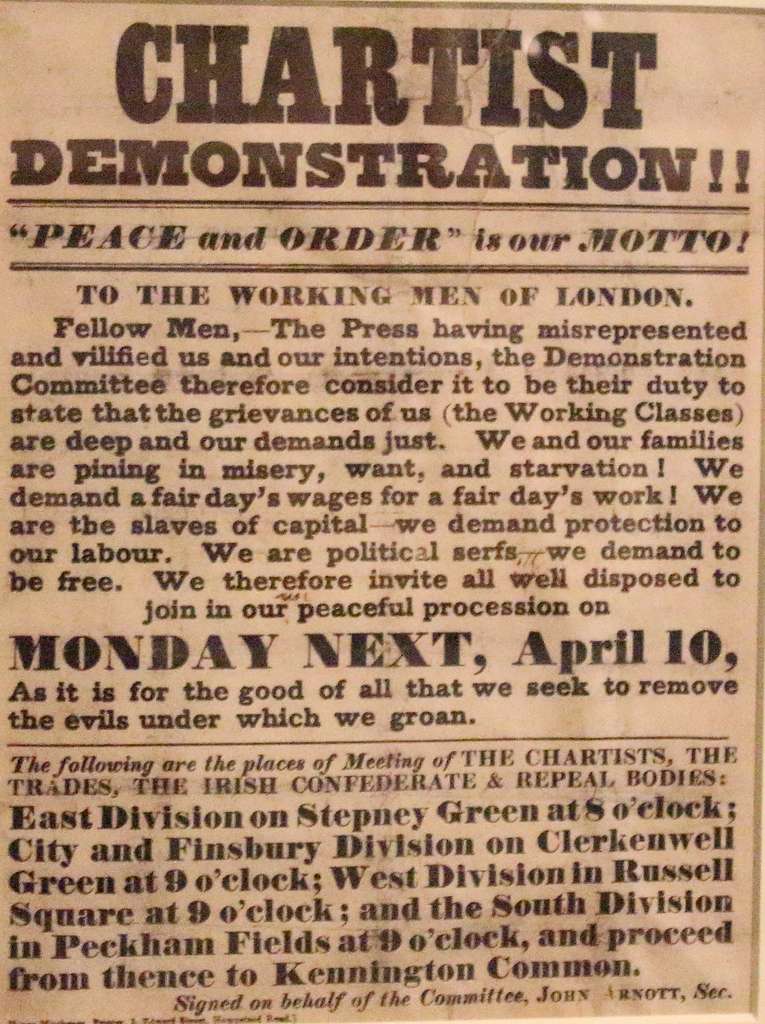
The whole democratic and socialist movement, which is based on considerations of the law of nature, considers the evil of the existing order of things to be the result of bad laws based on usurpation. Certain cunning despots are supposed to have got hold of society in order to oppress and to exploit it for the benefit of a small minority. This whole system of government is therefore a misuse and violation of the social contract and of natural equity. This conception appeared with classic clearness in the conspiracy that is connected with Babeuf’s name. The people are justified and in duty bound by all great principles to do everything in their power to sweep away the unnatural, unjust, and pernicious state of things. The fight against this condition is a holy war for the restoration of the law of nature, the social contract, the ancient constitution, innate rights and liberties—a holy war against usurpers, who destroyed and subverted the old conditions. What need is there of further arguments? What is the use of philosophising, of educating and enlightening the masses when everything is all as clear as daylight? The aim of society is the happiness of all and the protection of all. This aim would have been realised if despotism and oligarchy had not destroyed the ancient rights and pledges. The existing order is full of manifest evils; each of the evils is an indictment against the usurpers and an argument against the minority who gained their power by robbery and destruction. Nature created men in a state of freedom, the rulers threw them into chains.
Such conceptions are just as much calculated to incite violent insurrections of the mass of the people as the feelings of the robbed against the robber. The passions become much more easily roused to action if claims are made upon ancient rights which have once been possessed than if new rights are demanded. In the first case no further evidence or further arguments are required; force alone is necessary to overthrow the robbers i.e., the Physical Force argument. On the other hand, if rights are demanded which have not hitherto been enjoyed, or if indeed reliance is placed upon new rights in order to contest obsolescent and moribund rights, then the demand for these rights must be based on theory. In this case the feelings play a much smaller part than reason, research, and education.
O’Connor’s victory was inevitable; his tactics corresponded more exactly than Lovett’s to the fundamental ideas of Chartism.
The history of Chartism as outlined in the preceding four sections will be treated in detail in the following chapters.
NOTES
1. Quarterly Review, June to August, 1826, pp. 92-99. Cf. also Ure Philosophy of Manufacture, Introduction.
2. Leeds Patriot, November 29. 1829.
3. Voice of the People, Manchester, January 1, 1831.
4. Sheffield Courier, quoted by the Midland Representative, September 17, 1831. The latter paper was edited by Bronterre O’Brien.
5. Crisis, September 28, 1833.
6. Only one number of this weekly journal has been preserved. All that we know about it otherwise occurs only in extracts printed by the Poor Man’s Guardian in August, 1834.
7. These ideas were later secured for Socialism by Engels and Marx. Both expected great things from this movement, if not from its leaders. Cf. infra XIII. 2; also the Northern Star, December 4, 1847.
8. Poor Man’s Guardian (Penny Paper), May 26, 1831.
9. Ibid., January 12, 1833. The names of the specified ingredients are the titles of Thomas Paine’s works.
10. Carpenter’s Monthly Political Magazine, February, 1832, p. 229.
11. Poor Man’s Guardian, August 15, 1835.
12. Northern Star, May 14, 1842.
13. This idea is very clearly expressed in Pascal’s Pensies, ed. 1850, Pt. I. Ch. XII. § 7.
PDF of full book: https://archive.org/download/historyofbritish01beer/historyofbritish01beer.pdf
 Revolution's Newsstand