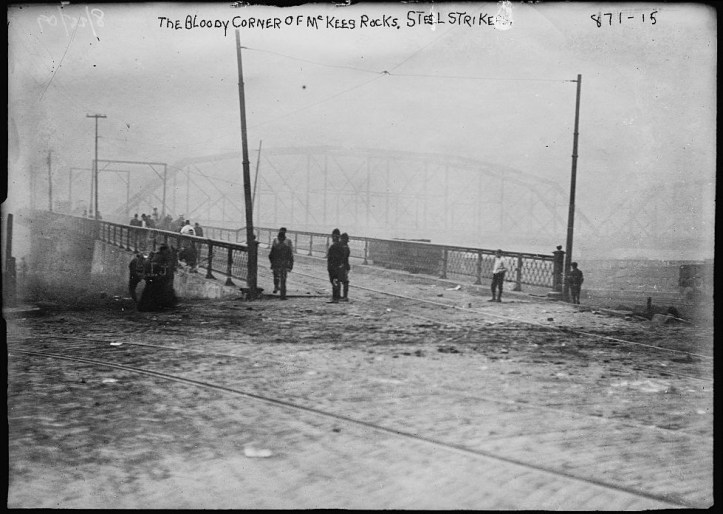
Details from one day of the epic confrontation with the Pressed Steel Car Co. that took many lives over the summer of 1909 outside of Pittsburgh.
‘News from the Strike Zone’ from The New York Call. Vol. 2 No. 205. August 27, 1909.
COMPANY EVICTS MORE STRIKERS
Kind Hearted Citizens Aid Women and Children Cast Out in Rain.
COSSACKS SEEK TROUBLE
Federal Investigation of Peonage Charges Show That Men Were Intimidated.
Although the courts and the powers of the state are lined up against them the 8,000 men, who are out on strike against the horrible conditions at the Hoffstot steel car plant, show no signs of weakening and declare they will fight on until victory is theirs.
A cold, drizzling rain fell on McKees Rocks and Schoenville today. And it fell on homeless families of strikers of the Pressed Steel Car Works who had been evicted from the company houses.
Many of the families evicted today had no place to go and friends were busy endeavoring to arrange for some place to house the unfortunates. A one horse wagon was pressed into service, the men buckled themselves to the shafts and the heavy furniture was moved in this way. A local butcher also donated a wagon, as well as promising to supply the evicted families with meat until the men got to work.
In many cases the parents and children carried heavy loads through the streets to a hillside just outside the strike district.
As the day progressed and the pathetic incidents were more numerous sympathetic team owners assisted the strikers.
Men Afraid to Talk in Plant.
Owing to the dissatisfaction expressed over yesterday’s investigation in the car plant on the peonage charges. Special Federal Agent H.W. Hoagland abandoned the idea of returning to the plant today. It was pointed out that the men were afraid to talk in the plant and Hoagland has arranged for the strikers’ committee to appear before him in private with any witness they may have. More than fifty strikebreakers left the plant today.
Hoagland examined a number of witnesses at the Federal building today. The first witness was James Goddfried, of New York City, who asserted he worked in the car plant six days and then wanted to quit. Little attention, he said, was paid to him and he refused to do any more work. He alleged that Samuel Cohen, head of the company’s service bureau, pointed a revolver at him and said: “You go to work, there, or I’ll shoot your head off.”
He refused, he said, and was then allowed to leave the plant.
The other witnesses testified that they had been held in the plant of the car company against their will. Eventually they were released, but when they first attempted to leave they said they were cursed, guns pointed at them, and ordered back to work.
Alexander Freidman testified to seeing two men stopped by guards when they tried to leave the plant. One of these men refused to work for two days and was compelled to go without anything to eat.
Guards Made Friedman Work.
Friedman also said that the company foreman asked that he be locked up in the box car prison because he refused to work. Friedman says Lieut. Smith refused to lock him up on the grounds that the constabulary was not there for that purpose.
He said it was not his duty at the plant to make the men work. When they left the lieutenant, the two guards took Friedman to two representatives of the company, and explained the trouble. The latter asserted they would make Friedman work. He was taken to the kitchen again and forced to work for an hour. He was told that his pay for the extra work would be his supper. Friedman did not claim that the force was used to keep him from leaving the works, but said he knew of cases in which it had been so. He quit at the plant the day after his experiences in the kitchen. He asked for his money and it was given him. He alleges, however, that he did not get as much as was coming to him. Friedman referred to Lieutenant Smith of the constabulary for confirmation of his statement regarding the incident in which the officer figured. Attorney Dodds, for the company, jumped to the floor and said: “We will hold this man. He has made charges that we wish to investigate.”
“You will not hold the man at all. He is a subject of the Austro-Hungarian government, and as attorney for the Austro-Hungarian consul I will see that the man is protected.” said Attorney Charles Culents.
Company’s Lawyer Throws Bluff.
“But he has made charges against our company which are awful if true, and if not true, he should be made to suffer,” shouted Dodds.
“I demand that he be held as a witness.”
District Attorney John M. Gibson at this point took a hand, declaring that the government authorities would decide who would be held and who would not. Dodds was insistent, and finally Attorney Gibson announced flatly that Friedman would not be held. Attorney Culentz protested to Special Agent Hoagland that this was all but a bit of side play to intimidate witnesses. Friedman testified that he had been locked up for days without food until he promised to work.
Joseph Barta, an Austrian, swore he had seen a guard pull a gun on men inside the works, and threaten to kill them. He had seen James Coddfraid) attacked by a guard with a gun, and Coddfraid had dared the guard to shoot,
Another company of state constabulary was rushed to McKees Rocks from Newcastle. Pa., today, making ninety mounted men on guard.
There was some excitement when fifty mounted troopers today swooped down on part of Schoenville and searched all houses for arms.
There were many weapons uncovered and in all cases where the house owners were foreigners the weapons were confiscated. In several cases after weapons had been taken the owners proved themselves to be American citizens and the arms were returned. The troopers said they had orders not to take arms from American citizens.
Inside Investigation a “Whitewash.”
The strikers declare that the investigation conducted within the plant was a “whitewash.”
Though Hoagland questioned more than eighty strikebreakers in the plant not one of them stated that they had been held in the plant against his will. The strikers, however, point to the fact that more than 200 strike-breakers have left the plant in the last two days.
These, they say, are the men who were clubbed and held in the plant, but were released as soon as an investigation was threatened. The men examined yesterday complained the food they received and stated that they were not being paid as well as the representatives of the company said they would be.
The strike district passed the quiet-st night in weeks last night. The streets were entirely deserted, and the guards were withdrawn at 11 o’clock.
The Money Cost of the Fight.
It is estimated that the strike has now cost the strikers, company and county a total of $1,000,000.
The strike has been on just forty-five days. The output of the car company is estimated at $60,000 per day and with an estimated profit of 10 per cent, and with thirty-nine full days lost, together with six Sundays when a half force is working, the loss in profits amounts to $252,000. This, taken with the damage to machinery due to being handled by inexperienced men, the chartering of special trains to import strikebreakers, the feeding and paying of the strikebreakers and the furnishing of the culinary department swells the cost to the company to $500,000.
The loss to the men has been almost as great, as 8,000 men are engaged in the strike.
The county has now expended $33.750 on the strike. Between 100 and 200 deputy sheriffs have been on duty constantly on an average pay of $5 per day, which has made the cost to the county $750 per day.
State Thugs Provoke Citizens.
The Cossack-like attitude assumed by the state troopers in taking ab- solute command over all persons within the strike zone will result in a number of informations being made against them by the strikers’ executive committee, backed by several McKees Rocks business men, who promise to push the cases to the end. An unprovoked attack was made on the strikers’ commissary Tuesday night which has aroused the committee and an appeal has been made to the sheriff for some redress. Dashing madly up and down the streets, and firing their guns in a reckless manner, the troopers almost succeeded in precipitating serious trouble and it was with difficulty that the workers were restrained by cooler heads.
Late in the evening a detachment of the troopers rode up to the commissary headquarters where a number of the committee is continually on duty. Firing repeated volleys from their riot guns the men dashed up to the door. One of the troopers, approaching a man who was leaning from the window, and pushing a gun into his face commanded him to get back into the building.
Threaten Death to Peaceable Strikers.
“Get back, in there, and stay there,” he commanded, “if you don’t we’ll kill every damn one of you.”
The men, one of whom have carried guns at any time since the start of the strike, obeyed, but the matter was reported to the sheriff.
The brutal attack upon Dr. Rudolph Hanover, who was struck on the head by a trooper while standing peaceably on the street, has done much to increase the hatred of the strikers against the troopers. Dr. Hanover is one of the most respected men in the district, having administered gratis alike to strikers, strikebreakers, deputy sheriffs, and troopers, and the entire populace is indignant at the brutal assault.
Despite the urging of his friends, Dr. Hanover refuses to prosecute the trooper, fearing that a hearing in the case would incite further trouble. Another man who was standing quietly on the street was attacked the same day as the assault was made on Dr. Hanover. The man was told by a trooper to move on, and when he said that he was a citizen of McKees Rocks he was struck on the head with the trooper’s mace and sent staggering down the street.
The threat against President C.A. Wise and the balance of the committee by Trooper Oscar Wolfe promises to culminate in serious trouble for the trooper. On Monday Wise was stopped by one of the troopers and asked to declare who he was and to explain his business. This Wise refused to do, believing that the troopers should knew him. Angered at Wise’s refusal to give the desired information the trooper said:
“If you do not answer decently and behave properly in this district you will get your damned head knocked off. You had better for the present keep your nose out of here.”
Wise Will Sue Brutal Trooper.
Wise indignant at the threat, reported the occurrence to Sheriff A.C. Gumbert, and the latter promised an investigation. It is said that the Sheriff reported the matter to Captain Marsh, of the troopers, who asked that the Sheriff request Wise to make future complaints direct to the troop commander. Wise declares he will not follow this suggestion, but will enter suit against Trooper Wolfe on a surety of the peace charge for a threat made by him. Wire says Wolfe, on behalf of the troopers, told him they would “fix him” and the rest of the committee before they were through.
More evidence of the outrageous conduct of the troopers is given by two young Germans who, early Sunday morning, were assaulted by two of the troopers, dragged from a street car, taken into the car plant office and locked in a filthy box car lockup and there confined until yesterday morning, when they were taken before Alderman Heber McDowell and fined $5 and costs each on charges of disorderly conduct. The men paid their fines and today reported their experiences to the Leader.
According to their story, the men had been at Caropolis Sunday and were returning to the city by street car. At 12:30 o’clock in the morning, they say, the car was stopped on the O’Donovan bridge and boarded by state troopers. They were told to get off the car, which they refused to do. Two troopers, they say, attacked them, beating them with their maces, dragging them from the car. They were handcuffed and taken into the company’s office where they were searched and relieved of their valuables. They were taken to the box car and locked up. Another man on the car, they say, pretended to be asleep and he was not molested.
After being kept in the box car without food until 12:30 o’clock Tuesday they were brought to the city and given hearings before Alderman McDowell. The charge of disorderly conduct was made against each by the troopers making the arrests. They say they were not heard and were not given an opportunity to plead guilty or not guilty.
On hearing the testimony of the arresting officers, the men say, the alderman imposed the fine, with the alternative of thirty days in the workhouse. The fines were paid but, owing to the absence of witnesses, the men believe it useless to appeal the case.
Innocent Man Shot by Assassins.
H.B. Robbins, a freight conductor on the Pittsburg and Lake Erie, who lives near the O’Donovan bridge, has made a statement regarding the shooting of a foreigner Sunday night by one of the troopers, to which he is willing to swear.
He says that on returning from a meeting of the Order of Railway Conductors he noticed a foreigner following him. On reaching an alleyway leading to his home, he says he left the street and saw two troopers dashing toward the foreigner, When the troopers were opposite the alley which Robinson had entered, he says he saw the trooper nearest the foreigner whip out his revolver and pointing it toward the inoffensive man, fire. The man threw up his hands and fell against the bridge railing. The troopers continued down the street without stopping to see if the man was seriously hurt.
Two of the injured man’s companions came to the rescue and escorted him to his home. An examination made by Robinson showed where the bullet had lodged in the bridge railing after striking the man. Robinson says he believes the bullet passed through the center of the man’s body.
It is generally conceded by neutral parties that the troopers are doing all in their power to incite rioting, and that if any further trouble starts the blame will be theirs.
Sheriff A.C. Gumbert has promised to meet with the strikers’ executive committee and hear their complaints against the troopers, and also to consider their request for the withdrawal of the troopers.
Sheriff Can Order Troops From Scene.
He has been called to time by the strikers’ executive committee and will be forced to make a positive declaration of his position. When the strike started the sherif told the executive committee that with the first attempt of the company to import strikebreakers he would withdraw his deputies. This he has failed to do, and in response to a request from the committee he has consented to attend a meeting today.
He has repeatedly stated that he has an authority to order the withdrawal of the state troopers, saying that he would do so if it was within his power. Governor Edwin S. Stuart’s declaration Tuesday to the effect that the sheriff is the only man who can order the troopers from the scene will be put squarely up to him and an explanation of his attitude demanded. Sheriff Gumbert declined yesterday to give permission for a representative of a Pittsburg paper to make an inspection of the Pressed Steel Car plant under the guidance of either the sheriff or a deputy selected for the purpose.
“It would be impossible for me at the time,” he said, “to arrange for such a visit, as I do not know when I will again visit the plant. I do not think it would be right, either, for me to show such courtesy to one paper without giving the other Pittsburg newspapers a similar opportunity to have a reporter visit the plant. I have practically turned down like requests from every paper in this city.”
It was learned today that when Eugene V. Debs, who addressed the strikers on Indian Mound yesterday, heard how difficult it was for the men to raise funds for the burial of their fellows who were shot in Sunday’s trouble. He contributed enough cash to defray the expenses of a casket, a hearse and carriages.
PDF of full issue: https://www.marxists.org/history/usa/pubs/the-new-york-call/1909/090827-newyorkcall-v02n205.pdf
 Revolution's Newsstand