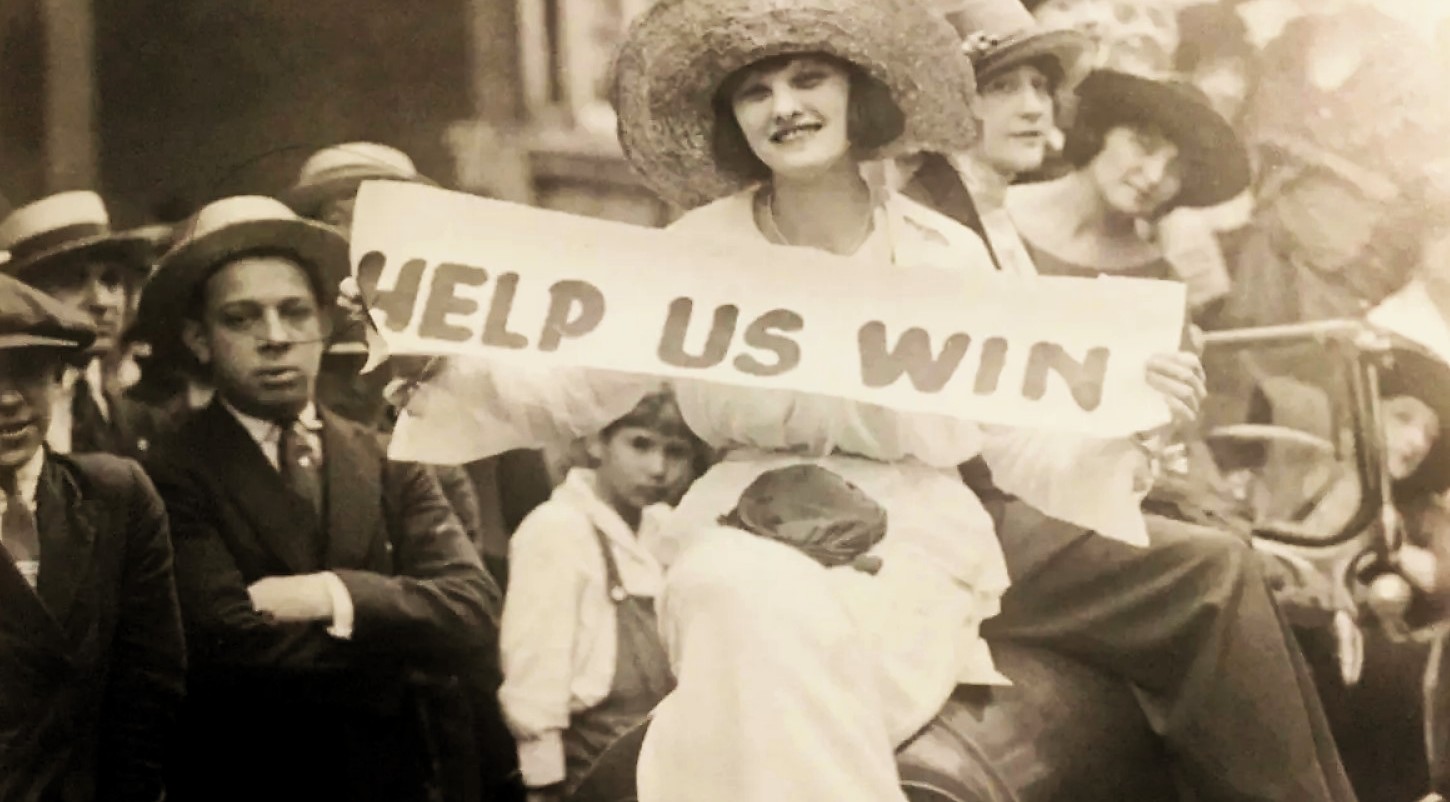
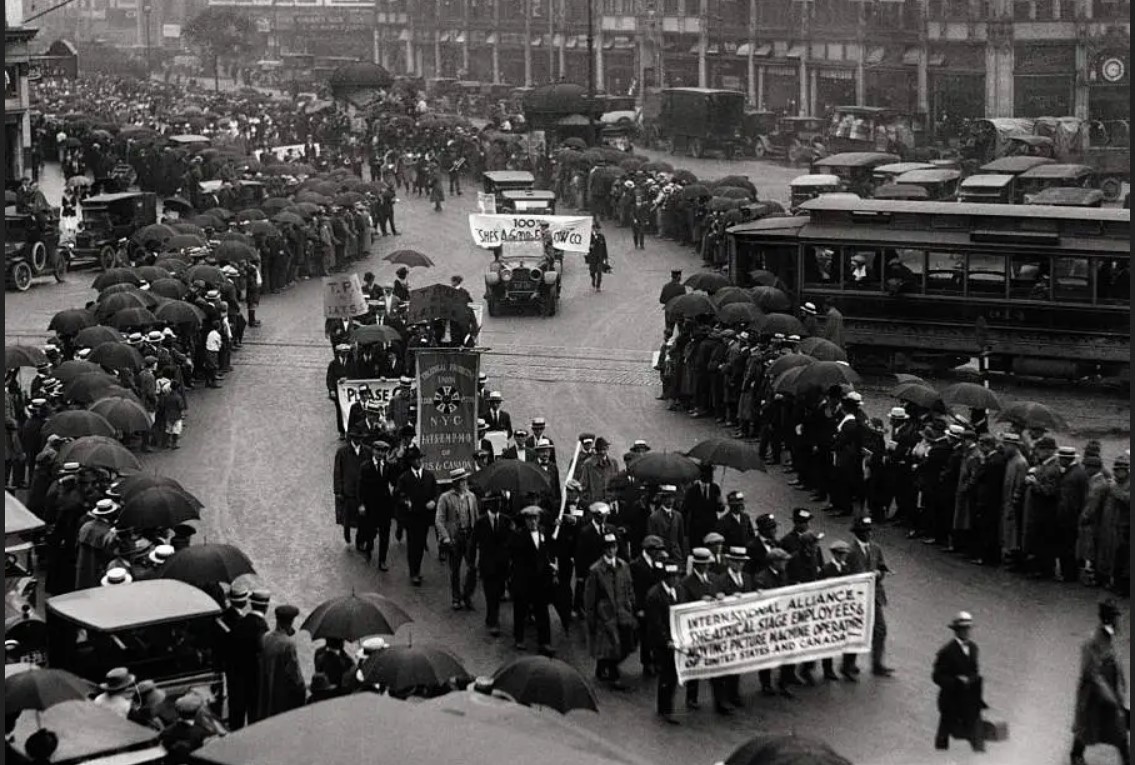
1919 was a year of strikes, with actors also part of the rising tide of class consciousness. Here, Los Angeles comes out in solidarity for 1919’s New York Equity strike.
‘The Actor’s Strike’ by Gertrude Andrews from New Justice. Vol. 1 No. 14. September 1, 1919.
The New York actors’ strike is a thing of deeper significance than is generally realized. It is a particularly interesting manifestation of the great driving force which is impelling the rights of life–life feared, suppressed, exploited, butchered. It is a part of the effort to realize the Universal Law which is growth–a growth that has been hampered by the dead logs of an old System.
The actor’s art is the interpretation of life. It is the most democratic of all the arts. All classes sit together in the same audience, and watch the same play. And now for the first time in history, these interpreters of life, of the art which is democracy, are making a concerted fight for life and democracy. They are trying to dignify their art by making it a recognized part of the world’s work. For the actor’s art has not been a thing so dignified. It has been a thing ridiculed. It has not gained the crown of utilitarian dignity, but has jingled the bells of Folly. It has not been considered a thing of food, but rather an after-dinner digestive tablet. So it was a day of big significance when the Actors’ Equity joined the Federation of Labor. It marked the beginning of the new social era; the impulse of which will be the development of the whole man–make him creative rather than efficient–when art and bread shall unite in corpuscles to nourish both spirit and body.
The Actors’ Equity was organized six years ago to better the condition of the actor workers. And these conditions very much need bettering. Other classes of workers have had to suffer the injustice of small pay. But actors form the only class who have had to work for nothing. No salaries have been paid for the weary work of rehearsals. Companies have rehearsed from eight to ten weeks with out pay. When the play is produced, if it be successful, the actor gets his salary. But very often it is not successful. It may run a week or two and close. Then the actor is not only thrown out of his job, but he has lost weeks of time and the money paid for his costumes.

He has had to work under a contract which stipulates that for three particular weeks of his season he shall receive only half salary–Holy week, the week before Christmas and election week. One of the big managers tries to book his company in Canada during our election week. By so doing he gets bigger profits in this reduction of salaries, for his business suffers no loss. No pay is given for extra holiday and Sunday performances. But if, on account of bad routing, the company loses a night on the train, then the actor is docked for the management’s failure to keep him at work. But he himself must pay for the sleeper necessary for the long trip. These are only a few of the injustices.
The equity made many attempts to change these conditions, but these were all abortive until the organization finally affiliated with Union Labor. Now, as Frank Keenan said, the other night at the Equity meeting at the Hollywood Hotel:
“They can’t lick Equity; for to do it they’ve got to lick the whole of Union Labor.”
And Milton Sills sounded the spirit of that Hollywood meeting when he said:
“I’m glad of the chance to take the other workers of the world by the hand.”
“Other workers” is significant.
The meeting in Hollywood was called Monday evening, August 18th. About three hundred actors, now working in the pictures, were present. George Fawcett acted as chairman. Frank Keenan, Milton Sills, Bert Lytell, Fred Niblo and William Courtleigh were the speakers. The whole attitude of the meeting was simple, big and genuine; with no touch of theatricalism in which actors might be expected to have indulged. Neither was there any bitterness; only an occasional ripple of amused contempt. And here suggests a thing which Equity might do for Unionism–inoculate it with the actor’s sense of humor.
The meeting was called for the purpose of raising money for the striking actors in New York. The response was not only generous, but fervent. Ten thousand dollars were raised in a few minutes. Frank Keenan, charter member of Equity, started the subscription with a thousand dollars. Others gave big sums. Many pledged percentages of their salaries. Immediately after the meeting the committee went to the telegraph office and wired the money on to New York where it was much needed.
It was a big meeting attended by people of big reputation, inspired by a big spirit and of big social significance. All of which should have made it big news. Yet scarcely any mention was made of it in the press. But life’s opportunities of growth have been increased by it. Good news comes across the wires. Ed Wynn, now the most popular and highest salaried musical comedian, is doing picket duty on Broadway. In the evening he entertains audiences on the street, to keep them from attending the few theatres now running with scab performers. He said the other day:
“I cannot impress too deeply on the public the fact that the artists earning large salaries have left their respective shows to fight, not for more money, as the public is led to believe, but purely for a principle.”
And Frank Bacon, so well known, and so much beloved, on the coast, and who made his big success late in life, said in New York to an audience of strikers:
“I’m an actor, author and manager; but when this strike began, my wife said to me, ‘we’ll stick to our own folks.’ I can still cook on a one-burner coal oil stove, if necessary, and if we go down we’ll go down in good company. So we’re sticking.”
“Our own folks” is expressive of the real social spirit–the solidarity spirit which gets results.
The New Justice was a twice-monthly journal published by the Friends of the Russian Revolution out of Los Angeles and edited by Roswell Brownson and Clarence Meily. Inspired by the Russian Revolution, New Justice was one of many communist journals that were produced by the Socialist Party’s Left Wing and the IWW in the years immediately after 1917. New Justice lasted less than year before folding. It’s pages, focused on the arts and art of revolution, reflected the cosmopolitan, English-speaking revolutionary West Coast left personified at the time by The Masses on the East Coast. A victim of the Palmer Raids, it shut production in January, 1920.
PDF of full issue: https://www.marxists.org/history/usa/pubs/new-justice/v1n14-sep-01-1919-justice.pdf
 Revolution's Newsstand