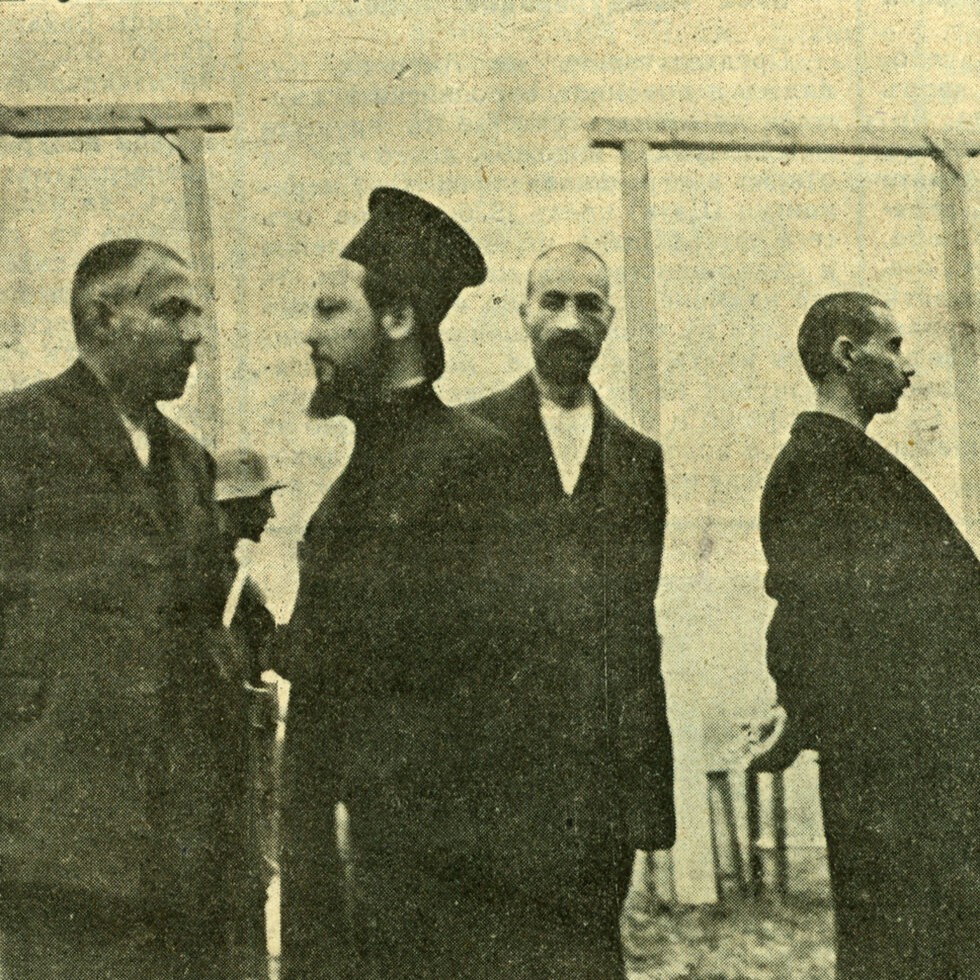
After a decade of slaughter in a series of wars, the Balkans became a prison-house and execution ground as imperialism, counter-revolutionary emigres, and local moneyed-reaction united to destroy the region’s powerful workers’ movement and stem the Eastern tide of Communism from washing over Europe. Dimitrov on the horror imposed upon the Balkans in the name of Church, Family, and State. ‘The tradition of all dead generations weighs like a nightmare on the brains of the living…’
‘The Anti-Bolshevik United Front in the Balkans’ by Georgi Dimitrov from International Press Correspondence. Vol. 5 No. 5. January 15, 1925.
Never since the war was the situation in the Balkans so serious and so uncertain as it is at the present moment. The present governments in the Balkan countries rely solely upon brute force against the masses of the people and upon the support of European imperialism of which they are the true and obedient agents in the Balkans. By their fascist methods of government the Balkan governments are intensifying the economic crisis still further, increasing unproductive expenditure (for police, army, fascist organisations etc.), completely disorganising production, transport and commerce, giving a free hand to profiteers and speculators in food, throwing the colossal burden of taxes, war and reparations solely upon the shoulders of the mass of the people and increasing their misery beyond all limits.
The few gains won by the working class during the first years after the war (Eight Hour Day etc.) and those won by the peasant masses (the distribution of a part of the land) have been abolished. The workers are exposed to unlimited exploitation; in many localities the land which had been distributed has been given back to the big landowners. The workers’ and peasants’ organisations are the object of constant and cruel persecution, while the prisons are filled with the leaders and functionaries of these organisations. Hundreds have been and will be murdered by the government organs and by the fascist bands; this is particularly the case in Bulgaria.
At the same time the national minorities are subjected to unbearable suppression. The Balkan governments know no other means for solving the complicated national problems than the most cruel denationalising, driving out of the alien elements from house and home, and the colonising of these districts with peasants of the ruling nation. In Bulgaria, Greece and Turkey there are hundreds of thousands of refugees who are left without land, without lodging and are lacking the barest necessities. These refugees act as unfortunate competitors with the native workers and peasants; they are made use of by the capitalists in order to worsen the position of the working masses and by the Balkan governments for their reactionary and fascist policy.
As a result of this, the discontent called forth by the reactionary regime in the Balkan countries is increasing daily among the masses of workers and peasants and among the suppressed nationalities. It is reaching bursting point and will finally find expression in a furious, irresistible movement for liquidating the reactionary regime.
In Bulgaria a powerful wave of popular feeling is rising against the Zankov regime, which the more it is debarred from legal means of expression the more inevitably will it find an outlet in an uprising on the part of the mass of the people against the governing oppressors and hangmen.
The attempt of the Serbian bourgeoisie and of the monarchy in Yugoslavia to retain their hegemony over the other nations and over the working and peasant masses at all cost by the bankrupt regime of Pasic-Pribicevic is driving the country into civil war. The government has already dissolved the Croatian Peasants Party and arrested its leaders.
The government of bankers and Boyars in Roumania, with Bratianu at the head, has not only aroused the antagonism of the population of Bessarabia, of Dobrudsha and Transylvania, but also the masses of people in the old territory of Roumania. The revolt which recently took place in Bessarabia, the increased national movement in Dobrudsha, the national fermentation in Transylvania, the revival of the labour movement and the growing peasants’ movement against the Boyars, are the precursors of the inevitable overthrow of the regime of the bankers and Boyars in Roumania.
The incompetence of the present Greek government to consolidate the Republican regime, to ameliorate the misery of the working masses, and particularly its inability to solve the problem of the refugees (in Greece there are at present 1,200,000 Greek refuges from Asia Minor), is creating deep disappointment among the working masses; this is encouraging the monarchists and opens the prospect of fresh severe inner struggles in Greece in the near future.
At the same moment the spectre of war is again appearing in the Balkans. As a matter of fact this war has already begun in Albania over the question of its division between Yugoslavia and Italy. For this purpose an armed invasion was organized the bourgeois press calls this revolution upon Serbian soil and with Serbian arms and soldiers, as well as with members of the Wrangel’s Army, by the former Albanian Prime Minister Achmed Zogu, who had been driven out by the Albanian people. The Albanian government of Fan Noli itself facilitated the realisation of the devilish plans of the foreign conqueror of Albania. in failing to fulfil the hopes of the Albanian peasants regarding a solution of the agrarian problem and to grant them land, and thereby in this manner alienating the Albanian peasants.
The bourgeois Balkan governments are carrying on their rule, although they are sitting on a volcano, and at the same time are playing the role of agents of Entente imperialism. They are now realising the hopelessness of their situation and are therefore stretching out their hands for mutual help. They seek salvation from the indignation and the revenge of their peoples by engaging in fresh military adventures, in order to divert the attention and the forces of the mass of the people and to continue their rule. The imperialist states on their side are taking advantage of this difficult situation of the Balkan governments, not only to consolidate their control in the Balkans and to exploit it all the better, but also to make use of the Balkans as a basis for their imperialist world policy and particularly for a war against the Union of Soviet Republics, in which the peoples of the Balkans are to serve as cannon-fodder.
It is quite evident that a temporary understanding between England, France and Italy regarding the Balkans has recently been arrived at. The Conferences which Mussolini and Chamberlain recently had with the Yugoslavian Foreign Minister Nintchitch, the journey of the Yugoslavian monarch, Alexander, to Paris and the visit of the chief of the murderers ruling in Bulgaria, Zankov, to Belgrade and Bucarest have also the same purpose.
In order to conceal from the Balkan peoples the real intentions which the Entente imperialists and the Balkan governments are pursuing, a noisy campaign against the Bolshevik propaganda of Moscow, which is endangering “peace and order” in the Balkans, has been instituted. Under cover of this noisy campaign, secret treaties and military agreements have been concluded in the last few days behind the back and at the cost of the Balkan population.
It is characteristic that whilst, officially, Serbia up till yesterday was an irreconcilable enemy of the Bulgarian government of Zankov, and looked for the slightest pretext for military intervention in Bulgaria, today when Pasic wishes to break the resistance of the Croatian and Macedonian peoples, as well as of the workers and peasants of Yugoslavia, and is being compelled by Paris and London to a reconciliation with Sofia the Bulgarian blood-hound Zankov is solemnly received by the government circles in Belgrade, in spite of the aversion of the mass of the people which was expressed by a demonstration on the arrival of Zankov in Belgrade.
The Bulgarian bourgeoisie on their part conducted a furious campaign against the government of Stambulisky, when the latter made the attempt to establish an agreement between Yugoslavia and Bulgaria, by accusing Stambulisky of betraying the interests of the Macedonian people. It was by this means that it succeeded in inciting the Macedonian organisation against Stambulisky and prepared the political success of the overthrow of the 9th June of 1923. The Zankov government, the representative of this same patriotic bourgeoisie, crushed the Macedonian organisation and murdered hundreds of its best leaders in the most cruel manner in order to free the way for Zankov to Belgrade and Bucharest.
The so-called anti-bolshevist united front in the Balkans is directed before all against the movement for freedom of the working and peasant masses and of the suppressed nations in the Balkan countries. It constitutes the desperate attempt of the bourgeois-monarchist cliques in the Balkans to continue their bloody rule. This attempt is closely connected with the imperialist acts of violence in Egypt, in the Sudan, in Morocco, India and China. It is the work of Entente imperialism and its vassals in the Balkans. It constitutes an integral part of the preparations for a new imperialist war, which will be directed against the movement for liberty of the working peoples of the world, at whose head there stands the Communist International, and which has as its basis one sixth of the globe as represented in the Union of Socialist Soviet Republics.
It is clear to everyone with a knowledge of the situation in the Balkans that a permanent agreement among the governing cliques in the Balkan countries is impossible. Irreconcilable antagonisms still divide them further. The rivalry for hegemony in the Balkans renders the chasm between them still deeper. They will not be able to solve a single one of the great national problems of the Balkans. As a result, the anti-bolshevik front in the Balkans will therefore soon collapse at the first collision between the bourgeoisie of the Balkan countries over the division of the booty and at the first fresh sharpening of the differences between France, England and Italy regarding the Balkans. The new predatory union of the Balkan governments and dynasties against the “bolshevik” danger will experience no better fate than the Balkan League against Turkey in 1912 which, as is known, ended in a war among the allies when the latter came to divide the spoil they had robbed from Turkey.
The present eager attempts to create an anti-bolshevik united front in the Balkans, the new dangers which arise therefrom for the Balkan peoples, the constant treachery which the Balkan governments practise against their own people in order to save their reactionary rule, all this will finally open the eyes of the working and peasant masses and of the suppressed nations in the Balkan countries. It will show them more clearly the necessity of a general revolutionary united front of the workers and peasants and of the suppressed nationalities for the overthrow of the present reactionary regime of bankers, big landowners and profiters, and for the creation of workers’ and peasants’ republics and their union in a Balkan Federation. Only such a federation like the Union of Russian Workers and Peasants Republics, will create the necessary conditions for the final solution of the national problems and of the agrarian question in the Balkans, for the emancipation of the working class and for securing the peace, freedom and independence of the Balkan Peninsula.
International Press Correspondence, widely known as”Inprecorr” was published by the Executive Committee of the Communist International (ECCI) regularly in German and English, occasionally in many other languages, beginning in 1921 and lasting in English until 1938. Inprecorr’s role was to supply translated articles to the English-speaking press of the International from the Comintern’s different sections, as well as news and statements from the ECCI. Many ‘Daily Worker’ and ‘Communist’ articles originated in Inprecorr, and it also published articles by American comrades for use in other countries. It was published at least weekly, and often thrice weekly.
PDF of full issue: https://www.marxists.org/history/international/comintern/inprecor/1925/v05n05-jan-15-1925-inprecor.pdf
 Revolution's Newsstand