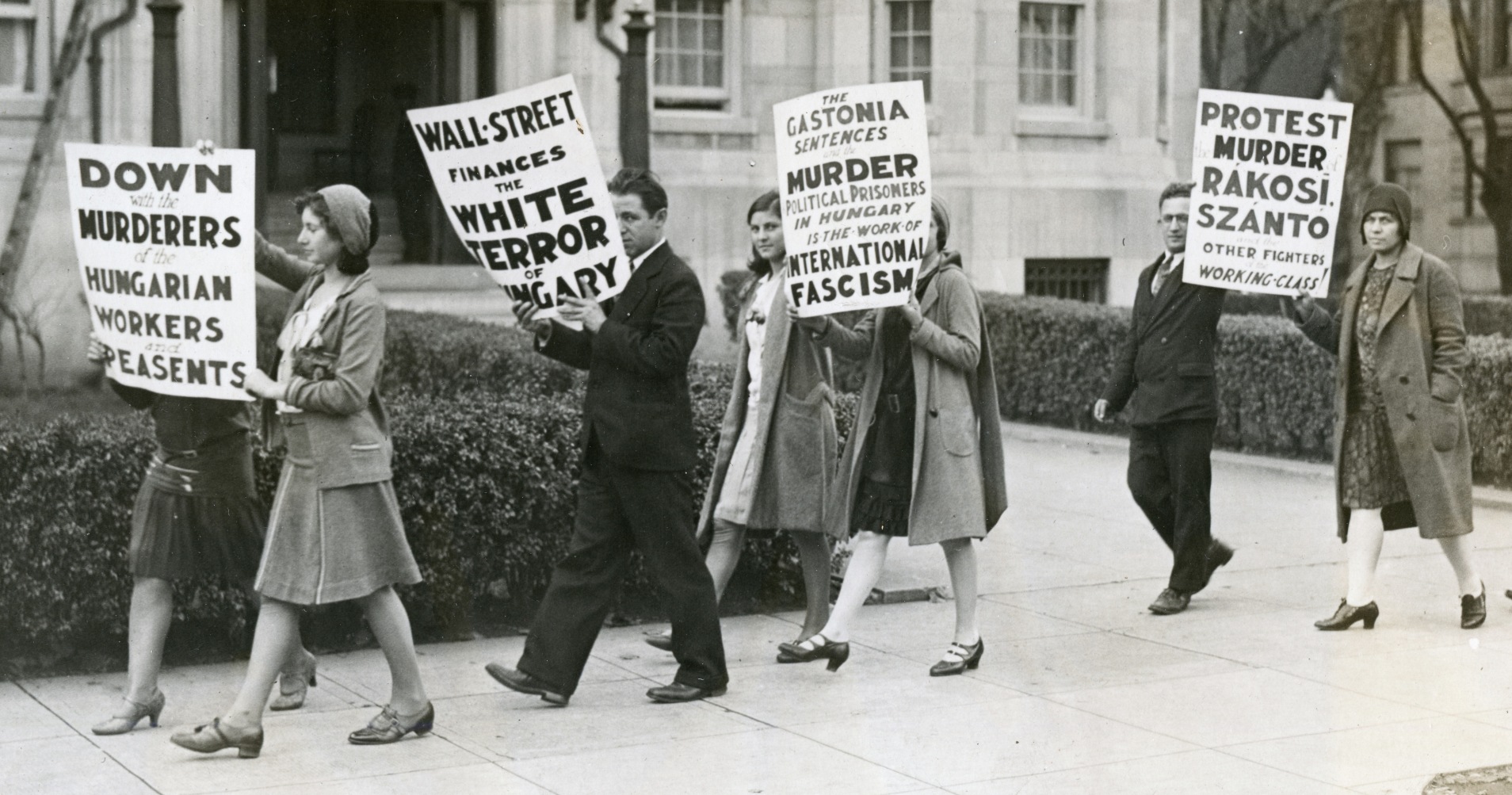
Alexander Löwy, member of Hungary’s Young Communist League participating in the hunger strike of more than 100 political prisoners, is murdered by guards force feeding him in Vacz prison. Another prisoner, Alexander Sztaron, will also died on the strike. In addition to Löwy’s obituary, articles on the beginning and end of the mass hunger strike are included below.
‘The Hunger-Strike of the Political Prisoners in Hungary’ from International Press Correspondence. Vol. 9 No. 62. November 1, 1929.
Since more than a week over 100 political prisoners in the five Hungarian prisons have been on a hunger strike. They demand the recognition of their rights as political prisoners, improved diet, increased facilities for sending and receiving letters, and free choice of books rights and privileges to which the political prisoners are entitled according to Hungarian law. The Hungarian government has issued an official communiqué according to which the hunger strike has been entered upon not owing to bad treatment but on account of questions of principle.
How cruel the prison regime is in Hungary is revealed by the alarming news which often reaches the public both from Communist and non-Communist sources. The well-known English liberal paper, the “Manchester Guardian”, published a few months ago the most startling revelations regarding the way in which Comrade Rakosi is being treated in prison. The Hungarian government did not succeed in refuting the statements of the “Manchester Guardian”. And recently a lawyer who had visited a number of political prisoners, including comrades Zoltan Szanto and Stefan Vagi, stated that these prisoners are actually delivered over to death from starvation.
As a result of the pressure of the working class, even two social democratic leaders, Alexander Propper and Anna Kethly, were recently compelled to submit to the Hungarian Minister for Justice a written complaint against the treatment of political prisoners.
This memorandum states inter alia:
Political prisoners in Hungary receive the most scanty and bad prison diet. They can expend only a part of their wages on the purchase of additional food. Yet their work is so badly paid and the food prices so high that by this means they can improve their diet only to an inappreciable extent. Still worse is the position of the sick who are not in a position to work. The friends and relatives of prisoners are not allowed to send in packets of food.
Political prisoners are subjected to military discipline. It has often happened that political prisoners have been punished solely because they have not stood at attention when confronted by prison officials, Political prisoners are placed in chains when being conveyed from one prison to another.
The Hungarian law prescribes that political prisoners can spend two hours daily in the open air. In actual fact however, they are allowed at most an hour’s exercise a day.
They are not allowed to have any writing materials. According to paragraph 137 of the prison regulations, political prisoners have the right to order books and magazines at their own cost. This right is not observed, so that the political prisoners have no other reading matter than that provided by the prison library. Books sent by post from outside are, as a rule, rejected.
Political prisoners are also compelled to work; contrary to the provisions of the law, however, they are not allowed any choice in the work to be performed. Political prisoners are allowed to receive letters only once a month. Letters sent to them are delivered only after great delay or not at all. Their correspondence with their lawyers is often held back and censored.
The brutal ill-treatment, the prolonged solitary confinement imposed as an answer to the slightest protests on the part of political prisoners are not mentioned at all in the memorandum. But even this memorandum contains sufficient facts in order to make it plain why political prisoners in Hungary have resorted to the weapon of the hunger strike.
Vienna, 24th October 1929.
The Hungarian Minister of Justice Zsitvay declared, replying to a question, that the hunger-strike of the political prisoners was a disciplinary offence and would be punished as such. The prison authorities had received instructions to use drastic measures in order to crush the strike. A number of the prisoners had already been placed in chains and all the hunger strikers were being forcibly fed.
The government and the bourgeois press continue the p of representing the hunger strike as a political action originating from outside the prison instead of a desperate attempt to prove the frightful conditions prevailing in the prisons. In order to calm the working masses, the social democracy pretends to be working on behalf of the prisoners, and the chairman of the commission for the protection of political prisoners, R. Payer, has “intervened” with the authorities on behalf of prisoners.
‘The Martyr Death of Alexander Löwy’ by Weltner from International Press Correspondence. Vol. 9 No. 63. November 8, 1929.
The hunger-strike in the Horthy prisons was carried on for a week. For a week hundreds of Communist prisoners were subjected to the most diabolical torture in order to compel them to abandon the hunger strike.
All in vain!
The Hungarian Communists, who had already often furnished heroic examples of contempt of death, on this occasion. too, bore themselves bravely in face of all the cruelties of the Bethlen jailers. Then the class rule of the hangmen played its last card. It proceeded deliberately to murder the strike leaders in order to strike fear into the hearts of the Communists.
Alexander Löwy, the heroic leader of the Hungarian Young Communist League, was murdered in the most bestial manner in the Vacz prison under the pretext of being “artificially fed”.
They thought that they would thereby intimidate the Communists; but they made a great mistake, for the Communists, as soon as they heard the news of this shameful act of murder, continued the fight with increased zeal and firmness and with still greater endurance.
Our Comrade Löwy fell in this battle. Fighting up to his last breath, in the same way as he had devoted the whole of his valuable young life to the fight against the bourgeoisie.
He came from a poor petty bourgeois family. He lost his mother at an early age; his father, a religious man, attempted with the most brutal means to bring him up in a conservative religious spirit. The bright youngster, who had passed through the difficult and painful years of the war and the revolution, soon revolted against the paternal yoke. At the age of 12 years he left his father’s house, became an apprentice in a leather business and commenced the hard life of a proletarian child. He soon came to Kaschau, where he changed his occupation and worked in a bakery. Here the storm of the revolution reached the clever, enthusiastic child, who had already become practically acquainted with the cruel lash of capital. Although yet little more than a child, he took up with unbounded enthusiasm the revolutionary Communist ideas, which found in him a fruitful soil. He was one of those few who after the overthrow of the proletarian dictatorship remained faithful to their convictions with undiminished enthusiasm. He was not yet 16 years old when he was imprisoned as one of the chief accused in connection with the Iglau putsch. In prison he was one of the most courageous; during the hunger strike the heroic youth struck for 12 days along with his adult fellow-prisoners. On his release from prison, he worked unweariedly as the district secretary of the Youth League until the end of 1925, when the Czech bourgeoisie again sentenced him to 6 months’ imprisonment. He fled from the country.
He studied for a few months in Berlin, then in Vienna, and after passing through the foreign agitators school of the C.P. of Hungary became one of the most gifted and best educated members of the Communist Youth. He then voluntarily applied for work in the illegal C.P. of Hungary. He proceeded illegally to Budapest, took up the threads which had been dropped on the arrest of Rakosi and Weinberger, and organised within the confines of the Hungarian Socialist Labour Party a big legal mass movement of the young workers. He laid the foundation for the illegal Young Communist League and extended the organisation of the Young Communist League of Hungary. As secretary of this League he was arrested in 1927 along with Comrade Zoltán Szánto.
At the police headquarters he displayed an unshakable disregard of death; as a true bolshevik leader he did not betray a word with regard to his fellow-workers or the organisations of the C.P. of Hungary, in spite of bloody tortures which were continued for three nights.
The behaviour of our Comrade Alexander Löwy, this courageous young revolutionary before the bourgeois police and bourgeois judges will for ever serve the Communists as a shining example.
He was sentenced to 3 years’ imprisonment. In prison he devoted every free minute to study. He prepared himself in order immediately after his release to take his place again in the fight against the class enemy, whom he fanatically hated in a way only those great revolutionaries who love their class more than their own lives know how to hate. In prison Löwy was among the first who fought for human treatment.
Thus he took part in the present hunger strike, in which he distinguished himself by his heroic courage. For this reason the jailers vented their rage first on him. For this reason they put an end to his valuable young life. But our Comrade Löwy has not died in vain, for his spirit lives on in the continued action of the proletariat.
The Young Communist League of Hungary and the Communist Party, of Hungary lower their draped red banner before their great dead the memory of the militant life and work of this exemplary Communist is enshrined not only in the great heart of the Party but also in that of the whole working class.
The Bethlen system, based on the brotherly union of the fascist robbers, big capital and the social traitors, is able to secure its rule for yet a while by bloodily crushing the ever-growing Communist movement. But the miserable bourgeoisie is deceiving itself. For the Communist movement in Hungary can no longer be stifled, no matter how many comrades the bourgeoisie imprisons and murders. This movement is marching uninterruptedly forwards; it is growing; it is developing in order to realise the second, the glorious and unvanquishable proletarian dictatorship.
It was in this fight that our Comrade Löwy fell.
The hunger strike is only an episode– a heroic episode–in this fight.
The heroic action of our Communist Comrades will serve to sustain the Hungarian proletariat, the proletariat of the whole world until it attains final victory.
The workers of Hungary and of the whole world will prevent the Hungarian bourgeoisie from murdering still further victims after our heroic and beloved martyr Alexander Löwy.
‘The Conclusion of the Hunger Strike of the Political Prisoners in Hungary’ by A.S. from International Press Correspondence. Vol. 9 No. 65. November 22, 1929.
The political prisoners of the Hungarian jails have stopped their hunger strike; in as just as well organised, simultaneous and disciplined manner as they began it.
The counter-revolutionary Hungarian Government boasts that it broke the hunger strike, compelled the political prisoners to give it up without making any concessions to them.
This fight was fought with very different weapons: on the one side the Terrorist Government with all the instruments of power in its hands; on the other side the prisoners, cut oft from the outer world and at the mercy of the hangmen. The prisoners knew very well that through their action they could achieve no immediate, tangible result and that the hunger strike was only the first step in the fight which the Hungarian proletariat is starting with the support of the international proletariat. The prisoners wanted to rally the oppressed toilers of Hungary, to call upon the proletariat of the whole world to support them, to expose to the whole world the conditions in the Hungarian prisons, the terrible position of the political prisoners in the “consolidated” Hungary of the Horthy-Bethlen regime. In this they were successful.
This hunger strike was an action in the class struggle. and was regarded as such by the enemy. The Bethlen Government tried with lies and calumnies to discredit this hunger strike in the eyes of the public at home and abroad. But they did not succeed in deceiving the world. In every country it is known that in Hungary those who participate in the fight for the emancipation of the proletariat are punished with hard labour and gradually done to death through a cruel prison regime.
The disclosures were very disagreeable to the Horthy-Bethlen Government and it tried to avenge itself on the defenceless prisoners. The most cruel forms of forcible feeding were resorted to and the hunger strikers were thereby maltreated and tortured with heavy disciplinary punishments. All this the heroic fighters suffered with fortitude and only gave up their hunger strike when they were sure that the Hungarian and also the international proletariat had learned of their fight and declared its solidarity with them.
This hunger strike exposed not only the Bethlen Government but also Hungarian Social Democracy, which thereby played a hypocritical role. The factory workers and the trade-union workers compelled the Social-Fascist press to publish reports of the hunger strike. The press. however, merely published complaints that the political prisoners were worse off than common criminals. The Social-Democratic press contented itself with an appeal to the government to grant the prisoners at least the regime provided by the law. Social Democracy would not take the matter up in parliament; the trade-union bureaucrats never mentioned the hunger strike anywhere and terrorised any worker who wanted to bring the matter up.
The Hungarian proletariat was not yet strong enough effectively to support the hunger strikers. The Communist Party of Hungary and the socialist Labour party raised a cry on behalf of the political prisoners, the broadest masses of the workers were in sympathy with the fighters, but no organised demonstrations or sympathy strikes came about.
The fight of the political prisoners in the Hungarian jails cost big sacrifices. Alexander Löwy, one of the best, most enthusiastic and most unselfish leaders of the Young Communist League, is dead. Alexander Sztaron, a non-Communist worker, gave his life in proof of his solidarity with the fight of the proletariat. All the others who participated in the hunger strike suffered in health therefrom.
But these sacrifices were not in vain. The hunger strike has come to an end, but the fight continues still more vigorously on a yet broader front. The proletarians and poor peasants of Hungary are not indifferent to this fight, and they will succeed in getting a humane regime for the prisoners and finally in procuring complete amnesty for them.
The oppressed proletarians of Hungary have faith in their own strength and in the support of the international proletariat. It is only a single battle that has come to an end. The class war continues.
International Press Correspondence, widely known as”Inprecorr” was published by the Executive Committee of the Communist International (ECCI) regularly in German and English, occasionally in many other languages, beginning in 1921 and lasting in English until 1938. Inprecorr’s role was to supply translated articles to the English-speaking press of the International from the Comintern’s different sections, as well as news and statements from the ECCI. Many ‘Daily Worker’ and ‘Communist’ articles originated in Inprecorr, and it also published articles by American comrades for use in other countries. It was published at least weekly, and often thrice weekly. Inprecorr is an invaluable English-language source on the history of the Communist International and its sections.
PDF of issue: https://www.marxists.org/history/international/comintern/inprecor/1929/v09n63-nov-08-1929-inprecor.pdf
 Revolution's Newsstand