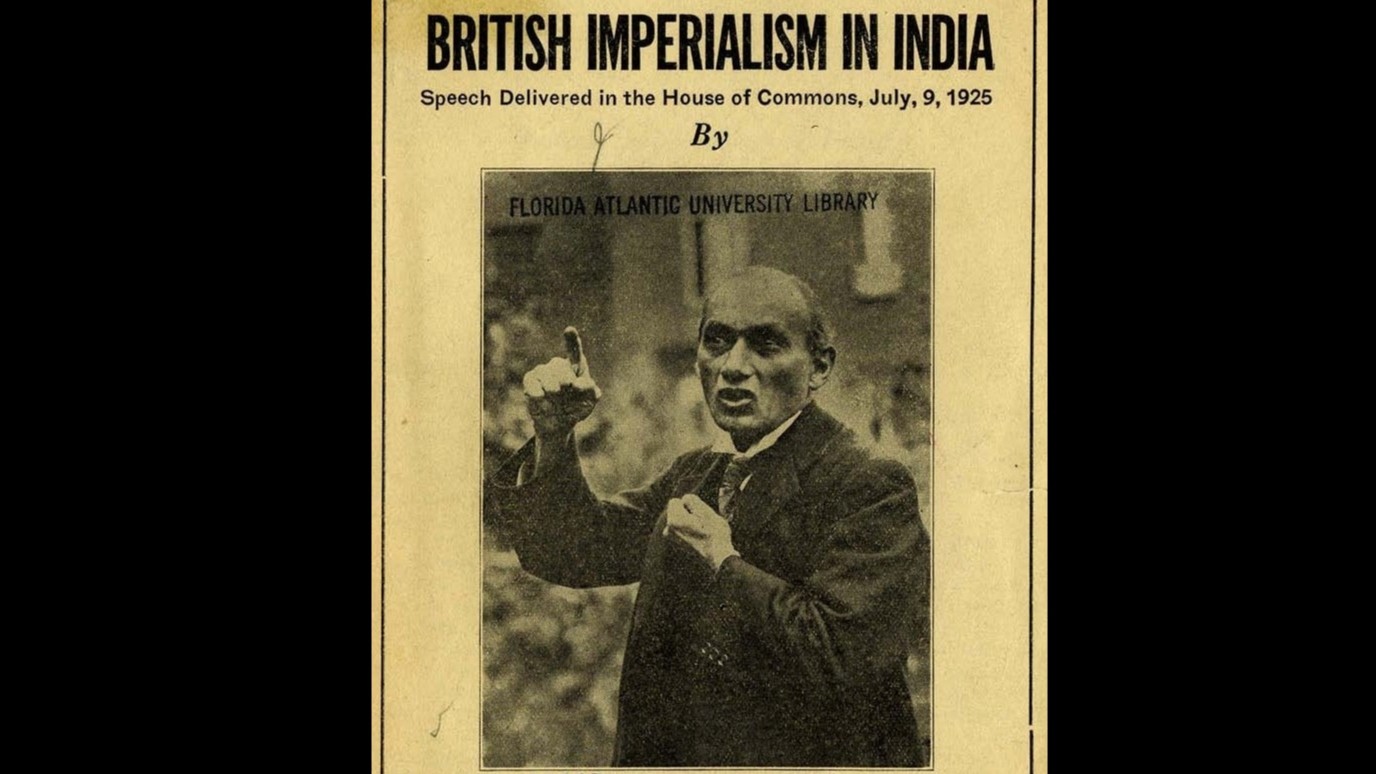
The full text of a defining speech given July 9, 1925 denouncing the British Empire from within the fetid belly of that bloated beast, Westminster, given by Indian Communist Shapurji Saklatvala. The would get him banned from a U.S. visit and have American Communists flood the country with mass produced pamphlets of the speech. That story to follow. from the Born in Mumbai on March 28, 1874, Shapurji Saklatvala was born on 28 March 1874 to education and wealth (his father a merchants, and his mother a member of the Tata family, starters the Tata Group, still among the largest capitalist enterprises in the world. Moving to England in 1905, he trained as a barrister and soon joined Social Democratic Federation and, in 1909, the Independent Labor Party. A leading force in the I.L.P.’s Left Wing Group which would join the new Communist Party in with dissident I.L.P. cadre in 1921. Endorsed by the Labour Party, but running as a Communist, Saklatvala comfortably won the Battersea North parliamentary seat in the 1922. The first Indian M.P., and with Walton Newbold also elected, the Communist to sit in His Majesty’s Parliament. After losing the following election, he was reelected in 1924 on a straight Communist platform, holding the seat until 1929.
‘British Imperialism in India’ by Shapurji Saklatvala. Daily Worker Publishing, Chicago. 1925.
Speech Delivered in the House of Commons, July, 9, 1925
In the House of Commons on Thursday, July 9th, Mr. S. Saklatvala, M.P., speaking in the Committee of Supply on the Vote for the Indian Office:
“That a sum, not exceeding £76,000, be granted His Majesty, to complete the sum necessary to defray the Charge which will come in course of payment during the year ending on the 31st day of March, 1926, for a contribution towards the Cost of the Department of His Majesty’s Secretary of State for India in Council, including a Grant,” said:
I am thankful to the Noble Lord that towards the close of his speech he told the Committee that I am bound to take a different view from both Front Benches, who are more or less alike in their policy and their outlook on Indian affairs. I would not take the Noble Lord’s certificate that both Front Benches are identically and absolutely alike, but he is entitled to believe that there is a general agreement on certain main questions. What I say here is not in any mood of anger or hatred, but positively with a view to speaking the truth, when sometimes truth, though unpleasant, is ultimately better than diplomatic statesmanship and political thought. I pay homage to the British spirit of hypocritical statesmanship. It is a wonderful sight to. We are talking of the Indian Empire just in the same strain of common agreement, with that very placid attitude of mind and phraseology of speech as if we were discussing some matters relating to the renewal of the furniture of the library or the cooking utensils in the kitchen of the House of Commons.
I assure the Committee that my whole object taking the line I do is to place before the committee, as well as before the country, not only the Communist party point of view, but the general international point of view, the overlooking of which in the near future is going to bring serious calamity of many European countries, and especially to Great Britain. We are debating here as if the Bengal ordinances were never promulgated as if the shooting of Bombay operatives during the cotton strike had never taken place, as if a great strike of thousands of railway workers is not even now going on in the Punjab, with men starving and the Government, the controller of those railways, taking up a hard-faced attitude, as if all these things had not happened, as if a great controversy is not raging, not only with the people of India, but with the people all over the world, whether British Imperialism, whatever its past history, is at all permissible to exist now for the benefit of the citizens of Great Britain herself. There are great problems pertaining to India and Britain which ought to have been discussed on an afternoon like this. I agree that the commonness of parties and the commonness of policy between the last Government and the present Government has tabooed all these important questions from being uttered in the House. The main question is of Imperialism and the existence of the British Empire in its present form.
India’s Place in the Empire.
It is rather unfortunate that from the earliest time you have called this agglomeration of different peoples and different races the British Empire. I wish you had from the first designated it as the Indo-British Empire, so that what we may say about the Indian subjects in the Empire may not be taken as a reflection by our Colonial friends in Canada, Australia, and elsewhere. The conditions are entirely different. Rules and regulations, formulae, political remedies and experiences which apply to that part of the British Empire which is composed of Great Britain and her white Colonies are not at all applicable to the other portions of the Empire, such as India and certain portions of China and Africa. I disagree even with those of my own Indian friends· and compatriots who would take a sentimental view of British Imperialism as it exists today. I take it for granted that if it is admitted that the Imperialist relationship of one dominant nation guiding the destinies of another bigger and vaster, nation, directing all her social, economic and political-forces in channels of her own choosing, to suit her own convenience–if that tie is to be taken as a justifiable tie my Indian friends have no right to come and dictate to the British nation how to hold on to that tie. If for diplomatic purposes, or if once India herself or the Socialist friends of India undertake to keep up the position of one dominating nation in an Empire controlling the destinies of another nation, then it becomes a contract, and I believe that Great Britain as the contractor should be the best judge as to how to carry out the contract. I do not take the view that there are progressive ways of self-government, of Dominion Home Rule, of Indianization of the Army and all those things just as possible as there are certain progressive measures for cultivating apples in Canada, cattle markets in Australia and bringing the fruit and meat to this country from the distant parts of the Empire.
I take the view of the reality of life, that if genuine self-rule is in the hands of the Indians and if there exists a genuine Indianization of the Indian Army, no Indian will be so despicable, just as to say that they would hold that country and that army for the benefit of some people other than their own. I do not want to deceive myself on that point. The talk of the Constitution, and the alteration of the Constitution, of a 10-year limit or a 15-year limit, are nothing but little details in the art of governing another nation by a sort of hypnotization. I am not interested in such problems. I tell my Indian friends as I tell to my British friends, that the same principles of life are in every European or Asiatic nation. I put that to the Committee and to the Noble Lord and his party quite seriously.
Take the problem as a human problem. India is a large country with over 300,000,000 people. You talk of 10 per cent of the people being educated today. That 10 per cent in that large country represents 30,000,000 people and you admit that those 30,000,000 people–which means a much larger population than many other smaller European countries–are educated and as fit as other similarly educated persons in several parts of Europe. Then you style yourselves the trustees of the whole of India, and as trustees you take jolly good care to see that the other 280,000,000 of people remain ignorant, illiterate, uneducated, with no freedom to call their souls their own. You tell those 30,000,000 people that although they may be educated, and although they may be fit–and in a short time those 30,000,000 will become 40,000,000 or 45,000,000; as big a population as the whole of Great Britain–because Great Britain, to suit her own purpose treats those 280,000,00,0 persons as so many animals or beasts of burden, these 40,000,000 or 50,000,000 of educated people will have to lead an unnatural life and will have to believe one thing and practice another.
Is there a single British man or woman today, is there a person in any country in Europe, in any of the backward countries, in the Balkan States, in any of the small nations which are not yet so fully developed as Great Britain who should tolerate for one day a power so despotic and arbitrary as the Crown, under the Imperial system, is insisting upon enjoying in India? There would not be man or woman who tomorrow would not rise and fight to the bitter end to claim their rights of monarchy claimed one-tenth of the privileges which in the name of the Crown are exercised over the people of India. Because you keep the other 280,000,000 people back, you are asking the 30 or 40 millions of educated people there also to swallow such an indignity and such an impossibility in public life.
Monarchy in the East.
It may be said, indeed it is said, for it is a Western idea, that the Asiatic people always allow a good deal of latitude to their monarchs. That is Western ignorance. Eastern people have never tolerated anti-democratic rights and privileges in their monarchs. You see in the 20th century the Chinese people have overthrown their monarchy, which was 3,000 years old, because the monarchy did not square in with the democratic opinions of the people. The Persians have overthrown completely one monarchy after another and have put their monarchs under lock and key for not obeying the people’s wishes. You see the same thing in Turkey. No Eastern country would tolerate as the British people have tolerated the humbug and nonsense from the governing classes; they have overthrown them and established the people, the peasants in power. It is an untruthful statement to say that the people of the East are tolerating high privileges in monarchy and in their ruling castes and classes. It is a false notion. It is the Western conceit; it is the Westerner admiring himself, as though the Westerners have the highest consciousness of human life.
How does the Committee reconcile the idea of telling 30, 000,000 people that they are British, that they have British culture, that they have received British education and yet. they must put up with the privileges and rights that have been claimed under the British Crown by their rulers in India and which the people in this country would fight to the bitter end rather than they would accept. Human feeling, the human heart and the human mind are just the same in India as here or elsewhere. You call the Indians seditious when they protest against these things, but when you rise in revolt in this country against the ruling classes it is called the spirit of democracy. In India it is sedition, conspiracy, subversive propaganda. Is it the intention of the Government, and is it their claim, that the people in India should call themselves British citizens, having equipped themselves fully with education and historical facts, and having received fully the ideas of the progress of the world, and yet put up with an out of date form of government? Day by day they see that the Chinese people, the Persian people, the Turkish people, and other Oriental nations are asserting their rights, the right of the people before the ruling classes.
Do you seriously propose that India should put up with a form of Crown government which was possible 100 years ago, but which today not even the people of the smallest Balkan states would put up with? I put it to my Indian friends that no sensible persons expect them to submit to such an unnatural state of mind and to such hypocritical expressions in their speeches. They are fully entitled to strain every nerve to carry on what is called seditious propaganda, what is called a revolutionary movement, and to fight with all their might and main such iniquities and unjust and brutal privileges as are claimed by the Crown, through their Agents, in India. It is perfectly right. You will all do it. No one doing it in this country would be condemned for doing it. That is the position which has to be viewed in the first place.
The Noble Lord was very angry with my Hon. Friend the Member for Dundee (Mr. Johnston) because he tried to scratch the surface. I do not say that he was angry from any personal motive, but through the habit of mind that believes that certain human beings must be slaves. Mr. Friend from Bombay who took part in the debate spoke of weekly wages in Bombay, and said that in Bombay there bad been monthly wages from time immemorial. The Hon. Member forgot that hand loom weaving was the only institution known in Bombay from time immemorial; and that does not prevent him and his partners and his fellow investors from starting factories there. They forgot all about time immemorial then but when it comes to applying to their men the principles of modern rights and privileges, then they speak of time immemorial.
A School-Boyish Theory.
The Noble Lord, if he will forgive me for saying so, stood up in a school-boyish fashion, and referred us to the lessons of his tory for the last 700 years. As I read English history for the last 700 years, it is a more ignominious record than ours. He says, “you have always had a foreign monarch, always an invader coming from outside to rule you.” Since my childhood day, when I was studying English history I have known that England so far never has had an English monarch. She has always had a foreign invader. Never has her monarchy been a home-grown product. Monarchy is a sort of family privilege. A few families supply monarchs to Europe just as a few biscuit factories supply biscuits all over Europe. We sent an English Prince to Norway to be called King Haakon.
The Chairman: We are dealing with the affairs of India and not with those of Europe or Norway. The Noble Lord, the Under-Secretary of State for India cannot be held responsible for the Government of Norway.
Mr. Saklatvala: No; but the Under-Secretary trotted out a theory which is a school-boyish theory, and I am simply showing the want of logic of the position which he took up in reproaching India as a country which was always governed by a foreign monarch, and thereby trying to establish the right of himself and his family and future generations to go on governing India. May I point out that monarchs may be foreign? We do not quarrel with an Englishman who went to India and settled there, and became a king. We shall become reconciled with him, but a foreign monarch never meant a foreign ruler. An Arab, a Turk, a Mongol or a Chinese invader, or anybody may have come in India and may have himself become an Indianized monarch, and lived in the country and become a ruler of the country. But never did the people of China, Turkey, Central Asia, Persia, or Greece, remaining in their own homes, call themselves the rulers of India, and continue to send out their advisers to rule.
It was entirely a futile argument, and if you go back 200 years your education, sanitation, and internal arrangements with bishops burning people, and with persecution and religious terrorism, you had nothing much to be proud of. You had your struggles, and we have ours, and shall still have them. I put it to the Noble Lord as well as to his own party, not to take the narrow-minded school-boyish view of life when talking of the biggest affairs of mankind. What is the good of entering into such reciliations which lead nowhere. We want to put it to you that you are talking in contradictory terms. Sometimes one thing is right and at another moment it is wrong. If you decide to go to India and revolutionize the lives of the Eastern people you do not talk of castes, you do not talk of Hindu and Mohammedan ideas, or of the suppressed classes. When it is your intention to start cotton factories, jute factories, steel works, engineering works, post offices, railways and telegraphs, you do not say, “We cannot do it because India is cut up by caste, or because of Hindu and Mohammedan hatreds, or because there are suppressed classes.” With just the same case, comfort and confidence here, you start factories, mines, railroads and dockyards there. Nothing stands in your way then. But when we tell you, “See here, you pay so much a head here”–not that you pay willingly, for it was extorted by the workers fighting inch by inch against you–and we say to you that if you apply these modern instruments of treating human life, you must also apply other conditions, you say, “We must never try such experiments.”
A Cowardly Game.
One Hon. Member interjected the Indian workers never work more than four or five hours. We are ready to compel them and to compel you to work eight hours a day. But the position is that when we ask you to apply to these workers the modern conditions of life, then you begin to talk to castes and of Hindus and Mohammedans and the suppressed classes, and you say, “Oh, no, let the Indians educate themselves,” which for the last 150 years you have never permitted, and “let them organize themselves,” which for the last 150 years you have not been anxious to permit. “Let them sit at their roll-top desks with their monthly circulars, and then in the next 150 years they will have the same rights as the workers of Lancashire.” I put it to you that that is a very cowardly game. I do not impeach your intention, but do impeach your habit of mind. It is a very crooked habit of mind to take in the case of human beings. It is a cowardly game.
If you were setting the Indian worker the same equal race with his employer as you have in this country, your argument might be at least logical, even if it were not humanitarian. But here you have a fully developed master class, who with their struggles of 100 years with the working classes in Europe are experienced, well informed and well-equipped with all the methods of enslaving and grinding down human life. That readymade master does not being slow. He goes to India, to Bengal, Bombay or somewhere else, and pitches his camp there, and ap plies his up to date knowledge and his full blast methods of controlling labor and grinding down human beings. His in formed mind, well-equipped with experience, devises schemes. You do not hold his hands. You see a group of British merchants going to India. Immediately they found a Chamber of Commerce, a Cotton Association and this association or that association. I do not blame them.
The Government from time to time says, “We are the trustees of the people, the protectors of the undefended.” Where are you when it comes to defending the people against the robbers of your own country? Then your custodianship vanishes. I put this matter to the Government seriously. They talk of labor legislation. The Hon. Member of Bundso (Mr. Johnston) got a whipping in his absence from the Noble Lord the Undersecretary. At the same time there were jocular remarks and insulting hints against the Indian Swarajists. There were roundabout aspersions on the fitness of the Indian councilor to administer his own country. Before the Indian councilors got some nominal power in their councils, these acts, had not been passed 50 years, I could allow the Noble Lord to take credit to himself as an honest man if these things had been done 50 years ago. This plan of life, the Factory Acts, the curtailment of hours and of child labor, were known to the British ruler for 50 years, and though the British rulers in India were acting as trustees for the people they have not made the slightest effort to use them. All the activity took place because of the push that from here and because of the co-operation of the revolutionary men in India who demanded a fight on behalf of the workers.
We are told by the man in the street how well the British merchants who go out to India take care of the poor people and are always anxious to grant them their rights. Yet two years ago, when our Indian friends wanted to hold a Trade Union Congress in the mining area, to draw the attention of the whole country to the most hideous and most brutal conditions prevailing in the Bengal mines, the Merchants’ Association, the European Mineowners’ Association asked the Government to stop the Congress. They demanded the presence of a Gurka regiment. Machine guns and soldiers, with bayonets ready, were in the mining areas. That is the part they played in granting the rights of the workers. When these tactics did not succeed, and when the Indians who devoted themselves to work on behalf of the miners, showed their determination and were backed up by 50,000 to 60,000 miners laying down their tools and attending the Congress, the Chairman of the Miners’ Association wrote a letter of apology and presented himself and said he would now agree. I appeal to my British friends that if they are so proud of being Britishers, for goodness sake let them remain Britishers when they go abroad. If they want to take credit for everything that somebody else does and refuse to take discredit for everything they neglect to do, the least I can say is that they are a very funny people. But remember that all other people in the world are not so funny; they see you through and through.
India’s Infantile Mortality.
Take another matter–the infantile death rate. My Hon. Friend from Bombay spoke in magniloquent terms of the £10,000,000 to be spent upon the homes of the workers. If it were so, I would give credit to the Englishman or Scotsman who did it. But it is not so. It is a case of contracts and contractors. They are handling this £10,000,000 scheme. I remember that over my own signature, four years ago, I had to take the place of the Bombay housing scheme. £10,000,000 are not to be spent on the workers’ housing scheme. The money is to be spent mainly for contractors’ profits, for the dwelling houses of the rich, for showy shop fronts for increasing the land values of the landlords, and so on. There are to be workers’ dwellings included, but the original scheme was for dwellings of one room, eight by ten feet, with an average calculated family of 8.3 persons in each room.
I communicated with an architect in this country, I submitted to him the whole plans, and I asked him to draw up a scheme which would not be extravagant. He was an architect belonging to your Army, but at the same time he belonged to the labor party. He studied the whole scheme most minutely, and gave us a design where we could have one anteroom, one back room and an open verandah (porch). We calculated the cost and printed 5,000 copies, and I sent some out to the Governor of Bombay. I had a very nice and courteous acknowledgement, with the usual statement that the proposal would be borne in mind and would be carried out some day when possible, followed by an admission, “At present our hearts are with you, but our money is with us.” There was human touch in that letter.
These things cannot work. They are bound to bring in the long run a painful fall which will be heavier for Humpty Dumpty in proportion to the long lease of life that he has. The Noble Lord, the Under-Secretary, has entirely evaded the issue of the Bengal Ordinances, seditious movement, suppression of the Communists and so forth.
Communist Bogey.
It may be that you are honest incompetents, and that you say this in your incompetence and incapacity, but why not learn from others? Our Russian Bolshevist friends have in five years’ time been able to give the political franchise to the agriculturists of Russia, who are as a class parallel with the agriculturist population of India. They are also people of diverse religions, including Mohammedans, Jews, Greek Church people, and others.
The Bolsheviks have been able to give them education in five years, yet in the Czar’s days these people were treated with the same callousness; and brutal cruelty as that with which you have been treating the Indian peasant for 15years. In five years after the Communist international revolution in Russia, 65 per cent of the agricultural population have received education and you have today the testimony of half a dozen British men and women that in spite of the bloodcurdling articles in your news papers, the Russians have done their job well. Why play a dogin-the-manger part? I appeal to this Committee to allow a com mission of Indians to go to Russia to study and to find what the British have failed to discover the way of granting to the people of political franchise and education, scientific laboratortes, institutions, health homes, compensation and allowances for industrial workers. If Russia, a country of agriculturists, could find the way out, how is it that you with your world-proclaimed cleverness as administrators have failed to find it, why not be honest and step aside and let us do the job, and we shall do it on an international Communist basis? Why are you turned inside out at the very thought of Communist propaganda in India? If as an industrial nation with your Western mind you have failed to discover a humanitarian cure for the ills of an agricultural population in an Eastern country, why play thedog-in-the-manger? Why not permit the Russian nation, which has actually discovered the way out of the darkness, to come and help you?
The Noble Lord delivered himself on a previous occasion of his views on Russian propaganda. Today we have to review his actions during the last 12 months with regard to the Cawnpore trials. Why does he consider himself entitled to suppress Communist propaganda? He says other propaganda or subversive propaganda. That is another contradiction. Every propaganda–must be subversive. If it is not subversive then there is no need for propaganda. The Hon. Member for Dundee (Mr. Scrym our) is carrying on prohibitionist propaganda. That is propaganda to subvert the drinking system, and if his propaganda were not subversive it would not be worth anything. Every propaganda, if it is effective and sincere, means something new, and if those who carry it on have the courage of their convictions and want to put what they feel to be right in the place of the old system, that propaganda must be subversive. You are talking to the 20th century in the terms of 18th century lawyers when you refer to subversive propaganda, sedition and revolution. They are the birthrights of modern nations, and they are the birthrights of the Indians just as much as they were your birthrights. I for one, will not yield to terrorism. I am going to carry on subversive propaganda, revolutionary propaganda, Communist propaganda with the assistance of the Russian, and the Chinese and the Germans and the British. I am not alone in that. The Government has kept quiet about the great Indian railway strike. The Government says all kinds of doings about the masters being kind, but the Government of India forgets that they themselves are the largest employers of labor in the world, taking their postmen, public men, railwaymen, miners in Government mines, workers in Government factories, and so on, and I put it quite definitely that taking a comparison with any other country, you pay the most miserable wage, and give the most miserable conditions, and deprive the population which works for you and for the prosperity of our great Empire of their rights and inflict on them political indignity and humiliation worse than can be found in any part of Asia. You could improve things if you meant to do so, but you would not be able to stay there after the improvements had taken place. You know it and I do. But the international spirit will throw you over the precipice, if you do not retreat gracefully. I am not talking only about my Russian comrades, but about my British comrades. I know the difficulties of the Front Bench among my British comrades. We must treat them as a section apart. But I think even the Noble Lord knows that the British Government is treating with the most inhuman, callous oppression the railway worker, and imposing
on them a negation of their rights to such an extent that the general council of the trade union movement in this country has telegraphed £100 assistance.
I touch on one more point, and that is the death rate to which the Hon. Member for Dundee (Mr. Johnston) referred. He asked the Committee to look at other reports besides the one to which he referred in regard to infantile death rate. You say you went to India because the Rajputs were killing their daughters, and you wanted to save human life; because suttees were being burnt, and you wanted to save human life, but I tell you, you are there to destroy human life. It may not be your intention, but that is part of the game, and without it you cannot play the game. I ask Hon. Members to analyze the infantile death rate a little more closely. The rate mentioned by my Hon. Friend for the City of Bombay was 411 per thousand. That is the normal rate, though it has been 834 in one year. Even this, however, is a mistaken figure. The City of Bombay, is a rich city. My own community is one of the richest communities there, and they do not present a death rate of 411. Their infantile mortality is very near your own. There is also the European population and the rich Hindu and Mohammedan populations. But if you take the figures of infantile mortality in the municipal records before the final abstract is made, and if you study the rate in those wards where the factory women live, the death rate there is not 411 per 1,000, but from 600 to 700 per 1,000. You cannot attribute that to the climate or to insanitary conditions, because all over India in the agricultural areas without sanitation or education and with a hot climate the infantile rate is about 190. It is in the factory wards of Bombay, Calcutta, A1lahabad, Delhi, and so on, wherever there are modern factories, that the infantile death rate comes to between 600 and 700 infants, and we think that, if nothing else that one inhuman item, that cannibalistic feature of your Imperialism, should be quite enough to make you come away.
An Eloquent Appeal.
You went there, you say, to save the people, but you have acted in a contrary direction, and in the name of the people there, in the name of the people here, in the name of the masses, I appeal to you to Bolshevize your own minds and hearts, and to determine once and for all, that Imperialism, with all its good talking points has got behind it a trail of inhuman murder, brutality, negation of rights and degradation of human life, and must be dissolved. British Imperialism must go if humanity is to progress. I do not say that in a spirit of anger again. I say it for your own sakes, that if you want to save yourselves from future misery, from a future heavy fall, from being cut out by India in all the raw materials on which alone your industries live, if you want to save the people, if you want to take away all the armaments and military, wasteful energies of the whole of Europe, at the bottom of it all is British Imperialism. Do not despise Communist Internationalism, study it from the point of view of the Indians, and you will find it of greater value.
It being Eleven of the Clock, the Chairman left the Chair to make his Report to the House. On Monday, 13th July, Mr. Saklatvala spoke as follows:
A Personal Explanation.
With your permission, Mr. Speaker, I ask the indulgence of the House while I make a brief personal explanation in regard to a sentence in my speech last Thursday night. It is due not only to me and my party, but the House, and for a correct understanding of the functions and purposes of debate in this House by my Indian friends. When I said in the course of my speech that I held myself responsible for, and that I am at the bottom of many of the Communist manifestoes and the Communist propaganda in India I beg to explain that I unequivocally, unreservedly and without reservation associate myself with, and endorse such manifestoes, resolutions, and propagandist literature as are openly and officially propagated by the Communist Party of Great Britain.
This does not refer to documents of doubtful origin advocating crime, of whatever is alleged, which has no proven authenticity. I submit that, while I, on behalf of my party, as well as on behalf of my electors, will always in this House express fearlessly and unequivocally the sentiments and true feelings of peoples struggling for freedom and liberty in this Empire, we would not, Mr. Speaker, endorse here in this House a propaganda which advocates individual crime through religious or racial animosities, or for personal revenge.
Daily Workers Publishing was the main Communist Party publisher before Workers Library began in 1927.
PDF of full issue: https://fau.digital.flvc.org/islandora/object/fau%3A4403/datastream/OBJ/download/British_imperialism_in_India__speech_delivered_in_the_House_of_Commons__July_9__1925.pdf
 Revolution's Newsstand