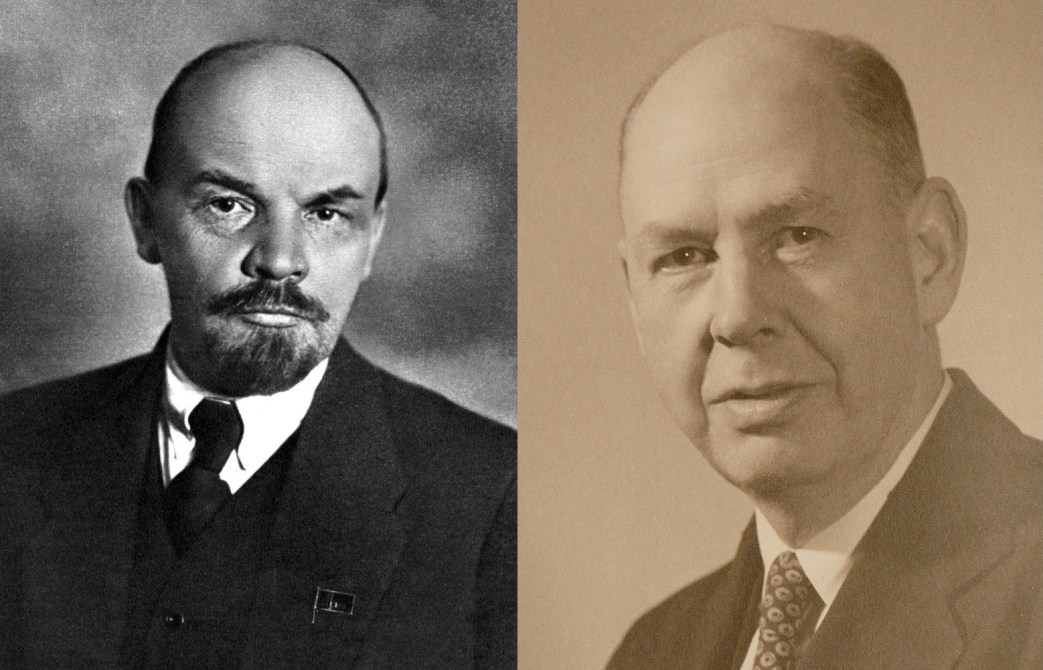
Proletarian Party leader John Keracher pays tribute to Lenin on in his death in January, 1924. An early and insightful U.S. proponent of Lenin and the Bolsheviks, Keracher chaired the Michigan Socialist Party, the first Socialist Party body to call for Communist Party in the U.S. and a splitting the old Socialist Party. However, unlike other parts of the emerging Communist movement, Keracher denied the efficacy of transferring Bolshevism’s specific organization models to U.S conditions, making he and the P.P.A. outliers, however interesting and locally important, to the reorganization of the revolutionary movement in the early 1920s.
‘Lenin’ by John Keracher from The Proletarian. Vol. 7 No. 2. February, 1924.
Nicolai Lenin was one of those great characters that historic conditions raised up. He was the greatest product of the Proletarian World Movement since Marx.
Just as Karl Marx was the greatest theoretician and philosopher of Proletarian Revolution, so Lenin was the greatest tactician of the actual living class struggl—the man of action.
His writings show beyond a doubt that as an interpreter of Marx and as an interpreter of social phenomena he stood out clearly ahead of all other Marxian thinkers. His scathing and unmerciful criticism of social patriotism and the leaders of the Second International portrayed him as the uncompromising opponent, not only of the capitalist order and its open defenders but all “socialist” apologizers and halfhearted defenders of the same.
Marxism with Lenin was not a dry formula. It was the intellectual equipment for the strategy of class warfare. Those who have taken the trouble to STUDY Lenin’s writings have it forcibly thrust home to them that he did not view the Revolution as a pitched battle, to be won or lost according to a prearranged plan, but as more or less protracted warfare in which defeats and victories, advances and retreats (militaristic and economic) were inevitable parts to be dealt with from the standpoint of actual existing conditions. He did not conceive of an abstract defense of the revolution. Fine phrases about liberty, justice, freedom of speech, and democracy were not his weapons. He knew that the Proletarian Revolution could only be defended by the armed Proletarian themselves—by a Red Army.
All things he viewed from a class standpoint. He realized that there were two concepts of Democracy—Bourgeois Democracy and Proletarian Democracy. The former he fought and the latter he upheld.
Lenin’s greatest work, which has left its stamp on the world movement, was his laying bare of the true character of the State.
Bourgeois writers say, “Lenin overthrew the Tsar,” “Lenin invented the Soviet State,” etc. What he actually did was to direct the Proletarian Revolution and function through the new state form that made its appearance, the historic function of which none understood as well as he.
A tireless fighter, an unyielding adherent to fundamental Marxian principles, a relentless enemy of World Imperialism, and a champion of all the downtrodden and exploited, Lenin is mourned by hundreds of millions of the world’s workers. It is questionable if any other man that ever lived made such a deep impress in world affairs, raised so much hatred from the money lords of Capitalism, and so much enthusiasm and hope in the breasts of the workers of all lands.
The death of Lenin is an immeasurable loss to the Russian Revolution and to the international movement of the working class. His passing should not be so much a cause for grief as his life and work should prove an example and source of inspiration to every true revolutionist.
Vladimir Illich Ulianov (Nicolai Lenin) is not dead. He will live forever in the memory of the world’s toiling millions.
John Keracher (1880-1958) was born in Scotland and settled in Detroit, Michigan in 1909. There he joined the Socialist Party of America as a Marxist. Expelled from the Socialist Party along with the Left Wing in 1919, Keracher had developed ‘Proletarian Clubs’ education societies and supported the Bolshevik Revolution. He and his co-thinkers had a number of important differences with the US Communist movement and, along with supporters, founded the Proletarian Party in 1920. He would lead the Party most of the rest of his life.
The monthly organ of the Proletarian Party of America, The Proletarian originally served a left wing faction in the Socialist Party of Michigan led by John Keracher, and was printed in Detroit and Chicago from May, 1918 until July, 1931. The Proletarian Party then published Proletarian News, from 1932 until 1960. Part of the early Communist movement, the Proletarian University and the Proletarian refused to join with others in going underground after the Palmer Raids, though it eschewed electoral politics. The Proletarian Party attempted to gain admittance to the Third International to no avail. The Party eventually took over the left wing publishing house Charles H. Kerr & Co.
 Revolution's Newsstand