Mary E. Marcy’s husband, Leslie Marcy, was also a writer for International Socialist Review doing some of that venerable magazine’s finest labor reporting, as with the near definitive article on 1916’s consequential Minnesota iron strike below.
‘The Iron Heel on the Mesaba Range’ by Leslie H. Marcy, photographs by George Dawson from International Socialist Review. Vol. 17 No. 2. August, 1916.
WHEN Jack London, the rebel, wrote his wild drama of the Iron Heel, back in 1907, few of us thought we would ever live to see his dream come true, although, at that very time, the iron miners of the North were on strike.
We were all carried away on a mighty wave of enthusiasm in those days by the splendid victories of the Western Federation of Miners. Were not Moyer, Haywood and Pettibone saved by the magnificent solidarity of the working class? So we dubbed Jack’s vision a pipe dream, discounted the future and went to sleep.
Since then the scenes have shifted; the Iron Heel of the steel trust has wiped out all labor organizations in the steel industry; the coal barons declared war on the coal miners of West Virginia, and won with an army of gunmen. They carried a curtain of fire into Colorado and made the workers dig their own graves. The copper kings of Michigan destroyed all organization among their slaves in one short winter. Have you forgotten the working class dead at Calumet and Ludlow? The IRON HEEL OF THE CAPITALIST CLASS IN FREE AMERICA HAS BECOME A COLD BLOODED FACT.
Twenty thousand iron miners in the state of Minnesota are making their last stand. They have revolted against the Steel Trust by going on strike, and the fighting power of these men is made up of SEVERAL THOUSAND CLASS CONSCIOUS WORKERS. Their fight is your fight! The amount of support you give them will accurately register the militant strength of the socialist movement in this country.
The Socialists among the Finnish miners have been the only force the companies have been unable to overcome, as there has been no labor organization on the range for several years.
Our Finnish comrades do not confine themselves to any one line of action. They believe the miners should be organized at the point of production in an industrial union, therefore, when they went on strike they called upon the I.W.W. to help them organize and win their demands.
Experienced organizers were immediately sent to co-operate with the comrades. Before they could cover the range the men in mine after mine had downed tools. They started first at the St. James mine near Aurora, on account of unfair conditions. The mine owners refused to meet the men and war was immediately declared.
Declaration of War.
“Fellow Workers and Friends:
“War has been declared against the steel trust and the independent mining companies of Minnesota, by the Industrial Workers of the World.
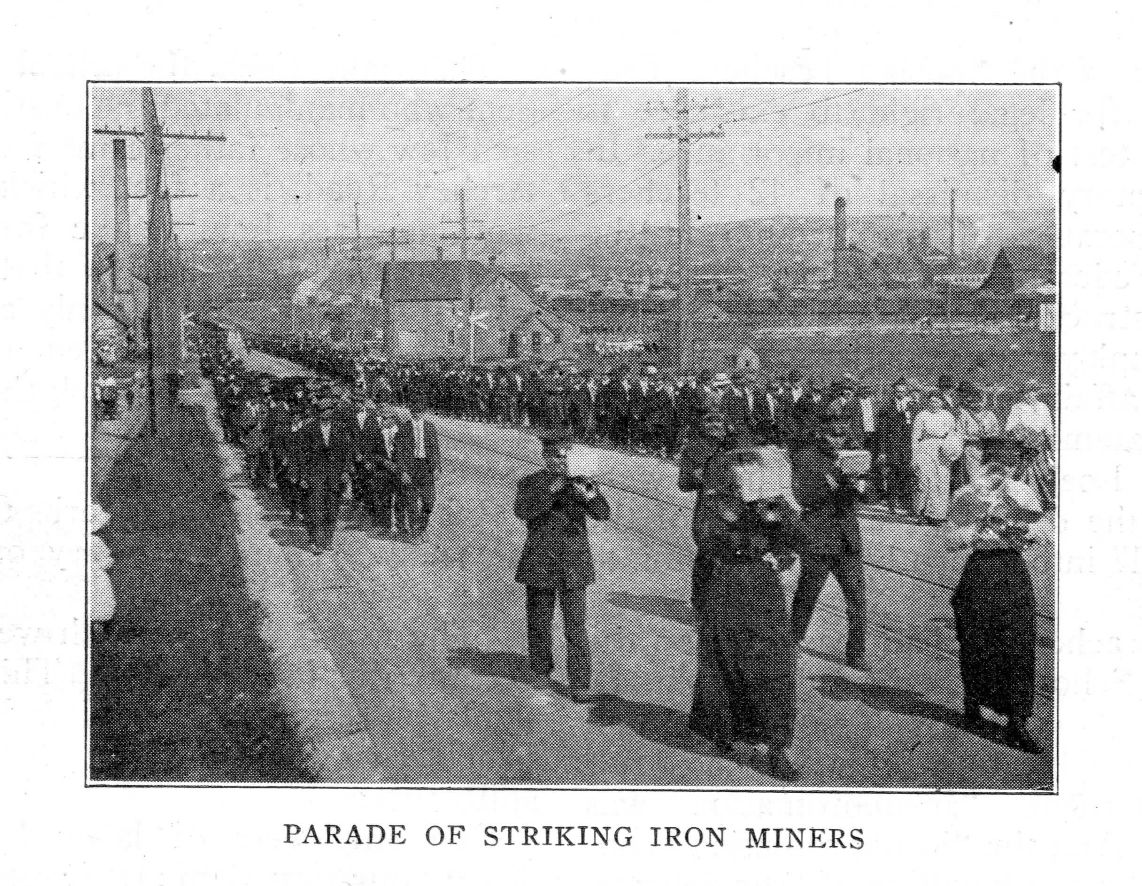
“The iron miners are mustering. Twenty thousand have left the mines and pits.
“More than seven thousand have already been sworn in.
“The steam shovels are idle. The drills are silent.
“The miners are on strike in the following camps: Hibbing, 4,000; Chisholm, 2,800; Virginia, 2,500: Buhl, 1,400; Eveleth, 1,600; Gilbert, 900; Biwabik, 600; Aurora, 900; Kinney, 800, and other small camps.
“The demands are $2.75 a day for top men. For miners, dry places, $3.00; for miners, wet places, $3.50; the 8-hour day; abolition of contract labor; bi-monthly pay days; to be paid at once when discharged or leaving work.
“It is the iron miners who are making these demands. Men who are doing hard, hazardous work. They take their lives into their hands every time they go down into the mines or pits.
“They are the men who produce the ore that is converted into iron and steel to make the machinery of the world. Without these men civilization could not exist.
“These barehanded iron miners, driven to desperation, have declared industrial war against the United States steel corporation. The masters of bread are fighting with their usual weapons—gunmen, detectives, courts and the press.
“We are united, but must have help. This is your fight. You must raise money for food, clothing, shelter and organization work.
“WILLIAM D. HAYWOOD, General Secretary-Treasurer.”
Meanwhile moves the Iron Heel, the steel trust’s Juggernaut! How deliberate and impassive its gunmen travel in armored motor cars. Private mine guards on the pay-rolls of the mining corporations have been deputized by the AUTHORITIES of St. Louis county to keep LAW and ORDER! How well these hired assassins do their work is told by the strikers in their bulletin:
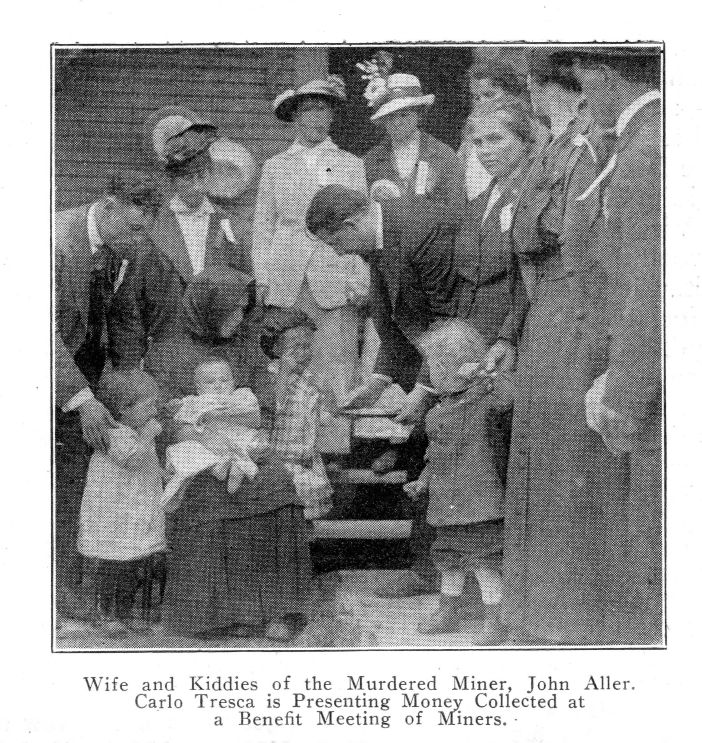
John Aller was murdered by the Oliver Mining Company gunmen at his home near the property, Thursday, June 22, 1916, at 6 o’clock in the morning. The strikers who were on picket line on that morning say that the gunmen deliberately walked into Aller’s house and shot him three times in the back. John Aller was a married man and leaves his wife and three children, the oldest being five years old and the youngest is an infant boy. They are orphaned because their father demanded a right for all of them to live. The strikers are supporting this fatherless family.
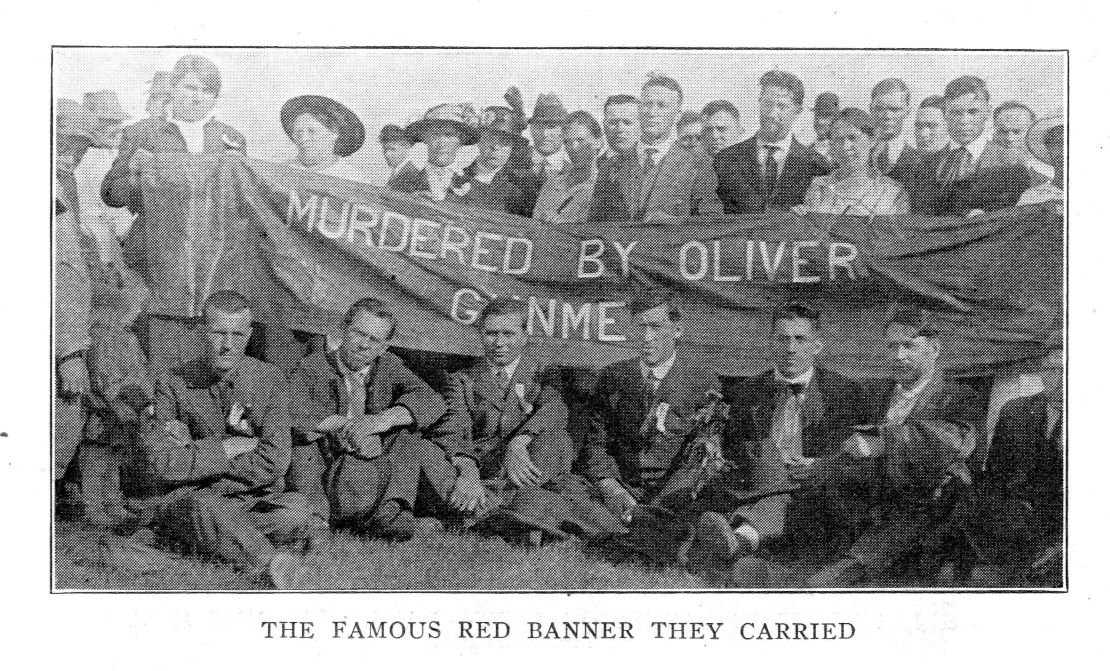
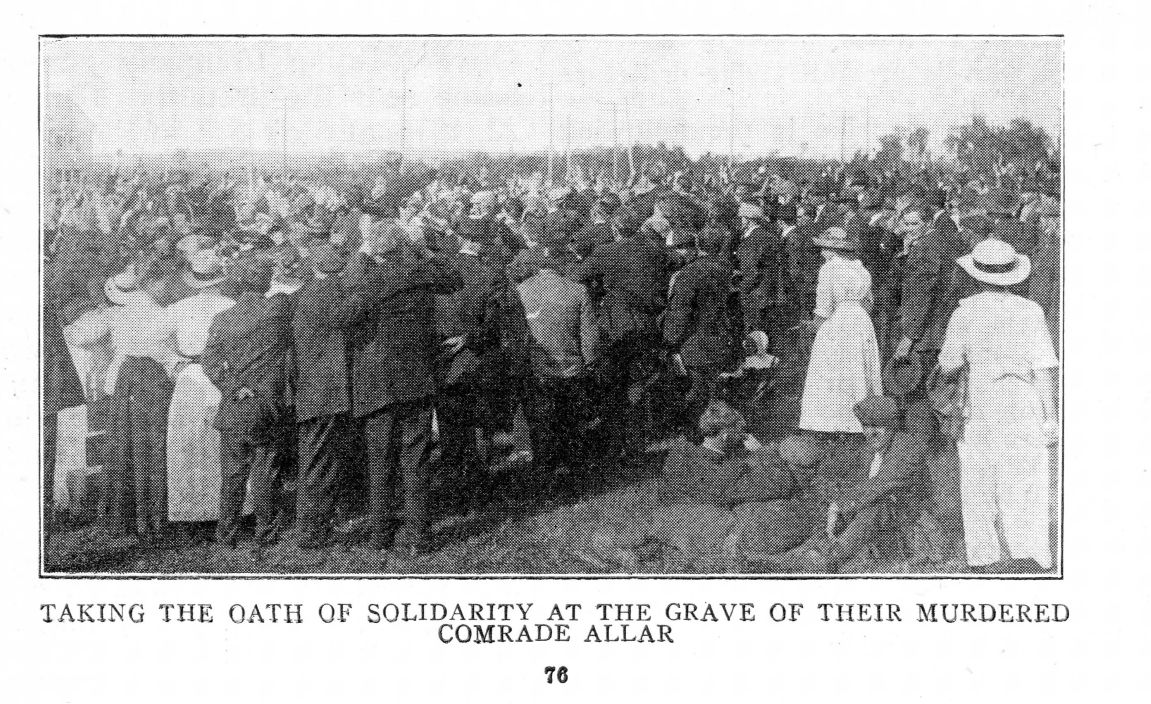
The funeral of this murdered striker was held on Sunday, June 26. The funeral rites were held in the Finnish Socialist hall at Virginia. Fully seven thousand strikers accompanied the murdered brother to the cemetery. The Catholic priests of all nationalities on the range refused to perform the rite over the remains of John Aller. It was the wish of the unfortunate widow, that the priest should officiate. The priests, however, being loyal to the master class, refused to do so, although the organizers did everything they could to obtain them. The funeral was headed by a large banner carried by four women, upon which was inscribed: MURDERED BY OLIVER GUNMEN. The Finnish Socialist band of Virginia played the funeral music and marched at the head of the parade. At the grave of John Aller, funeral orations were delivered in all languages of the strikers.
Up to date not a single gunman has been arrested for this foul murder! But Carlo Tresca and six other strike leaders were promptly arrested, thrown into jail and charged with criminal libel because the strikers carried a red banner at the funeral of their fellow-worker, reading, Murdered by Oliver Gunmen!
Little, Tresca and Gilday were kidnaped on Saturday night and when the news reached the miners of Buhl and Hibbing, they lined up three thousand strong and started to Virginia. It is needless to add that these organizers were immediately released on bail. Such is the majesty of law and order in the State of Minnesota!
The Iron Heel and the Governor
The Labor World, official weekly paper of the Duluth labor unions, says:
Governor Burnquist can stop the deputizing of private guards if he cares to do it. Unprejudiced people on the range, who are in closer touch with the situation than are the editors of the local daily press, will tell him where the responsibility lies, namely, at the door of the authorities who invite trouble when they deputize the men who are paid by the mining companies and who know no other masters.
But the governor has not yet proven himself big enough for the job. He has the power to do this if he wants to exercise that power.
The Governor knows there are two sides to every question. However, his representative, sent to the range to investigate the trouble got his information from one side and, we are reliably in formed by Mayor Boylan of Virginia, made no attempt to get the other side, the miners’ side.
Whether the strike is won or lost depends upon the miners themselves. The I.W.W. is a part of that strike and will fight to the limit of its resources. The following telegram was sent to Governor Burnquist:
“J.A.A. Burnquist:
Governor of the State of Minnesota,
Executive Mansion, St. Paul, Minn.
“You instructed sheriff of St. Louis county to disarm miners, peaceful citizens.
“We submit herewith gross violation of personal liberty of miners and ask you to remove all mine guards from within city limits of mining towns. Otherwise our miners will be instructed to defend themselves by constitutional rights.
“Seven mine guards forcibly entered home of strikers at Gilbert Friday night, June 30, 1916, with drawn guns. They threatened strikers if they do not return to work. They snatched a baby from the arms of its mother and brutalized it.
“The clear facts in our possession are ready to be submitted to your representatives.
“George Andreytchine was imprisoned 24 hours in Itasca county without a charge being placed against him. Inquiry was futile. Are we in Russia?
“(Signed) Sam Scarlet, Carlo Tresca, F. Rusel, Joe Gilday, L. Ha Lareen, V. Wesaman, S. Attaviani, M. Schustrick, J. S. Silti”
Hundreds of Arrests
A gunman was killed by a man whose wife had been struck by a thug. Twelve I.W.W. organizers are held on first degree murder charges for this. These men must have a first class lawyer to defend them and Judge O. N. Hilton of Denver has been secured.
Their names are: Frank Little, Joe Schmidt, Carlo Tresca, Sam Scarlett, James Gilday, L. Ahlgren, Frank Russell, Joseph Nickich, John Orlandich, Joseph Cerruogdrdovich, Leo Stark, Frank Wesserman.
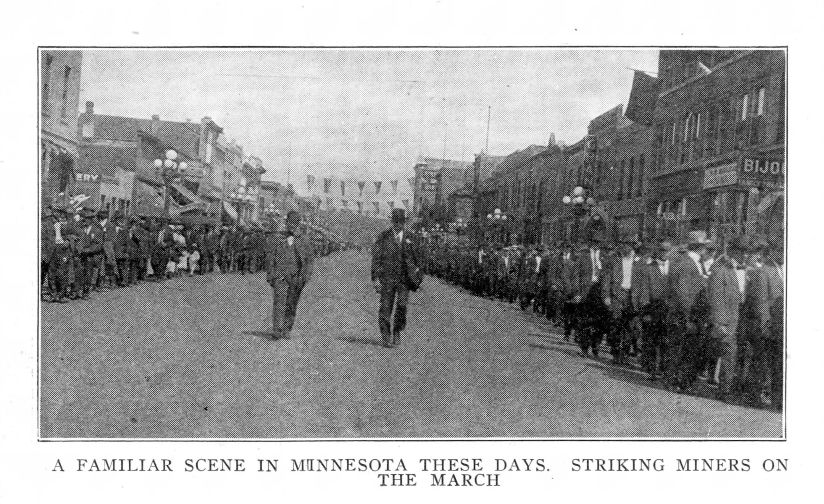
A large number of strikers who were peacefully parading from Aurora to Biwabik, where they expected to attend a strike meeting, were arrested and will be tried in court at Virginia.
At Nashwauk, twenty Austrian, Italian and Finnish pickets were arrested and thrown in jail by Deputy Sheriff T.T. Riley, assisted by an army of deputies. They will probably be taken to Grand Rapids for trial.
Chief Hayes said, “We haven’t allowed the I. W. W. agitators to get even a toe-hold here. The Socialists got the ball park for a picnic and as soon as we found that it was to be but a screen for a strike meting we soon put the ‘kibosh’ on them.”
At Chisholm, Sheriff John R. Meining, at a meeting of mining company police, stated that “men deputized at the mines had full powers of deputy sheriffs and that their duties were not confined to the property they were assigned to protect, but extended throughout the county.” He further informed these deputized thugs that “he had communicated with the attorney general and an opinion received from him on the question of mobs was to the effect that in times of disturbance, such as now exist on the range, three men constitute a mob and should be immediately dispersed.”
Some of the municipal authorities are friendly, but helpless when contending against the steel corporation. On July 7th a meeting was held, composed of officials of the Range Municipalities with committees from the striking miners from the different mines. Wages and working conditions were discussed and miner after miner testified to low wages and rotten conditions. Thousands of miners work only seven months and their pay does not average $2.50 a day.
Listen to Mike Stark of Chisholm:
Mike Stark, of Chisholm: “I am a miner for fourteen years—over fourteen years, and I have eight children—I have seven living and one died. I worked now for last three years, I have got $59 check (a month), $61, $62, $63, $67, up to $70 (a month)—but a couple of times over $70 in three years, and I send four kids to the school, and the teacher would like to have the children dressed and clean and everything like that. I like to do that myself. And the children go to church, the priest likes to see that the wife is dressed nice like the American ladies, and the children dressed nice like the American children. I like that too, but I can’t. You fellows think—a single man maybe get $50 or $60 check for his own self, and we are nine of us. I get $60, $70, and I have extra—I pay rent—no, I don’t pay rent—but we pay wood, we can’t get that any more. Before we used to get it, but now they don’t let us. We pay coal, pay insurance, pay taxes, pay light, pay water—now, I think, fellows, how I can live. I have a little property and I shouldn’t say that I don’t have it because I get it from the school board. And now I have to give my property back. I can’t go any further.
“And another thing is, you know the drivers wait for the car with a mule, you know. There was a poor year and the captain came around and saw driver waiting for the car, and he say: “What the hell you doing here with this mule.” He says: “I got to wait a minute or two until we get car there.” He says: “Go down with that mule to the trammer shaft so he get better air.” Now see, a man working there day and night, month and month, and year and year, and nobody asks him if he likes air, or “how you feel?” “Do you feel bad working there?” or “what is the matter with you?” Nobody don’t ask me, but when the first of the month I know when I receive check, well, you know—$2.39—”god darn it, you’re a poor man! You’re no good!” So I am no good working in there.”
And listen again, you free American citizens, to this miner,—
Fulvio Pettinelli: “Gentlemen, I like to tell you that I come in here in this country five years and a half ago. I been working in mine ever since. First I came to this country I worked Lincoln mine, and had bad place. No air at all, whatever, and that is my brother was working with me. There I wouldn’t get no candles—you couldn’t get no match to burn. You couldn’t light matches by no means, only by means of acetylene—carbide lamps-you know what that is, and I worked there last seven or eight months there, at least. At last I was exhausted and had to quit. I worked in there for only $2.60 a day all that time.
“Later I worked for the Oliver Iron Mining Company at the Alpena. Two years ago I struck a hard place, and I make $1.97. Some other times I make over $3.00 and $3.50. What I should do then? Two years ago I got married and got American girl. I believe she has right to live as another American, so I believe further I got right to live. What should I say when I got $1.97? I should tell her:”Later I worked for the Oliver Iron Mining Company at the Alpena. Two years ago I struck a hard place, and I make $1.97. Some other times I make over $3.00 and $3.50. What I should do then? Two years ago I got married and got American girl. I believe she has right to live as another American, so I believe further I got right to live. What should I say when I got $1.97? I should tell her:
“This month don’t order meat or nothing. I only get $1.97.” I should only pay rent of the house, insurance, and such things. That month when I work contract and strike bad place we no have enough to eat. I work in some other places in Alpena for $2.17. What do you think of that. Get $45 or $50. I should have paid $12.00 for rent of the house. I should pay $5 or $6 meat; $30 on grocery bill. What will be left? Nothing. We have to go without clothes. If we eat we don’t dress, and if we dress we don’t eat. That is fact.”
Such is the testimony of these men who are being crushed by the Iron Heel of the Steel Trust. The Norman property is operated by the Oliver Mining Company, a subsidiary of the Steel Trust. This branch of the industry is represented in the United States Smelter by the Pittsburgh millionaire after whom the mining company is named, and also the Oliver Steel works, near Pittsburgh, Pa.
The Norman mine is one of hundreds being operated by the Steel Trust on the Mesaba Range. It is located at Virginia, Minnesota. Here the trust is absolutely in control. The private police of the Oliver Mining Company are a conscienceless lot of wretches. Like the cossacks of Pennsylvania, recruited from the dregs of society, they are vigilant in the interests of the company.
True, these gentlemanly mine owners and guards do not eat the miners’ flesh or drink their blood, BUT THEY DO LIVE ON THEIR LABOR, THEIR DENIAL, THEIR WEARINESS AND WANT.
Hundreds of iron miners, deformed and degraded by years of hard labor for wife and children, go to their graves every year without ever having even one look in at one luxury of life.
The iron miners of Minnesota are appealing to you for aid. Their women and children must be provided for. This calls for immediate action by you. Take this matter up at the next meeting of your local or union. Pull off a picnic or get up an entertainment. Have a tag day in your town—anything to get in the game and help these workers who are standing firm in the face of overwhelming odds. Remit to John Leppanen, Secy.-Treas., Box 372, Virginia, Minn., or to William D. Haywood, Secy.-Treas., 164 W. Washington, St., Chicago, Ill.
The Finnish Socialists are literally working night and day to aid the strikers. Their daily newspaper, Sosalisti, is devoting a front page every day.
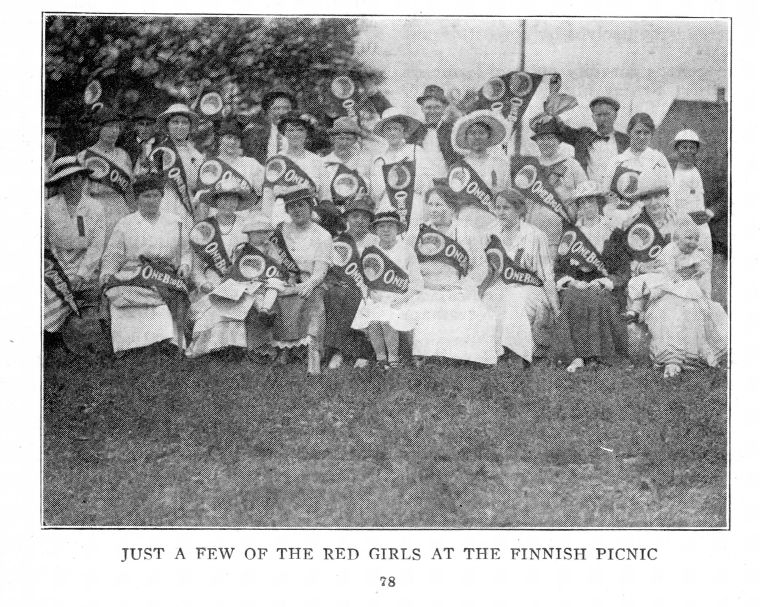
In Duluth Chief of Police McKercher said he would crush any attempt to bring out the dock-workers, and that absolutely no street meetings could be held. On July 2 the Finnish Socialists held a picnic at Fairmont Park and, although the chief had notified them there should be no speaking and absolutely no collection for the miners, there was a large enthusiastic crowd, many speeches and $56.17 collection.
Again on July 4, when celebrations were held nation-wide to celebrate “life, liberty and happiness”—the Finnish Socialists held an open-air meeting at First avenue South, where the strike was discussed. Police attempted to arrest Wm. Tanner, but the crowd protested so vigorously, he was released. They marched to the Finnish hall, where they were joined by the crowd from an adjourned I.W.W. meeting, and a protest meeting was held and resolutions passed denouncing the unwarranted usurpation of power by the police. These resolutions are published elsewhere.
On Sunday, July 9, 2,000 Finnish Socialists held a meeting, but the police were conspicuous by their absence.
Meetings are planned for Duluth, Two Harbors and Allouez, and it is hoped the ore-dock workers will all heed the call of their battling brothers on the Range and join in the valiant struggle for industrial emancipation.
Never was there a better time with war-orders flooding the big factories of the land, for the miners and ore-dock workers to demand some adequate share of “prosperity”; never a juster cause against a more pitiless or ruthless foe.
All together now, comrades—to win!
The International Socialist Review (ISR) was published monthly in Chicago from 1900 until 1918 by AM Simons and later Charles H. Kerr and loyal to the Socialist Party of America and is one of the essential publications in US left history. During the editorship of A.M. Simons it was largely theoretical and moderate. In 1908, Charles H. Kerr took over as editor with strong influence from Mary E Marcy. The magazine became the foremost proponent of the SP’s left wing growing to tens of thousands of subscribers. It remained revolutionary in outlook and anti-militarist during World War One. It liberally used photographs and images, with news, theory, arts and organizing in its pages. It was closed down in government repression in 1918.
PDF of full issue: https://www.marxists.org/history/usa/pubs/isr/v17n02-aug-1916-ISR-riaz-ocr.pdf
 Revolution's Newsstand