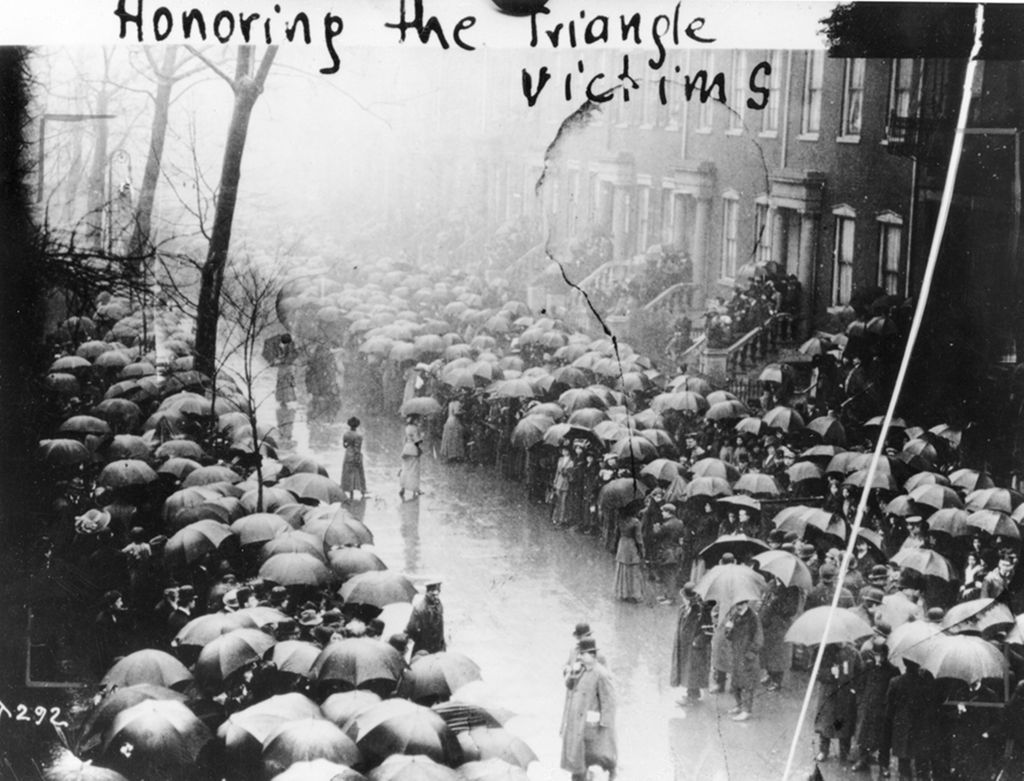
Powerful words as 1911’s Triangle Fire martyrs are remembered as the union’s pioneers during 1919’s general strike of New York garment workers.
‘Black Saturday and the Waist Makers’ Strike’ from Justice (I.L.G.W.U.). Vol. 1 No. 9. March 15, 1919.
This was eight years ago, on the 25th of March, 1911, on a Saturday which since then is known by the dreadful name of “Black Saturday.” On that day the entire city of New York, the entire country and, indeed, the whole civilized world were horror stricken at the terrible Triangle fire, in which 147 young lives of ladies’ waistmakers suffered the most horrible death imaginable.
It was not an accident, it was a horrid hellish crime. The victims were caught in a fire-trap.
It seems as if all forces of hell conspired to destroy these young lives. The doors through which the girls could have escaped had been barred at the order of the Triangle bosses. Nor were there any fire escapes that might have served as a means of escape to some. The elevator was not running and the victims had only one choice a choice between two deaths: to be burned on the eight or ninth floors or to jump from the windows and be dashed to pieces and cover the sidewalks with their blood and marrow.
It was a weird alternative, and on that Black Saturday 147 human beings were virtually killed in the ladies’ waist factory of the Triangle company, a name which no one can recall without wrath and abhorrence.
Eight years passed, and no other such accident–nay, massacre, for no other name can be given to the disaster of 1911, has happened since.
Why? It is because the court sentenced the Triangle bosses to long terms of prison at hard labor, and this sentence cast fear upon all other employers? Oh, no! The court, after a dragged out trial, strange as it is, declared the Triangle bosses innocent of this most horrible of crimes. Nor did the murderers suffer financially. They got their insurance money and without delay opened a new factory elsewhere.
It is not the bosses’ fault that another Triangle disaster has not occurred between 1911 and 1919. It is the Ladies’ Waistmakers’ Union, which, having received new vitality through the death of 147 of its members, that has kept its vow made at the graves of its martyrs, that no such massacre would happen again.
Perhaps this is news to our new members. If so, let them know that it is these lives perished in the fire that form the foundation of the Union. These martyrs would have died in vain if upon their mangled bodies were not erected the fortress of the Ladies’ Waistmakers’ Union, which is now conducting the determined and bitter struggle with bosses of the Ladies’ Dress and Waist Association.
The bosses perhaps wonder whence the girls draw their energy and endurance. Especially since they know that it would be possible to come to some sort of understanding in the matter of wages and hours, which the bosses think is the main thing with the workers. Why then, are they waging so bitter and stubborn a fight for the question of discharge, a question, which, after all affects the majority of them but little?
The bosses evidently do not realize that among the ranks of the living strikers are also the spirits of the dead martyrs who appeal to their brothers and sisters on earth in an ominous voice of martyr and warn them: “Beware of yielding on this point of discharge! If you give in on this point you forfeit your Union, and if you forfeit your Union, know, that the same lot, which brought us to our early graves, is in store for you; that you, too, will be burned and mangled and suffer agonies of hell in the minutes that will separate you from a horrible death!”
The charred arms of the dead martyrs stretch from the graves with a mute appeal:
“For your own lives’ sake, in the name of your honor as women, do not yield on this point of discharge, and thereby destroy the Union for whose strength and power we fell victims.”
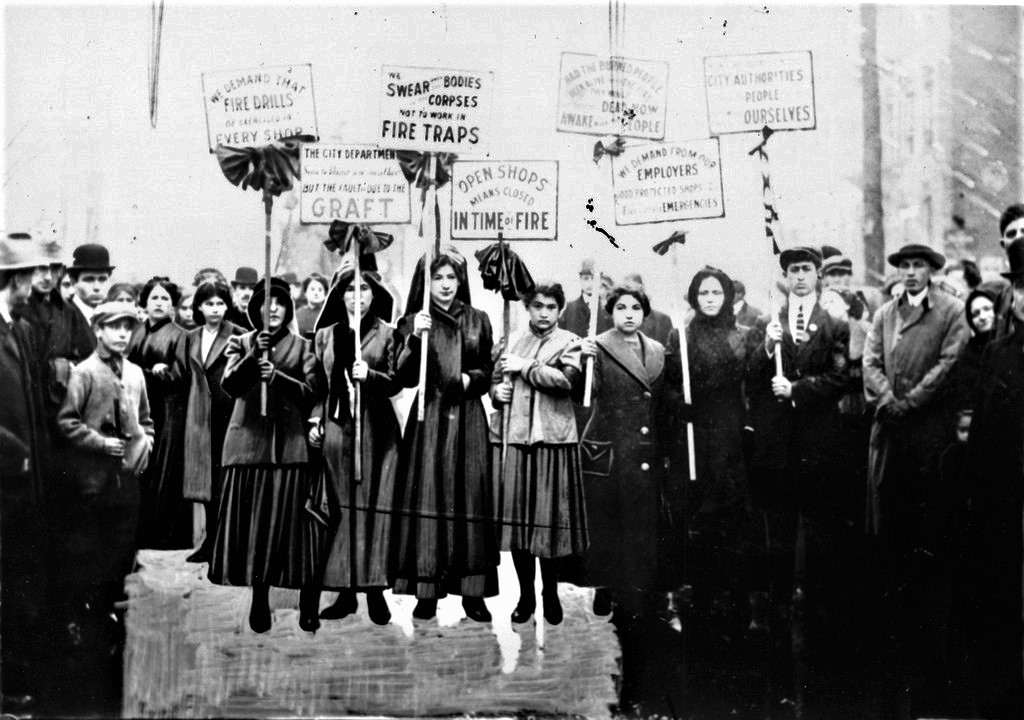
And the dead continue:
“With our life-blood we built your Union, your stronghold, your defense; cherish your Union, be vigilant lest evil befall it. Remember that in your present conflict there is more at stake than a few cents increase, a few hours’ leisure. Your dignity, your honor, your very lives are at stake!”
It is this voice of our Triangle martyrs that sweeps off the spurious issues of the bosses like so much cobweb. And it lends the strikers strength to go on and on with the struggle, till the victory is complete, till the Union is made safe against its enemies who will not even in their dreams dare plan for its destruction.
The weekly newspaper of the International Ladies Garment Workers Union, Justice began in 1909 would sometimes be published in Yiddish, Spanish, Italian, and English, ran until 1995. As one of the most important unions in U.S. labor history, the paper is important. But as the I.L.G.W.U. also had a large left wing membership, and sometimes leadership, with nearly all the Socialist and Communist formations represented, the newspaper, especially in its earlier years, is also an important left paper with editors often coming straight from the ranks radical organizations. Given that the union had a large female membership, and was multi-lingual and multi-racial, the paper also addressed concerns not often raised in other parts of the labor movement, particularly in the American Federation of Labor.
PDF of full issue: https://www.marxists.org/history/usa/pubs/justice/1919/v01n09-mar-15-1919-justice.pdf
 Revolution's Newsstand