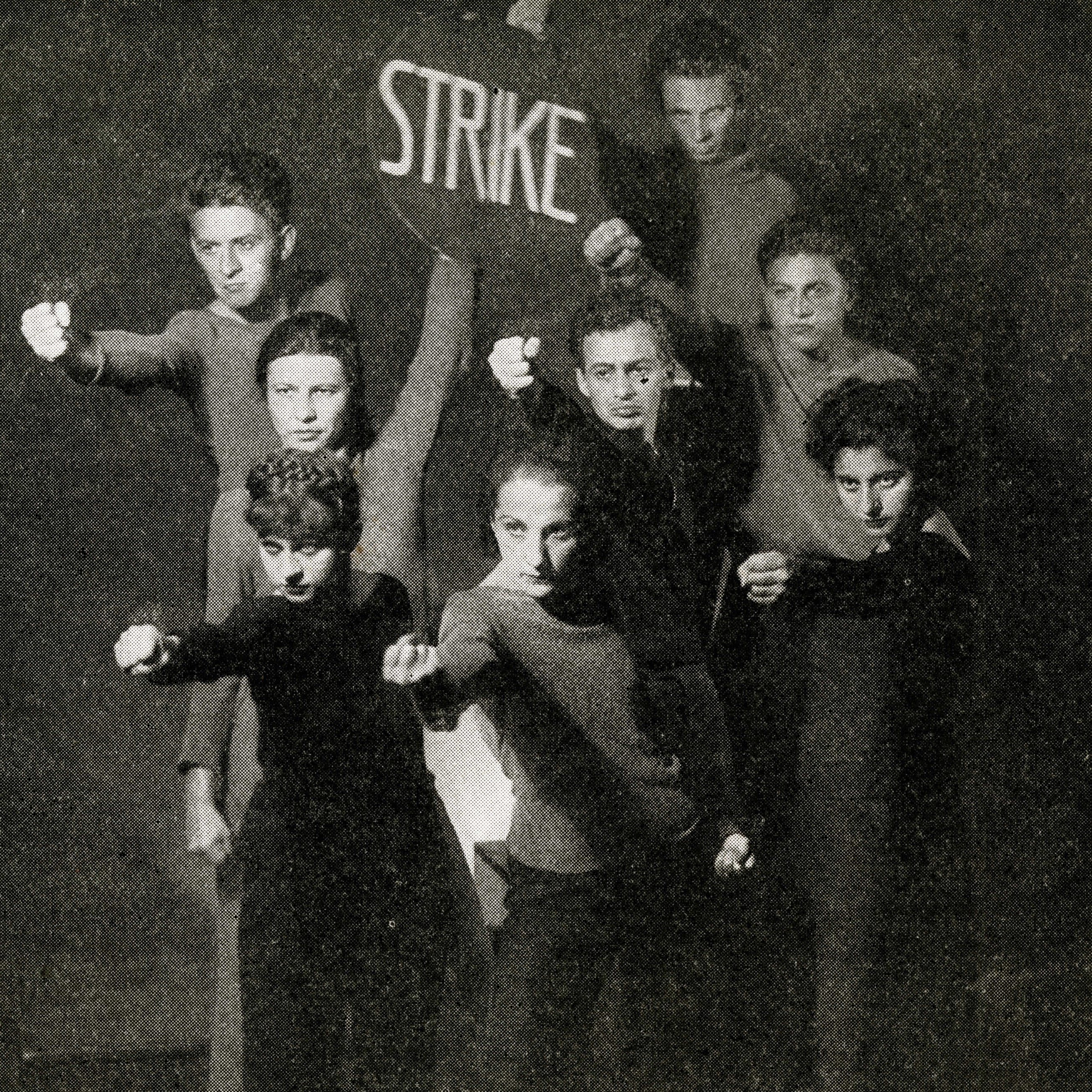
With different aims than bourgeois theater, workers’ theater required different, and new, methods of presentation.
‘Technique in the Workers’ Theatre’ by A. Prentis from Workers Theatre. Vol. 1 No. 10. January, 1932.
Shall the workers’ theatre adopt any of the techniques of the bourgeois theatre? This question, first asked at the cultural convention, has not been answered. For while attempts to answer it in the negative have been made, such answers, however, have shown an incomplete grasp not only of the essence and history of the bourgeois theatre but even more so of the workers’ theatre.
The problem must be approached analytically. We must know what is the aim of the bourgeois theatre, we must compare with it the aim of our theatre, we must analyze the elements or tools that the bourgeois theatre uses to accomplish its aim. Knowing our aims, we should ask ourselves, can we utilize any of these tools to accomplish them? The problem is simple and obvious. Suppose we follow this out.
The ultimate aim of the bourgeois theatre is to make money. The immediate aim of their theatre is to give their audience what they make them crave for–escape from reality. To the sex-starved spinster–love, to the sexually suppressed husband–hot sex, to the drudging wife–mysteries and love and racketeer thrills, to the poor–riches.
The ultimate aim of the workers’ theatre is solidarity of the working class. The immediate aim is education–propaganda and training in tactics to accomplish this aim. The workers audience must face reality, get acquainted with it on the stage, and train itself to cope with it in actual life.
A produced play, whether bourgeois or workers’, may be assumed to consist of two parts: 1) the written play and 2) its production. To take the written play as a beginning, what are the elements and the technique the bourgeois play uses to accomplish its aim–can we utilize any of those elements or techniques to accomplish our aim?
Since the aim of the bourgeois theatre is escape from reality, its plays must aim at the illusion of the audience, making them identify themselves with the action. And since identification can occur only if the play is plausible, the bourgeois plays are based to a great extent on what is known as the 3 unities–the unity of action, the unity of time, and the unity of place. Meaning by the first, that the entire play must be based on one main idea; by the second, that the entire play must take place within 24 hours; by the third, that the entire play must occur in one locality. (While the bourgeois playwrights do not strictly adhere to these unities, nevertheless they are the bases of their theatre)
To the above may also be added several other unities–unity of subject matter, unity of language, unity of situation. Since the aim of theatre is identification with the action, such an effect can be produced only if the play deals with subject matter, situation and language that the audience can understand and is familiar with–middleclass. Only then can the audience easily identify itself with the action.
With the above in mind they divide the play loosely into 3 parts–1) the Introduction, when the audience is made acquainted with the facts necessary for it to mow to understand the further progress of the play; 2) the development where, as the play progresses, the attention of the audience is drawn further into the action, and its emotions made to react with the drama in the play; and 3) the climax, where the play coming to a culminating point stops short, having brought out the idea of the playwright. These are briefly the basic elements of bourgeois playwriting, not always followed but consciously or unconsciously always aimed at. The actual details of writing the play we need not go into here as they are all implied in the above classification. Besides, the matter of writing dialogue, situation, etc., will be governed by the style of the writer, by the subject matter and by the theme.
We said before that the workers must face reality on the stage and train there to cope with it in actual life. How may this be done? Since we cannot transport our audience to the scene of action of a certain past or present event in the class struggle, we may do the reverse–we may transport that event to the theatre and stage it realistically enough to give the audience a sense of being present at that event. (If we are efficient enough we make the audience also an active, not a passive, actor in the play.) We find at once that our theatre must also have “illusion”–not the illusion of the bourgeois theatre where the play starting plausibly reaches a situation not always probable in real life, (A simple example–a poor girl at the beginning, marrying wealth at the end, or virtue being rewarded) but the illusion of being present and participating in a real event which could have a probable result if we pursue certain tactics. (For example–the winning of a strike because of adherence to a real militant union.)
Since, therefore, we also aim at illusion, we may subscribe to all the unities that the bourgeois theatre subscribes to–unities of action, time and place, subject matter, language and situation. But with this difference–that now that the subject matter, language and situation will concern themselves with the workers rather than the middle class, the plays and the method of treatment will both have to be modified, not only because situations are vastly different, not only because the psychological make-up of our actors and audience are different, but also because our places of presentation indoors or outdoors are different from that of the bourgeois theatre. The basic principles, however, remain the same.
So will also the matter of dividing the play into introduction, development and climax remain the same. This division is obvious and efficient, and helps to draw the audience towards identifying itself with the action. The matter of actually writing the dialogue will again depend upon the individual make-up of the writer–the worker writing the play on his own, or at the suggestion. of the collective–and will be governed to a great extent by the content.
We may therefore sum up, that as far as the written play is concerned, we may adopt the so-called bourgeois technique and adapt it to our own use.
The matter of the play “production” will be taken up in the following issue.
The New Theater continued Workers Theater. Workers Theater began in New York City in 1931 as the publication of The Workers Laboratory Theater collective, an agitprop group associated with Workers International Relief, becoming the League of Workers Theaters, section of the International Union of Revolutionary Theater of the Comintern. The rough production values of the first years were replaced by a color magazine as it became primarily associated with the New Theater. It contains a wealth of left cultural history and ideas. Published roughly monthly were Workers Theater from April 1931-July/Aug 1933, New Theater from Sept/Oct 1933-November 1937, New Theater and Film from April and March of 1937, (only two issues).
PDF of full issue: https://www.marxists.org/history/usa/pubs/workers-theatre/v1n10-jan-1932-Workers-Theatre-NYPL-mfilm.pdf
 Revolution's Newsstand