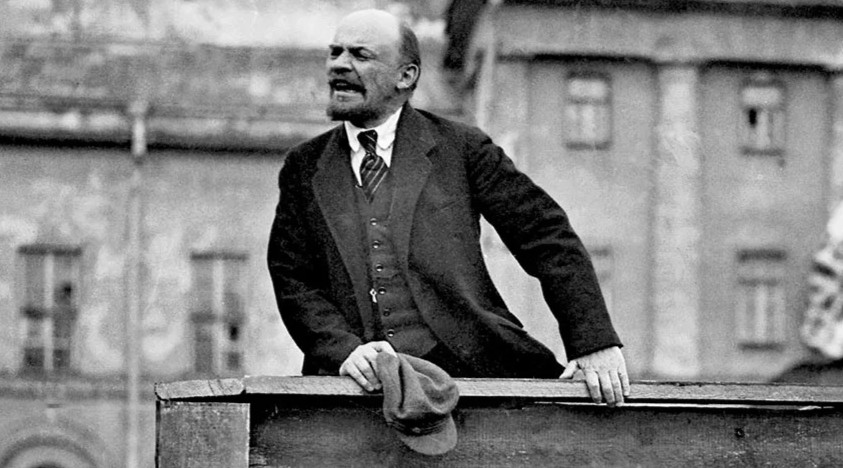
Lenin on how to formulate ‘slogans,’ here amid July, 1917’s crisis and retreat before reaction. As an art, a proper slogan judges and reacts to a myriad of public movements, capturing both realities and imaginations. Concrete slogans proposing precise actions are not just comments or aspirations, but whose real power can assert collective strength and open vistas of new possible realities to be made together, by our class, and in our own interests. As always with Lenin, the fundamental question was how to take advantage of every opportunity, or if necessary, making those opportunities, however small, to advance workers’ consciousness, organization, and purpose of mission. Too many of today’s ‘slogans,’ are only left-wing catch phrases designed to elicit familiar and knowing comforts. For Lenin, slogans were made not to reflect the world, but to posit a social transformation and arm those who would transform it. The slogan’s art were in their specificities, which allowed for generalization, while their generalizations illuminated and made common the specific experiences of workers. Their potency was in their function; these slogan were preparations for power.
‘On Slogans’ (1917) by V.I. Lenin from Collected Works, Vol. XXI. International Publishers, New York, 1921.
Written in the middle of July, 1917. Published as a pamphlet by the Cronstadt Committee of the R.S.D.L.
It happens only too often that, when history makes a sharp turn, even the most advanced parties cannot get used to the new situation for some time, and repeat slogans that were correct yesterday, hut have no more meaning today, having lost it as “suddenly” as the sharp turn in history “suddenly” occurred.
Something like this may, apparently, repeat itself with the slogan of all state power passing to the Soviets. This slogan was correct during that period of our revolution, say between March 12 and July 17, that has now vanished irrevocably. This slogan has obviously ceased to be correct at present. Without understanding this, it is impossible to understand anything about the urgent questions of the present moment. Every single slogan must be deducted from the sum total of the peculiarities of a given political situation. The political situation in Russia is now, after July 17, radically different from the situation of March 12-July 17.
During that period of our revolution now past, there prevailed in the state the so-called “dual power” which both materially and formally expressed the indefinite and transitory character of state power. Let us not forget that the question of power is the fundamental question of every revolution.
At that time, power was in a state of flux. It was shared, under a voluntary agreement, by the Provisional Government and the Soviets. The Soviets represented delegations from the mass of free workers and soldiers, i.e., such as are not subject to any force from without. The workers and soldiers were armed. Arms in the hands of the people, and the absence of an outside force over the people—this is what the situation was in essence. This is what opened and guaranteed a peaceful road of development for the whole revolution. The slogan, “All power passing to the Soviets” was the slogan of the next step, which could be immediately made along this peaceful road of development. It was the slogan of a peaceful development of the revolution, possible between March 12 and July 17 and, of course, most desirable, but at present absolutely impossible.
It seems that not all the adherents of the slogan, “All power passing to the Soviets” have given sufficient thought to the circum-stance that it was a slogan of a peaceful development of the revolution. We say peaceful, not only because nobody, no class, no single force of importance was then (between March 12 and July 17) able to resist or to prohibit the transfer of power to the Soviets. This alone is not the whole story. Peaceful development would then have been possible even in the sense that the struggle of classes and parties within the Soviets could—provided full state power had passed to the latter in due time—have taken the most peaceful and painless forms.
This latter side of the case has not yet been given sufficient attention. According to their class composition, the Soviets were organs of the movement of workers and peasants, the ready form of their dictatorship. Had they had full power, then the main shortcoming of the petty-bourgeois circles, their main fault, namely, their confidence in the capitalists, would have been overcome in practice, would have been refuted by the experience of their own measures. The classes and parties which had power could have succeeded each other peacefully inside of the Soviets as the only body possessing all power; the contact between all the Soviet parties and the masses could have remained firm and unimpaired. One must not forget for a single moment that only such a very close contact, freely growing in extent and depth, between the Soviet parties and the masses, would have helped the peaceful outgrowing of the illusions of petty-bourgeois compromise with the bourgeoisie. The passing of power to the Soviets would not and could not in itself have changed the interrelation of classes; it would have changed nothing in the petty-bourgeois nature of the peasantry. It would, however, have made a long step towards breaking the peasantry away from the bourgeoisie, towards bringing it closer to the workers, and finally uniting it with them.
Things could have followed this course had power in due time passed to the Soviets. It would have been most easy, most advantageous for the people. Such a course would have been the most painless, and it was therefore necessary to fight for it most energetically. At present, however, this struggle, the struggle for the passing of power to the Soviets in due time, is finished. The peaceful course of development has been rendered impossible. The non-peaceful, the most painful road has begun.
The turning point of July 17 consisted just in this, that after it the objective situation changed abruptly. The fluctuating state of power ceased, the power having passed at a decisive point into the hands of the counter-revolution. The development of the parties on the basis of a compromise between the petty-bourgeois Socialist-Revolutionaries and Mensheviks and the counter-revolutionary Cadets, has brought about a situation where both these petty-bourgeois parties have in practice proved the aiders and abettors of counter-revolutionary atrocities. The unconscious confidence of the petty bourgeoisie in the capitalists has led the former, in the course of the development of party struggle, to a conscious support of the counter-revolutionists. The cycle of development of party relations has been completed. On March 12, all classes found themselves united against the monarchy. After July 17, the counter-revolutionary bourgeoisie, hand in hand with the monarchists and the Black Hundreds, has attached to itself the petty-bourgeois Socialist-Revolutionaries and Mensheviks, partly by intimidating them, and has given over actual state power into the hands of the Cavaignacs, into the hands of a military clique that shoots down the insubordinate soldiers at the front, while it raids the Bolsheviks in Petrograd.
The slogan of the power passing to the Soviets would at present sound quixotic or mocking. Objectively, this slogan would be a deception of the people. It would spread among it the illusion that to seize power, the Soviets even now have only to wish or to decree it; that there are still parties in the Soviet which have not been tainted by aiding the hangmen; that one can undo what has happened.
It would be the deepest error to think that the revolutionary proletariat is capable of “refusing” to support the Socialist-Revolutionaries and Mensheviks out of “revenge” for their actions in raiding the Bolsheviks, in shooting down soldiers at the front and in disarming the workers. Such a statement of the question would mean, first, to ascribe to the proletariat philistine conceptions of morality (for the good of the cause the proletariat will support not only the vacillating petty bourgeoisie but also the big bourgeoisie) ; second—and this is the main thing—it would mean to substitute philistine “moralising” for an analysis of the political essence of the matter.
This essence of the matter is that at present power can no longer be seized peacefully. It can be obtained only after a victory in a decisive struggle against the real holders of power at the present moment, namely, the military clique, the Cavaignacs, who rely on the reactionary troops brought to Petrograd, on the Cadets and on the monarchists.
The essence of the matter is that those new holders of state power can be defeated only by the revolutionary masses of the people, whose movement depends not only on their having a proletarian leadership but also on their turning away from the Socialist-Revolutionary and Menshevik Parties, which have betrayed the cause of the revolution.
Those who bring into politics philistine morals reason this way: assuming, they say, that the Socialist-Revolutionaries and the Mensheviks have committed an “error” in supporting the Cavaignacs, who are disarming the proletariat and the revolutionary regiments. Still, they say, one must give them a chance to “rectify” their error; one must not “make it difficult” for them to rectify their “error”; one must make it easier for the petty bourgeoisie to incline towards the side of the workers. Such reasoning is childishly naive or simply stupid, if it is not a new deception of the workers. For the vacillating petty-bourgeois masses to incline towards the workers would mean this, and this only, that those masses have turned their backs on the Socialist-Revolutionaries and Mensheviks. For the Socialist-Revolutionary and Menshevik Parties to rectify their “errors” would mean only this, that they declare Tsereteli and Chernov, Dan and Rakitnikov to be abettors of the hangmen. We are fully and unconditionally in favour of such a “rectifying” of their error…
The basic question of the revolution, we said, is the question of power. We must add that it is the revolution that at every step reveals any beclouding of the question as to the holders of real power; that it is the revolution that reveals any discrepancy between formal and real power. This is one of the main characteristics of every revolutionary period. In March and April, 1917, one did not know whether real power was in the hands of the government or in the hands of the Soviets.
Now, however, it is especially important that the class-conscious workers should look soberly at the basic question of the revolution, namely, in whose hands is the state power at the present moment. Think of its material manifestations; do not take phrases for deeds; then the answer will not be difficult to find.
The state consists, first of all, of detachments of armed men with material appendages like jails, wrote Friedrich Engels. Now it consists of military cadets, reactionary Cossacks purposely brought to Petrograd; it consists of those who keep Kamenev and others in jail; who have shut down the newspaper Pravda; who have disarmed the workers and a definite section of the soldiers; who are shooting down an equally definite section of soldiers; who are shooting down an equally definite section of troops in the army. Those hangmen are the real power. The Tseretelis and the Chernovs are Ministers without power; they are marionette Ministers; they are the leaders of parties that support hangmen’s actions. This is a fact. Tsereteli or Chernov may, personally, “not approve” of the hangmen’s actions; their papers may timidly disavow those actions; this, however, does not change the fact; a modification of the political cloak does not change the substance.
The organ of 150,000 Petrograd voters was suppressed; the military cadets killed (July 19) the worker Voinov for carrying the Pravda Bulletin from the print shop; are these not hangmen’s actions? Is this not the work of Cavaignacs? Neither the government nor the Soviets are “guilty” of this, they will tell us.
So much the worse for the government and the Soviets, we answer, for that means that they are zeros, they are marionettes; real power is not in their hands.
First of all, and most of all, the people must know the truth–in whose hands state power really is. We must tell the people the whole truth, namely, that power is in the hands of a military clique of Cavaignacs (Kerensky, some generals, officers, etc.) who are supported by the bourgeoisie as a class, with the Constitutional-Democratic Party at its head, and with all the monarchists acting through all the Black Hundred papers, through the Novoye Vremya, the Zhivoye Slovo , etc., etc.
This power must be overthrown. Without this all phrases about fighting counter-revolution are empty phrases, are “self-deception and deception of the people.”
This power is now supported both by Ministers Tsereteli and Chernov, and by their parties. We must make clear to the people their hangman’s role; we must make it clear that suet a finale of those parties was inevitable after their “errors” of May 4, May 18, June 22 and July 17, after their approval of the policy of the offensive at the front, which policy predetermined nine-tenths of the Cavaignac victory in July.
All the agitation among the people must be reshaped so as to take into account the concrete experience of the present revolution, and particularly the July Days, i.e., so as to clearly point out the real enemy of the people, the military clique, the Constitutional-Democrats and the Black Hundreds, and so as definitely to unmask those petty-bourgeois parties, the Socialist-Revolutionary and the Menshevik Parties, who have played and are playing the role of hangmen’s aides.
All the agitation among the people must be reshaped so as to make it clear that it is absolutely hopeless for the peasants to obtain the land as long as the power of the military clique has not been overthrown, as long as the Socialist-Revolutionary and the Menshevik Parties have not been exposed and deprived of the people’s confidence. This would be a very long and difficult process under “normal” conditions of capitalist development, but the war and economic ruin will hasten the process tremendously. These are such “hasteners” that a month or even a week with them is equal to a year otherwise.
Against the above, two arguments could probably be advanced: first, that to speak now of a decisive struggle means to encourage sporadic actions which would help only the counter-revolution; second, that its overthrow would still mean the passing of power to the Soviets.
In reply to the first argument, we say: the workers of Russia are already enlightened enough not to yield to provocation at a moment which is clearly unfavourable for them. Nobody denies that to organise workers’ actions and to offer resistance at the present moment would mean to aid the counter-revolution. Neither does any one deny that a decisive struggle is possible only with a new revolutionary upsurge from the very depths of the masses. However, it is not enough to speak about a revolutionary upsurge, or about the aid of the western workers, etc., in general; it is necessary to draw a definite conclusion from our past, to take into account our own lessons. And this consideration will yield the slogan of a decisive struggle against the counter-revolution which has usurped power.
The second argument also reduces itself to substituting abstract reasoning for concrete truths. The bourgeois counter-revolution cannot be overthrown by any one, by any force but the revolutionary proletariat. It is the revolutionary proletariat which, as a result of the experience of July, 1917, must independently take state power, for outside of this there cannot be a victory of the revolution. Power in the hands of the proletariat, support of the proletariat by the poorest peasantry or by the semi-proletarians—this is the only way out, and we have already pointed out the circumstances that can hasten it enormously.
Soviets can and must appear in this new revolution, but not the present Soviets, not organs of compromise with the bourgeoisie, but organs of a revolutionary struggle against it. That even then we shall be in favour of building the whole state after the Soviet type, is true. This is not a question of Soviets in general, it is a question of struggle against the present counter-revolution and against the treachery of the present Soviets.
To substitute the abstract for the concrete is one of the main faults, one of the most dangerous faults in a revolution. The present Soviets have fallen through, have suffered a total collapse because they were dominated by the Socialist-Revolutionary and Menshevik Parties. At this moment, those Soviets resemble a flock of sheep brought to the slaughter-house, pitifully bleating when placed under the knife. The Soviets, at present, are powerless and helpless against the counter-revolution that has gained and is still gaining victories. The slogan of the power passing to the Soviets might be construed as a “simple” call to let power pass into the hands of the present Soviets, and to say so, to appeal for this, would at present mean to deceive the people. Nothing is more dangerous than deception.
The cycle of the development of class and party struggle in Russia from March 12 to July 17 is completed. A new cycle begins, into which enter not the old classes, not the old parties, not the old Soviets, but such as have been renovated in the fire of struggle, hardened, enriched with knowledge, re-created in the course of the struggle. We must look not backward but forward. We must operate not with old but with new, post-July, class and party categories. We must, at the beginning of the new cycle, proceed from the bourgeois counter-revolution that is victorious, that has become victorious thanks to the S.-R.’s and Mensheviks becoming reconciled to it, and that can be vanquished only by the revolutionary proletariat. Of course, there are still going to be many and various stages in this new cycle, before the final victory of the counterrevolution, before the final defeat (without a struggle) of the S.-R.’s and Mensheviks and the new upsurge of a new revolution. All this, however, can he discussed later on when these stages have each appeared…
International Publishers was formed in 1923 for the purpose of translating and disseminating international Marxist texts and headed by Alexander Trachtenberg. It quickly outgrew that mission to be the main book publisher, while Workers Library continued to be the pamphlet publisher of the Communist Party.
PDF of full issue: https://archive.org/download/in.ernet.dli.2015.58259/2015.58259.Lenin-Toward-The-Seizure-Of-Power-Volume-Xxi.pdf
 Revolution's Newsstand