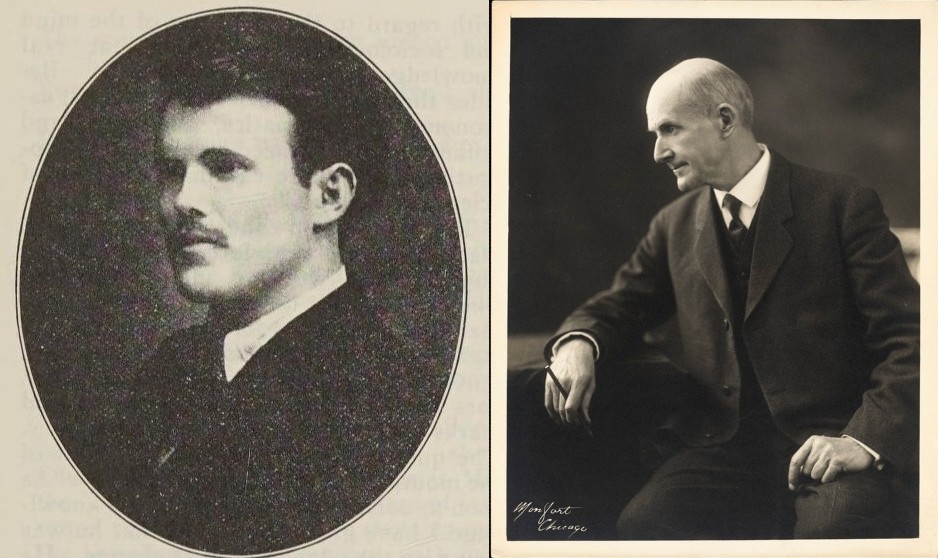
Duchez, from nearby East Palestine, Ohio, with a left critique of Debs’ speech at New Castle, Pennsylvania.
‘Debs at New Castle’ by Louis Duchez from Industrial Worker. Vol. 1 No. 52. March 19, 1910.
Debs spoke in New Castle a week ago last Tuesday. The lecture took place in one of the churches and the building was packed to the doors.
In this connection it should be stated that Rev. Johns, the pastor of the church, sees the necessity of “one big union,” and he has told his Welsh working-class congregation that time and again from bis pulpit. At the beginning of the Amalgamated strike he urged that the “independent” mills be called out and that the tin mill organize into “one big union,” such as the I.W.W., and stick together. He has told the strikers that that is the only method that will win against the Steel Trust. Rev. Johns sees clearly the tremendous power of working class solidarity in the industries. He also sees the superiority of the I.W.W. over the A.F. of L. and has said so to me personally.
But to come back to Debs. ‘Gene said some mighty good things during the course of his address. While listening to him I thought to myself: “If he only were not ‘managed’ by the business interests of the Little Old Appeal instead of in the interests of the Revolution, what a power he would be for the revolutionary movement?”
Debs knows where real proletarian power lies–in the industries. Throughout his lecture he implied that.
Of course, he flayed the judiciary. He even went so far as to say that Congress might as well stay at home, for when some measure is presented, anyway, that MAY do some good to the workers, the Supreme Court is ready to declare it “unconstitutional.” In short, he implied that with the increasing intensity of the class struggle and the consciousness of power on the part of the workers, the capitalists are becoming more arrogant, politically and industrially–and the workers WILL be compelled to take things in their own hands.
Debs said more than that. He said that the embryo of the new society is the industrial organization of the workers, developing itself along revolutionary lines, regardless of capitalistic institutions. To be sure, this truth was somewhat obscured by other more or less contradictory statements; nevertheless, the industrial unionist could see this was the meat in the cocoanut of Debs’ speech.
We are sorry that Debs is so “curbed” as he is by other than Proletarian elements. Whether this man, who was one of the first in this country to see clearly the revolutionary significance of an industrial union strike and went to jail because he attempted to employ its, tactics, will shake off the semi-bourgeois elements which are making capital of him and “come clean,” we are unable to say.
At least, he knows what’s what. His waiting for the “psychological moment” when spontaneous revolt takes place, may appear to his mind to be the proper course to take–for him. But we believe the thing to do NOW is to stand out NOW and in that way assist more effectively in in hastening that “spontaneous uprising.”
At any rate, we noticed, in keeping back the best revolutionary stuff that is in him, Debs lacked in his speech much of the spirit that the Debs of a few years ago manifested. No man can “spoon” with reform and keep from being contaminated by its deadly influence.
The Industrial Union Bulletin, and the Industrial Worker were newspapers published by the Industrial Workers of the World (IWW) from 1907 until 1913. First printed in Joliet, Illinois, IUB incorporated The Voice of Labor, the newspaper of the American Labor Union which had joined the IWW, and another IWW affiliate, International Metal Worker.The Trautmann-DeLeon faction issued its weekly from March 1907. Soon after, De Leon would be expelled and Trautmann would continue IUB until March 1909. It was edited by A. S. Edwards. 1909, production moved to Spokane, Washington and became The Industrial Worker, “the voice of revolutionary industrial unionism.”
PDF of full issue: https://www.marxists.org/history/usa/pubs/industrialworker/iw/v1n52-mar-19-1910-IW.pdf
 Revolution's Newsstand