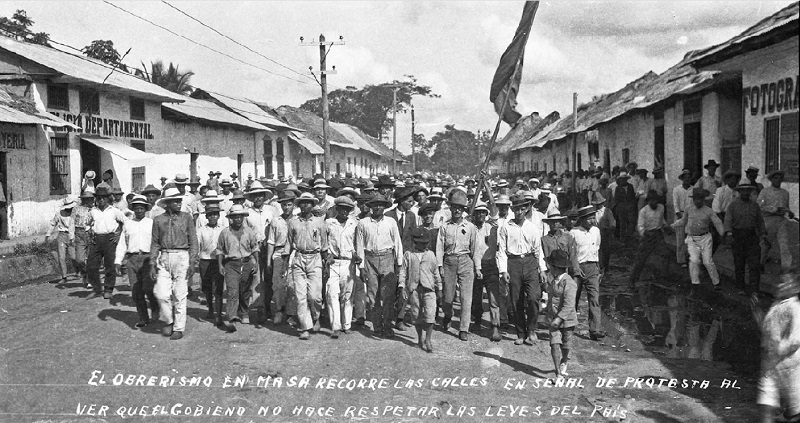
Cardenas was a Colombia unionist who participated in the 4th Profintern Congress and was a delegate from Colombia’s Partido Socialista Revolucionario, precursor to the Communist Party, to the Sixth Comintern Congress where he gave this speech on the class situation in Colombia as part of the Congress’ extensive discussion of the colonial revolutions against imperialism. I have a had a difficulty time finding more of his biography.
‘Communism and Anti-Imperialism in Colombia’ by Jorge Cardenas from from International Press Correspondence. Vol. 8 Nos. 74, 76, & 78. October 25, 30, & November 2, 1928.
Comrade CARDENAS (Colombia): Comrades, in a general way, I express the agreement of the Colombian delegation on the report presented here, except where it deals with the classification of the semi-colonial countries. This could be made more in agreement with the situation. For instance, Argentina, which is a semi-colonial country, is more free to dispose of herself than certain Balkan countries that are classified in the theses as independents.
The Colombian Delegation is also in agreement in general with what was expressed before the Congress by Comrade Humbert Droz with regard to Latin America. What Comrade Humbert-Droz said about Latin-America is only one step forward in the direction of the study of these Latin-American questions. Comrade Humbert Droz has certain ideas about Pan-Latin Americanism with which we do not agree, at least, not altogether.
I have the impression that the character of the coming revolution in the Latin American countries has not been clearly expressed here. It appears to me that there has been an overestimation of the role of the petty-bourgeoisie in the revolution. Owing to the extent of imperialist penetration on the part of the United States in some of the Latin American countries, the petty-bourgeoisie has become weaker, and the proletariat has arisen which, although it has no tradition as a proletariat, no clear Marxist understanding, has a very developed class-consciousness. There has been formed in Colombia a Revolutionary Socialist Party, which has shown considerable class- consciousness, and which has been able to deal a formidable blow to imperialism.
I therefore hope that the Latin American revolution will become a revolution somewhat between a proletarian and a petty-bourgeois revolution.
I also wish to express here the satisfaction with which I listened to the speech of Comrade Wolfe. This speech indicates that the North American Party now realises the enormous revolutionary force that Latin America represents at the present time, and that the Party will now pay more attention to the tasks in connection with the Latin American movement. think that no other Party in the Comintern should pay as much attention to our Latin American problems as the American Party.
Speaking of the characteristics of the coming revolution in Latin America, I refer to the statements of Comrade Travin, who asserts that it is not possible for a single country in Latin America to achieve a bourgeois-democratic revolution because of the dependence of these countries upon the U.S. We have a good example that repudiates this point of view. We have already seen that Sandino, in a little insignificant country like Nicaragua, has been able to fight against American imperialism for more than a year and a half.
If Comrade Travin would say that the possibilities of a victorious petty-bourgeois revolution in Latin America greater if it will take place in several countries, I would be in full agreement with him. Precisely the cohesion and organisation of the different movements of Latin America is the task of the Comintern.
A bourgeois-democratic revolution in Colombia, for example, would only be seriously menaced by Yankee imperialist intervention in the coastal districts, but in the interior of the country the United States would not be able to make great headway.
Until a short time ago Colombia was the country in Latin America which was able to stand outside the imperialist movement in Latin America. In fact, with the exception of the banana region, which is on the Atlantic Coast; and the platinum region on the Pacific Coast, the interior of Colombia has resisted imperialist penetration. But previously Colombia was subjected to the holy “imperialism” of the Roman Pontiff carried on through the priests and other kinds of the religious hierarchy who turned Colombia into a feudal territory of the Pope.
In a short time Yankee imperialism has rooted itself in Colombia. Its economic positions there are very solid. Its bankers have loaned, without any specific guarantee, than 2 million dollars. At the present moment negotiations are being conducted to put through a loan of 100 million more dollars.
To the U.S. we export 80% of our products and import 58% of our own total import trade. In 1913 the imports from the U.S. amounted to $7,647,164 and in 1924, to $25,671,858.
The banana exploitation and the extraction of the platinum yield a profit to Yankee imperialism of more than ten million dollars.
The oil zone, has a territorial extension of 88,000 sq. kilometres.
The best located section of this zone is already in the hands of American oil companies.
The only company, the Tropical Oil Company, has in Colombia 400,000 hectares of rich oil land, and it carries its oil to the sea through 800 kilometres of pipeline which cost $ 40,000,000. At the present moment negotiations are being carried on by the British oil companies, as a result of which the antagonism between these rivals is developing. In the course of a few years Colombia fell definitely under the influence of American capital and of American imperialism.
The bourgeoisie of Colombia has surrendered deliberately, it has joined hands with imperialism and has become a definite agent of it.
The Colombian proletariat has formed a party, a working class party, called “The Socialist Revolutionary Party”, which, if it has not a solid Marxist ideology, nevertheless has a class-consciousness quite sufficient to play an important role in the coming bourgeois democratic revolution in Colombia.
Imperialist penetration has not only called forth a vigorous opposition of the proletariat, but has aroused large sections of the petty-bourgeoisie. The intellectual and commercial bourgeoisie and even the petty-peasant proprietors find themselves in a certain dilemma whether they should go to the revolution with us or whether they should support imperialism. They do not like the idea to follow us, but imperialism is also repugnant to them. The definite ruin of agriculture which is its basis of living and the competition of industry from the United States undoubtedly tends to drive it into our camp.
This petty-bourgeoisie will not be able to keep away from, or to stand aside from carrying through its historical role which in Colombia is very great indeed, i.e. the struggle against feudalism. The petty-bourgeoisie will not play the same role that it did in Mexico because we have a Labour Party in Colombia. Naturally, the petty-bourgeoisie will have at the start the hegemony in the campaign, but it will have to reckon with us also.
In the centres of oil production, in railroad construction, in transport in general, which in Colombia has become great now, there are proletarian zones and this proletariat has formed the Socialist Revolutionary Party. And we are just at the beginning, in fact, of imperialist penetration. This developing proletariat will become more and more strong every day. The Communists will have to take advantage of the revolutionary situation which exists in Latin America and the Communist International will have to co-ordinate these movements, so that when they are in a united front against international imperialism, real results will be achieved. If a united front of the countries facing imperialist penetration in Brazil, Venezuela, Colombia, Peru, Ecuador, etc., is made, a great number of markets will be withdrawn from American imperialist domination and this will greatly affect American industry, and above all, will weaken the moral prestige of American Imperialism at home.
International Press Correspondence, widely known as”Inprecorr” was published by the Executive Committee of the Communist International (ECCI) regularly in German and English, occasionally in many other languages, beginning in 1921 and lasting in English until 1938. Inprecorr’s role was to supply translated articles to the English-speaking press of the International from the Comintern’s different sections, as well as news and statements from the ECCI. Many ‘Daily Worker’ and ‘Communist’ articles originated in Inprecorr, and it also published articles by American comrades for use in other countries. It was published at least weekly, and often thrice weekly.
PDF of issue: https://www.marxists.org/history/international/comintern/inprecor/1928/v08n78-nov-08-1928-inprecor-op.pdf
 Revolution's Newsstand