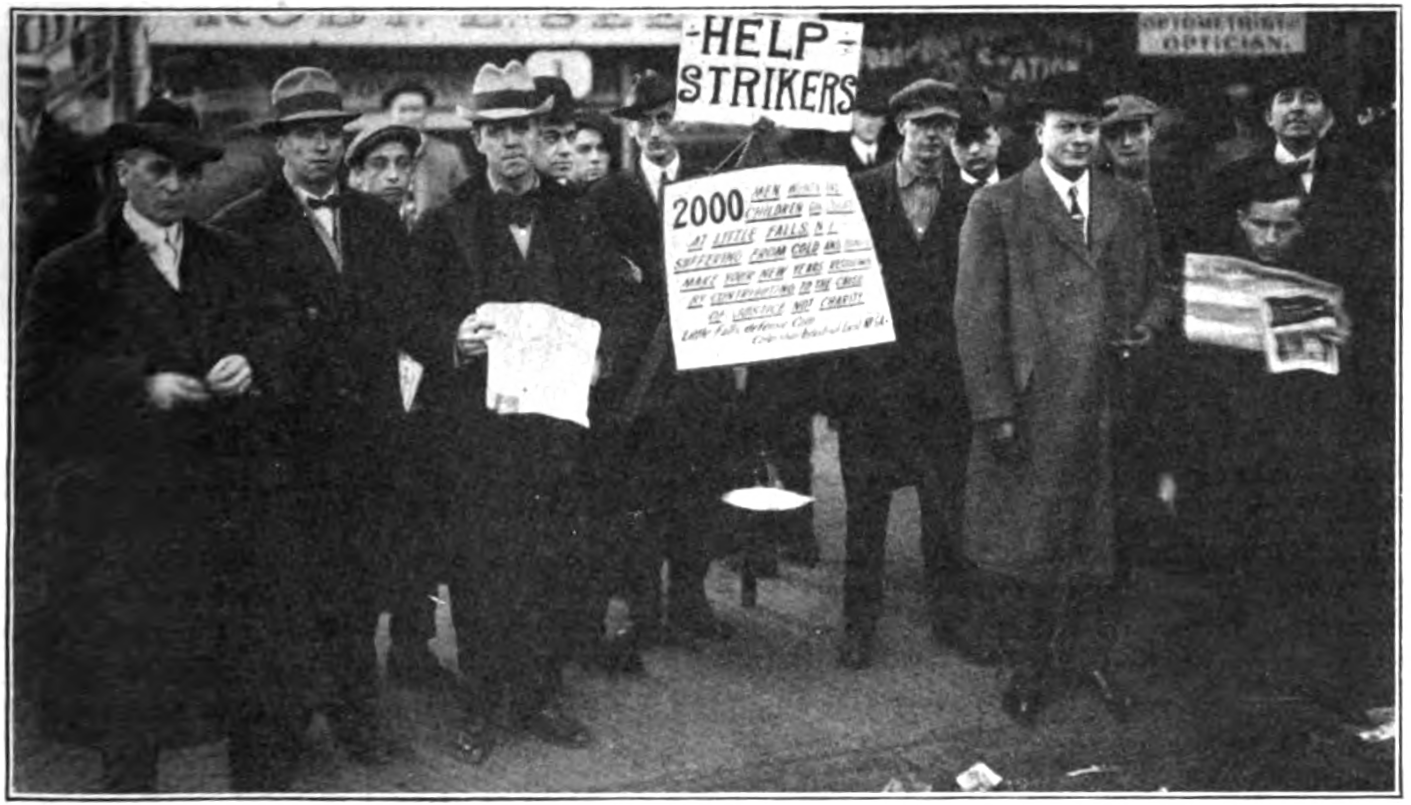
For our class, ‘an injury to one, is an injury to all’ is no hyperbole; nor is it, however powerful and true, simply an appeal to solidarity. It is, though often uneven in its injuriousness, a fundamental material reality. And one that, when generalized and acted upon, becomes a key instant of that most essential all revolutionary transformations; we, as an oppressed class cease to act ‘as ourselves’ and begins to act ‘for ourselves.’ Here, fellow workers in Columbus, Ohio, home of a recent hard-fought and bloody streetcar strike, act on ‘an injury to one is an injury to all’ and raise funds for the strikers at Little Falls, New York.
‘A Red Brigade: How the I.W.W. of Columbus, Ohio, Collected $40 for the Little Falls Strikers’ from International Socialist Review Vol. 13 No. 8. February, 1913.
THE accompanying photo will show how Local No. 54, I.W.W., with good results, took advantage of New Year’s day to raise funds for the fellow workers on strike at Little Falls, N.Y.
We secured two pots swung on tripods stationed on High street and placed signs in a conspicuous place above them. We sold fifty copies of the REVIEW, all that we had and could have sold five hundred additional copies
This being our first experience we have learned how to better conduct the next campaign. Local No. 54 has a small membership and the work fell upon the few active rebels that are striving hard to build up an organization, yet, what was lacking in numbers was more than made up in the true revolutionary spirit always found among the Industrial Workers of the World. We operated in reliefs as the day was very cold, especially when standing on the damp sidewalk.
The spirit with which we entered into this fight for justice seemed to permeate the winter atmosphere and become contagious as the day’s work netted $41.35, and after deducting $1.00 for the expense of the signs, immediately a check was mailed to the strikers for $40.00.
We secured permission to gather the funds from the Chief of Police, but had he refused we were determined to go ahead and fill up the jails if necessary.
Our experiences were varied and the coins ranged from a one cent piece to a ten dollar check. Little newsboys dropped in their hard earned pennies. Little children contributed, their sweet faces beaming with joy at being able to help along so worthy a cause. Workers, their faces covered with that unmistakable mark of the bitter struggle, dropped in their coins with such remarks: “That’s me, keep up the good work,” of “Sure, this is our fight.” Often during the day there came along the down-and-out with an empty pocket and stomach. These, of course, could not give but assured us they were with us. Even two policemen were seen to contribute.
Upon one side of the pot a fellow worker rang a little bell to attract attention and on the ether side another sold Reviews, holding open the pages showing the picture of the strikers in jail, explaining the strike and our object in collecting the funds. Naturally we were the center of attraction, this being something never before attempted upon the streets of this masters’ town. We had many arguments during the day, some amusing, others serious. We must relate one in particular.
A bourgeois from Little Falls happened along and, of course, had to give his version of conditions by blaming the strikers. During the course of his remark a big, fat plute dressed in faultless attire appeared upon the scene and lost no time in joining forces with the speaker by saying, “Sure it’s their own fault, if they did not spend all they made for booze they could live comfortably and each one buy a home.” By this time the crowd had increased, blocking the sidewalk and even standing in the street. A worker in the crowd whom we recognized as a blacksmith, asked, “Why is it that I am in my present condition bordering on poverty all the time? I work six day* every week and I don’t touch booze.” This was too much for the plute. His discomfiture was plainly noticeable and he looked appealingly around expecting someone to come to his rescue, but no answer was forthcoming and the crowd enjoyed itself immensely at his expense. Hot shot after hot shot was poured into him mercilessly and he was seen to edge his way out of the crowd muttering, “It isn’t fair, you are all against me. You fellows don’t know when you are well off and the d—n I.W.W. is the cause of it all.”
Thus we spent the happiest and most satisfactory day in the history of our short existence, fully establishing the fact that the I.W.W. knows how on occasion to adopt original tactics. These tactics are becoming a power in the labor world today and can no longer be resisted. In labor’s war for freedom we will continue to grow until the time when we will overthrow the cruel and murderous system and upon the scrap heap of wage slavery establish the Industrial Democracy of Freedom and Justice for the working class.
The International Socialist Review (ISR) was published monthly in Chicago from 1900 until 1918 by Charles H. Kerr and critically loyal to the Socialist Party of America. It is one of the essential publications in U.S. left history. During the editorship of A.M. Simons it was largely theoretical and moderate. In 1908, Charles H. Kerr took over as editor with strong influence from Mary E Marcy. The magazine became the foremost proponent of the SP’s left wing growing to tens of thousands of subscribers. It remained revolutionary in outlook and anti-militarist during World War One. It liberally used photographs and images, with news, theory, arts and organizing in its pages. It articles, reports and essays are an invaluable record of the U.S. class struggle and the development of Marxism in the decades before the Soviet experience. It was closed down in government repression in 1918.
PDF of issue: https://www.marxists.org/history/usa/pubs/isr/v13n08-feb-1913-ISR-gog-ocr.pdf
 Revolution's Newsstand