
The U.S.’s former Cuban colony was something like its Israeli colony today. Central to both regional interests and overall U.S. imperial strategy. Like Israel, U.S. ties to Cuba were deeply intertwined–military, political, economic, and on many levels, personal connections made Cuba of the ancien regime a cornerstone of U.S. omnipotence in the hemisphere. A leading figure in the U.S. Communist Party’s Latin-American Department, Gomez looks at the ‘strange case’ of Cuba where a popular revolt against the long-backed U.S. dictator saw American imperialism, instead of defending their asset, negotiate with Cuban opposition groups to facilitate a new ‘popular’ government. When Machado balked at the deal, the U.S. led the Cuban military in a coup against their former ally, with General Batista eventually rising to power.
‘The Strange Case Of Cuba’ by Manuel Gomez (Charles Phillips) from New Masses. Vol. 9 No. 1. September, 1933.
Historical science, for the liberals, is summed up in what I like to call the Innocent Interpretation of History. If we are to believe these gentlemen, there is no pattern to historical events except an accidental one. There is no such thing as continuity of foreign policy, there is no conscious foreign policy at all, and wars are the result of psychological factors or well-intentioned diplomatic blunders rather than basic clashes of interests—save perhaps wars of the more or less distant past. Living along from event to event in the spirit of the innocent Interpretation, your liberal is bound to find himself suddenly face to face with an occurrence which knocks the pins completely from under the equilibrium of his ideas.
For a long time now editorial writers of the Nation and the New Republic have waxed lyrical ever “the trend away from imperialism” on the part of the United States. They have pointed to the withdrawal of marines from Nicaragua, the relaxation of direct naval control in Haiti, the changed relations with Mexico, the Hawes-Cutting Bill program on Philippine independence. The America of Morgan and Mellon and Rockefeller had apparently bowed in humility before the doctrines of sweetness and light. Raymond Leslie Buell expressed it all in the characteristically laudatory formula “the New Deal in foreign affairs.” As recently as August 23rd, the New Republic was describing the Platt Amendment as “a hangover from our imperialistic jag of thirty years ago,” and congratulating President Roosevelt on having allowed a revolution to take place in Cuba without intervention.
The revolution to which the New Republic referred was the collapse of Machado and his hasty replacement by the rather freely acknowledged designate of Ambassador Welles, Senor Carlos Manuel de Cespedes. When de Cespedes, in turn, was forced out of office and the Commission of Five took over the government on the crest of the bloodless uprising of the army against its Machadista officers, the tender forbearance of the United States Government disappeared immediately. There had been no question of tumult in the situation. Yet, inspired press reports began to issue from Washington to the effect that “in spite of grave fears it is hoped that intervention can be avoided.” Mysteriously, the air became thick with cries that “intervention must be avoided, if possible.” Finally, President Roosevelt transmitted notes to various Latin American governments explaining that the United States would not intervene in Cuba except as a last resort. All this was plainly nothing else but a threat of intervention—and it has been so interpreted in Cuba. Now the threat has been reinforced by the concentration of thirty U.S. war vessels in or near Cuban waters, characterized by the New York Times as “a show of force unequalled by anything in recent history.” Presumably the only reason why more ships were not sent is that virtually all the rest of the Atlantic Fleet is in the Far East.
The New York Evening Post, which although a Republican paper, has given general support to Roosevelt’s foreign policies, found itself obliged to say editorially: “One can ask for some intelligible reason why there was the greatest forbearance during many bloody excesses, and then a sudden mobilization of the navy at a moment when the island was outwardly more peaceful than at any time during recent months.”
How do American liberals square this expedition against Cuba with their recent theories of a trend away from imperialism? Their theories are obviously confounded. Unless they are prepared to regard the aggression against Cuba as just another accident, they must revise their whole notion of what has been taking place in U.S. foreign policy under Hoover and Roosevelt.
Of course, while foreign policy has its continuity, it is not static. Unquestionably there have been changes of late, important changes. The changes have been expressions of a shift in the strategic center of a fundamentally imperialist policy.
Here it is necessary to go, what may seem, far afield, but we shall return to the Cuban situation in due time, and the reason for our digression will be manifest. Columbus was not the last to recognize that it may be possible to reach a certain quarter by setting out in a contrary direction. We shall approach the Antilles by way of the Far East.
At the present time the entire primary line of American policy abroad is orientated in the direction of preparation for war with Japan. It is not only the direct exploitation of China that is at stake, vital though this is for both American and Japanese capitalism today. There is the further fact that with Chinese manpower under her rigid control and all the resources of China at her command, Japan would be in a position to challenge American imperialism everywhere in the Far East. With a strong alliance in Europe she might challenge for the domination of the world. And already Japan has gobbled up a goodly share of Chinese territory.
What wonder then that the United States Government should have labored unceasingly to break up the Anglo-Japanese Alliance, continued until recently in spite of official disavowals. Or that a Japanese statesman should have remarked, during a visit to these shores early in the year, that his conviction of American amity would be considerably strengthened by the transfer of the Atlantic Fleet to the Atlantic. The United States Government manoeuvred successfully to isolate Japan in the League of Nations. The President-Elect made preparatory gestures in the direction of recognition of Soviet Russia, certainly not because there had been a change of heart toward the Soviet regime, and not entirely because of the pressure for Russian trade to alleviate the economic crisis.
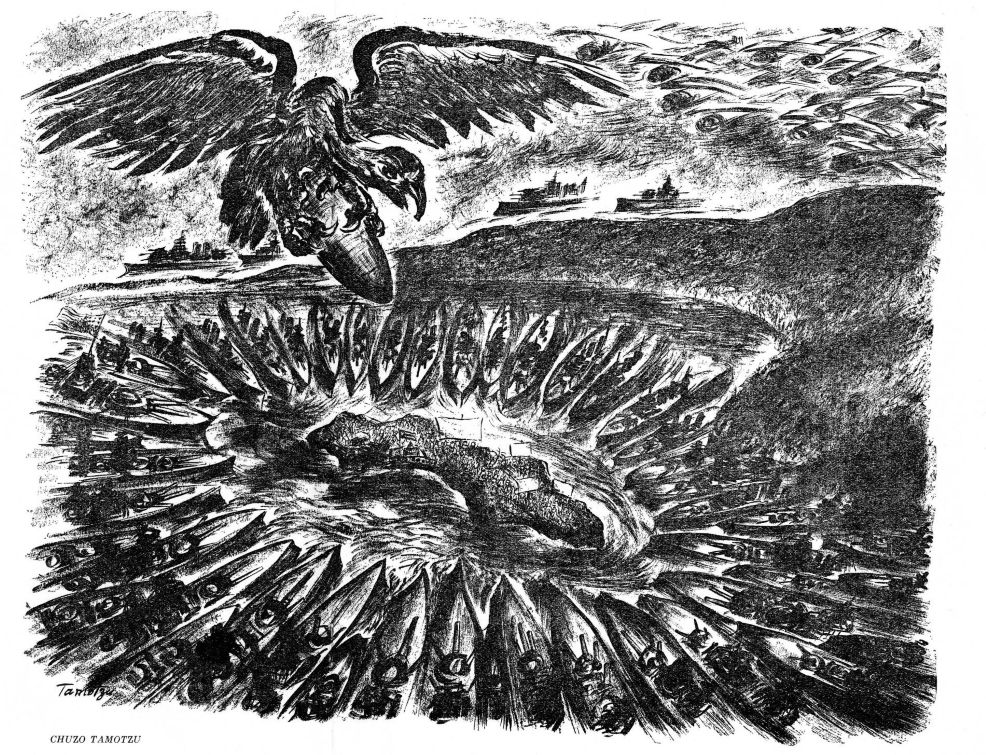
Steadily the tension between the two rival imperialisms has grown. The measure of its progress became apparent to all the world a few months ago, when the Japanese Government let it be known that Japan was no longer prepared to accept the 5:5:3 ratio of naval strength established at the Washington Conference, and at the expiration of the present treaty would insist upon equality with the United States and England. This is countered by an abrupt undertaking in this country to build “up to the full treaty strength.” President Roosevelt’s naval-building program (adopted as part of the “economic recovery program”) creates the certainty of a military and naval budget which in the course of the next few years will approach $750,000,000. From Japan now comes the charge that the United States is engaging in an armament race with her.
An amusing commentary is afforded by the return from a trip to the Orient of Roy Howard, of the Scripps-Howard newspapers, who has come back “in a mood of great concern over the relations between the United States and Japan.” According to the New Republic, “he feels that all the beneficent attempts at internationalism of the past few years have failed as regards the Far East…He also recommends that we should at once build our navy up to treaty strength.” The New Republic takes issue with Mr. Howard on the latter point. It seems that this liberal journal is afraid Mr. Howard’s recommendation is likely to disturb Japan’s belief “in our disinterested and friendly intentions…It must be remembered,” the editorial goes on to say, “that Congress has voted, and the President has signed, a law giving the Philippines their freedom; that the United States officially turned its back upon imperialistic intentions in any part of the world, and that we are likely to make our foreign trade only an easily dispensable luxury. In the light of these facts, would not Mr. Howard’s ends be better achieved if we said to Japan: ‘Under no circumstances do we propose to fight you for land, trade, or opportunity for investment in Asia…’”
Whether Mr. Howard’s position or the New Republic’s affords the most comfort to imperialism, it is difficult to say. Mr. Howard at least does not attempt to hide the war danger. The New Republic goes out of its way to champion governmental intentions, and spreads the implication that American imperialism does not propose to fight, when in fact it does propose to fight and the preparations for that fight are an outstanding feature of world policy. To the individual unfamiliar in such matters it is astonishing how far these liberals will go in their eagerness to establish the innocence of the ruling classes. The measure “giving the Philippines their freedom” has been repudiated overwhelmingly by the Filipinos themselves as a measure which did not give freedom at all. It provided that, if the Filipinos adopted a constitution acceptable to the President of the United States, then, at the expiration of ten years, the Philippine Islands would be declared “independent” with the reservation that a special treaty must be signed with the United States and that certain military posts in the islands must remain under the control of the United States.
The significance of the Hawes-Cutting formula was two-fold. While preserving the substance of imperial domination over the Philippines, it allowed the United States to pose as the “white hope” of anti-imperialism in the Far East, as a rallying center against the open aggressions of Japan. Secondly, by giving the American beet sugar anti-imperialists what they really wanted, it put an end to their sniping tactics at home and consolidated support behind the naval and war programs.
As already suggested, this Philippine policy has its counterpart in Latin America. Japan has developed the irritating habit of comparing China to Latin America, and of explaining her aggressions there by citing the application of the Monroe Doctrine in this part of the world. Thus, when the United States began to concentrate its foreign policy more and more on outmaneuvring Japan, the strategy of the situation demanded that the methods pursued in Latin America become less embarrassing. Moreover, it would hardly do to enter a major war across the seas without providing against rumblings nearer home. The situation is further complicated by the coming Pan-American Congress, at which the whole question of the Monroe Doctrine is scheduled to be aired. Hence, the peculiarly hospitable attitude of the United States Government toward the intervention of the League of Nations in the Leticia controversy between Colombia and Peru. Hence the apparent restraint in handling recent obstreperousness on the part of Santo Domingo and Salvador.
In its relation to the Latin American countries nearest at hand, the tactic that has been adopted is simple enough, and it is not a new one in the manual of imperial instrumentalities. It is the tactic of indirect, unostentatious domination, reinforced by the nearby reserve of armed might. If marines are withdrawn from Nicaragua, they leave a puppet government in charge. Similarly in Haiti (from which the marines have not been withdrawn as yet), and other countries. The marines are by no means out of the picture—even when they are in the background. The experience of the past makes it clear that they are ready at hand when the puppet government falters. Does any informed person seriously question that the United States Government continues to be the decisive force in Nicaragua or in Santo Domingo, or that it will continue to control Haiti? Or does anyone suppose that “the changed relations with Mexico” would be possible if the Mexican government had not sufficiently indicated its subservience? Nevertheless, it remains true that the weight of emphasis with regard to specific measures in Latin America is somewhat different as a result of the orientation of major policies on the Far East.
Now let us look at Cuba, where American capital has some $1,600,000,000 invested, as compared with only slightly more than two and one-quarter times that figure invested in all the other Latin American countries. It is a well-known fact that the bestial Machado ruled by the grace of the United States Government, and that he was discarded by the sugar interests, by Wall Street and by Washington only after there was no other course open. President Coolidge repeatedly did honors to Machado. Harry F. Guggenheim, U.S. Ambassador under Hoover, made it a point to discourage all opposition to the dictator. The latter took every opportunity to cite U.S. Government support as a justification of his regime, notably in speeches when Ambassador Guggenheim sat silently at his side. Meantime, Machado was draining the resources of Cuba to satisfy the demands of American finance capital, was piling up debts, impoverishing the people, dealing death and destruction to workers, peasants and even honest petty-bourgeois nationalists who cried out against his methods.
Because of the economic situation in Cuba and the widespread ferment that Machado’s methods had aroused, it became clear that he could no longer control the situation. Only then, when students of the closed colleges and schools were coming under the influence of Communist workers, when peasants were preparing to attack sugar centrals, when the ABC secret terrorist society had recruited thousands of members, when even the well-paid army was growing restive, did Washington prepare to withdraw its support. Shortly thereafter, President Roosevelt sent Mr. Welles to Cuba to take charge of the situation.
What followed is. a matter virtually of public record. Although the students had talked and the politicians had schemed, it was the general strike of the workers that spelled Machado’s doom. Like wildfire the strike movement spread, caught up larger and larger sections of the population, until the general atmosphere became one of revolution. Then the army deserted Machado, and on August 12th he fled. During all this time Ambassador Welles was holding private meetings in his hotel with the so-called official opposition elements—the Menocal Conservatives, the Mendieta Unionists—and the ABC leaders—in an effort to prevent any fundamental change. As for the students, most of their leaders occupied themselves with urging the workers to give up the strike now that Machado had disappeared from the scene. The pressure of an aroused working class was not wanted by any of these elements in determining the character of the new government.
As a result of the Welles conferences, a “satisfactory” President was named—Carlos Manuel de Cespedes, former ambassador at Washington and the Secretary of State in Machado’s first cabinet. De Cespedes lasted less than a month. And that brings us to the U.S. naval mobilization stage.
There was no threat of military intervention in the time of Machado. As elsewhere in Latin America, imperialism worked through native tools. There was no threat of military intervention when Machado fell, because an equally willing tool could be put in his place—although the United States Government did send one warship to Havana harbor for the moral effect. Why then has Washington felt obliged to pursue a more vigorous course of action now?
The answer lies in the special turn that events have taken. The Commission of Five consisted of three professors, a journalist, and a banker. They stood for an unclear petty-bourgeois nationalism, and declared themselves against the Platt Amendment, but they comported themselves with typical lack of decisiveness and could hardly be thought to constitute an insurmountable barrier to the objections of Ambassador Welles. The peculiar aspect of the situation was that this indecisive government had been placed in power by the students, through the medium of an army which had deposed its officers. Moreover, whatever may have been the allegiances of the sergeants who succeeded to the command, the soldiers were fraternizing with the workers and peasants, and this was the whole key to the situation.
Imperialism cannot rule through a puppet government if the latter has no dependable army. Consequently, for American imperialism, it is a question of the “reestablishment of discipline” in the Cuban army, or military intervention on the part of the United States. It is certainly not without significance that the rebellious Cuban officers saw fit to entrench themselves in the National Hotel, where Ambassador Welles was staying. Nor that the officers—with a treasonableness almost unexampled in cynicism—declared that they would call for the United States to intervene unless de Cespedes were restored to the Presidency. However, the United States is not unprepared to throw de Cespedes overboard. Even Dr. Ramon Grau San Martin, whom the five commissioners finally decided to make President, seems to be acceptable, providing the army can be brought back under control. Grau San Martin was not too far to the left to participate, with the old-line politicians of the Menocal and Mendieta groups, in the Miami “Opposition Junta.” But, regardless of what shifts may be made at the top, or how long the affair may be drawn out, the U.S. Government will decide for military intervention unless the soldiers can be subjugated and the fraternization with the masses brought to an end.
This is the reason for the thirty warships. This explains why the threat of military intervention hangs over Cuba, at a time when American imperialism seems to be withdrawing forces elsewhere. There is no inconsistency in the United States Government’s Cuban policy and its recent foreign policy as a whole. Indeed, the Cuban episode fits into the picture with revealing exactness. The general policy is one of imperialism holding its covenants while bracing itself for war. Cuba is not only an important center of invested American capital but is also a basic strategic point of American imperialist policy in a military sense. As the key to the Panama Canal, its absolute control is vital for a war with Japan. The Encyclopedia Britannica, in its article on the Panama Canal and the Caribbean says: “With the chief positions on Cuba and Porto Rico in the hands of the United States, the question of strategy virtually disappears but their loss in case of war quickly change the whole strategic problem.”
The sensitiveness of American imperialism to every development in Cuba is to no small extent an earnest of its general concern with strategic positions. It is an indication of the ripening of the plans for war with Japan. It is a phase of the preparations for that war.
The New Masses was the continuation of Workers Monthly which began publishing in 1924 as a merger of the ‘Liberator’, the Trade Union Educational League magazine ‘Labor Herald’, and Friends of Soviet Russia’s monthly ‘Soviet Russia Pictorial’ as an explicitly Communist Party publication, but drawing in a wide range of contributors and sympathizers. In 1927 Workers Monthly ceased and The New Masses began. A major left cultural magazine of the late 1920s to early 1940s, the early editors of The New Masses included Hugo Gellert, John F. Sloan, Max Eastman, Mike Gold, and Joseph Freeman. Writers included William Carlos Williams, Theodore Dreiser, John Dos Passos, Upton Sinclair, Richard Wright, Ralph Ellison, Dorothy Parker, Dorothy Day, John Breecher, Langston Hughes, Eugene O’Neill, Rex Stout and Ernest Hemingway, Artists included Hugo Gellert, Stuart Davis, Boardman Robinson, Wanda Gag, William Gropper and Otto Soglow. Over time, the New Masses became narrower politically and more journalistic in its tone.
PDF of full issue: https://www.marxists.org/archive/gomez/1933/sep-1933-New-Masses.pdf
 Revolution's Newsstand