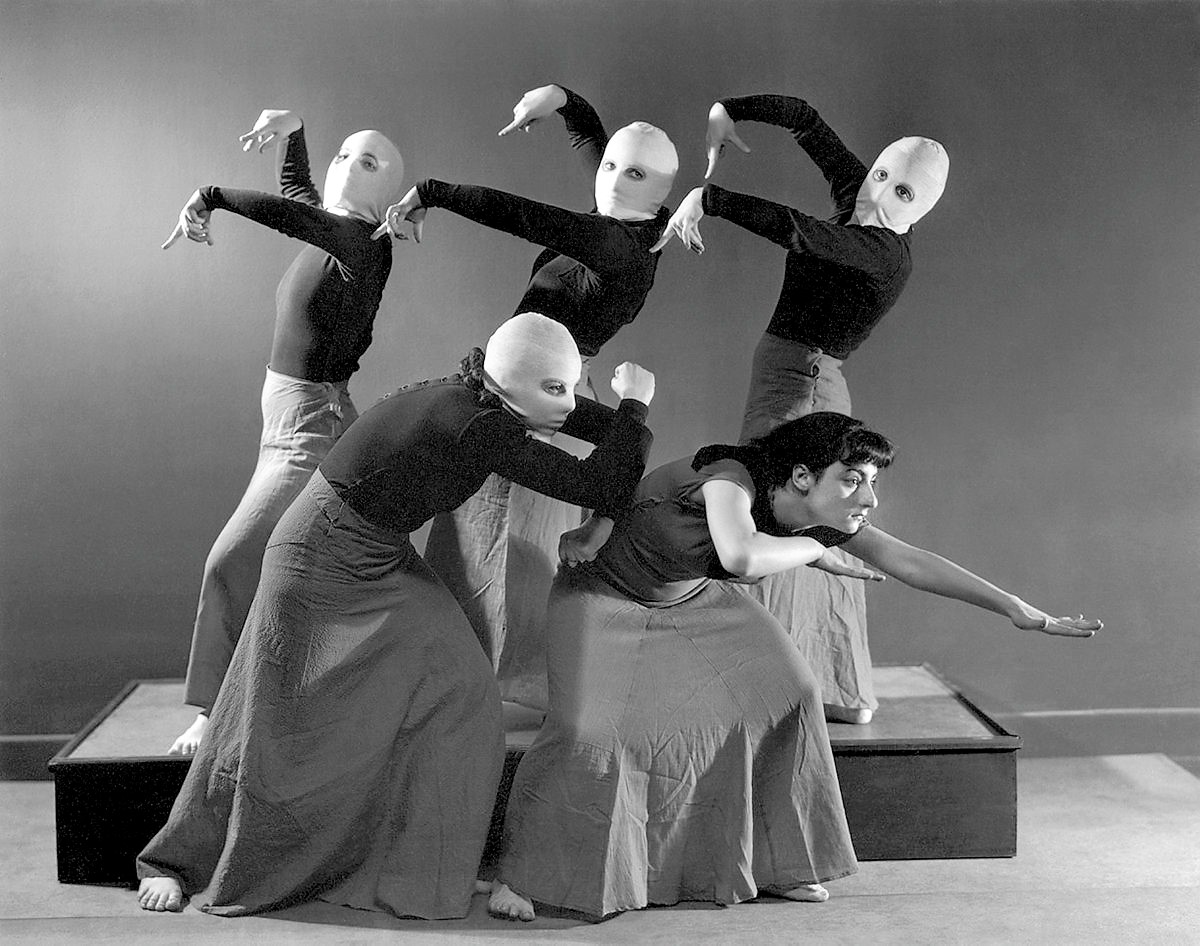
A review of the June 9, 1935 New Dance League benefit-festival for the League Against War and Fascism involving leading artists and troupes from the exuberant and vanguard world of 1930s radical dance.
‘The Finale to a Brilliant Dance Season’ by Stanley Burnshaw from New Masses. Vol. 16 No.1. July 2, 1935.
DURING the past year no other left-wing artists have done more exciting work than the New Dance League, which wound up its season’s activity in an all-day Festival on June 9.
One should preface comment on such an event with some sketch of the season as a whole–and a warm pleasure it would be to reminisce about the first recital of Revolutionary Solo Dances (Nov. 25), the All-Men Dance program (May 4), the handful of New Theatre-New Dance League Sunday night recitals. But nobody easily forgets such occasions, or the historic evening of Feb. 17 at the Center Theatre when our dancers performed before the largest dance audience ever assembled in this country. The impact of these events on the “general dance public” appears in the ever-increasing audiences that support the New Dance League.
The Festival began with an afternoon competition of seven “amateur” groups, the winner to appear in the evening program. Exactly what “amateur” designated this reviewer hasn’t found out, for in terms of fresh feeling and technical finish the amateurs of the afternoons sometimes surpassed the professionals of the evening. “Two Variations” by the State Unit of Dance, Music and Drama (C.W.A. Project) is a ready example: beautifully designed, colored with irony and executed with ease. If its picture of genuine lamentation (part 2) had been as emotionally true as its mockery of lip-service mourning (part 1) this dance would have commanded the prize. As it happened the Blanche Evans Amateurs won the award with “Unite Against War and Fascism.” There can be little doubt that this was one of the least distinguished items on the program–mechanical, uninteresting, flat. The judges would have done better had they made no award since “Unite…” can add nothing to the glory of the New Dance League or to the American League Against War and Fascism, for whose benefit the Festival was held.
In this reviewer’s opinion the “Dance of Death” by the Matons Experimental group would have been a logical prize-winner judged according to New Dance League standards. In a series of short episodes, alternating mockery, horror and grim humor, this “revolutionary ballet” communicates a powerful anti-war message. It has very little of the glib frenzy and irritating choppiness that mar the other works by this group. Some judicious cutting and sharpening of the finale could easily make this ballet one of our most stirring dances. The Matons group performed two other numbers, (“Lynch,” “Ivory Tower”) both new compositions and both spilling over with ideas waiting to be marshalled into clear, persuasive forms. No comment on the afternoon program could fail to mention the “Folk Dances” by the Junior Red Dancers, which were delicious, naïve and gay. In addition to three new numbers–one of which is something of a landmark in the contemporary dance–the evening program included several works already famous though less than a year old. We have spoken before in these columns of the warmth and fresh feeling in two Tamiris group numbers (“Camaraderie,” “Work and Play”), of the superb rhythmic beauty of “Studies in Conflict” and the magnificent comedy of “Traditions,” both designed by Charles Weidman and danced by Weidman, Limon, Matons and group. This latter study of the difficulties of substituting new traditions for old has already been hailed by some critics as a masterpiece of abundant, annihilating revolutionary humor; and the thunderous applause it received at the Festival was proof that the audience agreed.
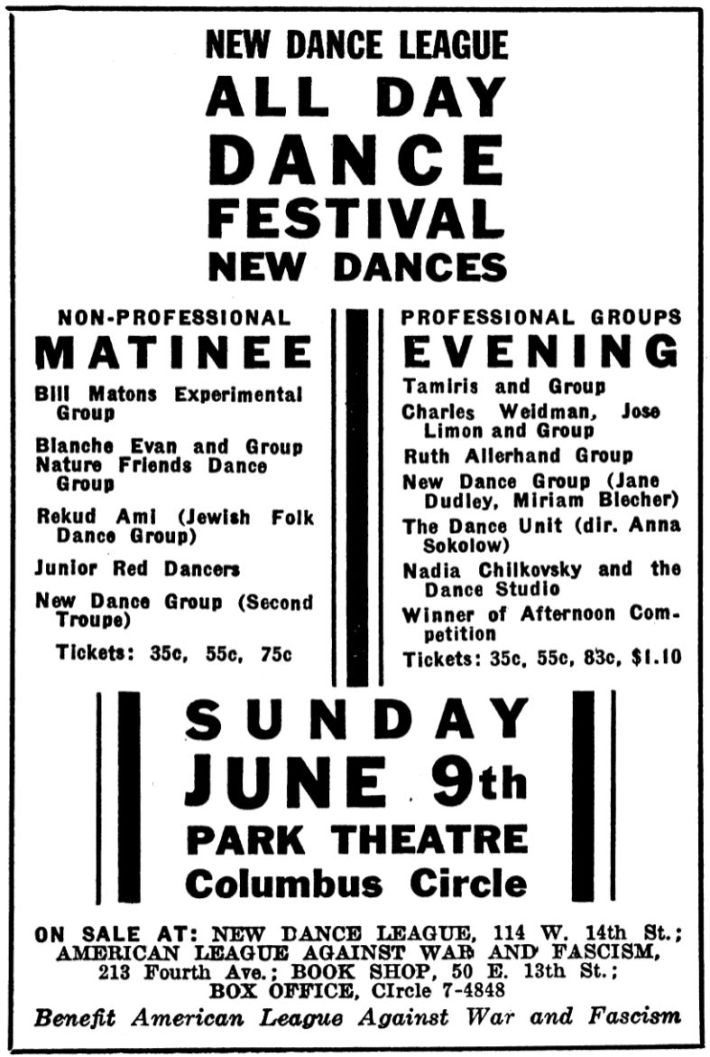
Far less resounding was the applause for “Ah Peace” and “Strike,” two new works by the New Dance and the Ruth Allerhand groups respectively. One expected more than a flash of boisterous anti-war wit from the New Dance Group which won last year’s festival with “Van der Lubbe’s Head”; and such a weak and outmoded composition as “Strike” no longer evokes more than patient indulgence from New Dance League audiences. But these disappointments are pushed. out of mind by the overwhelming power of “Strange American Funeral,” presented for the first time by the Dance Unit. Using Michael Gold’s poem as her text and Elie Siegmeister’s piano-voice duet as her score, Anna Sokolow has attempted to dance the story of Jan Clepak, Pennsylvania steel worker. To communicate the moving tragedy by means of a triple fusion of poem, song and dance is, to put it mildly, a prodigious problem; and the degree of success to which Anna Sokolow has solved it constitutes one of the brilliant achievements of the revolutionary dance. To be sure some passages do not shine with full clarity and there is not yet an entirely perfect coordination of words, music and movement; but these flaws are lost in dynamic patterns of such emotional power as to drive the audience into prolonged cheers, whistles and applause. “Strange American Funeral” has not a single fuzzy or uninteresting figure, not a single trick of mere facility, but clean and brilliant designs flowing together along a line of rising intensity until it achieves a summit of militancy and accusing power.
Such a work of imagination, which builds out of subtle suggestion as well as direct statement, shows how far the revolutionary dance has progressed toward full development. There is no longer the notion of limiting it to basic black-and-white posters and trying to dress them in pleasing variations. From this year’s work of the New Dance League we see how many-colored and vigorously original the revolutionary dance can be while retaining–indeed usually strengthening–its communicative power. Art, to be original, need not be obscure; for originality by no means involves tortuousness and hyper-sophistication as we have been led to accept by the involuted forms grown fungus-like on the stumps of a decaying social order. Art can be startlingly fresh, original, new and yet remain as clear, as memorable, as persuasive as a Negro work-song.
The New Masses was the continuation of Workers Monthly which began publishing in 1924 as a merger of the ‘Liberator’, the Trade Union Educational League magazine ‘Labor Herald’, and Friends of Soviet Russia’s monthly ‘Soviet Russia Pictorial’ as an explicitly Communist Party publication, but drawing in a wide range of contributors and sympathizers. In 1927 Workers Monthly ceased and The New Masses began. A major left cultural magazine of the late 1920s to early 1940s, the early editors of The New Masses included Hugo Gellert, John F. Sloan, Max Eastman, Mike Gold, and Joseph Freeman. Writers included William Carlos Williams, Theodore Dreiser, John Dos Passos, Upton Sinclair, Richard Wright, Ralph Ellison, Dorothy Parker, Dorothy Day, John Breecher, Langston Hughes, Eugene O’Neill, Rex Stout and Ernest Hemingway, Artists included Hugo Gellert, Stuart Davis, Boardman Robinson, Wanda Gag, William Gropper and Otto Soglow. Over time, the New Masses became narrower politically and more journalistic in its tone.
PDF of full issue: https://www.marxists.org/history/usa/pubs/new-masses/1935/v16n01-jul-02-1935-NM.pdf
 Revolution's Newsstand