Foster reports on the wave of insurgent, dissident, and wild cat strikes, yet to crest, that swept coal mining regions in 1931.
‘War in the Coal Fields’ by William Z. Foster from Labor Defender. Vol. 6 No. 7. July, 1931.
THE miners, 40,000 of them at the time this is written, are in a desperate strike against starvation. This is no ordinary mine strike.
It is not called by a reactionary United Mine Workers with all the police formalities, the long notice given, and the orders to the strikers to “stay home-go fishing- let us handle the strike,” which the officials of the U.M.W. used to issue.
The splendid fighting ability of the coal miners, which many times in the past has broken through the U.M.W. program of letting a strike die through inaction, has now no restraint.
The strike itself started with mass picketing, and from the first, mass marches of thousands of miners, with their wives and children, have spread it.
The strike has already swept into Ohio and West Virginia coal fields, and is spreading there with the greatest rapidity. There are 5,000 miners on strike in Ohio, at this is written. The first mines to come out were, late last week, the Hanna Coal Co., mines at Pineyfork and Dillonvale. Others followed, and on one day, June 15, 200 more came out at Gaylord No. 1, and 300 more still at Big Run. A frame-up proposition is under way there, with the arrest of several persons for an explosion. Friday 750 struck at Powhatan, and 300 at Provident, Ohio (June 13).
The District conference of the Ohio miners held with 109 delegates from 27 mines and with a steel workers delegation present offering support, was denied a hall in Bellaire June 14 by the police, and adjourned to Dillonvale, 26 miles away.
In West Virginia mines are coming out daily. Eight hundred men struck June 15 at two Constanza mines. Others struck previously and the movement is spreading.
Naturally enough, the coal operators fear this strike as they never feared another. They dread to see it spread, day by day, with big lunges forward, particularly on Mondays, following the great mass meetings and preparations on Sundays. They know that the iron has bit deep into the minds of these men, who starved along on $6 and $8 or even less the Coal Fields a week, nominal wages – nominal because they never saw any of the money in most cases. Company charges, powder, caps, doctor, insurance, board or rent and store bills (at double prices) take up all the man earns. He lives in peonage.
Against such a system the miners strike saying: “No worse to starve striking than to starve working.”
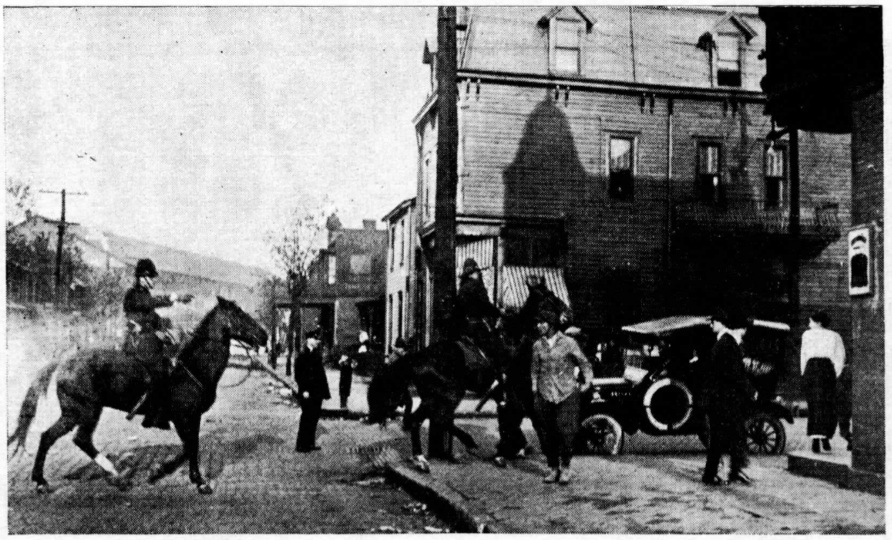
In this kind of a strike, then, you can expect plenty of terror. Already ten men have been shot for picketing, fortunately none of them killed. Strikers are shot at by state police, coal and iron police, and deputy sheriffs. State troopers, deputies, and green khaki coal and iron cops ride madly over the countryside, armed with tear gas, clubs, and all kinds of guns: shot guns, pistols, rifles, and machine guns.
They have beaten severely, wounded by breaking their bones, cracking their skulls, knocking out their eyes, about three or four hundred men, women and children
The natural desire of the policeman who crippled a miner is to arrest him and charge him with some crime, so as to give himself a defense.
Thus Adam Getto, organizer of the N.M.U., at the march on Ellsworth mine, where the crowd charged four times through a tear gas cloud and drove the deputies behind their barricade, was clubbed until he had to have six stitches taken in his head, and then arrested.
Over in Ohio they charged young Leo Thompson with attempted murder, and everything less, and hold him on $50,000 bail because he spoke at a meeting of 3,000 workers at St. Clairsville Court House. The meeting was in protest against the arrest of pickets, and they drenched that meeting with tear gas and arrested 9 more.
There are 140 arrested so far in western Pennsylvania, and forty of these are still in jail. Some are held under as high as $6,000 bail. These men come up before “squires,” the justices of the peace, and in small places before “the burgess,” who is a combination mayor and judge. These fellows are usually hooked up with the coal companies. When Pat Fagan, Pittsburgh District President of the U.M.W. comes to town, he makes the burgess or the squire a part of his “local union.” Pinchot steadily adds more state troopers to the strike section, and permits the illegal “proclamations” of the sheriff of Washington County, which prohibit assemblages of more than three in streets or vacant lots of towns. There are eviction notices in plenty.
Governor Pinchot is now publishing statements declaring that “peaceful picketing and marching” is to be allowed, and asking the evictions around Avella be stopped. The hypocrisy of this action of the governor is evident when it is considered that he simultaneously increases the armed force, that on June 18 he presided at a strike-breaking conference of himself, Phil Murray, vice-president of the United Mine Workers, and president Pursglove, of the Pittsburgh Terminal Coal Co. This will probably (though not certainly) result in a scab agreement, which the miners of the seven Terminal mines on strike will meet with mass picketing. Then Pinchot will try to force the miners back with force.
This is one of the great, heroic strikes of this century. The miners now on strike fight for the first time under their own leadership. It is a good fight, and terror will not crush it. But the working class of the world must not stand idle and let these brave men, women and children, starving but fighting, go needlessly to prison, fall before the bullets and clubs of the police. There must be mass protest against the terror; there must be great collection of funds and food, for they were starving when they started to strike.
Labor Defender was published monthly from 1926 until 1937 by the International Labor Defense (ILD), a Workers Party of America, and later Communist Party-led, non-partisan defense organization founded by James Cannon and William Haywood while in Moscow, 1925 to support prisoners of the class war, victims of racism and imperialism, and the struggle against fascism. It included, poetry, letters from prisoners, and was heavily illustrated with photos, images, and cartoons. Labor Defender was the central organ of the Scottsboro and Sacco and Vanzetti defense campaigns. Not only were these among the most successful campaigns by Communists, they were among the most important of the period and the urgency and activity is duly reflected in its pages. Editors included T. J. O’ Flaherty, Max Shactman, Karl Reeve, J. Louis Engdahl, William L. Patterson, Sasha Small, and Sender Garlin.
Link to PDF of full issue: https://www.marxists.org/history/usa/pubs/labordefender/1931/v06n07-jul-1931-LD.pdf
 Revolution's Newsstand