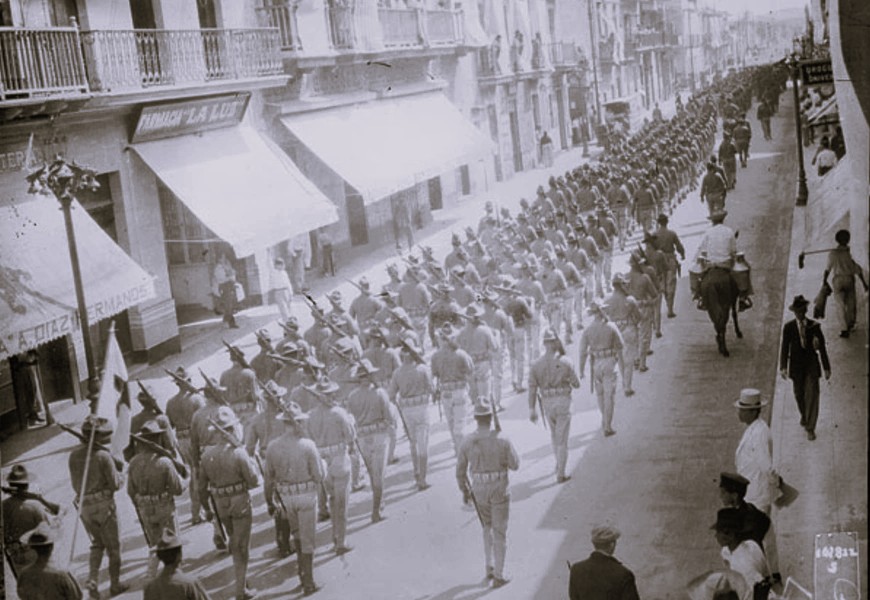
Dispensing with all democratic pretenses, the current administration returns to simpler times when, child,-like if they see something they want, they just take it. There is nothing new in the imperialist playbook. Though they are illiterate, they don’t need to read to invoke it. Thieving comes natural to born thieves. Though the logic and appetite of the predator is the same, Ella Wolfe on U.S. imperialism’s rather more sophisticated 1920s application of the imperialist principle in Mexico and Nicaragua.
‘Mexico and Nicaragua’ by Ella G. Wolfe from Workers Monthly. Vol. 5 No. 16. February, 1927.
AMERICAN imperialism is on a rampage. It swings its big stick in an effort to whip a few Central American republics into line—so they may be hitched onto the profit coining treadmill of Wall Street finance and oil capital. Mexico is being threatened. Nicaragua is invaded. All the arts of demagogy are employed to justify this plain imperialist aggression. Even Bolshevism is conjured up to play its trick of blinding the masses to the real character of the expeditions. But the facts are too plain. The acts of the imperialists speak too loud.
Mexican oil has sent our battleships into the Caribbean and has landed our marines in Nicaragua. “We” must defeat Sacasa not because he is a bolshevik, not because he is friendly to the working class—nor even because he is a liberal. We must defeat him now because his success would mean a strengthening of the rebellious Latin-American feeling against the U.S. in general—and in Mexico it would stiffen the opposition against American interests, and endanger the easy, steady flow of oil.
We have a vital need of Mexico’s oil wells. John Ise in his recent book summing up the oil resources of the United States calculates that at the present rate of American consumption our oil resources will last about six years. Six years! An appalling short period; there is little time to lose. Mexico is still rich in producing oil lands and a number of American geologists who have been busy for years in reconnoitering for Standard Oil report that in the States of Chihuahua, Chiapas and Tabasco alone there are millions of acres of rich oil lands.
In our scramble for oil we must consider not only the 19 million American automobiles that have to be fed daily, but also the fuel supply of a future war. Modern battleships have taken to burning oil. First, because it is easier to store and second, because it emits no telltale smoke. These battleships consume millions of gallons. And while these are being consumed on the sea, other millions are being consumed by the modern motor transport on land. But in the next war the major apparatus will be the airplane which takes even larger quantities of this precious fuel.
But what has Mexican oil to do with Nicaragua? Nicaragua is a good excuse for picking a quarrel. It would be somewhat raw and very unpopular, to say the least, for the State Department to tell the American people that we are fighting with Mexico because we want her oil. Even American statesmen are somewhat concerned by outward appearances, and desire to give a more idealistic reason. So our State Department tells the world that we are landing marines in Nicaragua to fight the influences of Mexican bolshevism. On November 17, 1926, the Assistant Secretary of State, Robert Olds, called the directors of the Washington Bureaus of the three principal news agencies—The Associated Press, the United Press, and Hearst, into a secret conference, and he told them that “it is an undeniable fact that the Mexican government today is a bolshevist government. We cannot prove it, but we are morally certain that a warm bond of sympathy, if not of actual understanding exists between Mexico City and Moscow. A steady stream of Bolshevist propaganda has been filtering from Mexico down through Central America, aimed at property rights and designed to undermine society and governments as they are now constituted. We feel that this picture should be presented to the American people and I desire to ask for your advice and co-operation.”
One of the representatives present asked why the State Department did not make a public statement to that effect. The reply was: “Surely you must realize why the Department of State cannot afford to be directing such a serious statement against a government with which it is on friendly terms.”
The Associated Press fell for this piece of inspired propaganda and published it broadcast—but the “news” fell flat on the American people as a whole and failed to browbeat Calles into submission on the oil and land laws. Not because the Calles regime is revolutionary—nor always even friendly to labor—but because he is forced by the militant spirit of the Mexican peasantry and working class to make revolutionary gestures from time to time. Calles, like Obregon, before him, has had to straddle in his policy. On the one hand he is constantly bullied and worried by the demands of the American concessionaries with all the power and wealth of their government behind them; and on the other, he is threatened hy a well organized militant peasantry and a partially organized proletariat. To remain in power he must try to please these two interests—so diametrically opposed to each other. Up to the present moment the workers and peasants of Mexico have received the revolutionary gesture—while the American concessionaires and bankers have been handed the goods—sometimes quietly—and secretly.
Calles’ insistence on the laws regulating land and oil in Mexico is nothing but a revolutionary gesture to his militant constituents. The law decides nothing. It is the supreme court of Mexico that has the final say. And how has the court decided in the past? In every case of oil property brought before it, it has decided that the retroactive provisions of the Constitution do not apply. And it will continue to decide in this manner, in favor of American interests. In fact, in the latest interviews of Calles to the press and in the last conciliatory one of Aaron Saenz, Minister of Foreign Affairs in Mexico, as much has been promised. Our State Department knows this, yet it is kicking up such a fuss. First, because the very existence of such laws are a source of constant annoyance to the Anglo-Saxon. His puritan sense and desire for security urge him on to fight for the repeal. They want to eliminate the red tape of appealing to the court in each dispute. Calles, however, feels that on this he cannot surrender. Such a surrender would bring the workers and peasants against him.
Why is Nicaragua the field of battle for Mexican oil? First, because developments there occurred at the same time as our State Department was browbeating Mexico into a retreat on the oil and land laws, and it could be used as a source of attack against the Calles regime. A brief historic summary of the events leading to the present conflict in Nicaragua will help to further explain.
In February, 1923, at a conference held in Washington between the United States and five Central American states—an agreement was signed providing that: “The violent or illegal alteration of the constitution of any of the countries is a menace to the peace of all and each promises not to recognize a government in another state resulting from a coup d’etat or revolution against a recognized government.”
Under certain conditions peace means greater profits to the investor—and the above treaty was calculated to be more profitable in the long run.
In October, 1924, a perfectly legal election was held in Nicaragua, and Solorzano and Sacasa were elected President and Vice-President respectively—defeating the Chamorro ticket, two to one.
Prior to this election the Nicaraguan national bank and the national railways were in the hands Of American bankers. The Solorzano and Sacasa government bought back the railway and the bank.
A few months after this, Chamorro, Minister of War in the Solorzano cabinet, with the aid of Diaz; the present president of Nicaragua, executed a coup d’etat against Solorzano and forced the latter to resign—and Sacasa—who then constitutionally was entitled to the presidency, was forced into exile.
Chamorro has always been the friend of American bankers—and as soon as he took power he offered them the Nicaraguan Railway and bank in return for a loan. These bankers pressed the State Department to recognize Chamorro—but in view of the five-power pact signed in Washington in 1923, it would have been too raw even for the American State Department to recognize him. However, if a creature of Chamorro’s could be substituted—one just as “friendly”—the State Department let it be understood that recognition would be granted forthwith. Chamorro then decided that Diaz would be the right man, and he had congress (with all the “Liberals” eliminated) “elect” him. Three days later (for the above many reasons), the State Department recognized Diaz as the legal president of Nicaragua. Of course, no amount of word twisting can convince those acquainted with the provisions of the five-power treaty that the U.S. acted in line with this treaty in recognizing Diaz.
Mexico followed with the recognition of Juan Sacasa, the constitutional president of Nicaragua, which infuriated the State Department. It again began to issue statements accusing Mexico of attempting to bolshevize Nicaragua and to endanger the position of the United States in the zone of the Panama Canal; it increased the number of battleships in the Caribbean and suddenly the American press increased its number of stories on the revolutionary movements in Mexico.
In these many troublesome months Mexico has consciously tried to establish friendlier relations with Central America. Her efforts have been feeble and quite unobtrusive. She made several gifts of radio stations to three of the Central American countries—of libraries to others, scholarships for Central American students in the University of Mexico. The State Department has watched these first beginnings with great interest and hostility. Unfortunately the State Department could not state frankly that this Mexican tendency is one of the causes for our hostility—and so the administration began to justify its brow-beating policy in the Caribbean by a number of hypocritical acts.
First: We sent our bluejackets to Nicaragua “to protect her from” Sacasa who had made an agreement with Calles to establish a bolshevist government there.
When that was ridiculed then:
We sent our troops and battleships with 10,000 men to “protect our citizens and our property” in, Nicaragua.
When the absurdity of that excuse was ridiculed by the press, then;
The administration trots out the plea that we must protect our property rights in the future Nicaraguan canal against Mexico. When Sacasa says that no one in Nicaragua is attempting to endanger the treaty granting canal rights to the U.S.;
Then “we will brook no interference in our Caribbean policy.”
The inconsistent, hypocritical, uncertain movements of Coolidge and Kellogg has created a general conviction that the massing of so many battleships in the Caribbean has nothing to do with the Nicaraguan affair—that 100 marines could keep Diaz in power but that it is aimed directly at Mexico. As time progresses the intention of Coolidge becomes more sharply defined. First we will defeat Sacasa—even if we have to exterminate all of his followers—and then the U.S. will leave several hundred marines to keep Diaz in power. That settled, our bankers will be once more free to negotiate a large loan to Diaz, who has already announced his desire for the loan in return for which he will turn over the Nicaraguan Railway and bank to American interests, and the U.S. will have added another black page to the history on her policy in the Caribbean.
That settled, the administration will be able to center all of its attention on the Mexican situation. “We” will make no war on Mexico. “We” will not intervene in Mexico. First, because it is too unpopular at the present time. Second, the proposition is too expensive. Intervention in Mexico implies a long drawn out struggle—over thousands of miles of mountainous territory excellently suited to sniping and guerrilla warfare at which the Mexican people are much more expert than the American soldiers. After the long and costly invasion—if the United States takes some of the important and strategic cities, it will entail an enormous army of occupation for many years.
Intervention is really not necessary. With the proper kind of imperialistic tactics so well known to “US” because used so often before—it is possible to get the opposition in Mexico to fight for “US”, to overthrow the present regime. The opposition has already promised a modification of Article 27, eliminating the “obnoxious” retroactive clauses, and a revision of the oil and land laws. The State Department need do only two things—first, break diplomatic relations with Mexico, and lift the arms embargo to Mexico. This will mean power, ammunition and plenty of money for the Catholic and landed opposition with which to overthrow Calles. If and when this happens the ensuing struggle will not be short nor simple. Its final success is even doubtful. The opposition will meet adamant resistance from the partially organized peasantry and proletariat which the Calles government will arm against the counter-revolution. The workers and peasants will fight to protect what few and meager rights they have won during the last decade and a half, for they know that should the Church and landed opposition come to power—all rights: will be destroyed.
American imperialism is gradually swallowing Central America. South America is next on the list. The Monroe Doctrine is preparing to celebrate its final triumph.
Mr. Borah, Chairman of the Foreign Relation Committee of the United States senate, protests against the invocation of the Monroe Doctrine. He claims that because no European government is interfering in Nicaragua the United States are not justified in excusing their own aggression as a defense of the Monroe Doctrine. But Mr. Borah is wrong. The Monroe Doctrine was originally the expression of a very clear foresight of the development of American capitalism. It reserved all American territory for United States capitalism at a time, when the latter was still fully occupied in opening its own native resources to exploitation. This period of service of the Monroe Doctrine is now terminated. United States capital, by the enforcement of the Monroe Doctrine through its government, has preserved all the choice morsels of American territory from the covetous desires of European capitalist countries. But now it wants to harvest the fruit of this labor. It wants to consume these morsels itself.
There can be no doubt that the present expeditions of American capital in the Caribbean are in execution of the Monroe Doctrine. The Monroe Doctrine is not an instrument of peace. It is, first, a threat of war against all European capitalist governments, if the latter should actively challenge the priority rights of United States capitalism to all territory on both American continents–North and South; and, second, it is a threat of war against all central and South American countries if any of the latter should actively challenge the rights of the United States capitalists to make them their private objects of exploitation.
From this point of view the present military and naval expedition of the United States in the Caribbean must be judged, and any judgment from this standpoint must come to the conclusion that even a temporary “peaceful” settlement of the present controversy cannot mean peace, but merely another step toward the final consummation of the object of the Monroe Doctrine: The economic, political—and military conquest of Central and South America by the United States capitalists.
The Workers Monthly began publishing in 1924 as a merger of the ‘Liberator’, the Trade Union Educational League magazine ‘Labor Herald’, and Friends of Soviet Russia’s monthly ‘Soviet Russia Pictorial’ as an explicitly Party publication. In 1927 Workers Monthly ceased and the Communist Party began publishing The Communist as its theoretical magazine. Editors included Earl Browder and Max Bedacht as the magazine continued the Liberator’s use of graphics and art.
PDF of full issue: https://www.marxists.org/history/usa/culture/pubs/wm/1926/v5n16-feb-1927-1B-FT-80-WM.pdf
 Revolution's Newsstand