
Carl Reeve reports on what must have been an indelible experience for all involved as Rhode Island joins the national Uprising of ’34. 45,000 textile workers fighting for their lives gave battle against the companies, their gun thugs, police, and the National Guard for a week in the Blackstone River Valley during September, 1934. We should all know the name of the Moshassuck Cemetery, where the workers retreated and made a desperate, heroic two-day stand among the gravestones, some of which are still marked by bullets today, and where fellow workers Charles Gorczynski, William Blackwood, Jude Courtmanche, and Leo Rouette fell.
‘Scores Are Injured as Saylesville Strikers Battle Troops’ by Carl Reeve from The Daily Worker. Vol. 11 No. 220. September 13, 1934.
PROVIDENCE, R.I., Sept. 12. After more than 12 hours of continuous battling against 500 National Guard troops, several thousand textile strikers are now still massed around the Sayles Mill at Saylesville, a few miles from Providence, pressing against the clubs and bayonets of the National Guards. The troops are digging up the streets with picks and erecting barbed wire entanglements across the streets several blocks from the mill.
It took the National Guard 12 hours to push the strikers these few blocks. There are now nearly 2,000 guardsmen in the vicinity of the mill. Scores have been injured in the fighting. After deputy sheriffs shot into the thick of the strikers last evening, seriously wounding a number of strikers, Governor Francis Green called out every National Guard unit in the State and 500 immediately went into the mill. Martial law now rules Saylesville. The order to shoot to kill has been given to the National Guardsmen this afternoon. Nine strikers are arrested and held under $1,800 bail on charges of rioting and other accusations.
Strikers Repulse Guards
In the all-night fighting, the strikers, with well disciplined action, put out all lights around the mill, stopped autos in the area and forced them to put out all lights, opened fire hydrants and manholes in order to disconnect lighting. The strikers beat back an attack of the guards, who used not only tear gas but strong vomit or nausea gas, which makes the victim deathly sick. In the night fighting they pushed the National Guards back into the mill’s gates. They broke down one gate of the filtration plant of the mill and surged inside the mill gates before the guardsmen arrived.
Following the arrival of the guardsmen in the evening, the strikers during the night again and again repulsed ferocious attacks by the troops.
Troops Fire Gas Bombs
Heavy fighting occurred in the Moshassuck Cemetery fronting on Lansdale Avenue near the mill. It took the National Guards several hours to clear the Cemetery. Hundreds of gas bombs were set off during the night. Seven known National Guardsmen are in the hospital and at least 30 more suffered enough injury to go off duty.
The strikers tore up cobblestones from the streets, used bricks and stones and sticks.
Strikers hurled the vomit gas bombs time after time back into the ranks of the guardsmen. The troops clubbed viciously. They soon attached bayonets and advanced on the strikers with bayonets ready to strike. The hands of a number of strikers were severely burned from the gas bombs which they hurled back at the troops.
Many Strikers Wounded
James Dolan, a striker, received a fractured skull from a trooper’s club. Included among those shot were a 73-year old woman, Mrs. Leonie Gussart, shot in both legs. Deputy sheriffs used both shot guns and riot guns in the early evening firing, wounding many.
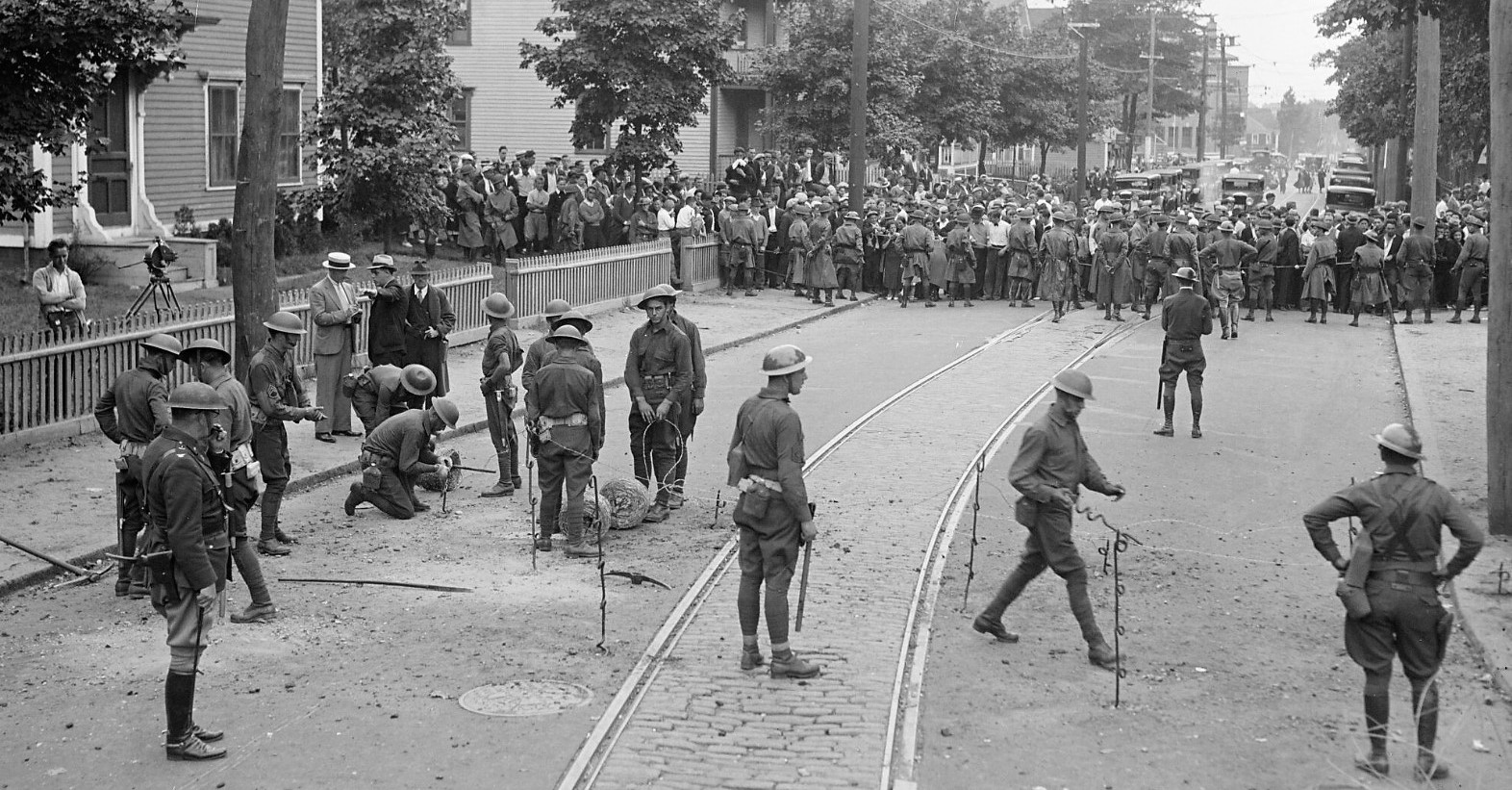
The Guardsmen rode into the strike area on their artillery caissons. This morning trucks brought them rifle ammunition. They used barbed wire for entanglements around the mill and last night sent up many illuminating flares trying to search out the strikers in the darkness. They also used anti-aircraft searchlights. This afternoon an airplane was hovering over the pickets.
The published list of injured, set at 50, is undoubtedly far too low, as many injured were not treated at hospitals. Although it is reported in the press that the troops were told not to fire, it is a confirmed fact that the troopers fired several volleys from their rifles in the heavy fighting in the cemetery.
Strikers Taunt Troopers
This afternoon the strikers were standing several thousand strong at the deadline set by the troopers and taunting the National Guards for their attack on the workers.
“Do you want us to work for two dollars a week?” I heard one striker ask the guardsmen, who stood club in hand, in a heavy line across Lonsdale Ave. Another declared, “You wouldn’t shoot that gun at us, would you?” “When are they going to call out the Boy Scouts?” was a frequent slogan.
Undoubtedly many of the young guardsmen, who are themselves mill workers, do not relish their job and look actually sick. They are very young boys from Providence, from workers’ homes. The strikers were appealing to them not to do the work of the mill owners. “You have to come out here and shoot us down so that Sayles can make more money,” one striker told the guardsmen.
Town Supports Strike
The population of the town is solidly behind the strikers, and there is great indignation at the use of the troops to break the strike and keep the mill running The Sayles Company claimed 700 inside the mill yesterday. They claim 500 inside today. The Sayles mill workers are virtual prisoners in the mill.
At 10 o’clock last night the strikers counter-attacked from three different sides, as tombstones were scattered in the cemetery. The troops were beaten back.
At midnight the guardsmen again charged down Lonsdale Avenue. A rain of rocks halted them. It was not until 7 o’clock this morning that the strikers were finally forced back and the deadlines set up.
U.T.W. Heads Aid Terror
Joseph Sylvia, U.T.W. leader, arrived on the scene at ten last night. He went inside the guardsmen’s lines and conferred with the head of the troops, General Dean, for an hour. Sylvia refused to state what had been said. The guardsmen all had steel helmets, riot guns, rifles, gas bombs, grenades, and clubs. Their headquarters are inside the mill gates. Horace Riviere, in a statement to Governor Green, blamed the trouble on “a gang of hoodlums.” This is the U.T.W. leader’s characterization of heroic strikers. Riviere said there was no objection to the militia.
It was reported in the Boston press that U.T.W. President McMahon had conferred with Green before the guard was called and McMahon said he had no objection to calling of the Guard. Thus U.T.W. heads are furthering the terror against strikers and are helping the efforts to open the mills, at the same time they attack Communists.
Another Strike Danger
Another danger the strikers must guard against came forward today in evidences that U.T.W. leaders are trying to effect separate settlements which would weaken the national strike front. For example, the U.T.W. announced it had cancelled a strike order at the Roxbury Carpet Co., mills in Saxonville. The rail has now reopened. It was said they had signed an agreement and ended the strike in the plant.
The U.T.W. leaders announced in the New Bedford mass meeting this morning that one mill which they did not name would be allowed to reopen because it has signed an agreement. It is also reported that at Danville, Va., a similar U.T.W. order called off the strike there. The strikers must not allow the U.T.W. leaders to break their ranks with individual settlements.

The U.T.W. leaders continue to refuse to call local union meetings or union membership meetings to strengthen the strike organization. For example, in New Bedford, where I was this morning there were no union meetings called since the strike. The strikers demand union meetings to better organize the strike apparatus and the picketing. But the U.T.W. leaders by refusing to call union meetings prevent the rank and file from participating in strike leadership.
12,000 Troops Called Out
The strikebreaking terror of the state armed forces increased in New England not only at the Saylesville Mills but at many other points in New England. Twelve thousand troops were called out by governors in all. And in Massachusetts the guard has been mobilized and equipped and ordered to be ready to be called out at a moment’s notice.
The National Guard is out at Lewiston and Augusta, Maine; in Connecticut two National Guard companies are patrolling mills at Putnam. They are patrolling in Danielson, Conn. In Norton, Mass., the sheriff of Bristol County has called the Guard out to transport scab goods for the Defiance Bleachery.
National Guards are on patrol in Bristol, Rhode Island. A strike of 3.000 wool sorters was voted to take place there Friday morning. In Woonsocket 2,000 mass pickets were forced to retreat only after a tear gas barrage. Severe fighting took place also at Woonsocket in front of the Woonsocket Rayon Company.
Thomas Kelly, U.T.W. leader, made a vicious attack on Communists in a statement today.
Ann Burlak speaks tonight at a mass meeting at Ashley Park, New Bedford. Fred Biedenkapp, well-known as an organizer in the 1928 New Bedford strike, will speak in New Bedford on Thursday at 3 o’clock, in Hazlewood Park, South End, and at 7 o’clock at Brooklawn Park, Norh End.
Terror Troops Concentrate
Fred Biedenkapp will speak in Fall River Friday evening at Liberty lot. There will be a mass meeting at the Common tomorrow in Boston in support of the textile strike. Ann Burlak will speak. Other evidences of increased terror against strikers are seen in the orders of Worcester police forbidding picketing at the Worcester Knitting Co.; the concentration of over 100 police in Fitchburg against a picket line there; the concentration of over 500 private deputies at North Dighton; the heavy police attacks in Maine, Connecticut and Rhode Island, where troops are out.
More Mills Closed
New mills which were shut down today include Three Rivers and Bondsville, Mass., mills, which employed 900 workers; Chicopee Manufacturing Co., Mass., with 1,000 workers closed yesterday when only a dozen reported for work; nine Rhode Island Mills employing a total of 1,100 workers, the biggest being the Lebanon Mills. The strike definitely continues to spread, and remains solid and effective throughout New England. Mass picketing throughout the whole textile area was good today. Mass picketing took place at many points.
The Daily Worker began in 1924 and was published in New York City by the Communist Party US and its predecessor organizations. Among the most long-lasting and important left publications in US history, it had a circulation of 35,000 at its peak. The Daily Worker came from The Ohio Socialist, published by the Left Wing-dominated Socialist Party of Ohio in Cleveland from 1917 to November 1919, when it became became The Toiler, paper of the Communist Labor Party. In December 1921 the above-ground Workers Party of America merged the Toiler with the paper Workers Council to found The Worker, which became The Daily Worker beginning January 13, 1924.
PDF of full issue: https://www.marxists.org/history/usa/pubs/dailyworker/1934/v11-n220-sep-13-1934-DW-LOC.pdf
 Revolution's Newsstand