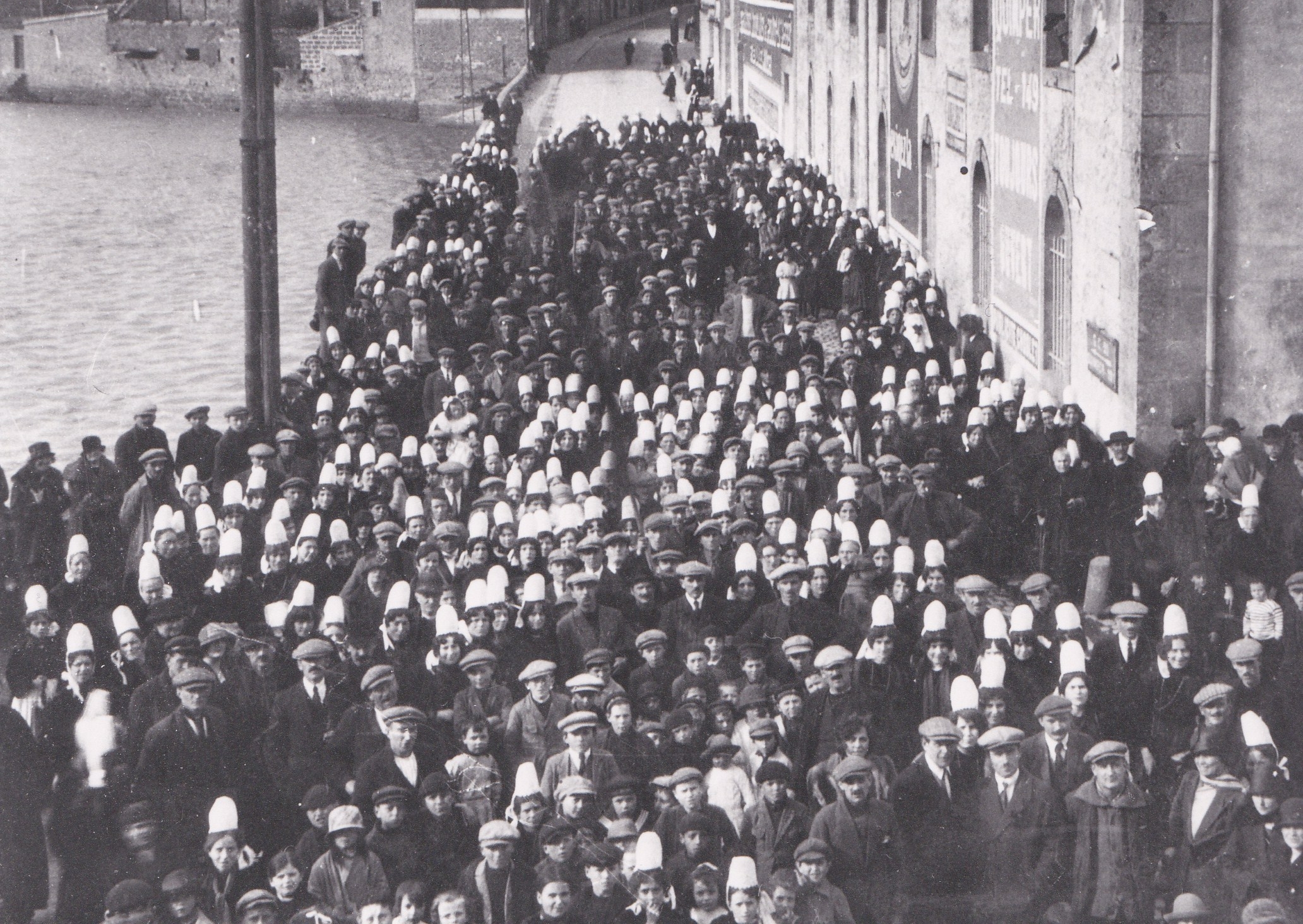
Tens of thousands of Bretons, men in boats and women in canning factories, strike against the fishing industry in an epic, ultimately losing, battle.
‘The Fight of the Breton Fishermen’ by J. Raveau from International Press Correspondence. Vol. 7 No, 45. August 4, 1927.
The great fight of the Breton fishermen has ended in a defeat.
At the beginning of June 25,000 fishermen of Brittany and 10,000 working women in the sardine factories entered into a struggle with the group of employers in whose hands are combined the exploitation of the catch and the 120 factories for preserving fish on the whole of the French coast of the Atlantic Ocean.
The fight started in three harbours of the district of Penmarch in the South departement of Finistère The cause of the dispute was the sudden reduction of prices paid to the fishermen for the fish caught. For 100 kilogrammes sardines, for which between 1100 to 1200 Francs were paid in 1926, no more than 300 Francs were paid. This meant a reduction of the earnings of the fishermen by not less than 75 per cent.
At first 1500 fishermen went on strike in order to resist. the attack of the fish-canning companies. But the employers, who are united in a powerful Federation (“Comptoir National D’Achat”), wished to dictate prices for the whole of the country. Hence the fishermen of the Breton coast, who were soon followed by the fishermen of the whole of the Atlantic coast, were compelled to enter on a struggle.
While the fishermen fought in the first place only against a reduction of their earnings, the employers aimed at the following objects: 1. rationalisation of the fishing industry, mainly by increasing profits at the cost of the earnings of the workers; 2. ousting of foreign competition in order to gain the monopoly of the French market; 3. to make use of the colonies, especially Morocco where very cheap labour is to be had; 4. systematic weeding out of small undertakings and small owners, who still play a certain role in the fishing industry; 5. fight against the Communists, whose hands are to be found mainly in the little fishing town of Douarnenez where the bourgomaster is a Communist.
The official figures show that the measures of the employers in the sardine industry have yielded the following results: the employers, in four months of the present year, have pocketed nine million Francs more in profits than during the whole of 1926. The import of foreign sardines has declined considerably; the export of French sardines has remained the same.
Now, when the employers can no longer derive advantage from the depreciation of the Franc, when they have to reduce their prices, they do so at the cost of the proletarian fishermen on the one hand, and by the more intense exploitation of the colonies on the other. In the colonies which lie nearest to France, in Algeria and Morocco, but also in the farther-lying colonies, new undertakings are arising everywhere and founding fishing companies, the purpose of which is to reduce the cost of production and thereby to exert pressure on the Breton fishermen. The fish-canning companies are also working at high pressure in order to transplant labour from the Atlantic coast of France to the colonies, before all to Algeria and Morocco. In France itself the workers are exposed to unemployment and starvation in order to induce them to emigrate. A depopulation of the coastal departement of Finistère has already set in.
The Breton fishermen were not yet aware of the wide aims of the attack of their masters. At first they fought with enthusiasm, but when at a certain point a victory, or at least a fairly acceptable compromise was in sight, they suddenly gave up the struggle. In addition it was Red Douarnenez, the town council of which is led by the Communists, which collapsed first. Seventy small fishing undertakings were capable of shattering the whole movement.
This result is due in no small measure to the very old and complicated organisation of the fishing industry: a sort of co-operative purchasing society for the most important raw materials required by the fishermen. This organisation of small fishermen was not capable of offering resistance to the big, firmly united national federation of the fish preservers. At the same time the big employers succeeded with the aid of a financial institution, the Credit Maritime, in gaining, by means of loans, ever increasing influence in the co-operatives of the small fishermen and in rendering tractable some of the leading people. Special attention was paid to the co-operative of Douarnenez; and with success. The women, who are still greatly under the influence of the Catholic priests, lost courage, and they were finally followed by the sea-fishers. Thus a vote was taken in Douarnenez, which put an end to the strike under unfavourable conditions. And when the colours were hauled down in the red harbour town the other harbours followed suit.
But the great conflict is not yet at an end. It is true the proletarians of the French coast have suffered a severe reverse in the class war; but at the same time they have received a serious object lesson. The role of the reactionary leaders of the co-operatives in now clearly recognised by the fishermen. In the coming fights–and these are unavoidable they will no longer give them their confidence. They will also from now on work against disunity in the fight, which was also one of the causes of the defeat.
The next and most important task of the fishermen is to rally together again for the decisive fight against the employers. For this purpose they must build up a strong trade union, extending along the whole coast, which will be capable of capturing the fishermen’s co-operatives and conducting them in the interests of fishermen.
International Press Correspondence, widely known as”Inprecorr” was published by the Executive Committee of the Communist International (ECCI) regularly in German and English, occasionally in many other languages, beginning in 1921 and lasting in English until 1938. Inprecorr’s role was to supply translated articles to the English-speaking press of the International from the Comintern’s different sections, as well as news and statements from the ECCI. Many ‘Daily Worker’ and ‘Communist’ articles originated in Inprecorr, and it also published articles by American comrades for use in other countries. It was published at least weekly, and often thrice weekly.
PDF of issue: https://www.marxists.org/history/international/comintern/inprecor/1927/v07n45-aug-04-1927-inprecor-op.pdf
 Revolution's Newsstand