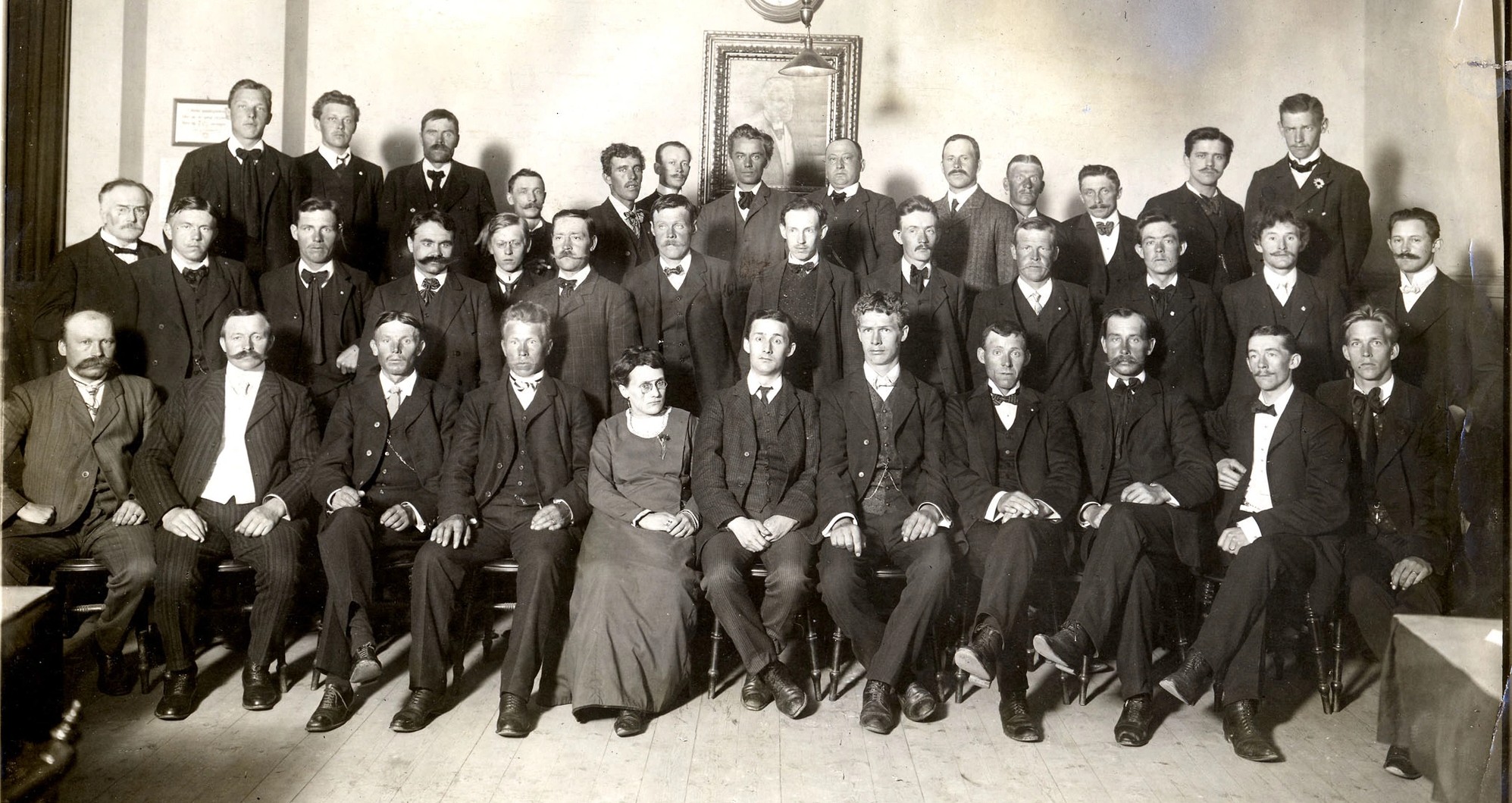
Swedish syndicalist John Sandgren on the massive class battle of Sweden’s general strike which led to the formation the Sveriges Arbetares Centralorganisation in 1910.
‘General Strike in Sweden’ by John Sandgren from Industrial Worker. Vol. 1 No. 43. January 15, 1910.
Due to the deplorable lack of an international tabor press bureau there has been practically no news about the Swedish labor situation since it lost some of its most sensational features.
In a way, it may be said that the struggle has been won. The issue about which this magnificent battle of Labor is being fought is, as is now well known, the life or death of organized labor in Sweden; in fact, in all northern Europe. So far the struggle has been a signal victory of Labor. On the one side the employers’ association has become so weakened that its officers are in some cases repudiating the obligations entered into with the members and have sent out circulars to the membership asking for leniency in fulfilling these obligations. On the other hand the Swedish national organization has come out of the battle with 40,000 new members. True, they nominally lost about 30,000 in the battle, but these men have for a large part surrendered their membership upon the advice of the national organization, and against their own will. It was a tactical move on the part of the national organization to ease its burdens and to insure victory along the main lines of battle. Still, even so, there is an increase of 10,000 men.
It is nothing but natural that in a contest of this magnitude Labor should have to sacrifice some of its troops on certain weak points. Taking it as a whole the Swedish workers have won a glorious victory.
Still the struggle is by no means over. According to the latest news received by mail from Stockholm there are still 2,000 men in the fight of the original 350,000. But besides there are now between 13,000 and 14,000 men who are “discharged,” which is only another word for “blacklisted.” These men have actually no chance of ever securing employment in Sweden or any other country where their language is spoken, as the employers are quite solidly organized throughout Scandinavia. With or against will they have practically no choice but to emigrate. At present they are with their families, being supported by the national organization, but realizing what a burden they are on their brothers and realizing the bleak prospects before them, they are now scattering all over the world, facing an unknown destiny. The president of the Swedish national organization of workers writes that support is still urgently needed and that any and all help would be exceedingly welcome.
Those that hoped that this gigantic struggle would crush the spirit of the Swedish workers and be “the beginning of the end” of Labor’s efforts in Northern Europe are sorely disappointed.
The national organization met in convention the 22nd of November. The convention lasted nine days, was visited by 580 delegates, and a large number of representatives of Labor from foreign countries, who paid a glowing tribute of admiration to their Swedish brothers. The spirit prevailing in the convention, in the midst of the great battle, was one of exemplary self-control and moderation, and the convention stands as one of the most creditable pages in Labor’s history.
Among the innumerable important subjects up for discussion there are two that are especially worthy of international attention, namely, the question of a complete reorganization, and the question of the relations between the economic, organization and the Social-Democratic party of Sweden.
The debate on the question of reorganization lasted for two days and 180 delegates spoke on the question, showing the seriousness of the matter.
As a result of this discussion a committee was elected to draft a plan of reorganization to be submitted to all subordinate organizations six months before the convention of 1911, and, significantly enough, upon the motion of the president, Herman Lindquist, the committee was instructed by the convention to bring in a report based upon gradual transformation from craft unions to Industrial Unionism.
In regard to the question of the relations between the economic organization and the Social-Democratic party of Sweden there was a clause in the preamble prescribing that, the economic organization exert its efforts to have the unions join the local organizations of the Social-Democratic party of Sweden. On motion of the iron and metal workers, supported by other organizations, these words were stricken from the preamble by a vote of 232 to 224. This action of the convention is very interesting in view of the fact that the Social-Democratic party in the next election is very likely to become the dominant political party, due to the “universal suffrage” that has recently been forced on the Swedish workers.
At the same time the convention, to avoid misinterpretation, adopted a resolution by a considerable majority, “that by this decision it was not intended to break up the unity and solidarity of labor’s forces, but that the convention considers the Social-Democratic party “as the natural expression of the political ambitions of the Swedish workers.”
Put together, these measures mean that the anti-parliamentary tendencies in the Swedish labor movement were strong enough to force a complete cutting loose from the political party which previously had been one of its constituent parts, in order to avoid a rupture in the ranks of the economic movement.
Large bodies of the Swedish workers place a good deal of faith in the brilliant political prospects lying at their feet, and in view of this fact the solution must be considered a happy one.
Another of the interesting features of the convention was the motion to instruct the executive board to make a full report of the methods and efforts of the syndicalist movement. The motion was lost, but the large minority vouches for that hereafter French methods of fighting the capitalist class will play quite an Important part in the struggles of the Swedish workers.
They are evidently preparing for the next grand fight.
Labor papers please copy!
The Industrial Union Bulletin, and the Industrial Worker were newspapers published by the Industrial Workers of the World (IWW) from 1907 until 1913. First printed in Joliet, Illinois, IUB incorporated The Voice of Labor, the newspaper of the American Labor Union which had joined the IWW, and another IWW affiliate, International Metal Worker.The Trautmann-DeLeon faction issued its weekly from March 1907. Soon after, De Leon would be expelled and Trautmann would continue IUB until March 1909. It was edited by A. S. Edwards. 1909, production moved to Spokane, Washington and became The Industrial Worker, “the voice of revolutionary industrial unionism.”
PDF of full issue: https://www.marxists.org/history/usa/pubs/industrialworker/iw/v1n43-jan-15-1910-IW.pdf
 Revolution's Newsstand