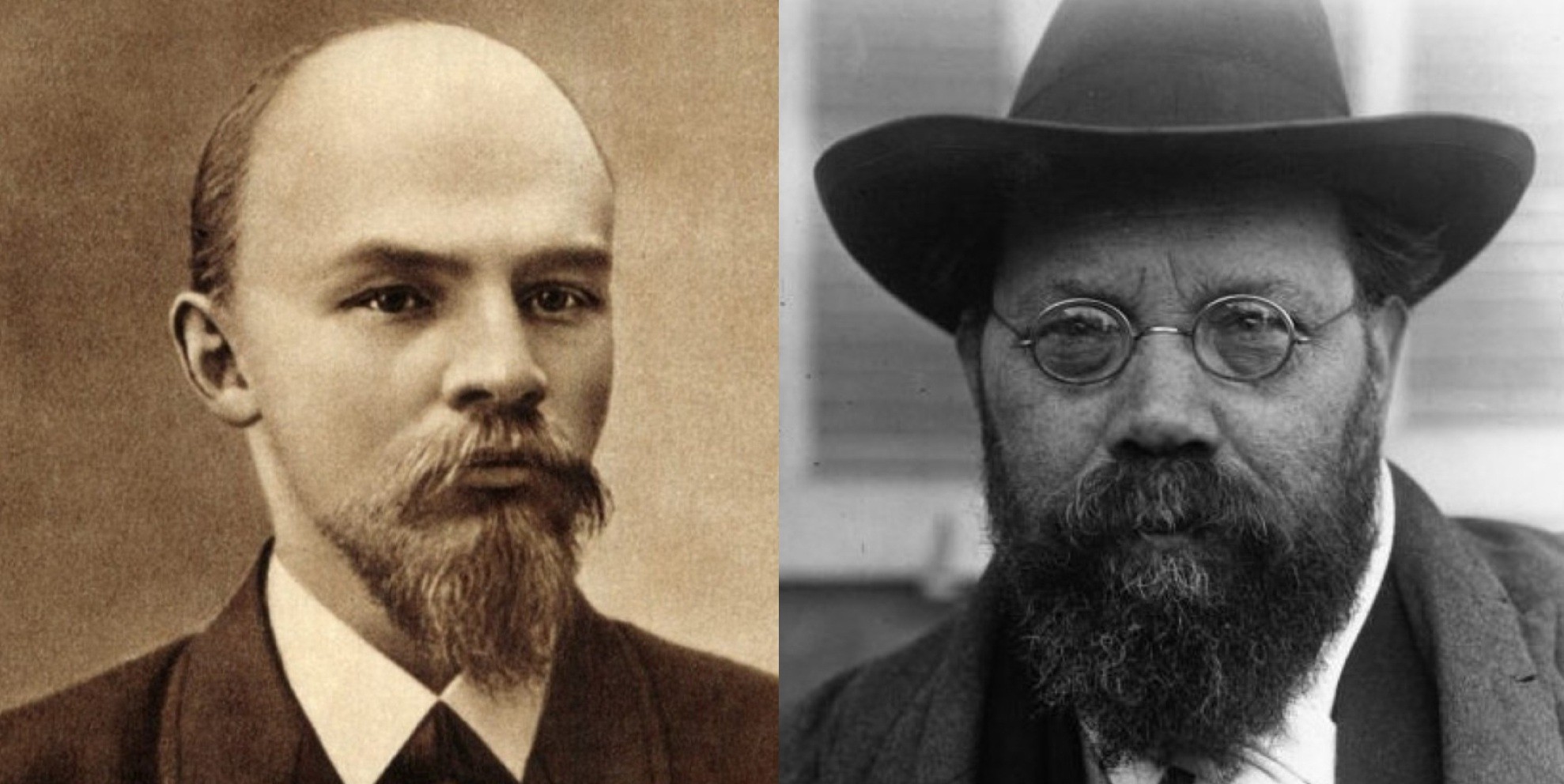
The veteran French Marxist on knowing Lenin among other Russians in exile.
‘Recollections of Lenin’ by Charles Rappoport from Soviet Russia (New York). Vol. 2 No. 8. February 21, 1920.
The celebrated Russian Socialist who is the author of this article has been living in Paris for many years. We take the following personal reminiscences of Lenin from a book entitled “Hommage a la Republique Socialiste” which has recently been printed in Paris.
It was in the year 1902. His book, “What Is to Be Done?” had just fallen into my hands. Or rather, I should not call “What Is to Be Done?” a book; it is an execution—an execution of the “Socialistic” reformism represented by Bernstein and the Syndicalistic reformism which is preached in Russia by Boris Krichevsky.
This brilliant pamphlet contains in embryo all of Lenin’s tactics. It is a life and death struggle upon two fronts: against the capitalistic bourgeoisie and against opportunism, both in a Socialistic and in a Syndicalistic cloak.
His organizing genius is also apparent in this book. Lenin is not content with general tendencies; he also proposes a goodly number of practical measures in order to awaken the party from the lethargy into which it had been plunged by the failure of the terroristic tactics. He demands the formulation of “professional revolutionaries,” that is, people who live only for and by the revolution. He is ready to avail himself of all the questions of the day in order to set them down as a foundation for the revolutionary struggle.
The agrarian question already plays a prominent part in this question. Czarism is represented as a remnant of feudalism. In order that capitalism may attain its full development and offer a foundation for the modem class struggle, it must first overthrow Czarism by means of the revolution* Lenin opposes the “economism” of the group surrounding Krichevsky, and advocates the revolutionary political and social struggle. He wishes to win over the peasants for the revolution by increasing their land holdings.
“What Is to Be Done?” created quite a stir in revolutionary circles. Old revolutionaries such as Paul Axelrod made reservations, but the allied themselves with Lenin, who was then the editor of “L’Etincelle,” appearing in Geneva, which led the struggle against the opportunist danger. In order to fight opportunism it was necessary not to become involved in quarrels with Lenin.
I became personally acquainted with Lenin on the occasion of a conference in Paris at about this time. The thing that most impressed me in the personality of the present leader of the Soviet Government was the clarity and energy of his ideas. For the first time in my life I heard from the mouth of an orthodox Marxist the words “armed insurrection”; the Marxists of the old school had come to the point where they considered every call to revolution to be an antiquated “Blanquism.”
About 1903 there ensued the split between Martov and Axelrod on the one hand, and Lenin and his friends on the other. Lenin had forced this split by utilizing a slight majority (of one or two votes if I am not mistaken). This is the origin of the so-called “Bolshevism,” which, entymologically speaking, means nothing more than majority. Since I was in favor of unity, I did not attach myself either to the Bolsheviki or the Mensheviki. As Russian Socialism did not possess a single means of operating legally and it was persecuted by the Czarist banditti, I could not see how it could afford to indulge in the luxury of a split, which must necessarily condemn it to inactivity. And I later gladly seized the opportunity of declaring my solidarity with Plekhanoff, who was also working for unity. But it was a unity on the basis of the Left
In spite of a sort of external unity, the struggle of the various tendencies went on all the more sharply. Every editorial meeting of the party paper developed into a real battle between Lenin and Zinovieff on the one hand, and Martoff and Dan on the other. I then became more intimate with Lenin. His power to work was marvelous. He was simultaneously the first theoretician of his group, its editor, its organizer, its tireless orator. He possessed an extraordinary strength of will. Here is a fact which may serve as proof of this statement: One group of adherents of his, among whom were Lunacharsky and Bogdanov, were trying to fuse the Marxian doctrine with the teachings of Ernst Mach. Lenin smelled a danger for the purity of the doctrine, and more particularly for its tactics. And, already forty years old, he plunged into the study of philosophy. He worked his way through a whole library of philosophical writings and produced a philosophical treatise in which he mercilessly exposes the philosophical errors of his friends. Those who know the difficulties of philosophic study will be able to appreciate this work of Lenin’s, who made himself a philosopher in order to save the theoretical integrity of his party. Being a passionate friend of clear and transparent relations, Lenin considered the union of opposing elements—Bolsheviki and Mensheviki—as an intolerable yoke. For the second time he broke up the unity of the party. I was unable to agree with him. For, together with Plekhanoff, Lenin was indisputably the leader of the party and of its organs. He was therefore giving up a position which seemed to me to be very favorable and his friends of the present day then thought as I did; among others Lunacharsky and Trotsky. But the later course of events showed how absolutely irreconcilable were two tendencies, one of which advocates a rigid carrying out of the class struggle doctrine without any compromise, while the other—in spite of all its fine words—actually amounted to an advocacy of class harmony and a surrender of Socialism. The history of the revolution of 1917-18 has clearly shown this. The majority of the Mensheviki joined with the Democratic bloc, and, under the knout of Kerensky, was completely controlled by it. Lenin’s tactics do not consist in concealing oppositions and fractures, but in forcing them into their most emphatic expression. When he finds himself in the presence of one who is vacillating, he does not take him by the hand and lead him over to the Left, but permits him to move to the Right and even pushes him on in his course. There are situations in which it must require a superhuman will and an unparalleled clarity of mind to resist a tendency toward reconciliation. Lenin’s closest friends, Zinovieff, Lunacharsky, Rykov, were in favor of an alliance with the Left of the other Socialistic parties; they resigned from the Central Committee of the party in the most ostentatious possible manner. Lenin stood figuratively alone, but he stood firm. The situation was completely opaque. No one could know how things would turn out. Kerensky and the Cossacks still had the upper hand. The German armies were invading Russia. The Entente was threatening. Lenin turned out to be right; success was his; his friends returned to him, his enemies were defeated. I seek in vain for a parallel in history. I cannot find such a parallel. You may make what objections you please to Lenin’s tactics. Yon may propose to him other and more practical tactics. But, regardless of what may be our tactical reflections, we can obtain no other impression of Lenin than this: “Ecce homo!” This is a man!
And we may add: A man that represents a class that has only its chains to lose and a world to gain. You may crush an individual man, but you cannot crush the proletarian class, for the future belongs to it.
Soviet Russia began in the summer of 1919, published by the Bureau of Information of Soviet Russia and replaced The Weekly Bulletin of the Bureau of Information of Soviet Russia. In lieu of an Embassy the Russian Soviet Government Bureau was the official voice of the Soviets in the US. Soviet Russia was published as the official organ of the RSGB until February 1922 when Soviet Russia became to the official organ of The Friends of Soviet Russia, becoming Soviet Russia Pictorial in 1923. There is no better US-published source for information on the Soviet state at this time, and includes official statements, articles by prominent Bolsheviks, data on the Soviet economy, weekly reports on the wars for survival the Soviets were engaged in, as well as efforts to in the US to lift the blockade and begin trade with the emerging Soviet Union.
PDF of full issue: https://www.marxists.org/history/usa/pubs/srp/v1v2-soviet-russia-Jan-June-1920.pdf
 Revolution's Newsstand