
Not until six years after it formed, at its 1925 conference, did the U.S. Communist Party create organizational bodies to conduct work among women. Sonia Croll reports for to the International on how the Party responded to a wave of women-led strikes and struggles in the mid-1920s.
‘Work Among Women in America’ by Sonia Croll from International Press Correspondence. Vol. 6 No, 53. July 22, 1926.
As powerful an imperialist country as America is today with its relative stabilisation and its labour aristocracy it nevertheless provides a vast and fertile field for work among women. For behind the bright picture of the well paid workers of America, posed for by the skilled and for the most part “one hundred percent American” white workers has always been the great army of unskilled workers who mostly consist of foreign born, Negro men and women and also “one hundred percent American” women, and whose standard of living in many States has been found to be hardly above the subsistence level.
With the ever increasing development of American industry and the perfection of its machinery more and more unskilled labour is required. The result is that skilled men are thrown out of work and ever more women are being forced and drawn into industry: On the one hand to supplement the family income of their male breadwinners who are obliged to work for a lesser wage as a result of this development and on the other hand to support themselves or their children as well.
Where the womenfolk of these workers remain at home they have the almost impossible task of providing food and shelter out of the meagre wages which means that they must work like slaves from sunrise to sundown. Recent housing investigations made in New York and Chicago have found in many instances two and three families huddled together in one room, and that room unfit for pigs to live in.
The insufficient allowances made by the government for education is continuously arousing hundreds of thousands of women in protection of their children. In New York children were made to walk two miles through most congested traffic areas to save the expense of providing more schools in their own localities. In Chicago portable schools and the platoon system with their ill effects on the children provide one of many opportunities of uniting the women even of the better paid workers and the patty bourgeoisie with the working-class women and of winning their sympathy and adherence to the Communist Party as the leader of the working class. Outrageously high rents, lack of legislation in protection of women, or where there is legislation the failure on the part of the government to carry out the law, the question of war, and many other such matters are of vital import to all but the parasitic women of the bourgeoisie.
Hundreds of local and national working women’s organisations are already in existence under petty bourgeois, liberal or socialist leadership and as the programme for work among women of the Workers (Communist) Party of America states it is our task to penetrate them, to give them the working class viewpoint of the class struggle and to bring them into participation of these struggles, side by side with the men and thereby win them to our leadership, or where necessary to form united front councils for the same purpose.
But organising the more than eight and a half million women workers “gainfully employed” as the federal census puts it, is in itself a mature, yet, one might say, virgin field for our work. For although it is difficult to ascertain the number of women organised in trade unions, it would appear, from an approximate survey of women in trade unions, made by Alice Henry, an official in the National Women’s Trade Union League who exerts every effort to show that women in industry are organised and that progress has been made in their organisation, that there are about 178,000 women in trade unions. Out of these, 107,000 are in the two large needle trade unions, the International Ladies Garment Workers and the Amalgamated Clothing Workers of America. Out of 61,000 women in the cigar and tobacco industry only 7,000 belong to the trade union, even according to Miss Henry.
A fact which must be given close attention is that about a fifth of all “gainfully employed” women are Negro women, who if women are “the slaves of slaves” then they are even worse. When Negro women and white women work in the same factory or mill, the Negro women are given the most unpleasant, the most undesirable and poorly paid work. In some instances white women even refuse to work with Negro women as a result of the race prejudice cultivated by the bosses in them in order to retain a source of cheap labour for the meanest work. As women they are very often most shamefully abused by white men.
Out of 572 occupations examined only 35 were carried on without women, yet the highest medium wage pad to women was found to be 16 d. 85 c. per week, South Carolina and Alabama where large proportions of women are employed paying a medium wage of only 9 d. 50 and 8,60 d. respectively.
Only three out of the 13 states that have minimum wage laws have troubled to provide for their enforcement. As for regulations on night work and the length of the working day for women only seven States provide for a 48 hour week, the others having no laws at all or allowing a working week up to seventy hours. It is clear of course that only the organisation of the working women in trade unions can really protect them from the avaricious greed of their employers, nevertheless it is interesting to note these things in a so-called “free country” and to make use of them.
Of late there has been a wave of strikes among women workers. The establishment of a Women’s Secretariat in the Party since the last Party Convention in 1925 and its instructions to the Districts, that district councils for work among women be formed has already shown results in some of these strikes.
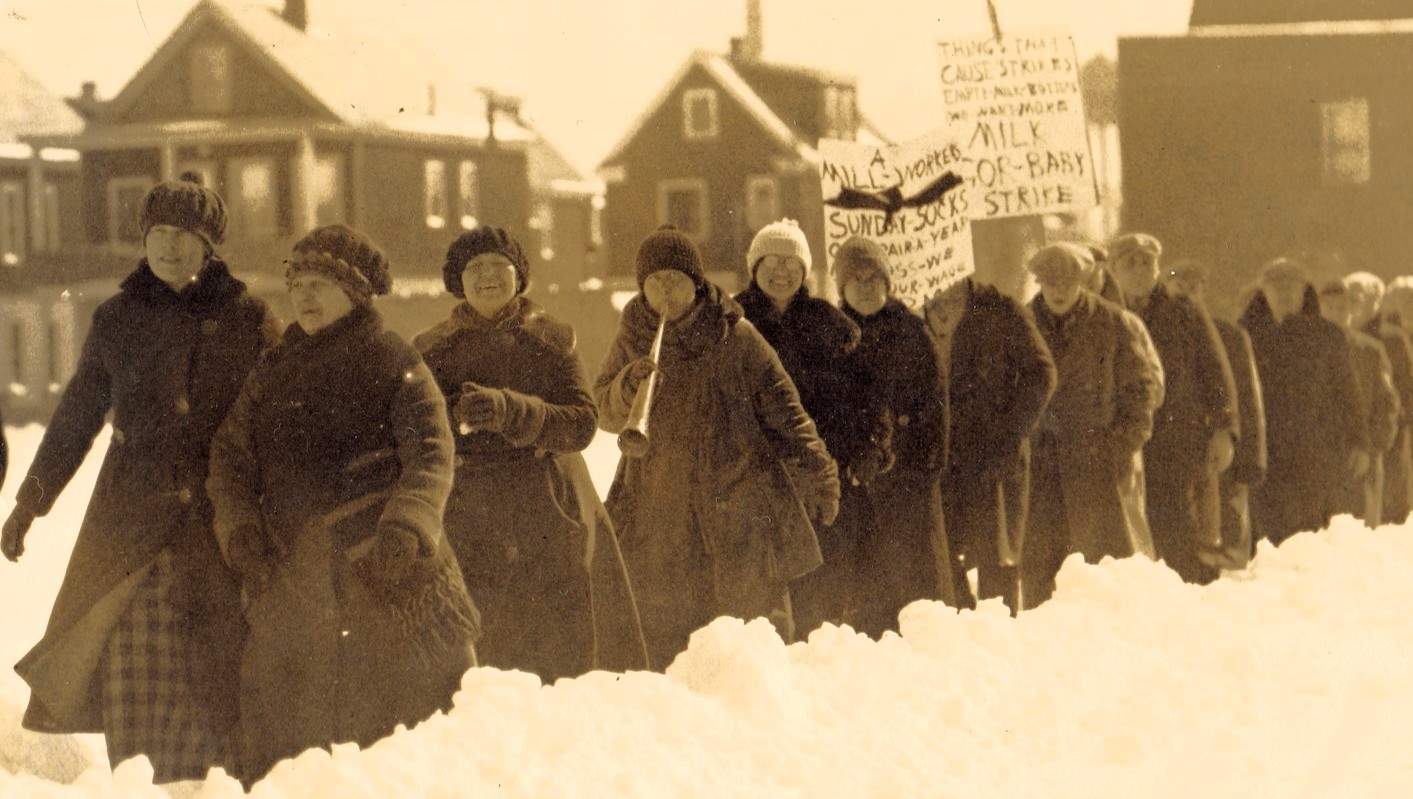
At present there is the Textile Strike in Passaic, New Jersey in full swing. About half of the 16,000 strikers are women or female children. The strike has brought to light the most deplorable conditions of these unorganised textile workers and has aroused the sympathy of workers throughout the country. It is led by the United Front Textile Committee with a Communist as organiser, Many Heaton Vorse, a well-known woman writer on working class life has written many stories for the “Daily Worker”, describing the lives of the women textile workers, their needs, their hopes and the miserable wages they receive, in a simple and appealing style. There is hardly a day passing without a woman worker correspondent, appearing in the “Daily Worker” telling about the textile and other strikes and about conditions in their factories, and homes.
In Chicago a strike of millinery workers resulted in the organisation of a women’s local of several hundred in their union and a Communist woman as their secretary and also as their delegate to the Chicago Council of the A.F. of L.
In Cleveland the Women Workers’ Progressive League was formed through the activity of the Party’s Cleveland Council for work among women. This league met in the middle of April “to start work among the working class women in that city, against militarism in the schools, imperialist wars, for fight against monopolies, against child labour, for the promotion of cooperatives and of trade unionism among women.”
In Boston, the Mothers’ League of New England took part in a parade which was part of a campaign to organise the unorganised, carrying banners with the slogans of “Organise the women workers”, “Equal Pay for Equal Work”. “Working Women Join a Trade Union”, “Down with Slavery for Women” and so on, thereby linking up the working-class men with the workingwomen.
In New York the United Working Women’s Council of New York, one of the first organisations in which Communist women gained influence and leadership and which has made much progress through “Better Housing for Workers” campaigns, through school strikes against the lack of school accommodation for working class children, through doing picket duty and giving other material assistance in strikes, and other such practical issues, is now carrying on a campaign of collecting funds and winning sympathisers for the Textile Strikers. They gathered or bought with money collected a truck load of food which they drove into Passaic from New York just a few hours distance and opened up a food kitchen for the strikers’ children.
Of course these are all beginnings. It is only a few months since work among women has been seriously and systematically undertaken by the Workers (Communist) Party of America and there are immense tasks yet to be undertaken and carried out but we are on the road and have before us the splendid achievements of the work of our Russian Comrades as an inspiration and a goal.
International Press Correspondence, widely known as”Inprecorr” was published by the Executive Committee of the Communist International (ECCI) regularly in German and English, occasionally in many other languages, beginning in 1921 and lasting in English until 1938. Inprecorr’s role was to supply translated articles to the English-speaking press of the International from the Comintern’s different sections, as well as news and statements from the ECCI. Many ‘Daily Worker’ and ‘Communist’ articles originated in Inprecorr, and it also published articles by American comrades for use in other countries. It was published at least weekly, and often thrice weekly.
PDF of issue: https://www.marxists.org/history/international/comintern/inprecor/1926/v06n53-jul-22-1926-Inprecor.pdf
 Revolution's Newsstand