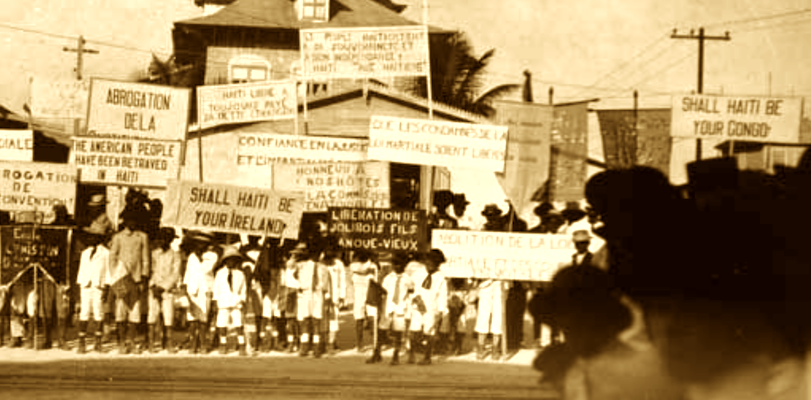
The United States cancels an election in Haiti when it appeared the National City Bank’s preferred leader, President Borno, would lose.
‘Another Act of Oppression Against Haiti’ by Joseph Freeman from The Daily Worker. Vol. 2 No. 250. November 1, 1925.
Rockefeller Government Prevents Elections
American imperialism in Haiti scored another triumph last week when President Louis Borno, puppet of the American military occupation, announced that there will be no legislative elections next year.
The Haitian constitution forced on the republic by the National City Bank of New York and United States marines—provides that the president may order legislative elections on January 10 in an even-numbered year. This year President Borno has discovered that Haiti’s population “is almost totally illiterate, ignorant and poor, is still incapable of exercising the right to vote, and would be an easy prey” for unscrupulous (i.e., opposition) politicians. He promised that some day a new electoral law would, he put into effect when it might be “without danger to the republic.”
Military Rule Supreme
Two years ago President Borno announced that no legislature would be elected in 1924. In the absence of a popularly chosen assembly, the legislative functions have been exercised since 1917 by the Haitian council of state. The council is an executive body of twenty-one members appointed and recalled at will by the president. This state of affairs has enabled the American military occupation to rule without the trouble of a parliamentary body which afforded expression to native leaders bitterly opposed to American domination.
Borno’s refusal to call elections springs from the fact that the legislature, when convened, will choose Haiti’s new president. Since 1917 the president has been elected by the American-controlled council of state. It was this executive body which elected Borno in 1922. His election was followed by mass demonstrations organized by the Union Patriotique d’Haiti (a nationalist organization) and by the Haitian Federation of Labor. As a result the presidents of both organizations Nvere arrested by the American military authorities.
Kellogg Aids Tyranny
Borno’s action last week did not come unexpectedly. Late in September a group of Haitian journalists wrote Secretary of State Kellogg requesting that the United States government see to it that legislative elections were called. The request warned Secretary Kellogg that “American officials and their Haitian agents plan to repeat the coup of 1922, and to have the president elected by the council of state.” The request also called Kellogg’s attention to “the systematic opposition with which Haitian requests have always been met by American officials in Haiti and by their Haitian creatures and proteges.”
On September 27 an Associated Press dispatch reported that “State department officials see no reason to expect serious trouble in Haiti even if President Borno should decide, as he probably will, and has the constitutional authority to do, to withhold the call until October 1927.” This prediction was fulfilled by President Borno on October 10, and Washington has decided not to interfere.
Military Rule
Political life in Haiti, however, is completely dominated by American interests. The United States controls the republic through a detachment of marines, an American-controlled constabulary, an American financial adviser, and an American receiver-general who collects all customs revenues. Above all there is an American high commissioner, at present General John H. Russell of the U.S. marine corps. Haiti’s political subjection to the United States is intimately connected with the Investments in that republic of the National City Bank of New York, a Rockefeller institution. Six times during 1914 and 1915 the state department made direct overtures to Haiti to obtain control of its customs in order to guarantee American investments. When these overtures were turned down, American battleships and marines, commanded by Admiral Caperton, invaded the republic and assumed control.
A Rockefeller Game
The “legal” foundation of America’s control rests on the treaty of 1915, which was later extended to 1936. The treaty was forced on the Haitian legislature after Admiral Caperton seized the capital and the leading ports and declared martial law.
Subsequently an American financial adviser appointed by President Harding brought pressure to bear on Haiti to pass laws giving the National City Bank financial control. Haiti owes the New York institution $16,000,000. Furthermore, Haiti’s national bank and railroad are both in the hands of the National City Bank.
Over 3,000 practically unarmed Haitians were killed during the process of turning Haiti into a protectorate of the United States.
The Daily Worker began in 1924 and was published in New York City by the Communist Party US and its predecessor organizations. Among the most long-lasting and important left publications in US history, it had a circulation of 35,000 at its peak. The Daily Worker came from The Ohio Socialist, published by the Left Wing-dominated Socialist Party of Ohio in Cleveland from 1917 to November 1919, when it became became The Toiler, paper of the Communist Labor Party. In December 1921 the above-ground Workers Party of America merged the Toiler with the paper Workers Council to found The Worker, which became The Daily Worker beginning January 13, 1924.
PDF of full issue: https://www.marxists.org/history/usa/pubs/dailyworker/1925/1925-ny/v02b-n250-NYE-nov-01-1925-DW-LOC.pdf
 Revolution's Newsstand