U.S. interference in Mexico long predates the discovery of oil, but with its exploitation also began a whole new level of imperialist machinations.
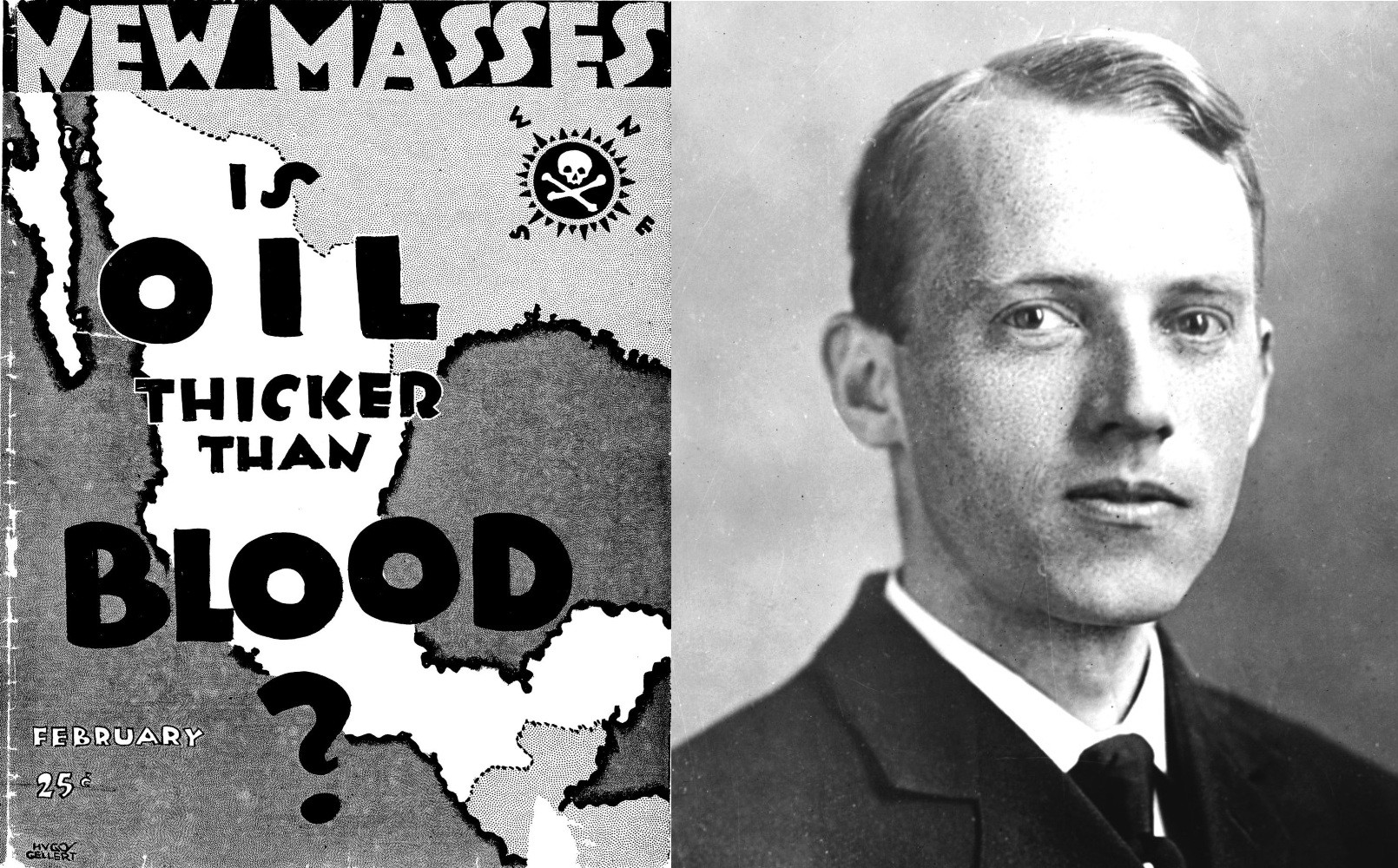
‘Is Oil Thicker Than Blood?’ by Scott Nearing from New Masses. Vol. 2 No. 4. February, 1927.
Mexico has a population of about 17 million human beings. Mexico has an annual oil production of about 130 million barrels. Humans or oil? That is the choice before the United States.
Between 1848, when the United States took the Southwest away from Mexico and 1910, when the United States interests backed Madero against Diaz for the Mexican Presidency, the American Empire let Mexico pretty severely alone. But since 1910…
Oil was discovered in Mexico about 1900. E.L. Doheny was the hero of the occasion. By 1910 he had wells that were flowing 25,000 barrels a day—liquid wealth in undreamed of quantities.
British oil interests were already busy however, and there were reports that Diaz was preparing to make large concessions to a British syndicate. Consequently, when Madero raised the standard of revolution in 1910, he had American support in plenty.
Madero won. But he did not last. Two years later, he was thrown »out of office and shot by Victoriano Huerta, who became president of Mexico at almost the same time that Wilson became president of the United States. Huerta was openly pro-British in his oil sympathies.
Wilson and Bryan, shoulder to shoulder with Doheny, made war on Huerta. This war culminated in the taking of Vera Cruz (April 22, 1914) with the loss of seventeen American and several hundred Mexican lives. Huerta was forced out of office, and Carranza took his place.
Meanwhile, however, four years of revolution had called into being a disciplined Mexican working class, and an organized farmer element, demanding basic changes in the laws of their country. It was this group that rewrote the Mexican Constitution in 1916-1917, and issued the famous Quaretero document. Article 27 of this Constitution begins:
“The ownership of lands and waters within the limits of the national territory is vested originally in the nation.” In other words, the resources of Mexico belong to the Mexican people, just as the rivers and harbors of the United States belong to the people of the United States. In the same section, these words appear “The nation shall have at all times the right to impose on private property such limitations as the public interest may demand) as well as the right to regulate the development of natural resources.”
All oil companies are required to register with the Mexican Government and to receive “confirmatory concessions.” In the case of some United States concession owners, there is question as to the validity of their titles. These companies may lose their “rights” to bad titles. In the other cases, if the titles are good, the companies are to receive concessions covering a period of fifty years.
Within fifty years, as a matter of course, all of the oil will have been exhausted from the present fields, but there is the matter of principle!
The principle involved is that I buy what I can pay for and keep what I buy! Humans? No, not since 1863. Oil? Certainly! And if the keeping of the Mexican oil fields costs a few rivulets of working-class blood—well, at any rate, Standard will have the oil—and oil is thicker than blood any day.
The New Masses was the continuation of Workers Monthly which began publishing in 1924 as a merger of the ‘Liberator’, the Trade Union Educational League magazine ‘Labor Herald’, and Friends of Soviet Russia’s monthly ‘Soviet Russia Pictorial’ as an explicitly Communist Party publication, but drawing in a wide range of contributors and sympathizers. In 1927 Workers Monthly ceased and The New Masses began. A major left cultural magazine of the late 1920s to early 1940s, the early editors of The New Masses included Hugo Gellert, John F. Sloan, Max Eastman, Mike Gold, and Joseph Freeman. Writers included William Carlos Williams, Theodore Dreiser, John Dos Passos, Upton Sinclair, Richard Wright, Ralph Ellison, Dorothy Parker, Dorothy Day, John Breecher, Langston Hughes, Eugene O’Neill, Rex Stout and Ernest Hemingway, Artists included Hugo Gellert, Stuart Davis, Boardman Robinson, Wanda Gag, William Gropper and Otto Soglow. Over time, the New Masses became narrower politically and more journalistic in its tone.
PDF of full issue: https://www.marxists.org/history/usa/pubs/new-masses/1927/v02n04-feb-1927-New-Masses.pdf
 Revolution's Newsstand