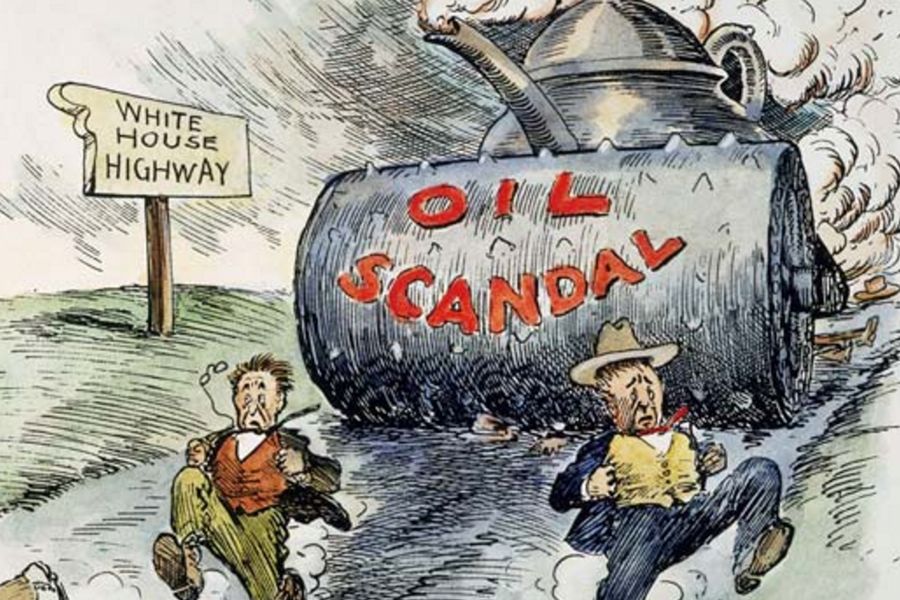
At the minimum, scandal requires some level of shame, and there was a time when the ruling class was not as shameless as it is today. Meaning that being caught in a hypocrisy or public malfeasance used to have, even if only occasionally, some consequence. It should be no surprise that one of government’s greatest scandals, involving the entire political establishment, was centered on oil. Israel Amter explains to the world the meaning of the ‘Teapot Dome’ scandal of 1924.
‘Oil in American Politics’ by I. Amter from International Press Correspondence. Vol. 4 No. 22. March 27, 1924.
A scandal that threatens to break up the Republican Party and engulf the Democratic Party has arisen in the United States. The ramifications of the scandal have not all been touched, and more disclosures are being made daily. As both parties are implicated, one is outdoing the other in bringing to light every phase that will discredit each party. Up to the present, the Republican administration is most involved and, as a result, an open rift may take place at any time.
The scandal arose over the now notorious Teapot Dome oil reserves. The American navy is turning more and more to oil power, as being the most economical fuel. Loading and storage in tanks on board a vessel can be effected with a big saving in time, wages and space. The big oil corporations have grabbed up almost all the oil resources of the country. Hence the government decided to reserve the Teapot Dome fields in Wyoming, the lease of it to take place only upon approval of Congress.
American capital has got used to taking care of its own business even before Harding issued the famous slogan, “less government in business”. Hence Mr. Fall, Secretary of the Interior, under Harding, decided to negotiate a deal for the Teapot Dome oil with Sinclair, the oil speculator, who is well known in Soviet Russia and the East, and for some Californian oil fields with Doheny, notorious for his American and Mexican oil operations. They entered into friendly relations with Mr. Fall on this very delicate matter as friend to friend. Teapot Dome has a production of 26,000,000 barrels of oil a year. But this big production was under the control of Mr. Denby, Secretary of the Navy. Hence, Mr. Fall persuaded Denby to hand it over to him, since it belonged rather in the department of the Interior than of the Navy. Denby could have nothing against it, as long as his friend Fall favoured it. Thereupon Fall, Doheny and Sinclair considered that if Schwab, of the Bethlehem Steel Corporation, during the war could charge the government 3 billion dollars for wooden ships, only one of which ever crossed the ocean, and get paid for them, surely they would make a better deal and the government and the people would rejoice that they had not been robbed so much. So Mr. Fall and Mr. Sinclair decided that they would give the government 1,600,000 out of the 26,000,000 barrels, or about 1 barrel out of every 16 that was produced. That surely was fair, and, as it was to be kept secret, nobody would hear of it, and if they did, they could not complain.
But Sinclair was more generous. The American government must have this oil stored at strategic points. Sinclair was willing to transport it in tanks to Hawaii and store it there. Thus, he becomes doubly patriotic and sees further ahead than even the government. This is public spiritedness that should be held up to school-children as a model!
To be sure, Mr. Fall cannot be expected to do these favours for nothing. He is a friend of Sinclair and of Doheny so they reward him. Mr. Fall has a ranch in New Mexico he had retired from the cabinet owing to differences with Harding. And it just happens that he needs a small sum of money to make some improvements on the ranch. Whom should he turn to, when in need, but his good friends Doheny and Sinclair? Doheny, generous as he is and always willing to do a fellow a good turn and to return a favour, gives him $100,000, and Sinclair gives him $68,000.
Fate would have it that this little private matter should become public. Sinclair suddenly had business in Europe and immediately sailed. Mr. Fall was in Florida, ill and uncomfortable. But he assured the world, that the whole thing was a foolish tale garbled by scandalmongers. He had not received $100,000 or $68,000 at all. And as for his being to blame, he did not hand over the Teapot Dome to Sinclair or the California oil fields to Doheny. The matter was thoroughly discussed in Harding’s cabinet. It was generally approved even Harding approved it. And Coolidge, who was only a vice-president at that time, because Harding had not yet died Coolidge had been present at the cabinet meetings; he knew all about it and did not disapprove. If the cabinet of the U.S. government believes in handing the natural resources of the country over to private exploitation even if it is against the law whose business is it? The U.S. government is responsible and nobody else.
The first thing to do in such cases is to state very boldly that there is nothing wrong in the deal. If the public will not believe it, then declare that it was the act of a single man in this case Mr. Fall, who is no longer a cabinet member, so that the present administration cannot be held responsible for his reprehensible act. A man in the position of Mr. Fall, of course, must stoutly deny that he received any “fee” or “loan” or “gift” for such a favour. This is all right among friends; but this is election year and people have a way of thinking wrong when politics comes up. So Mr. Fall denied the existence of the $100,000 and the $68,000.
Fate again would have it otherwise. Good friend, McLean, friend of Mr. Fall and also of Doheny and also interested a little in oil told about taking the $100,000 to Mr. Fall in nice, clean bills, no cheque, so that there would be no trace left of the transaction. Sinclair told about having three notes from Mr. Fall, nice notes without a time limit and bearing no interest just such a transaction as friends would make between themselves. These notes were not intended for the public. Only a memento for Doheny from his good friend, Fall, which he would keep locked in his safe, where nobody could misinterpret the motives of these two good friends.
But Senator Walsh, the Democrat, and opponent of the Republican administration, was looking into this matter quite earnestly. This is an election year and any scandal that one can raise against the existing administration is gold for the other party. Here was a vile crime that must be unearthed in all of its ramifications. The Progressive Republicans with La Follette at their head, who are waiting for any kind of an uproar in order to discredit the present party leadership and take over themselves, pounce upon it with glee. It is election year and anything is fair at such times. An investigation is started: the Senate must investigate. That is its duty that is its function.
Surely, however, Coolidge, who has since become president, would not remain silent. But he did strange to say. He was astonished at the fearful disclosure. How could it be done–by the Republican Party, and this is an election year. Coolidge is not yet beloved by the people of his country especially the farmers and now comes a scandal that might shake the Republican Party to its foundations. The Progressive storm aided by the Democrats in the Senate gathers. Coolidge sees that he must act of course, with dignity as befits a president of the United States. So he acts.
He appoints a special committee to investigate the horrible affair thoroughly, leaving no guilty person unscathed. He appoints a non-partisan commission: but lo and behold, it is found that even the Democrats whom he sought out in his wisdom and frankness, are somehow involved in this oil business. Gregory, Assistant Attorney General under Wilson, who saw to it that 5,000 revolutionists were maltreated and deported; Garrison, Assistant Secretary of War under Wilson, who was a real liberal and disagreed with Wilson, also had their hands in oil. So Coolidge has to appoint another commission, but loud voices declare them also incompetent. Coolidge is determined to see justice done. He had not learned in Sunday-school for nothing that “honesty pays”, “virtue is its own reward” and the many other beautiful sayings and proverbs of the great teachers. No, Coolidge, now president of the United States, in whom has been placed a terrible trust, will see to it that no man guilty of stealing the national property goes unpunished. That is his duty as president of the United States, and Coolidge will do his duty. The people may trust him to do that.
Coolidge has a Department of Justice, whose function it is to investigate just such matters. This Department and its head have been occupied very much of late hunting down Communists and striking workers. The chief of the department, Mr. Daugherty, two years ago took great pains to keep the country from ruin by getting out that splendid Injunction against the striking railroaders. He has also been very busy, with the aid of his good man Burns, chief of the Secret Service, in rounding up boot-leggers. Loose-tongued people, however say that they have taken bribes to keep off prosecution–but that is all idle gossip. Public officials like Daugherty and Burns could not commit such ignoble deeds, for money can be earned in many other ways. Daugherty is also said to have been very busy punishing the scoundrels guilty of war frauds. The public has not heard much about the cases but Daugherty has them well in hand.
But the scandal-mongers get busy once more. How can Daugherty investigate this fearful affair, when, as Attorney General of the United States government, he must have known of the lawlessness of it and he attended the cabinet meetings at which the matter was discussed and approved of the deal? And how about Coolidge? He was present at the cabinet meetings himself, and knew all about the affair and yet did not say a word? In fact he seemed thrown into consternation when the whole affair popped up. This surely was too terrible. Then there is the Assistant Secretary of the Navy, Roosevelt, son of his father of like name. He is said to have stock in Sinclair’s concern. Surely no son would disgrace his deceased father that way and get implicated in a public scandal? There are whispers about Senators and other public men, and public-spirited men who have done noble duty at national crises, such as when America was to embark on the war, when workers were “striking against the public”, when Communists were pointing out the nature of the capitalist government–there were whispers that these public men were somehow involved. It was being said that they bought oil stock and engaged in other questionable deals. How could these men do such things? Did they not go personally to factories to speak to the workers about the “sanctity of property”, the beneficence of capitalist government? Did they not speak at the Young Men’s Christian Association about the ethics of public life and the viciousness of the Communists and “Reds”? How could they then even attempt such patriotic measures, if they were guilty of a nefarious steal on the “people’s” property?
But rumours persist they have a funny way of doing so when alighting on such thick fluid as oil. Rumour even said that General Wood’s son in the Philippines–the brave general who shot down steel workers when Wilson was still alive and now is shooting down Filipinos who are asking for the freedom that was promised them, and who, they say, is letting some New York bankers make profits in the Philippines for supporting his nomination for the presidency in 1920, which however, he did not get–but one good turn deserves another. Well, they say that this good general’s son made a little fortune of a few million dollars speculating also in oil, by having a good brother in America who gave him tips.
Here it is time to step in. The Progressives and Democrats are raising hell. They are demanding the resignation of Denby. Coolidge stands by his friend. If he is guilty, then they all are. The Chairman of the Republican National Committee refuses to believe in Denby’s guilt, and stands by him. There is trouble ahead, however, if a scapegoat is not found to appease the public wrath. Denby is willing to go. He resigns, and Coolidge, with tears in his eyes, writes him a note of acceptance expressing his deepest regrets. The Progressives yell with glee: their appetite is not yet satisfied. Daugherty who should have known of the illegality of the whole proceeding and whom they hate with their whole heart and wanted to force to resign for a long time.
Daugherty must go, too. But Daugherty is ill–ill in Florida, where his friend Mr. Fall is. Daugherty, sick man, refuses to resign and no one would take advantage of a sick man. He promises to return soon and to enter the fight against his calumniators. Coolidge, good man who does not like to hurt a good man’s feelings and altogether has such a broad sense of justice which he inherited from his fathers, but more particularly from his predecessor, the deceased president, Harding cannot think of asking him to resign, even though the clamours rise high. Roosevelt, the papers demand, should also resign but this would only increase poor Coolidge’s burdens, and no one would ask the President to assume more obligations when he has the tax and bonus questions to solve, the provoking farmer and reparations questions to settle. This is altogether too much.
But let not the Democrats laugh with such glee. Have they also not a Teapot Dome? Is there not Mr. McAdoo, son-in-law by marriage of another deceased president, Wilson, who manages even though dead, to get mixed up with all this oil? Has he not had his dealings with Doheny, who gave him a little retainer of only $ 250,000 to help him in his oil affairs in Mexico? McAdoo, good soul that he is, cannot help that he had good connections in Washington who fix up such matters. Doheny is a liberal fellow. He promises Mr. McAdoo even more much as $1,000,000, if he puts through this deal successfully. No $100,000 for Doheny this time: he can afford to give his legal friend munificent retainers and to make glowing promises. Why not? He made $ 100,000,000 on the transaction, and a lawyer is entitled to one per cent of the earnings.
Some foolish, weak-kneed Democratic organs say that Mr. McAdoo cannot be the Democratic presidential candidate. Mr. McAdoo rushes to Chicago to consult his boosting committee, and after the conference assures the American public that he can run without any sully to his name and any danger to the party. Coolidge remains placid within the ruins of his castle, which is crumbling over his head, and smilingly tells the guileless American people that he is their only logical Republican candidate. La Follette, the scheming Progressive wants the Republican nomination himself. Surely after such disaster to the frail fabric of the Republican Party, none is better fit to be the leader and next president of the United States than La Follette.
But what about the American people the 110 million workers and farmers, who experienced the pillage during the war which is not yet over and are witnessing one of the boldest steals in the history of the country? Are they going to change to the other capitalist party, the one that does not happen to be in power and take another chance? Or will they take a lesson from this whole dirty business as ordinary and commonplace as it is in American political life and form another party? Will this new party be another capitalist party allowing its leaders to swear the same oaths and engage in the same oily business when it grows up? Or will they form a class party of the workers and farmers with a class point of view and a class aims, which will have as its goal the establishment of a government of workers and farmers?
Undoubtedly this oily business will have a tremendous effect on American politics: the Republican Party faces a split; the Democratic Party has disgraced leadership; the Progressives, especially La Follette, feel that they are entitled to the Republican Party leadership. The great masses of the workers and farmers are beginning to recognize the nature of the capitalist governments and are waiting for something definite to happen. They are nauseated with the proceedings, but must be driven to action. The Communists are taking advantage of the situation and are reinforcing the propaganda for the formation of a class farmer-labour party. A convention will take place on May 30, at St. Paul: the issue will be a class party against a petty bourgeois party. La Follette, although the leader of the petty bourgeois movement, hesitates between the Republican nomination and the formation of a petty bourgeois party. The influence of the Communists will be decisive.
International Press Correspondence, widely known as”Inprecorr” was published by the Executive Committee of the Communist International (ECCI) regularly in German and English, occasionally in many other languages, beginning in 1921 and lasting in English until 1938. Inprecorr’s role was to supply translated articles to the English-speaking press of the International from the Comintern’s different sections, as well as news and statements from the ECCI. Many ‘Daily Worker’ and ‘Communist’ articles originated in Inprecorr, and it also published articles by American comrades for use in other countries. It was published at least weekly, and often thrice weekly.
PDF of full issue: https://www.marxists.org/archive/amter/1924/mar-27-1924-Inprecor.pdf
 Revolution's Newsstand