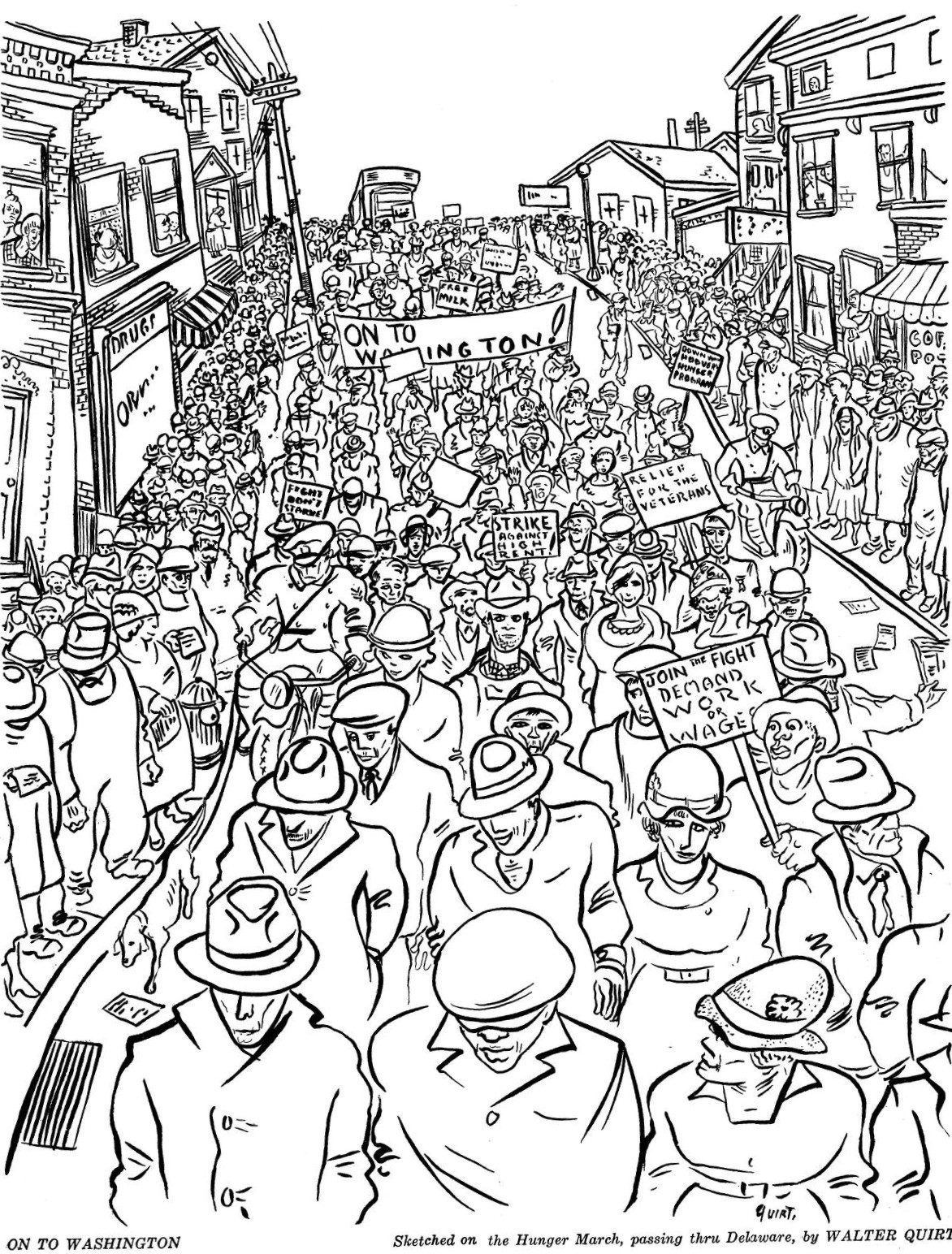
Two years into the Great Depression, with ten million out of work and real starvation beginning in many communities, Michael Gold says the masses must march.
‘Hunger March’ by Michael Gold from New Masses. Vol. 7 No. 7. December, 1931.
Over 10 million Americans are out of work today, which means, with their dependents, that some 35 millions are living in misery, hunger and panic.
What are these people to do? The stale old lies of individualism break down in such a crisis. “Anyone who really wants a job, can always find it,” is one of the vulgar taunts that used to be flung at the unfortunate. But 10 million men today really want a job, and where can they find it? Christian Science, New Thought, the Freudian adaptation to one’s environment, the transcendental literary heroism of Emerson, Thoreau, H.L. Mencken, or the Pelman Institute, all the familiar ideology of capitalist self-help turns shabby and useless when 10 million men are out of jobs.
There simply is no individual solution to such a problem. And this is why the individual unemployed man sinks into such despair. He feels himself naked and alone in a battle against giant forces. The thought of suicide follows the unemployed man like a mangy yellow cur that cannot be driven away. Every daily newspaper is spotted with suicide tales. If there were honest statistics on such subjects in this country, it might be found that in the year 1931 more Americans died of hunger, worry and suicide than were killed in the Great War.
Suicide is the capitalistic method of solving unemployment. If there were utter Machiavellian frankness among our rulers, they would openly advocate suicide among the jobless. When the helots grew too numerous for safety in Sparta, the upper-classes conducted periodical massacres in which the state was relieved of its “surplus” population. We are witnessing in the wave of contemporary suicides a similar slaughter of the helots. Surely around the gas-filled bedroom where another family of starved workers has destroyed itself there must sit an invisible audience of bankers, generals and politicians applauding the solution of another of their dangers. Yes, every working-class suicide is a murder by capitalism, and is chalked down as such by the avenging angel of the proletariat.
The capitalist system is founded on the ignorance of the workers. It will endure only as long as these workers can be kept in their present state. The machinery of stupefaction, the radio, the press, the church, the political government, all are in the hands of the capitalist class, and work night and day to keep knowledge from the masses.
It was a serious crime, in the Czar’s holy Russia, to teach an illiterate peasant to read and write. It is a crime in Fascist China, sometimes punishable by death, to write even the mildest poem or short story on a working-class theme. It is a serious crime, in the United States, to teach the working-class the ABC of organization, to teach it its own power.
For if the 10 million jobless men could be organized there would be no more hunger or suicide among them. Individually, they are less than nothing; as an organized mass they could be a power greater than all the battleships and police brass-knuckles. Every capitalist knows this; and every capitalist fears it more than death, and stops at no brutality to prevent this organization.
Capitalism does not fear liberals and socialists, because it knows they do not practise the organization of class against class. Socialists are intensely interested in electing Norman Thomas or Morris Hillquit to Congress, but not in organizing the unemployed. The liberals are people with great hearts beating for humanity, and have lovely manners and speak grammatical prose. But they distrust class organization, too.
Only the Communists have a passion for organization, only they repeat again and again the magic word that will unlock the prison door of humanity, and set the masses free. And for this they are hated by capitalist, socialist, liberal.
Examine the bare facts. The crisis has lasted two years, and has grown progressively worse. It is not improving, it cannot improve for some time. Who has done anything to organize the jobless workers? Who has brought the problem out into the streets, and into the first pages of the newspapers but the Communists?
It is a familiar platitude that everyone agrees as to the ends of Communism, but disagrees as to the means. “Let us take Communism away from the Communists,” was a perfect statement of this liberal instinct. The liberal dreams, like Stuart Chase in his recent Nation confession, of a good-will pilgrimage, a painless and invisible change from one system to another. The corporations will be merged into a few great national trusts; a dividend of eight per cent will be guaranteed the former shareholders; a planning board made up of Stuart Chase and his friends will run the industries; Utopia will arrive as by stealth, like a god in the night.
They quarrel with the Communists as to means. But what are their own proposed means for bringing in this eight per-cent Utopia? We are not told; I am afraid we shall never be told, for if there is anything the American liberal lacks, it is a sense of economic or political reality, and a sense of organization.
Utopians are sometimes valuable; certainly Saint Simon and Proudhon and Thomas More and Shelley were great pioneers in the emotional realization of the possibilities of a free world. But these latter day Utopians, with their sordid eight per cent reservations, are really nothing but the rear guard fighters for capitalism when it is in retreat.
Stuart Chase and the liberal-Socialists are “constitutional” capitalists. They want to save the eight percent system by rational and necessary concessions, of the type Bismarck made to save Germany from the Socialists.
The deed could perhaps be done, the world might be changed painlessly into a fair garden of industrialism awarding eight per cent dividends to idlers with all the reasons, but for the fact that capitalism produces catastrophes.
It is fated to produce greater wars and panics than even the ones we are living with now. Karl Marx pointed this out 70 years ago, but the liberals are Bourbons incapable of learning. Capitalism has made great wars, great panics; capitalism is speeding into greater cataclysms. This is so stale a truth one hesitates to repeat it, yet it is the all-important truth. Capitalism, by the laws of its own nature, is fated to go through recurrent cycles of expansion, collapse; boom-time and depression; imperialism and war; prosperity and unemployment. The cycles grow shorter and shorter; the crises greater and bloodier. How can you plan for orderly Fabian change with such materials?
Freud has helped explain most liberalism and Socialism; it is the crudest wish-fulfillment. These philosophers prefer to believe that war and unemployment are not inevitable under capitalism, and that capitalism can be reformed. But wars and panics arrive periodically, like the cruel blows of reality that fling the neurotic from his soft nest of dreams. So they find other escapes, they invent eight per cent Utopias or discover “war to save democracy.”
The greatest answer to Fabianism is all around us today. It is the long breadlines of New York and Detroit, for example, or the Japanese artillery booming away in Manchuria. All our goodwill, all our liberal dreams cannot brush away these capitalist realities. Men are dying, men are starving, because of capitalism. And they cannot wait until Stuart Chase and the New Republic have finally drawn up all the charts and blue-prints for the 8 per cent Utopia.
Politics is a series of crises, and if the masses are not organized and led to a co-operative commonwealth by leaders who know how to act in crises, they will be misled into race massacres and world wars by Fascist capitalists as in the past.
Today, with 10 million jobless men walking the streets of America, the Communists say to them: “Workers, do not kill yourselves. That is helping the capitalist class; it is not a solution for workers. Workers, your lives are precious and useful; they are the bricks with which we can build a new Communist world. Workers, use your lives; fight for unemployment insurance; fight for the rights of your class. In organization you will find a new power that will give you confidence and hope. Workers, the struggle is bitter and painful, but it has its glory, and it is better than the suicided grave. Workers, organize, and all things will be added to you!”
This is the crime of the Communists, that they organize the masses. In Socialist cities like Milwaukee and Reading, the Socialist police have clubbed the organized unemployed, exactly as in other places. Every political group seems to unite against the Communists for this grave crime of insisting on the class struggle.
On December 7th there will be a Hunger March in Washington, D.C. From every corner of the free and famished republic squads of the unemployed will converge, and form a regiment of the damned to parade before the White House.
Already, the officials have begun the propaganda that danger and violence are in the air. Everyone knows this is a lie, but Washington is being turned into an armed fortress. It seems certain the old Tory answer will be given to the hungry; they will be sapped, kicked, jailed, slugged, slaughtered and damned. It is sedition to talk about hunger. And liberals and Socialists, will as usual, deplore the demonstration, and advise the unemployed to starve quietly and politely.
But one Hunger March like this will perhaps save a thousand workers from suicide, teach ten thousand others the lesson of organization, alarm a few thousand capitalists and legislators into some thought of unemployed relief, and spread the truth for a day on the first pages of America’s newspapers.
The New Masses was the continuation of Workers Monthly which began publishing in 1924 as a merger of the ‘Liberator’, the Trade Union Educational League magazine ‘Labor Herald’, and Friends of Soviet Russia’s monthly ‘Soviet Russia Pictorial’ as an explicitly Communist Party publication, but drawing in a wide range of contributors and sympathizers. In 1927 Workers Monthly ceased and The New Masses began. A major left cultural magazine of the late 1920s to early 1940s, the early editors of The New Masses included Hugo Gellert, John F. Sloan, Max Eastman, Mike Gold, and Joseph Freeman. Writers included William Carlos Williams, Theodore Dreiser, John Dos Passos, Upton Sinclair, Richard Wright, Ralph Ellison, Dorothy Parker, Dorothy Day, John Breecher, Langston Hughes, Eugene O’Neill, Rex Stout and Ernest Hemingway, Artists included Hugo Gellert, Stuart Davis, Boardman Robinson, Wanda Gag, William Gropper and Otto Soglow. Over time, the New Masses became narrower politically and more journalistic in its tone.
PDF of full issue: https://www.marxists.org/history/usa/pubs/new-masses/1931/v07n07-dec-1931-New-Masses.pdf
 Revolution's Newsstand