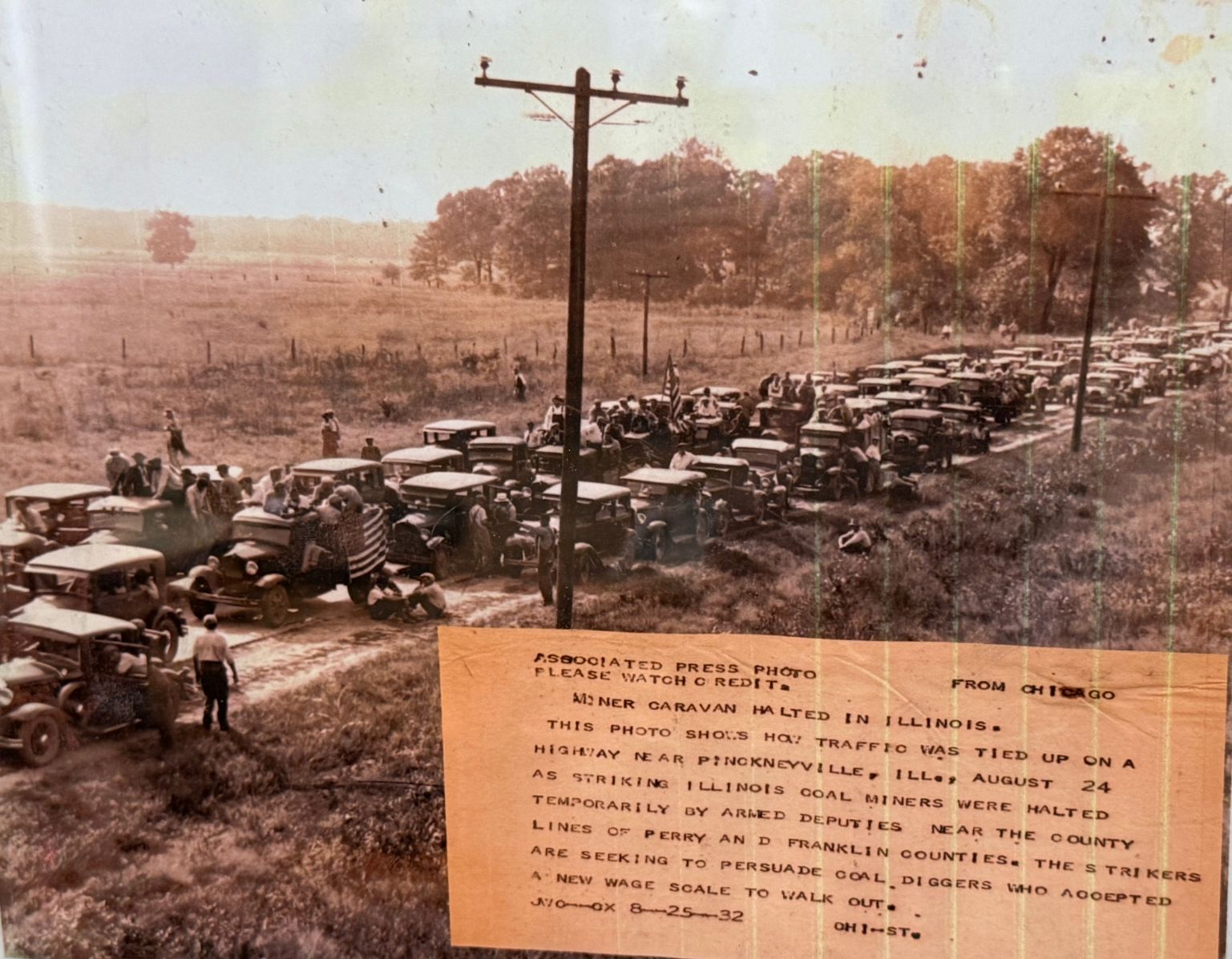
A momentous day in Southern Illinois as that state’s miners caravan to Belleville in a movement against the bosses and the bureaucrats, going on to form the Progressive Miners of America.
‘August 24’ by Hugh Talley from Labor Age. Vol. 1 No. 29. September, 1932.
WE left Springfield in a caravan of cars that was more than three miles in length, with about 3,500 miners. We went through Mt. Olive and Staunton, meeting other groups of miners all the way. When we arrived in Belleville another huge caravan was there to meet us. In all there were around 35,000 miners. It would be hard to estimate the number of cars, for we were in front and did not have a chance to see the end of the line.
The first compulsory stop was made at Swanwick, Perry County, which adjoins Franklin. The sheriff was there with about 60 special deputies. They had machine guns, rifles, shotguns and pistols. We blocked the road completely with our cars and told them we would not open up until they would permit the caravan to pass. The state police were there and tried to turn us back, but were unsuccessful. After a stop of about two hours the road was cleared and we were permitted to proceed. We were about 40 miles from our objective.
At Duquoin, six miles outside of Franklin County, we met a second group of deputy sheriffs and gunmen well armed and assisted by state police. Our plan had been to go directly south of Duquoin into Dowell, Jackson County, where the mayor had extended a welcome to us. But the deputies and state police turned us toward Franklin County, which we had not intended to invade until the following day. This was a dastardly trap. We were headed for Mulkeytown, but we never reached there. Our car was along toward the front and just as we reached a sweeping turn hell broke loose. The deputies’ guns began to roar. They fired into the cars and a number slumped over in their seats at the first fusillade. Then everything was confusion and panic. Women in the cars were struck as well as men, the windshield in our car was shattered. How we escaped is more than I can understand.
The driver of our car attempted to turn and it seemed that everyone else was trying to do the same. The road was soon choked and we were forced to abandon the car, for the gunmen, not satisfied with the havoc already wrought came charging at us wielding clubs and discharging machine guns, pistols and shotguns. After the first charge, cars attempted to leave with the wounded, but the road was completely blocked. We returned to our car then. Again the guns began to roar. Glass was shattered in our car a second time and we were again compelled to leave. This time our group scattered and my brother and I leaped into a ditch by the roadside. We had not lain there long until bullets were flying all about us. We dashed back upon the road, dodging from car to car hoping to get back across the county line into Perry some half mile away.
Along the way we saw cars piled up in ditches, some burning others badly wrecked. Some were attempting to move, others were deserted. The road was choked. After some debate we decided to go back and attempt to retrieve our car. It was then that we ran the gauntlet of gunmen, who clubbed and beat us. I tried to ward off some of the blows and received others for my pains. I saw one of our fellows beaten to his knees and still being beaten without being able to go to his help. I was stopped by three, and while one held a machine gun against me the other two beat me with clubs. I put my arm over my head for protection which probably accounts for my not having a busted skull.
The newspapers report 12 injured by gunshot and some 100 wounded with clubs. It seems impossible that none were killed.
This incident is one more lesson the Illinois miners have had to learn and pay for. Once again they attempted to protect their rights by peaceful and legal methods. Not a miner was armed and we had caused no disorders. Some of us had said before we started, “Put the American flag on the cars, they won’t shoot her down.” But they did shoot her down. I saw one gunman tear the flag from a car and trample it in the road. Now we are about through with flags and peace and law. These things can get us nothing. Those who rob us of our labor do not believe in such things, they are only instruments to keep us in slavery.
August 24 is another day the Illinois miners will remember.
Labor Age was a left-labor monthly magazine with origins in Socialist Review, journal of the Intercollegiate Socialist Society. Published by the Labor Publication Society from 1921-1933 aligned with the League for Industrial Democracy of left-wing trade unionists across industries. During 1929-33 the magazine was affiliated with the Conference for Progressive Labor Action (CPLA) led by A. J. Muste. James Maurer, Harry W. Laidler, and Louis Budenz were also writers. The orientation of the magazine was industrial unionism, planning, nationalization, and was illustrated with photos and cartoons. With its stress on worker education, social unionism and rank and file activism, it is one of the essential journals of the radical US labor socialist movement of its time.
PDF of full issue: https://www.marxists.org/history/usa/pubs/laborage/v21n09-sep-1932-labor-age.pdf
 Revolution's Newsstand